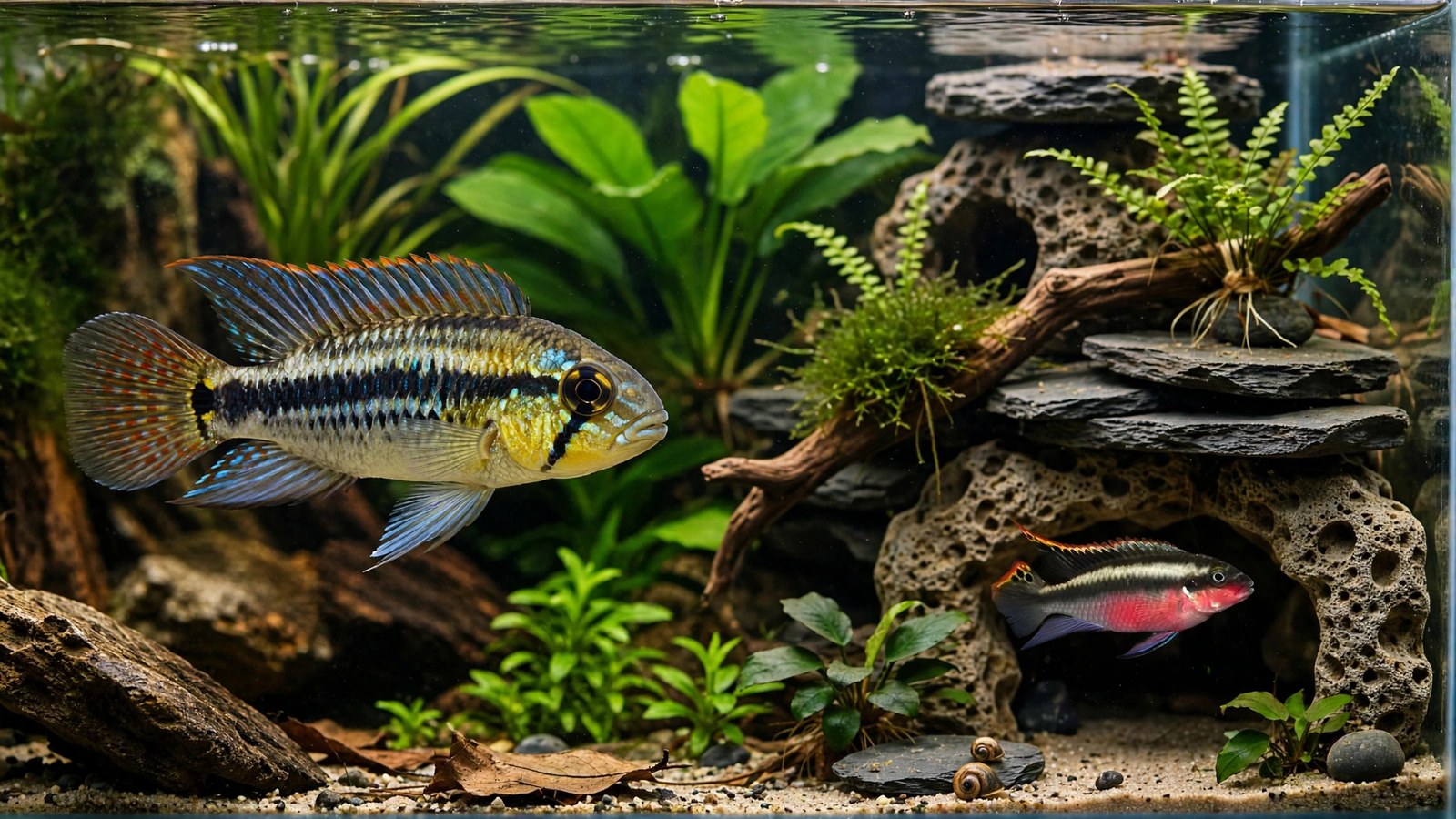
Skip the pretty carpet-and-stone layout if you are keeping kribs. These West African dwarf cichlids dig, shove, and remodel their corner daily — and that is exactly why a kribensis planted tank rewards planning for their behavior instead of fighting it. A bonded pair carves breeding pits in the sand, guards a cave with surprising ferocity, and lets the female steal the show: she turns a deep cherry-purple belly when ready to breed.
Planning Your Kribensis Planted Tank: Step-by-Step Setup
Start with the cave, not the plants. Kribensis are cave-brooders from the rivers of Nigeria and Cameroon, and the layout should orbit one decision: where the pair's territory begins and ends. In a 20-gallon, put one cave — a halved coconut shell, a flowerpot with a doorway knocked out, or stacked slate — in a back corner with the entrance facing the front glass. In a 40-gallon breeder, two pairs work with cave clusters at opposite ends and hardscape stacked between them; sight-line breaks matter more than raw distance.
Next, lay sand before anything else: 1.5–2 inches of fine pool-filter or play sand, which the pair will turn into breeding pits within days. Then add only dig-tolerant plants: rhizome plants (Java Fern, Anubias) tied to wood and rock, never in substrate; rooted Vallisneria and Amazon Sword in back corners the pair rarely digs; floating plants to soften the light. The dig-tolerant plant selection in this aquarium plants for fish tank guide covers the full menu of species that coexist with bottom-diggers. Cycle fully first, then add dither fish like Congo tetras — their calm presence often triggers spawning.
Why the Pair Bond Changes Everything
Most dwarf cichlids are harem spawners where the male is the centerpiece. Kribs flip the script: the female claims the cave, lays eggs on the ceiling, and fans them while the male patrols. Buy a bonded pair if you can — a female flashing her belly at one male is the giveaway. Otherwise raise four to six juveniles together for three months, let pairs form naturally, and rehome the extras. One pair defends a 12–18 inch radius around its cave, doubling while fry are out.
Sand: The Non-Negotiable
The pair digs pits around the cave and shuttles fry between them. Fine sand passes through their gills cleanly when they mouth and spit it; gravel abrades mouths and can wedge in gills. Because the fish constantly turn the bed over, anaerobic pockets almost never form.
Dig-Proof Plants That Survive the Pair
Rule: anything planted in the substrate goes where the pair does not dig. This list has survived thousands of krib tanks:
| Plant | Placement | Why it works |
|---|---|---|
| Java Fern (Microsorum pterotoides) | Tied to wood/rock | Rhizome out of substrate; low-light tolerant |
| Anubias (Anubias barteri) | Tied to cave roof/rock | Tough leaves kribs ignore; shade-loving |
| Java Moss | Wedged in hardscape crevices | Infusoria nursery for fry |
| Vallisneria | Back corners, 3 in deep | Runners outpace digging |
| Amazon Sword | Behind the cave | Deep roots; pair rarely digs there |
| Frogbit / Water Lettuce | Floating | Diffuses light; fry hide in roots |
See best plants for cichlid tanks for more options — every species there holds up under excavation.
Caves, Territories, and Tankmates
Each cave needs a snug entrance (~1.5 in) and a dark interior where eggs stay shaded. One cave per pair is the minimum; a second gives the female a decoy retreat. In a 40-gallon two-pair tank, put cave clusters at opposite ends with a slate wall and Vallisneria screen to break sight lines. Tankmates stay midwater and peaceful: schools of 8–10 Congo tetras, harlequin rasboras, or small danios. Skip bottom-dwellers and a second male under 55 gallons.
Dim Light, Low-Tech Water
Kribs come from tannin-stained, overhung river margins and breed more reliably under gentle light. A dimmable LED at 20–30 PAR, six to eight hours daily, plus a floating canopy, is the sweet spot — and the cheapest way to run the tank. No CO2 needed; this plant list was chosen for low-tech survival. The walkthrough in low-tech planted tank setup maps cleanly onto a krib tank: modest light, root tabs for the swords, half-dose liquid fertilizer weekly. Target 75–79 °F, pH 6.5–7.5, nitrates under 20 ppm. Keep a lid; chasing males jump.
| Parameter | Target | Notes |
|---|---|---|
| Temperature | 75–79 °F (24–26 °C) | Raise to 79 °F to encourage spawning |
| pH | 6.5–7.5 | Stability beats exact value |
| GH / KH | 5–12 dGH / 3–8 dKH | Softer water aids egg fertility |
| Ammonia / nitrite | 0 ppm | Cycle fully before adding the pair |
| Nitrate | < 20 ppm | 30% water change weekly |
Feeding and Raising Fry
Feed adults micro-pellets and frozen daphnia or brine shrimp — twice daily, only what finishes in 90 seconds. Eggs hatch in 3–5 days; fry free-swim at 8–12 days, and the parents herd them between pits for two to three weeks, grazing moss and biofilm. Add live baby brine shrimp 2–3 times daily; the baby brine shrimp hatchery DIY setup pays for itself within a week. For repeated batches, the breeding tank plants setup guide scales these principles to a nursery tank. Do not move fry early — the pair spawns again in four to six weeks.
Weekly Routine: 20 Minutes
Test nitrates, then do a 30% water change with temperature-matched, dechlorinated water. Wave the siphon over the sand to lift waste without disturbing the pits, trim Vallisneria runners invading the cave zone, and thin floaters to cover no more than half the surface. Wipe the glass, dose fertilizer, and check the cave ceiling for amber eggs. Log every spawn date; after two spawns you will predict the next one within days.
Frequently Asked Questions
Can kribs live with other cichlids in a planted tank?
Not other bottom-dwelling cichlids. A breeding pair treats the whole bottom as its nursery and relentlessly harasses apistos, rams, or a second krib male. Midwater schoolers like Congo tetras or rasboras are safe — and act as dither fish.
Will kribs uproot all my plants?
Only vulnerable ones. Rhizome plants tied to hardscape (Java Fern, Anubias) are immune since nothing sits in the substrate. Rooted plants survive in back corners and behind the cave, where the pair rarely digs. Delicate carpets near the cave will be destroyed.
How do I tell a male from a female kribensis?
The female is smaller (about 3 inches), rounder, and develops a cherry-purple belly in breeding condition — she is the more colorful fish. The male reaches about 4 inches with longer, pointed dorsal and anal fins and a lyre-edged tail.
Do kribs need a cave to breed?
Yes — they are obligate cave-brooders. The female lays 200–300 eggs on the cave ceiling in near-darkness and will not spawn in the open. Coconut shells, terracotta pots with a doorway, or stacked slate all work; a snug entrance and dark interior matter.
What tankmates are safe with a breeding pair?
Peaceful midwater schoolers in groups of 8–10: Congo tetras, harlequin rasboras, ember tetras, or small danios. They occupy the upper water the pair ignores and signal safety. Avoid bottom-dwellers like corydoras, loaches, or shrimp.
How fast do krib fry grow?
Eggs hatch in 3–5 days; fry free-swim at 8–12 days, grazing biofilm immediately. On live baby brine shrimp 2–3 times daily they reach 0.5 inch in 4–6 weeks. The pair guards them for 2–3 weeks and typically spawns again within 4–6 weeks.
Start With the Cave
A successful kribensis setup is built backwards: cave first, sand second, dig-proof plants third. Get those three right and the pair does the rest — courtship, pit-digging, fry-herding. For species-level reference, Seriously Fish's Pelvicachromis pulcher profile corroborates the cave-brooding behavior, and Tropica's plant database backs the light and placement picks. Set the cave, lay the sand, plant tough — and let the female's cherry belly tell you when it worked.