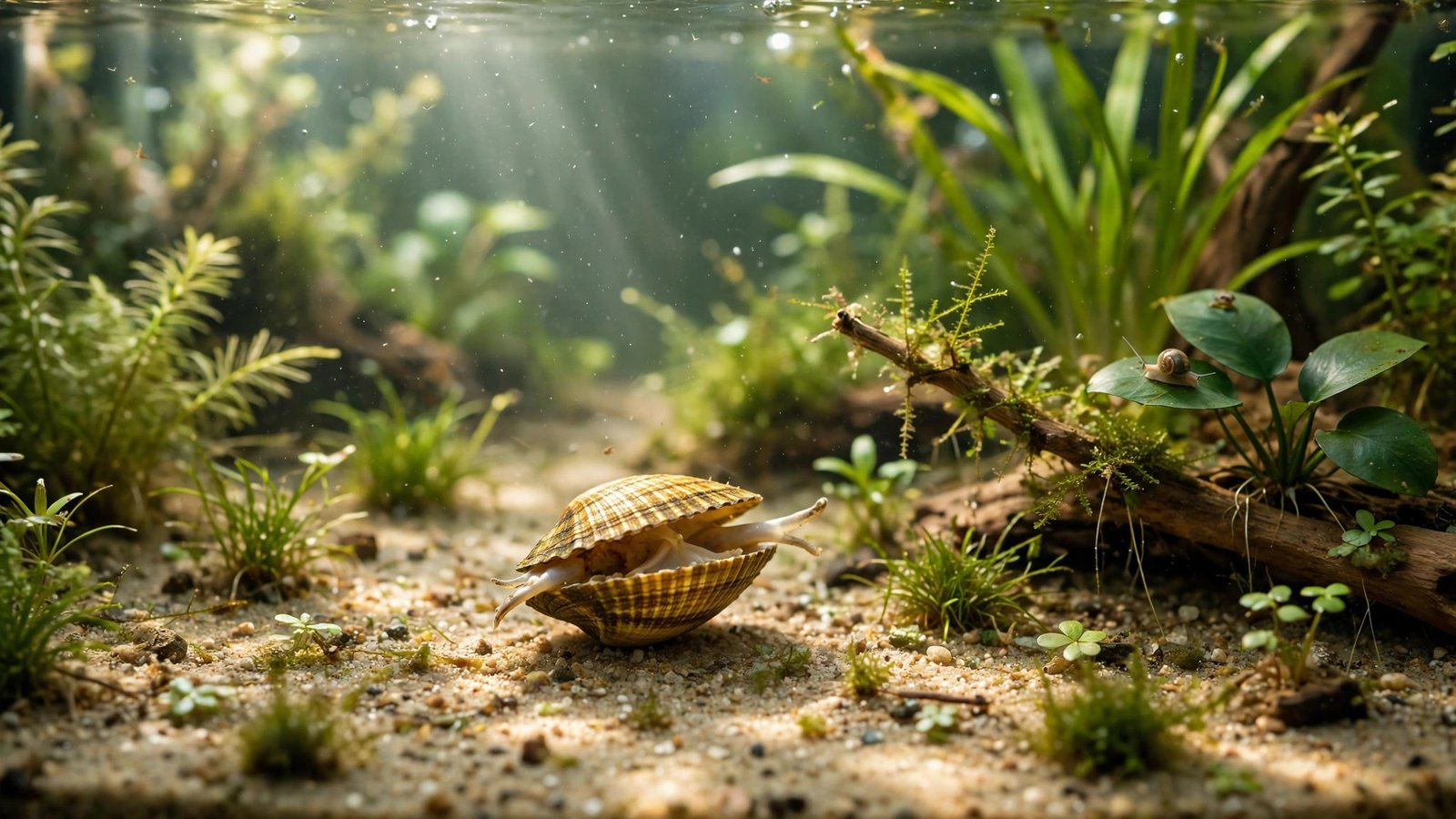
The Asian gold clam is sold as the perfect "living filter" — a small bivalve that buries itself in the substrate and quietly strains food from the water. The cruel twist: in a clean, well-kept aquarium there is nothing for it to strain, so the typical asian gold clam planted tank is a slow starvation chamber wearing a filter label. This clam (usually Corbicula fluminea) will not eat algae off glass, will not touch fish food, and will not live on "there's stuff in the water" — it eats only what drifts past its siphons: phytoplankton and other micro-foods. This guide shows how to keep one genuinely alive — burrow-friendly substrate, deliberate feeding, safe tank mates, and the one check that tells you whether it's alive at all.
The buried roommate: what the Asian gold clam actually is
The Asian gold clam is a small freshwater bivalve, typically 2–4 cm across, with a golden-olive shell banded in darker brown. It buries itself in soft sediment and feeds by drawing water through one siphon, filtering out microscopic particles, and expelling the rest through the other. In a river this works beautifully; in an aquarium it quietly fails.
Clams are not faster shrimp and they are not decorative snails. They do not graze algae or polish leaves; they occupy a niche no other common invertebrate touches: the water column itself. Before planning the aquascape, check how plant selection for a fish tank interacts with substrate depth and feeding routines, because clam care and plant care share the same decisions.
How to set up an asian gold clam planted tank that keeps the clam fed
Start with a 10-gallon (40-liter) minimum; a 20-gallon suits 2–3 clams. Substrate is non-negotiable: 5–8 cm of fine sand or very fine rounded gravel (grains under 2 mm). Clams dig with a muscular foot and wedge between grains — coarse gravel chips shell edges and can trap the foot. Drop them onto the sand; they burrow at night, usually within hours.
Keep filtration gentle. A small sponge filter or a baffled HOB on low flow is ideal — strong currents scatter the micro-food you dose. Plant moderately, but keep the substrate zone free of thick, established carpet roots, which block burrowing. A low-tech planted tank layout suits them perfectly: moderate planting, soft flow, and food you control.
Feeding: the part most clam tanks get wrong
A clam filters a continuous, dilute soup of phytoplankton in the wild. Your tank, with its clean filter and regular water changes, has almost none. "It filters the water" is the marketing line; the biology says it filters food out of the water, and with no food it starves over weeks — slowly enough that the tank looks fine until the shell never closes again.
Feed deliberately. Dose phytoplankton or liquid invert food at the label's per-gallon rate, 2–3 times per week, with the filter turned down for 20–30 minutes so the food stays suspended near the substrate. A jar of green water dosed at 50–100 ml per 40 liters works too, and doubles as a gentle nutrient source for floating plants.
Watch the nitrates: micro-food is still food, and overdosing fouls the water faster than a clam can clean it. If nitrates climb, cut the dose before cutting frequency — a slightly hungry clam in clean water outlives a well-fed one in an ammonia spike. For how food, waste, and plant uptake interact, see the planted tank water parameters guide.
Tank mates: who is safe and who kills clams
Shell growth needs calcium, so keep pH at 7.0 or above and carbonate hardness at least moderate — soft, acidic water slowly erodes the shell. Avoid copper-based medications entirely; clams are invertebrates and copper is lethal.
| Species / situation | Safe? | Notes |
|---|---|---|
| Small community fish (tetras, rasboras, guppies) | Yes | Ignore the buried clam entirely |
| Shrimp and most snails | Yes | Different niches; a snail-focused tank mixes fine with clams |
| Loaches, puffers, large cichlids | No | Will pry shells open or crush them for food |
| Crayfish | No | Excavate and eat buried clams |
Think of the clam as one member of a planted tank cleanup crew, not the whole crew: it processes the water column while shrimp and snails work surfaces. A buried clam shows nothing but two tiny siphon tips above the sand — it lives under the scenery, not on it.
How to tell if your clam is alive or dead
This is the single most useful skill in clam keeping, because a dead clam hidden in the substrate can foul a whole tank before you notice. The rule is simple: closed clam = alive, permanently open clam = dead. A living clam rests with its shell firmly shut; when feeding, the shell opens just a slit for the siphons. If the shell gapes and stays open, and a gentle nudge with plant tweezers produces no closing and no siphon retraction, the clam is dead.
Do the nudge test weekly, not daily — clams are nocturnal burrowers and repeated poking stresses them. Remove any confirmed-dead clam at once, freeze it, and bin it: a 3-cm shell of decaying tissue in warm water is a nitrate bomb.
Frequently Asked Questions
Do Asian gold clams clean the tank?
They filter suspended micro-particles from the water column, which can improve clarity, but they do not eat algae, fish food, or detritus. They are a supplement to your filter and cleanup crew, not a replacement — and they need deliberate feeding with phytoplankton or liquid invert food 2–3 times per week.
What substrate do Asian gold clams need?
At least 5–8 cm of fine sand or very fine rounded gravel (under 2 mm grain). Clams burrow with a muscular foot and wedge between grains; coarse gravel chips shell edges and can trap the foot. Keep the substrate zone free of thick carpet roots, which block burrowing.
How do I know if my clam is dead?
A living clam keeps its shell firmly closed or opens just a slit to feed, and snaps shut when nudged. A shell that gapes open and shows no reaction to a gentle nudge with plant tweezers is dead. Remove it at once, freeze it for 24 hours, and bin it — a dead clam in warm substrate fouls water fast.
Is the Asian gold clam invasive?
The trade "Asian gold clam" is typically Corbicula fluminea, invasive in much of North America, Europe, and elsewhere, where it disrupts native mussels and clogs water infrastructure. Never release one or dump tank water into waterways. Freeze dead specimens for 24 hours and bin them with household waste.
A final word before you buy
An Asian gold clam is a commitment to a feeding routine, not a decoration. If you will dose micro-food twice a week, lay real sand, and check your shells weekly, it is a genuinely fascinating addition — a quiet filterer working the water layer everyone else ignores. Per the USGS Nonindigenous Aquatic Species fact sheet, Corbicula fluminea has been established across most US waterways for decades — which is exactly why the never-release rule is non-negotiable.