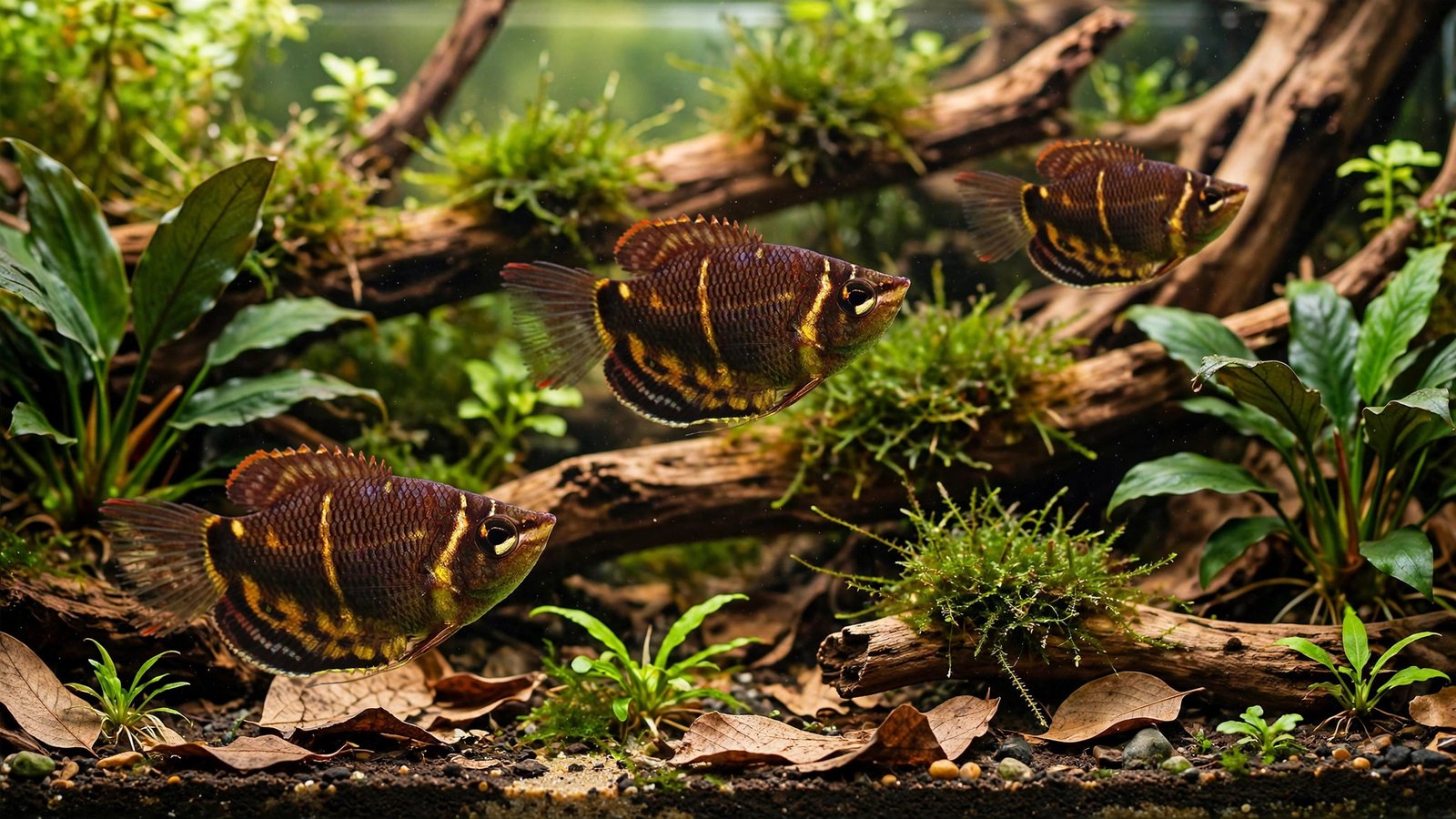
The most expensive mistake chocolate gourami keepers make is buying the fish before the water is ready. Sphaerichthys osphromenoides comes from Malaysian peat swamps where the water is tea-dark, near rain-soft, and more acidic than most tap water — conditions a freshly cycled tank simply cannot offer. A well-planned chocolate gourami planted tank reverses that logic: you build the blackwater habitat first, mature it for weeks, and only then welcome these shy, jewel-toned gouramis home.
Chocolate Gourami Planted Tank: The Blackwater Foundation
A chocolate gourami planted tank is less an aquascape and more a habitat replica. In the wild, these fish drift through submerged leaf litter in forest streams where sunlight barely penetrates and the substrate is dark peat. Your tank should echo that: dark substrate, driftwood, dried leaves, and shade-tolerant plants.
Start with the water chemistry before a single plant goes in. Test your tap water's KH and GH. Most municipal water sits at 6–10 dGH — far too hard. You have two reliable paths: an RO (reverse osmosis) unit remineralized to near zero, or rainwater collected cleanly. Either way, run it through peat moss or alder cones to pull the pH into the 5.0–6.0 range and tint it a light tea color. Peat is the engine of this setup — replace it every 4–6 weeks as its acids deplete.
Floating plants pull double duty here: they diffuse the light chocolate gouramis fear and absorb nitrogen compounds that soft-water systems struggle to buffer. Amazon frogbit and red root floaters are ideal — soft-leaf plants suited to betta tanks map closely onto chocolate gourami needs, and that palette is a reliable starting point for blackwater species.
Water Parameters That Actually Matter
Chocolate gouramis do not adapt to hard, alkaline water — they fade and die over weeks. These are the parameters experienced keepers check weekly, not monthly:
| Parameter | Target range | Why it matters |
|---|---|---|
| pH | 4.0–6.5 | Wild water can read below 4.0; aim for 5.0–6.0 |
| General hardness (GH) | 1–5 dGH | Soft water drives osmoregulation and breeding behavior |
| Carbonate hardness (KH) | 0–3 dKH | Low KH lets peat keep pH stable and acidic |
| Temperature | 77–86 °F (25–30 °C) | Peat swamps are warm and stable; avoid swings |
| Ammonia / nitrite | 0 ppm | Soft acidic water makes nitrite especially toxic |
| Nitrate | < 10 ppm | Keep low with water changes and fast floaters |
Cycle the tank for 8–12 weeks before adding fish, then run it planted and stable for another 4. Bacteria colonies are thinner in acidic water, so stability — not just a finished cycle — is the goal. During this window, tannins settle, leaf litter begins breaking down, and microfauna (copepods, infusoria) blooms into a natural first food source.
Planting for Dim Light and Leaf Litter
Choose low-light, acidic-water plants that need near-zero fertilizer input. High-tech stems will starve and rot here:
- Cryptocoryne wendtii and C. parva — the backbone foreground and midground; shrug off soft acidic water once established.
- Anubias nana / nana petite — tie to driftwood; nearly indestructible in blackwater.
- Taxiphyllum barbieri (Java moss) — drapes wood and litter with micro-habitat for fry and infusoria.
- Bucephalandra species — slow, sculptural, and perfectly at home under floaters.
- Floating plants — Amazon frogbit or red root floaters covering 60–70% of the surface.
Layer dried catappa (Indian almond) leaves over the substrate and let them decay. They release antibacterial compounds, feed biofilm, and give shy gouramis the litter to sift through. Add a fresh handful every 3–4 weeks as the old ones break down. A comprehensive guide to aquarium plants for fish tanks can help you cross-check which species tolerate the soft, acidic end of the spectrum if you want to experiment beyond this list.
Feeding a Shy Micropredator
Chocolate gouramis hunt tiny invertebrates in the wild and will ignore most dry food — a flake-only diet is a slow starvation plan. Feed small portions twice daily: baby brine shrimp, microworms, daphnia, and finely chopped frozen bloodworm or mysis. Live foods trigger their hunting response best, especially in newly arrived fish that are still settling in.
Feed in dim conditions — under bright lights they often refuse food entirely, so many keepers feed just before lights-out. If a new group will not eat after a week, live baby brine shrimp almost always breaks the fast. Remove uneaten food within 10 minutes: in soft acidic water, decay products are harder to buffer.
Choose tank mates from species that share blackwater origins and a gentle temperament — small rasboras and other peaceful microfish work well; avoid anything boisterous or fin-nipping. Fellow gourami species with similar water needs can coexist in larger tanks — honey gourami in a planted tank setups overlap on many husbandry points, though honeys tolerate wider parameters. For a smaller-scale parallel, sparkling gourami in a planted tank offers dim-light scaping and shy-fish feeding lessons that transfer directly. And to deepen the biotope, a planted blackwater tank setup walkthrough covers botanical and tannin layering in detail.
Cleanup Crew and Gentle Companions
Because this tank runs dim and soft, pick algae-eating companions that tolerate acidic water. Twig catfish are a beautiful, unobtrusive grazer for low-energy setups — farlowella twig catfish in a planted tank pairs naturally with blackwater scapes. A slow-moving snail rounds out the crew — Japanese trapdoor snails in a planted tank handle leaf litter without disturbing it. Keep stocking light: 6 chocolate gouramis plus a handful of small companions fully stocks a 20-gallon tank.
Frequently Asked Questions
Are chocolate gouramis good for beginners?
No. Chocolate gouramis are an advanced species that demand extremely soft, acidic water (pH 4.0–6.5), a mature tank of 2–3 months minimum, and live or frozen foods. Beginners should master a hardier gourami first — most chocolate gourami losses trace back to hard tap water or tanks that were too new.
What pH do chocolate gouramis need?
Aim for pH 5.0–6.0, within the tolerated 4.0–6.5 band, with hardness of 1–5 dGH. Achieve this with RO or rainwater run through peat moss, plus catappa leaves and alder cones. Stability matters more than a perfect number — swings kill faster than a slightly high pH.
Why are my chocolate gouramis hiding all the time?
They are naturally shy, and hiding signals missing cover or excessive light. Raise floating-plant coverage to 60–70% of the surface, dim the lighting, add driftwood and leaf litter, and keep them in groups of 6 or more. A confident group in a dim, covered tank will forage openly at dusk.
What should I feed chocolate gouramis?
Small live or frozen foods: baby brine shrimp, microworms, daphnia, and finely chopped frozen bloodworm or mysis, fed twice daily in dim conditions. Most specimens ignore dry flakes. Live baby brine shrimp is the most reliable food for newly arrived fish that refuse to eat.
Do chocolate gouramis breed in home aquariums?
Yes — females are maternal mouthbrooders, holding eggs for 2–3 weeks before releasing free-swimming fry. Breeding usually requires pH under 5.5 and a conditioned pair on live foods. Fry take infusoria and baby brine shrimp, and do best raised in the parents' dim, heavily planted tank.
The Quiet Reward
A chocolate gourami planted tank will never be the brightest or busiest aquarium in the room — and that is the point. When the water is right and the floaters dapple the light, a group of six drifting through the leaf litter is a window into a peat swamp most aquarists never see. Build it slowly, stock it patiently, and the fish will do the rest. For authoritative species data, the Seriously Fish chocolate gourami profile is an excellent reference alongside this guide.