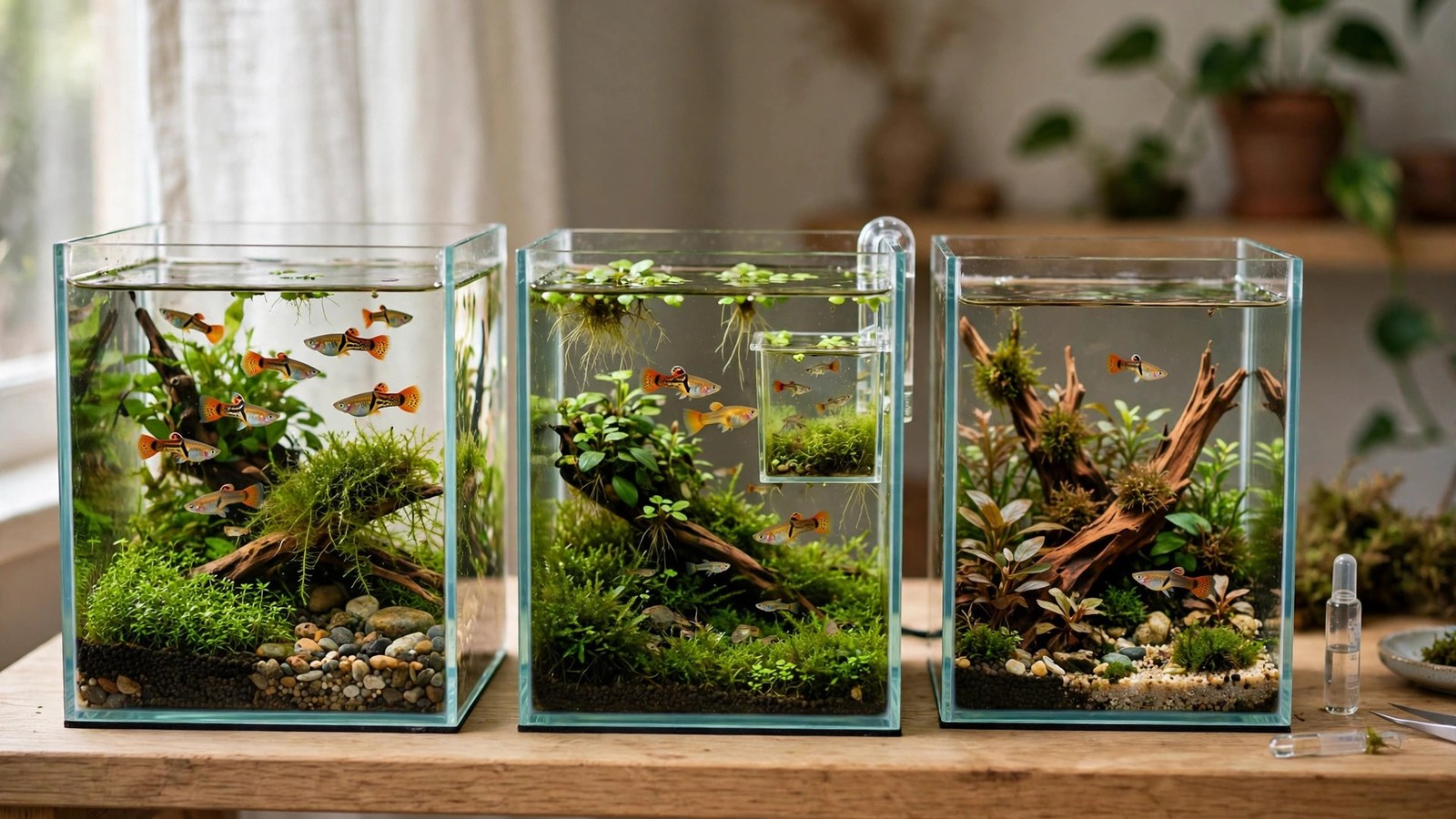
A female Endler dropped fry four months after she had last seen a male — she had simply stored the sperm and carried on. That is the Endler's livebearer: a one-inch fish that treats an endlers planted tank like a nursery franchise. This guide covers nano sizing, the aquarium plants for fish tanks that turn newborns into survivors, and how to stop a breeding colony multiplying faster than your houseplants.
The endlers planted tank: choose your path before you plant
Every endlers planted tank starts with one honest decision: do you want babies? With Poecilia wingei, babies are the default setting.
Path 1: the male-only nano display. A 5-gallon tank, three to six males, zero fry ever. Males carry all the color — electric orange, lime green, black filigree — while females are plain silver. You can plant purely for looks.
Path 2: the self-sustaining breeding colony. A 10- to 20-gallon tank at one male to two or three females. In three months, five starters can become forty. Now the plants are not decoration — they are the nursery.
Water Parameters and Gentle Filtration
Endlers are forgiving, pairing well with easy beginner aquarium plants, but they need stability: warm, mineral-rich water echoing their native lagoons.
| Parameter | Ideal range | Notes |
|---|---|---|
| Temperature | 72–82°F (22–28°C) | Room temp works in warm climates; below 72°F add a small heater |
| pH | 6.8–8.0 | Stable beats perfect — never chase numbers with chemicals |
| Hardness | 10–20 dGH | Livebearers struggle in very soft water; crushed coral helps |
| Ammonia / nitrite | 0 ppm | Cycle fully before adding fish — fry are less forgiving than adults |
| Nitrate | Under 40 ppm | Plants absorb nitrate, which is why planted Endler tanks stay cleaner |
| Water changes | 25–30% weekly | Fry grow visibly faster in clean water |
The Fry-Saving Plant Layout
Adults eat some fry — less than guppies, but a bare tank can lose most of a brood. Fine-leafed plants create a maze newborns vanish into. Design in layers.
Floating cover. Cover 30–50% of the surface: frogbit, water sprite, or dwarf water lettuce. Floating guppy grass is best — its fine needles are a jungle at fry scale.
Mid-water thicket. Plant back and sides thick with hornwort, anacharis, and Najas guadalupensis — Tropica's plant database ranks guppy grass among the fastest growers for this role. Leave the front-center open for displaying males.
Low cover. Tie java moss to driftwood or stones and let cryptocorynes fill the foreground. Newborns drop first, and a mossy floor catches them before adults do.
This layered no-CO2 approach — the same grammar as a low-tech planted tank setup — thrives under a basic LED. Aim for 60–70% planted volume: open enough to watch your fish, dense enough to never count the fry.
Feeding Adults and the Fry Food Schedule
Endlers are unfussy omnivores with tiny mouths: crushed micro pellets or fine flake daily, frozen daphnia or cyclops two to three times weekly. Feed what they finish in two minutes — overfeeding fuels dirty water and runaway breeding.
Fry arrive hungry and too small for flakes. Feed 2–3 times daily and males color up in three to five weeks:
- Days 1–3: powdered fry food or dust-ground flake, tiny pinches.
- Days 4–14: newly hatched baby brine shrimp daily, plus powder — the single biggest growth accelerator.
- Weeks 3–5: add microworms and crushed micro pellets.
- Week 6+: crushed adult food. Females can breed at around two months, so settle your colony plan before then.
Buy brine shrimp eggs and powdered fry food before your first drop — females often arrive from the shop already pregnant.
The Breeding Cycle: What Happens and When
A mated female gestates 23–24 days, releases 5–25 live fry, and can repeat for months on stored sperm. Males display constantly — which is why the 1:2–3 ratio matters: the attention spreads and no single female burns out.
Watch for the boxy belly and darkening gravid spot as delivery nears, keep cover dense, and let the tank do the rest. A well-planted colony reaches equilibrium: fry hide, the strongest survive.
The long-term decision is strain purity: Endlers hybridize freely with guppies, erasing named strains like Tiger or Japan Blue within generations. Poecilia wingei is endangered in the wild — keeping your colony's genetics clean is genuine stewardship.
Managing the Population Explosion
A healthy colony in a 20-gallon can add twenty to forty fish a month at peak. Five levers:
- Rehome the surplus. Local shops often take healthy Endlers for store credit; hobby groups snap up named strains.
- Feed modestly. Surplus food converts directly into surviving fry. The two-minute rule is population control, not just water-quality advice.
- Add gentle competitors. Peaceful nano companions like ember tetras or celestial pearl danios eat the occasional newborn without harassing adults.
- Split by sex. Moving males to a separate display tank freezes growth instantly — a trick medaka ricefish keepers use too.
- Give them away. A jar of Endlers is the hobby's favorite gift, and it keeps your bioload where the filter can handle it.
Decide where extra fry go before you need to. A colony doubling every few months will outgrow a 10-gallon's carrying capacity — stressed, stunted fish are the price of ignoring the math.
Frequently Asked Questions
Can Endlers live in a 5-gallon planted tank?
Yes, for a male-only display of three to six Endlers — no breeding means no population pressure, and males show the best color. For a breeding colony, start at 10 gallons minimum; one pair's descendants can overcrowd a 5-gallon within a few months.
Do Endlers eat their babies?
Far less than common guppies. Adults may pick off a few newborns, but most fry survive with dense fine-leafed plants like guppy grass, hornwort, or java moss. In a bare tank with hungry adults, losses climb sharply — the plants are what make a colony self-sustaining.
Can I keep Endlers with guppies?
They coexist peacefully but hybridize freely, and the offspring are fertile. To keep a pure Endler strain, never mix them — the strain's genetics dilute within a few generations. For mixed tanks, choose non-livebearer nano fish like chili rasboras or ember tetras instead.
How fast do Endler fry grow?
Very fast on good food. Males show adult coloration at three to five weeks, and females can breed at around two months. Feed baby brine shrimp and powdered food two to three times daily, keep up weekly water changes, and expect marketable juveniles within eight to ten weeks.
Why are my Endler fry disappearing?
Three usual culprits: food too large for newborn mouths, filter intakes sucking up fry, and too little plant cover. Switch to powdered food and baby brine shrimp, fit a sponge pre-filter over the intake, and thicken your floating plants — most cases resolve within a week.
An endlers planted tank gets more alive the longer you resist intervening. Plant it thick, feed it small, stock one male to two or three females — and decide before your first drop where the extra fry go. With Endlers, there will always be extra fry.