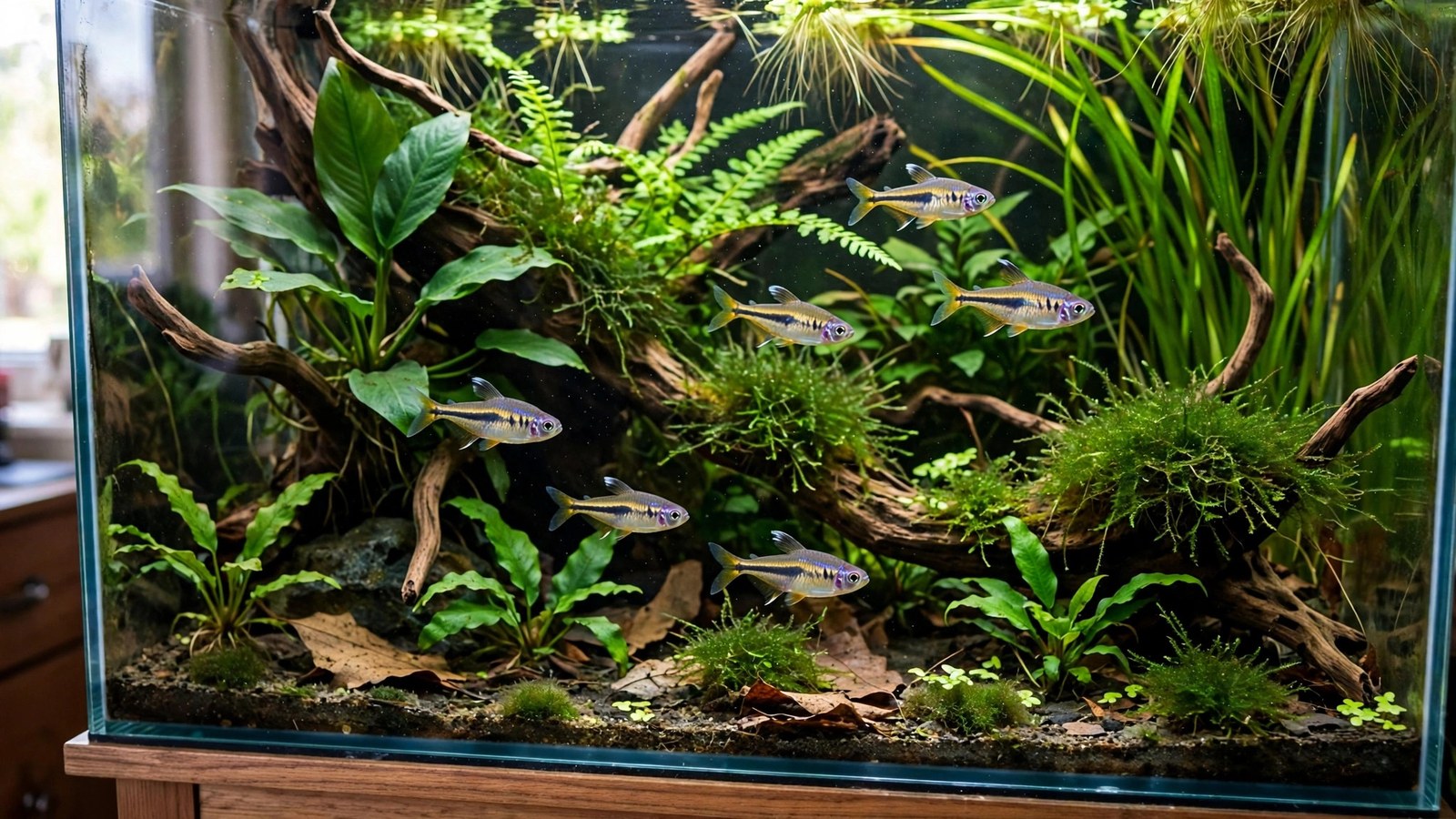
There is one freshwater fish you can sex at a glance from across the room: the emperor tetra. Males carry a brilliant blue iris; females carry a green one. That instant visual payoff, plus a calm temperament and honest hardiness, is why an emperor tetra planted tank is one of the best setups in the hobby. By the end of this guide you can plan, plant, and stock a tank for a thriving school of ten-plus.
Why Emperors Deserve a Planted Tank
Emperor tetras come from slow, shaded backwaters in Colombia's San Juan and Atrato basins — overhanging vegetation, sunken branches, leaf-littered sand. In a bare tank they school nervously in a corner; in a planted tank you get the animal as it exists in nature, with males flaring fins in ritual displays and the violet stripe glowing. Unlike species that merely tolerate plants, emperors need the security plants provide. If you are choosing plants for your fish tank with the fish's needs first, this is the setup that pairing was made for.
They are also one of the most forgiving display tetras: nearly all trade stock is captive-bred and tolerant of varied water chemistry, so the planted tank is about beauty and behavior, not survival. Start with easy beginner aquarium plants — the species emperors like best are undemanding.
Planning Your Emperor Tetra Planted Tank
Geometry matters more than volume. Emperors are horizontal swimmers, so a 40-gallon breeder (36 × 18 inches of footprint) beats a tall 55-gallon column; a standard 30-gallon is the honest minimum for a school of ten plus tankmates. Use a dark substrate — black sand or dark aquasoil — to intensify the emperor's purple-black stripe against its violet sheen.
Filtration should be calm and reliable: a hang-on-back or quiet canister turned down low, or a well-sized internal filter. Emperors come from slow water, so baffle the outflow — strong current pins them to the corners.
Water Parameters: The Stable Middle Ground
| Parameter | Target range | Notes |
|---|---|---|
| Temperature | 72–79°F (22–26°C) | No daily swings over 2°F |
| pH | 5.5–7.5 | Tannins settle it near 6.5 |
| General hardness | 1–12 dGH | Soft-to-moderate |
| Ammonia / nitrite | 0 ppm | Cycle the tank before stocking |
| Nitrate | Under 20 ppm | Weekly 25–30% water changes |
Trade stock is tank-bred, so you do not need to replicate Colombian blackwater chemistry. But do not chase parameters either — stable pH 7.2 that never moves beats pH 6.5 that bounces after every water change. If your tap is extremely hard, blend with RO water at changes. One stable regime serves fish and plants alike, and these ranges overlap healthy planted tank water parameters almost exactly.
Planting: Cover on the Edges, Open Water in the Middle
The formula that works every time: dense planting along the back and sides, a driftwood centerpiece, and an open swimming lane across the front third. Without the open lane emperors never display; without the cover they never relax.
For the background, fine-leaved stems do double duty — they are the cover this species evolved with and the best backdrop for a blue-eyed school. Cabomba, Myriophyllum, and hornwort thrive in the soft water emperors prefer, and females retreat into their feathery texture during male sparring. Tie Java fern and Anubias to the driftwood, and set Amazon swords in the rear corners with root tabs — the heart of a good low-tech planted tank setup, no CO2 required.
Then break the surface. A patch of frogbit or water lettuce at one end cuts light below, mimicking their shaded backwaters — the behavior change is immediate. Dimmer conditions deepen their colors, the same trick that makes a cardinal tetra planted tank glow. Keep a gap in the floaters for gas exchange, plus a feeding ring so food doesn't drift under.
Hardscape: Driftwood, Leaf Litter, and Tannins
One good piece of spider wood or mopani, positioned off-center, gives rival males display territories and leaches the tannins that tint the water tea-gold — the trigger that makes emperors color up. Dried Indian almond or oak leaves over the sand complete the wild-substrate look. Soak new wood until it sinks, then aim for a light, permanent amber tint. Skip activated carbon here; plain sponge plus bio media is enough.
Feeding: Small Mouths, Varied Menu
Emperors are micropredators with small mouths — food must be bite-sized. A quality micro pellet or crushed flake forms the daily base, but color and breeding condition come from frozen and live foods: daphnia, baby brine shrimp, and grindal worms. Feed twice daily only what the school finishes in two minutes; uneaten food becomes algae fuel fast.
Variety drives the behavior you bought the fish for. A school conditioned on live daphnia hunts as a pack, and well-fed males develop extended fin rays — including the elongated central tail ray unique to this genus. Dull, ragged fins often trace back to a monotonous dry-food diet — review feeding before assuming disease, and quarantine any fish with worsening symptoms.
Tankmates That Work (and Ones That Don't)
Emperors are peaceful but confident, suiting a calm community: other peaceful tetras and rasboras, Corydoras and small loricariids, pencilfish, and dwarf cichlids like Apistogramma. Avoid anything big enough to see an emperor as food, and hyperactive fin-nippers. A similar community built around a different centerpiece fish, like a dwarf gourami planted tank, shows how the same stocking logic transfers. For shrimp: adults are usually ignored, but shrimplets are the size of the live foods emperors hunt — breed shrimp separately if it matters to you.
Breeding in a Planted Tank
Emperors are egg scatterers with zero parental care that breed readily — the challenge is raising fry, not getting eggs. A few fry survive among fine-leaved plants in a display tank, but for real numbers use a dim spawning tank with Java moss or spawning mops, pH 6.0–7.0 water, and a gentle sponge filter.
Condition the group on live foods for two weeks, then move your best-colored male and fattest female across in the evening — they usually spawn the next morning, releasing a few eggs at a time. Remove the adults once you spot eggs; they eat their own spawn. Eggs hatch in 24–36 hours, fry swim free at 4–5 days, and need infusoria for the first week before baby brine shrimp nauplii.
Frequently Asked Questions
How can you tell male and female emperor tetras apart?
Look at the eyes: males have a brilliant blue iris, females a greenish one. Mature males are larger and more colorful, with extended fins including an elongated central tail ray. Females are plumper-bodied.
How many emperor tetras should be kept together?
Eight is the minimum, but ten or more is where the species shines. Rival males posture constantly; a large group spreads that display so no individual gets harassed. Groups of four to six tend to be shy and washed-out.
Do emperor tetras need a heater?
Usually yes — room temperature rarely holds 72–79°F year-round. Use an adjustable heater with a reliable thermostat.
Will emperor tetras eat aquarium plants?
No — emperors are micropredators, not herbivores, and they leave plants alone. Fine-leaved stems like Cabomba and Myriophyllum are safe, which is why they are recommended as cover.
Can emperor tetras live with neon tetras?
Yes, in a tank of 30 gallons or more with plenty of plant cover. Emperors are peaceful mid-water fish while neons school slightly lower, so they rarely clash. Keep both in schools of 8–10+ so each behaves naturally.
Bringing It All Together
An emperor tetra planted tank succeeds on four decisions: a wide tank with open swimming room, a school of ten or more, soft stable water with real tannins, and plants that give cover without closing off the middle. For the full species background, the Seriously Fish profile of the emperor tetra remains the best reference available.