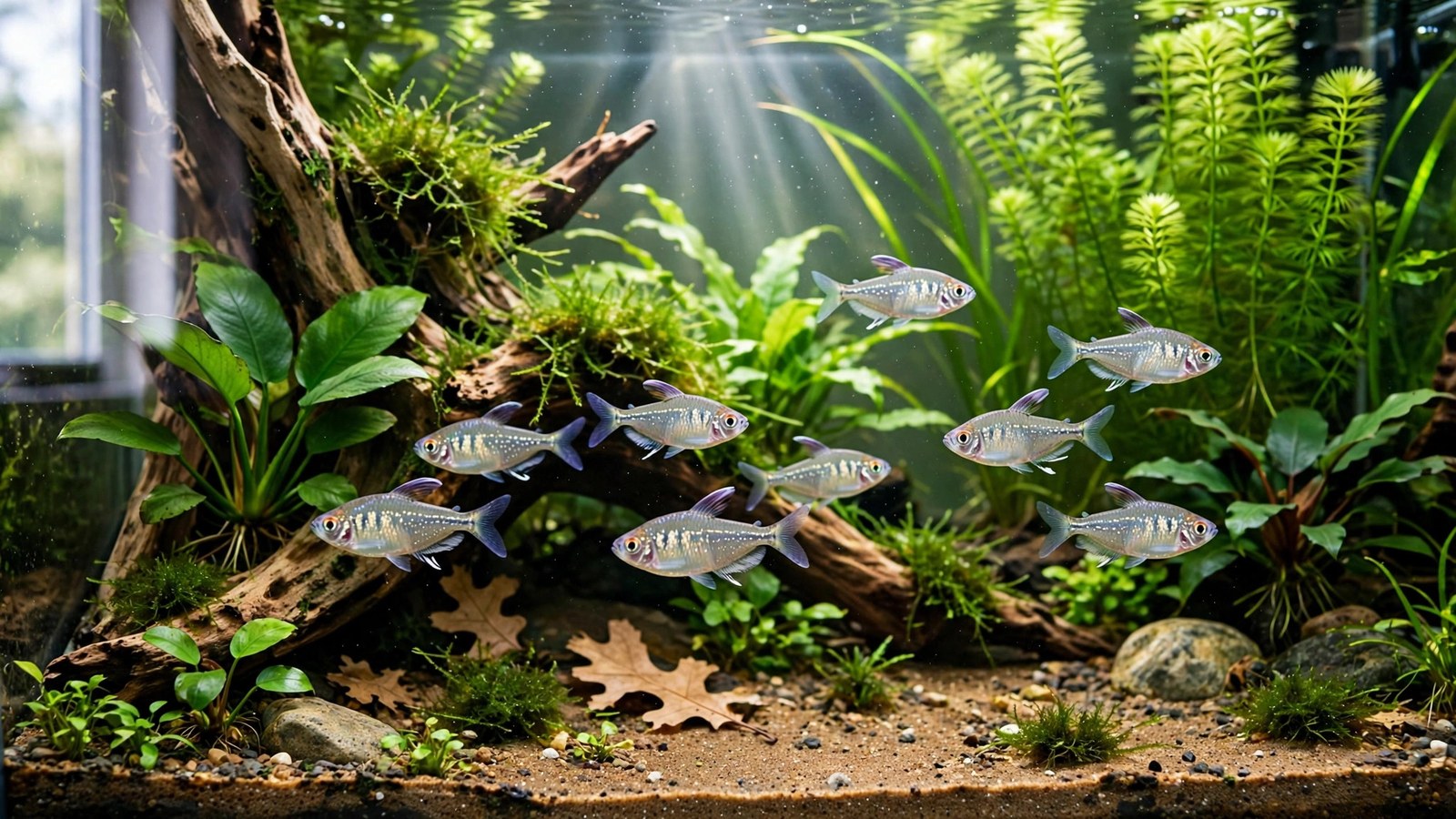
Most tetras look the same under a dim shop strip light as they do in your living room. Diamond tetras are the glorious exception: a shy grey fish in the dealer's tank that erupts into violet, gold, and electric blue under quality light over a dark background. That transformation is the whole reason to build a diamond tetra planted tank (Moenkhausia pittieri) around lighting first and aquascaping second — planted the fish-first way, as laid out in our Aquarium Plants for Fish Tanks guide.
The Fish That Rewards Good Lighting
Diamond tetras carry guanine-rich iridophore cells in their scales — biological mirrors that split reflected light into violet, gold, and steel-blue flashes as the fish changes angle. Under a weak cool-white tube over pale gravel, those mirrors barely fire and the fish looks like a plain silver tetra. Swap in a quality full-spectrum LED, black out the back glass, and lay a dark substrate, and the same school becomes the most photographed fish in the room.
Lighting geometry matters as much as brightness. These fish sparkle most when light strikes them from above and slightly ahead, and floating plants like frogbit break it into dappled shafts — the way sun filters through the vegetated backwaters of their native Lake Valencia basin. Bright everywhere is fine; bright with texture is spectacular. Compare fixtures in our roundup of the 8 best aquarium lights for planted tanks, favoring a high-CRI white channel over red-and-blue-only spectrums.
Diamond Tetra Planted Tank: The 25-Gallon Lighting-First Blueprint
Twenty-five to thirty gallons is the honest minimum — not because adults are large (they top out around 6 cm), but because a school of 8–10 needs turning room to school tightly, and tight schooling is when the collective flashing happens. A standard 30×12×18-inch footprint is ideal; horizontal swimming space matters more than height for every schooler, as our guide to the best schooling fish for planted tanks explains.
Build it fish-first. Lay 2–3 inches of dark aquasoil and press a matte black background to the rear glass — the cheapest upgrade you can make, and it does more for iridescence than any fertilizer. Place one or two low pieces of branching driftwood off-center, keep the central third of the tank genuinely open, and filter gently: a baffled canister or HOB suits these slow-water fish, with a 100–150W heater holding 24–26°C.
 ★4.6
NICREW ClassicLED Plus planted aquarium light
Check Price on Amazon ★4.6Plants That Make Diamonds Sparkle
The planting plan serves the fish: a dense layered perimeter so the school feels secure enough to leave the shadows, plus floating cover that dapple-filters the light. Every plant here tolerates the same 24–28°C, pH 6.0–7.5 window as the tetras.
| Zone | Plants | Why it works |
|---|---|---|
| Floating | Amazon frogbit, red root floaters | Dapples light into the shimmering shafts that trigger the violet-gold flash |
| Background | Vallisneria spiralis, Rotala rotundifolia | Tall green walls for the school to wheel against; dark green reads beautifully behind silver bodies |
| Midground | Cryptocoryne wendtii, Anubias barteri on wood | Shadowed cover without stealing the swimming lane; crypts love soft, slightly acidic water |
| Foreground | Staurogyne repens, dwarf sagittaria | Low carpets keep sightlines open so the school reads as one glittering unit |
Lean gently blackwater — a few almond leaves in the corners, tannin-leaching wood — to echo the leaf-littered Venezuelan streams these fish evolved in. Our planted blackwater tank setup shows how to style this without going tea-dark, which would cost you the light you built the tank for.
Stocking, Tank Mates, and Feeding
Buy 8–10 at once, ideally from the same dealer tank, and quarantine them two weeks in a bare 10-gallon with a sponge filter before they meet your display. Males develop noticeably longer dorsal and anal fins as they mature; a male-leaning group gives the best fin display. Unlike nano tetras, adult diamonds have the mass to hold their own with medium-sized peaceful community fish — which opens up stocking options smaller species cannot take.
| Tank mate | Why it fits |
|---|---|
| Corydoras (panda, bronze) | Bottom dwellers that never compete for the mid-water lane; same temperature window |
| Otocinclus | Peaceful algae crew for leaf surfaces; add once the tank is 2–3 months mature |
| Honey gourami | Calm centerpiece for the top third, no bullying |
| Black neon or ember tetras | Smaller peaceful schoolers that school separately — a nice scale contrast |
Feed them like the omnivorous micro-predators they are: a quality micro-flake or 0.8–1.2 mm pellet as the daily staple, rotated with frozen daphnia, baby brine shrimp, or cyclops three to four times a week. Varied protein visibly improves scale luster within a month. Two small feeds a day, only what vanishes in two minutes.
Weekly Routine and What Actually Matters
Clamped fins and washed-out iridescence are the first symptoms of parameter drift. If numbers ever swing, our planted tank water parameters guide explains which ones matter for fish-first tanks.
- 30% water change weekly — gravel-vac the open areas where the school’s waste concentrates.
- Thin the floaters — keep about a third of the surface covered; a full canopy starves the tank of the light you built it around.
- Wipe the glass before the water change — film algae on the front panel scatters light and dulls the view.
- Trim background stems every 2–3 weeks so they stay walls, not ceilings; replant the tops.
 ★4.8
API Freshwater Master Test Kit
Check Price on Amazon ★4.8Frequently Asked Questions
How many diamond tetras should I keep together?
Keep 8 to 10 as a practical minimum in a 25–30 gallon tank. Smaller groups turn shy, school loosely, and look washed out — the collective flashing that makes this fish famous only happens when a proper school wheels together. Groups of 12+ are even better if your filtration and water-change discipline can handle the bioload.
What light makes diamond tetras sparkle the most?
A full-spectrum LED at 6,500–7,500K with a high-CRI white channel, over a dark background and dark substrate, with floating plants breaking the light into dappled shafts. Avoid blue-only “night” modes as the main light — they flatten the violet-gold iridescence into a single dull tone and encourage algae.
Can diamond tetras live with cherry shrimp?
Yes, with realistic expectations. Adult diamonds generally ignore adult cherry shrimp, especially in a densely planted tank with moss cover — pair them with a solid cleanup crew for planted tanks and they coexist fine. Newborn shrimplets may get eaten, so a shrimp breeding colony belongs in its own tank.
Do diamond tetras breed in a planted tank?
They can. They are egg scatterers: a conditioned pair spawns among fine-leafed plants at first light, eggs hatch in 24–36 hours, and fry are free-swimming in 3–4 days. In a community display most eggs become food — dedicated breeding needs a separate 10-gallon tank, soft acidic water, and the parents removed after spawning.
Are diamond tetras aggressive or fin nippers?
No — they are genuinely peaceful, even for a tetra. Occasional chasing within the school is normal social behavior. The only time diamonds get nippy is in groups smaller than six or in cramped tanks, where stress redirects into harassment. Their species profile confirms the calm temperament.
A diamond tetra planted tank is one of the rare setups where the equipment choice is the aesthetic: buy the light for the fish, not the plants, and the school pays you back every evening in violet and gold. The diamond tetra care card at Aquarium Arts is a solid second reference for species care beyond the planted-tank angle.