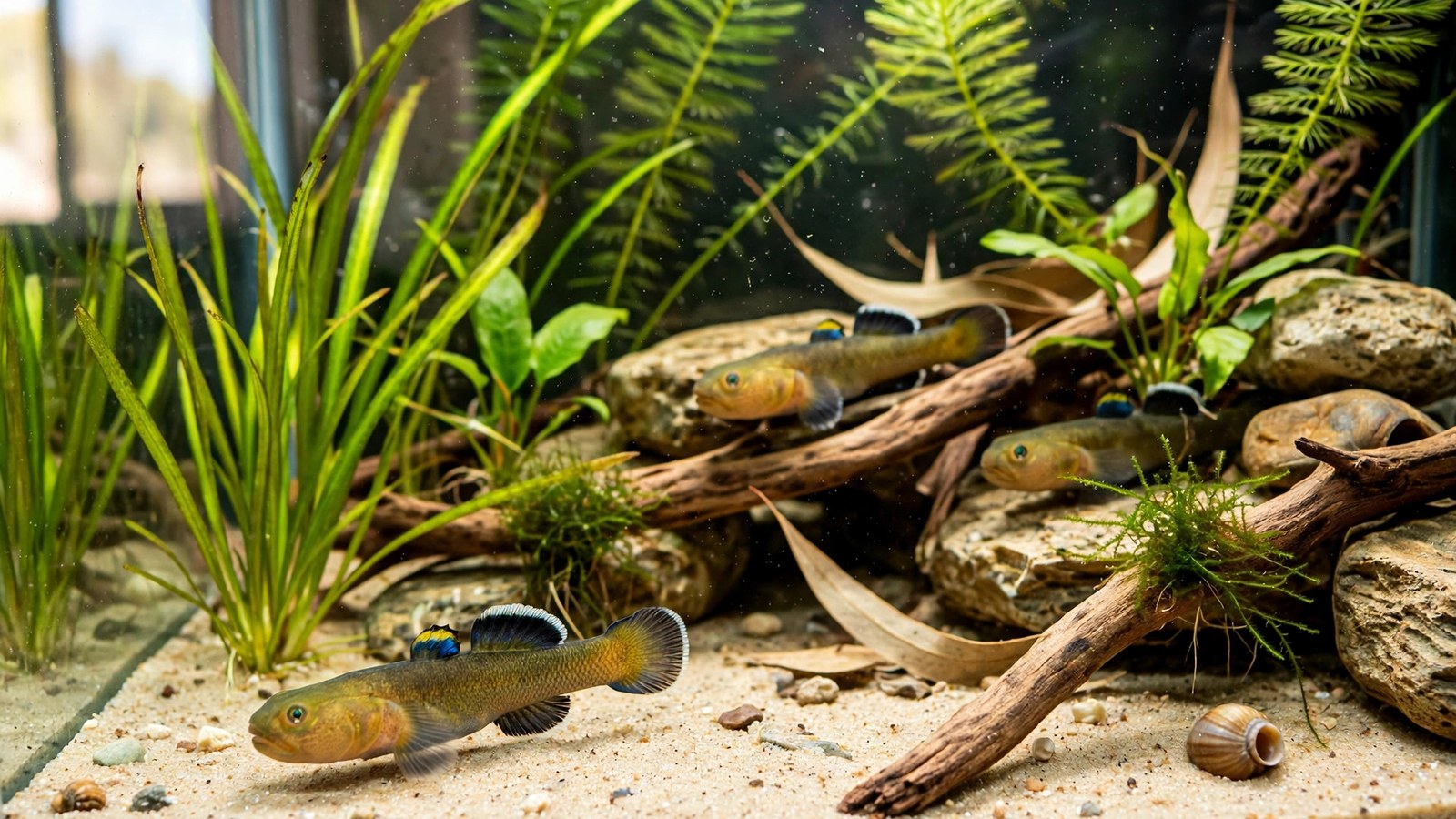
Your aquarium heater fails on a summer afternoon and the tank hits 35°C. For most tropical fish, that is a disaster. For the desert goby, it is Tuesday. Chlamydogobius eremius lives in the artesian mound springs of Australia's Lake Eyre basin, where shallow pools swing from near-freezing nights to scorching afternoons. This guide shows you how to build a desert goby planted tank that plays to that toughness — sand to burrow in, caves to claim, and hardy plants that shrug off a bulldozer.
Why a desert goby planted tank works
Most fish we keep come from stable tropics. The desert goby comes from one of the least stable habitats on Earth: shallow artesian springs in the Lake Eyre basin, where pools can warm past 40°C under the midday sun, creep toward freezing overnight, and concentrate into near-seawater salinity as they evaporate. Per the SeriouslyFish species profile for Chlamydogobius eremius, wild fish tolerate 5–41°C, pH 6.5–11.0, and salinity from 1 to 37.5 ppt — a tolerance range few aquarium species can touch.
That hardiness makes an Australian biotope aquarium setup unusually forgiving for beginners. One caution: toughness is not adaptability to anything — in the trade, desert gobies are freshwater fish that need moderately hard, alkaline water, and soft, acidic setups stress them. And they are emphatically not the brackish-loving bumblebee goby — different genus, different continent, different water.
At 5–7 cm with a 2–4 year lifespan, this is a small, busy fish. Males colour up with a bolder dorsal fin; females stay plainer. Expect constant substrate activity — nosing into sand, darting between caves, and breeding-condition males excavating pits under their chosen shelter.
Tank setup: sand, caves and calm water
Start with a 40-litre tank minimum for a small group, but 75 litres (20 gallons) is the sweet spot for a pair: enough floor space for two territories that do not constantly collide. Floor area matters more than depth — these are bottom-dwellers, so a long shallow footprint beats a tall cube.
Lay 3–5 cm of fine, rounded sand. Coarse gravel works in a pinch, but sand lets gobies do what they evolved to do: burrow. Then build the cave network the whole tank revolves around. Stack flat slate or smooth river rock into crevices, or half-bury short terracotta pipes and small clay pots on their sides — one cave per fish, spaced apart, so each can claim its own. Position plants only after the hardscape is final.
Filtration should be gentle: a sponge filter gives aeration without the current these fish dislike, per the sponge filter vs HOB comparison for planted tanks. Keep the temperature steady at 22–28°C — yes, they survive 41°C, but chronic high heat shortens lifespan and stresses plants.
Hardy plants that survive a burrowing goby
The planting rule is simple: roots deep or attached to rock, nothing delicate, nothing floating loose. Desert gobies dig daily, so treat this like landscaping around a small, determined excavator. For general toughness benchmarks, check the aquarium plants for fish tank guide — the species below all pass the "digger-proof" filter.
| Plant | Why it works | Planting note |
|---|---|---|
| Vallisneria | Deep, spreading runner roots shrug off digging; tolerates hard, alkaline water | Plant along the back in clusters of 5–7; runners refill gaps |
| Anubias spp. | Attached to rock, never rooted in sand — immune to excavation | Tie or glue rhizome to hardscape; keep rhizome above substrate |
| Java fern | Epiphyte like Anubias; hardy and slow | Attach to wood or rock near cave entrances for shade |
| Cryptocoryne | Dense root mat anchors firmly once established | Plant in pots or weighted pockets until roots take hold |
| Hornwort | Floating stems oxygenate and give fry cover | Leave floating; no planting required |
Keep lighting moderate — a 6–8 hour photoperiod on a low-to-mid intensity LED is plenty, since brighter light mostly fuels algae. The easiest aquarium plants for beginners overlap well with this species' digger-proof shortlist.
Water chemistry: the light-brackish option
Run this tank as plain freshwater and you will never go wrong: pH 7.0–8.5, moderate hardness, temperature 22–28°C. Wild desert gobies handle near-seawater salinity, but aquarium fish are raised in fresh water and breed in it readily. The extreme tolerance is survival insurance, not a husbandry requirement.
Some keepers add marine salt at around one teaspoon per litre, which the fish tolerate. But plants mostly do not: Vallisneria accepts mild salt, Anubias and Java fern accept very little, and Cryptocoryne melts. If you are planting the tank, skip the salt.
Feeding and behaviour
Desert gobies are opportunistic bottom-feeders: micro pellets or crushed sinking granules as the staple, plus frozen or live brine shrimp, daphnia or bloodworms two to three times a week — the frozen foods noticeably improve male colour. Feed modestly once daily; they are enthusiastic beggars that will overeat if you let them.
Behaviour is why you buy this fish. Males are territorial year-round — a dominant male claims the best cave, digs a pit beneath it, and flares at rivals, while females wander freely. Stock one male with one or two females per zone and give each male his own cave, or you get endless border disputes. Species-only or calm Australian natives work best; if a pair spawns, the male guards the eggs and fry take infusoria, then baby brine shrimp.
Frequently Asked Questions
Can desert gobies live with other fish?
Yes, with peaceful tank mates of similar size — small Australian natives or calm tetras. Avoid boisterous or fin-nipping species and anything small enough to be eaten, like cherry shrimp fry. Keep the gobies' caves on one side of the tank so territorial males leave tank mates alone.
Do desert gobies need brackish water?
No. They survive and breed in plain freshwater of moderate hardness. Wild fish tolerate salinity to 37.5 ppt, and some keepers add about one teaspoon of marine salt per litre, but salt restricts your plant choices — skip it in a planted tank.
Will desert gobies uproot aquarium plants?
They dig constantly but mostly around, not through, plants. Vallisneria and Cryptocoryne survive once established; epiphytes like Anubias and Java fern are immune since they grow on rock. Use buried mesh pots for the first month, and keep new plants out of the sand lanes in front of each male's cave.
How many desert gobies can I keep together?
A trio (one male, two females) suits 40 litres; 75 litres can hold two pairs. The limiting factor is male territory — give each male his own cave on opposite ends of the tank, or they will spend their days flaring and sparring.
How hot can the water get for a desert goby?
Wild fish survive 5–41°C, and Monash University researchers documented goby springs enduring extreme outback swings (Monash Lens on the desert goby's survival story). But survival is not comfort: keep the tank at 22–28°C. Chronic temperatures above 32°C shorten lifespan and stress both fish and plants.
The bottom line
The desert goby is the rare fish where "hardy" understates the case. But the planted-tank version of that hardiness is simple: hard, alkaline freshwater, sand to dig, caves to own. Build that with digger-proof plants and you get one of the most personality-dense bottom dwellers in the hobby.