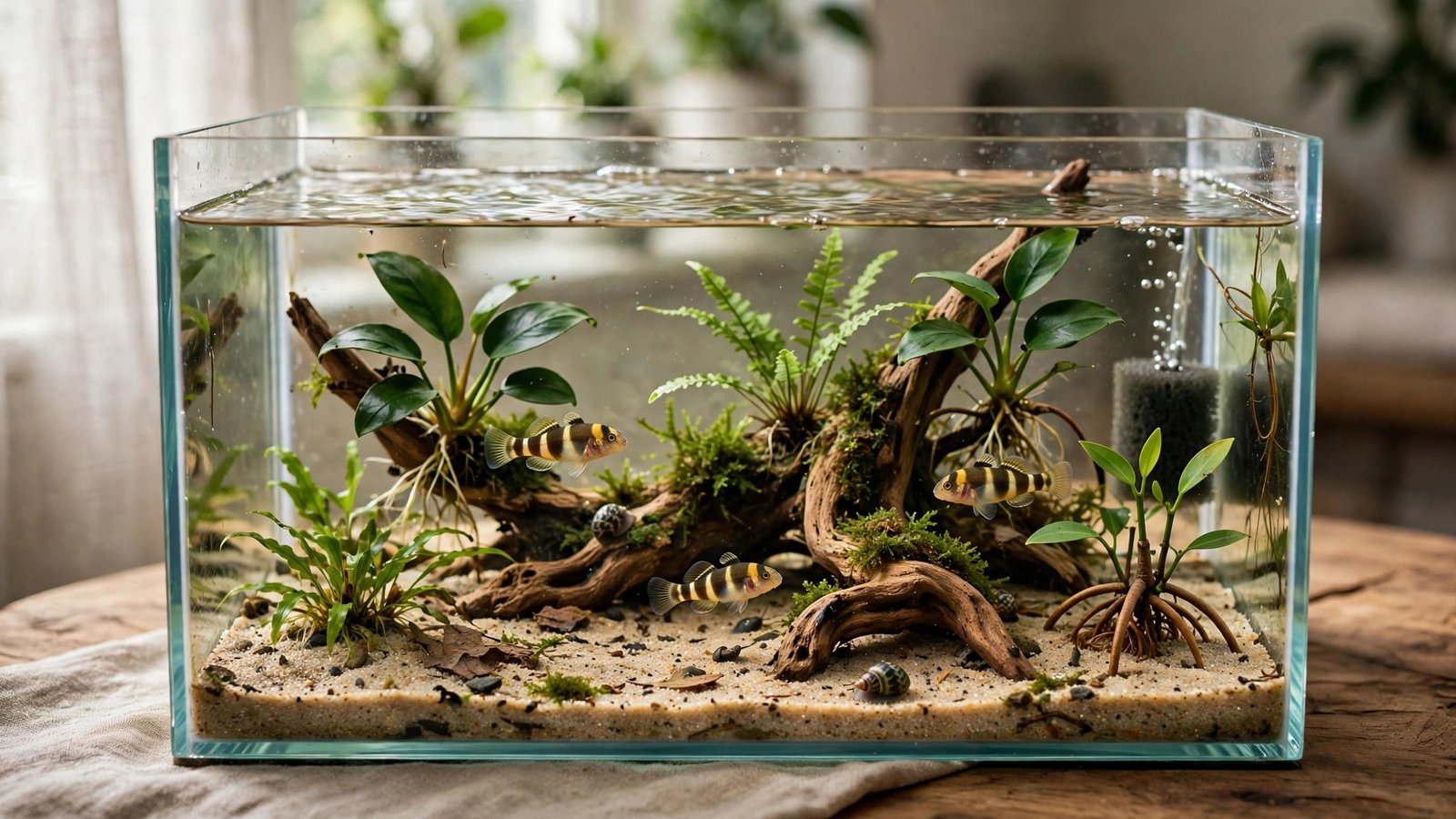
Most planted tanks are pure freshwater. Most brackish tanks are bare sand and rock. A bumblebee goby planted tank lives in the sliver between them — and that sliver is where most hobbyists fail, either by salting the water like a marine setup or by skipping plants entirely. Brachygobius doriae, the bumblebee goby, is a one-and-a-half-inch territorial bottom dweller from Southeast Asian estuaries that needs only a taste of salt: a specific gravity of about 1.005. Stay at or below it, and Anubias, Java fern, vals, and mosses grow happily. Push past it, and the plants melt.
The short answer: A bumblebee goby planted tank is a species-only 10–20 gallon brackish nano at SG ~1.005 (1–2 g/L marine salt) — low enough for Anubias, Java fern, Vallisneria, and mosses. Use sand, one cave per fish, and frozen or live foods, since most gobies refuse dry food.
The Bumblebee Goby Planted Tank Rule: SG 1.005, No Higher
The bumblebee goby is sold in the freshwater aisle, and that is the root of most of its problems. Brachygobius doriae comes from coastal mangroves and estuaries across Southeast Asia — water never pure fresh, never full marine. In hard freshwater, gobies fade within months.
SG 1.005 is the compromise where both sides win: 1–2 grams of marine salt per liter reads brackish to the gobies while the toughest plants never notice. Hold 1.003–1.005 and evaporation between water changes won't push you into the danger zone.
| Parameter | Target | Notes |
|---|---|---|
| Specific gravity | 1.003–1.005 | Refractometer at ~77°F; hydrometers drift at this range |
| Temperature | 76–82°F (24–28°C) | Stability matters more than the exact number |
| pH | 7.0–8.0 | Brackish water buffers upward naturally; don't chase lower |
| Ammonia / nitrite | 0 ppm | Cycle 4–6 weeks before adding gobies |
| Nitrate | Under 20 ppm | 25% weekly water changes, matched-salinity water |
| Lighting | Low–medium, 6–8 hours | More light buys algae, not plant growth |
Low-Salt Planting Strategy
Think of this as a planted tank with a pinch of salt, not a brackish tank with plants: dense slow growers, hardscape for structure, no heavy fertilizer dosing or CO2. A low-tech, lightly planted approach is the correct container — a lightly planted, low-tech aquarium setup — the right frame for a pinch-of-salt tank.
Plant before you salt. Set the tank up as freshwater, let the plants root for 2–3 weeks, then raise salinity about 0.001 SG per week. Freshly planted specimens shocked by salt rarely recover; established plants shrug it off. Attach epiphytes to driftwood and rock — a buried rhizome rots, salt or no salt. A low-tech planted tank setup transfers wholesale, minus the salt ceiling and with a lighter hand on liquid fertilizer.
The Plant Shortlist: What Tolerates SG 1.005
All of these have repeated hobbyist confirmation at SG 1.005 and below — slow-growing and undemanding.
| Plant | Placement | Why it works here |
|---|---|---|
| Anubias (barteri, nana, coffeefolia) | Epiphyte on rock/wood | Nearly indestructible; broad leaves are goby perching spots |
| Java fern | Epiphyte on rock/wood | Tolerates brackish water well; slow and steady |
| Vallisneria (americana, spiralis) | Background, in sand | Likes hard, mineral-rich water; runners fill the back |
| Java moss / Christmas moss | Tied to hardscape | Softens cave entrances; microfauna colonize it as free snacks |
Choose plants for the fish, not the aquascape contest: aquarium plants for a fish tank, fish needs first is the right order. Skip delicate stems, carpeting plants, and anything labeled "soft water only" — they melt at the first teaspoon of salt.
Sand, Caves, and Hardscape
Sand is non-negotiable. Bumblebee gobies are bottom sifters that press their bellies to the substrate and sleep half-buried; coarse gravel abrades them and traps the meaty foods they eat. Use fine silica or pool-filter sand, 1–2 inches deep.
The territorial rule is one cave per fish, plus one spare. Gobies hold micro-territories of a few inches each, and a fish without a claimed hideout gets harassed. Coconut huts, small terracotta pots on their sides, and stacked slate all work — one entrance each, spread across the tank. For how planted-tank substrates compare, plain sand remains the goby-correct answer.
Feeding: Frozen or Live, Flakes Need Not Apply
This section decides whether your gobies live three years or three months. Most will not recognize dry food as food — sit-and-wait micro-predators keyed to movement and scent. Budget for frozen food before buying the fish: bloodworms, brine shrimp or daphnia, and a pipette for target feeding.
Feed once or twice daily, only what disappears in two to three minutes. Squirt a few thawed bloodworms near each goby's cave — gobies are slow eaters that lose every race to faster tank mates (another reason this tank is species-only). Rotate bloodworms, brine shrimp, and daphnia, with live baby brine shrimp for new arrivals. Rinse frozen food in a fine net first.
Stocking and Tank Mates: Species-Only Wins
A 10-gallon holds 4–6 bumblebee gobies; a 20-gallon long holds 6–8 with room for the cave-per-fish rule to breathe. The 20-long is the better tank — its footprint gives each goby a real territory. Add all gobies at once after cycling; trickling new fish into claimed territories starts fights.
Skip tank mates. Anything fast enough to outcompete them starves them, anything large may eat them, and freshwater-only species can't follow the gobies to SG 1.005. Species-only is where gobies behave like gobies: perching, posturing, defending caves. For contrast, stiphodon gobies in a planted tank are freshwater algae grazers with different rules, and a chili rasbora planted nano shows a freshwater nano community done right.
Mixing Salt Without Guesswork
SG 1.005 cannot be mixed by feel — a "teaspoon per gallon" recipe drifts with grain size and humidity. A refractometer (optical, $20–30, calibrated with distilled water) is mandatory. Use marine salt mix, not table salt or plain aquarium salt: it adds the magnesium, calcium, and trace minerals that make brackish water brackish.
Mix in a separate bucket of dechlorinated water, stir until fully dissolved, verify SG, then add during water changes — matched to the tank's SG exactly. Never add dry salt to the tank, and never salt top-off water: evaporation removes water, not salt. For the dosing math, see brackish water dosing and specific gravity explained.
Marine salt mix for the SG 1.005 dosing section; the exact mixing product named: Instant Ocean Sea Salt ★4.8.
Refractometer to measure SG 1.005 instead of guessing; the article's central measuring tool: salinity refractometer ★4.4.
Frequently Asked Questions
Can bumblebee gobies live in pure freshwater?
They survive in freshwater for a while — which is why shops sell them there — but they don't thrive. Brachygobius doriae is an estuary fish; in long-term freshwater most keepers report shorter lifespans and fading color. SG 1.003–1.005 is the sweet spot.
What happens if salinity goes above SG 1.005?
The plants suffer first. Anubias, Java fern, and mosses tolerate roughly up to SG 1.006, but beyond that leaves yellow and melt. If evaporation pushes you high, bring it back down gradually with freshwater — about 0.001 SG per day.
Will bumblebee gobies ever eat flakes or pellets?
Rarely, and never count on it. Most individuals ignore dry food entirely; a few can be weaned onto micro-pellets over weeks, but that's the exception. Plan around frozen bloodworms, brine shrimp, and daphnia from day one. A goby that "isn't eating" usually needs live baby brine shrimp to trigger its hunting response.
How many bumblebee gobies per tank?
Four to six in a 10-gallon, six to eight in a 20-gallon long. They are territorial with their own kind, so the rule is one cave per fish plus a spare. Add the whole group at once after cycling.
Can I keep bumblebee gobies with shrimp or snails?
Snails yes, shrimp no. Nerite snails tolerate SG 1.005 well and clean algae the gobies ignore. Shrimp become expensive snacks — gobies are micro-predators that hunt shrimplets relentlessly, and most dwarf shrimp dislike brackish water anyway. Stick to nerites and Malaysian trumpet snails.
A bumblebee goby planted tank rewards restraint: salt measured, not guessed; plants chosen for toughness; food that moves, not flakes. For the species profile, see Brachygobius doriae: the bumblebee goby species profile.