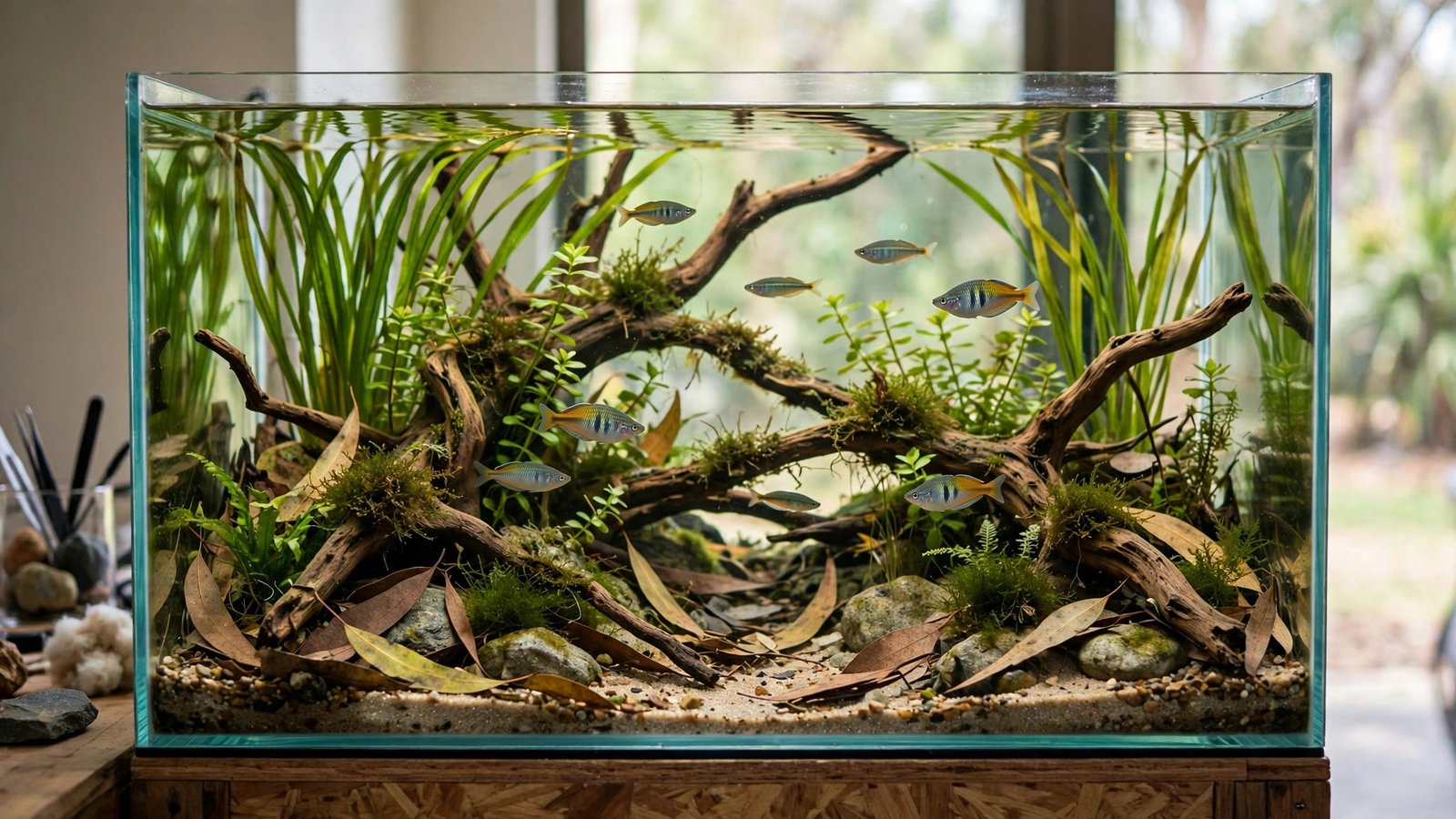
The rainforest creeks of far-north Queensland run clear over fine sand, fringed by pandanus roots and half-submerged paperbark branches — and a faithful australian biotope aquarium setup recreates exactly that scene in a 75–100 litre tank. Most aquarists get it subtly wrong: they mix New Guinea species with Australian ones, or arrange decorative drifts that never existed in these waters. Pick one creek type, learn its seasons, stock only what swims there, and the result feels like a window into the Daintree.
To set up an Australian biotope aquarium, recreate a Northern Australia rainforest creek: fine river sand, smooth water-worn stones, and submerged branches; plant genuine natives like Vallisneria nana; and stock Australian rainbowfish such as Melanotaenia splendida in groups of 8–10. Hold 24–28 °C and pH 6.5–7.5, then simulate the wet season with a large cool water change — a 3–4 °C storm-front temperature drop is the spawning trigger most keepers never provide.
The creek you're recreating: far-north Queensland streams
The tributaries of the Daintree, Tully, and Russell–Mulgrave systems are shallow, sun-dappled, and alive with movement. Water flows over fine sand and rounded pebbles, broken by fallen branches and streamside root mats. Vallisneria nana sways along the margins while leaf litter settles in the slower pools, releasing the faint tea-coloured tannins that set the habitat's light.
The November–April wet season swells the streams, drops temperatures, and triggers courtship and spawning; the dry season brings lower, warmer, clearer water. A convincing biotope builds that rhythm into its maintenance, because the wet-season trigger is what turns rainbowfish into displaying rainbowfish. For planting a tank around fish rather than the other way around, this approach is ideal: plants are chosen because the creek's fish evolved alongside them.
Inside the australian biotope aquarium setup: the step-by-step build
Start with a 60 cm or longer tank — 80 to 100 litres gives a proper rainbowfish shoal room to move. Keep it out of direct sun; moderate light matches the rainforest canopy.
- Riverbed. Rinse fine sand until clear, spread 3–4 cm, sloping deeper at the back. No soil, no gravel.
- Hardscape. Set 5–8 smooth water-worn stones in loose clusters; lean 2–3 driftwood branches like fallen paperbark limbs.
- Plant. Cluster grasses along back and sides, leaving the central third open over sand for swimming room.
- Fill and cycle. Fill over a plate, fishless-cycle 2–4 weeks, and add a few dried leaves to the slow corner.
- Stock. Add the full rainbowfish shoal at once (8–10 fish), then companions a week later.
Hardscape: sand, river stones and fallen branches
Every piece must belong in a Queensland creek. Sand is non-negotiable — it anchors the whole illusion. Stones should be smooth, rounded, and earth-toned; wood should be branchy and water-stripped, not decorative root tangles.
| Material | Use | Amount for 80–100 L |
|---|---|---|
| Fine river sand | Riverbed, deeper at back | 12–15 kg |
| Smooth river stones | Loose mid-ground clusters | 5–8 pieces |
| Driftwood branches | Fallen-limb structure | 2–3 pieces |
| Dried leaves | Slow-corner tannin litter | 6–10 leaves |
When choosing the right substrate for a planted riverbed, let the biotope override the usual rules: nutrient-rich aquasoils are wrong here — the creek bed is inert sand, and these grasses feed from the water column.
 ★4.2
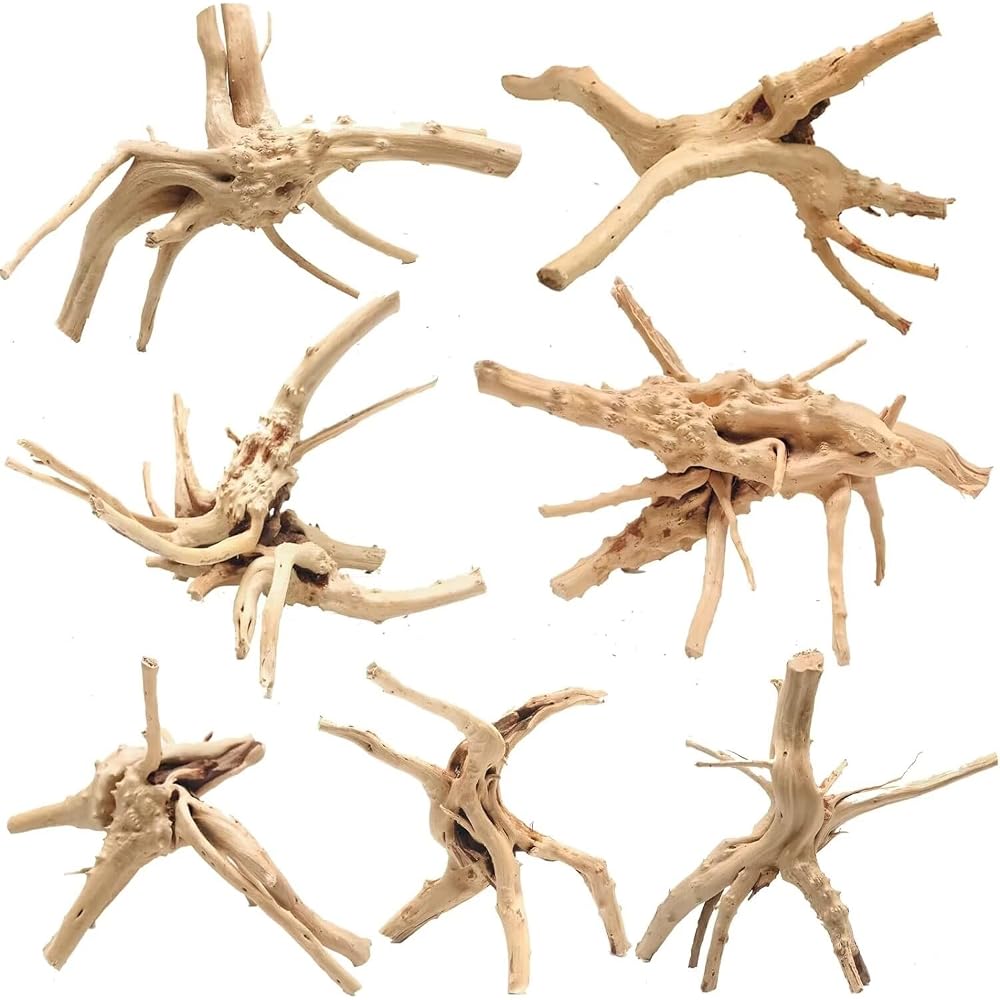
Hamiledyi Natural Spider Wood Driftwood
Check Price on Amazon ★4.2Flora: native river grasses and reed marginals
The planting list is short, and that is a strength — a real creek has a handful of species in abundance. All six below are genuine Australian natives thriving at 24–28 °C without injected CO2.
| Species | Role | Placement |
|---|---|---|
| Vallisneria nana | Signature creek-edge grass | Back and side margins |
| Blyxa aubertii | Tufted mid-ground grass | Drifts between stones |
| Ceratopteris thalictroides | Feathery cover for fry | Corners and behind wood |
| Aponogeton elongatus | Tall ribbon leaves | Rear corners |
| Nymphoides crenata | Floating-leaf accent | Slow-water zones |
| Ottelia alismoides | Broad-leaf rosette | Beside the stones |
Plant grasses in odd-numbered clusters of 5–7; a creek margin is a drift of one species, not a row of specimens. Vallisneria nana is the workhorse — it spreads by runners, tolerates pH 6.0–8.0, and its narrow leaves are the fastest visual cue that the tank is Australian.
Fauna: rainbowfish and creek companions
Rainbowfish are the beating heart of this build — and Australia gives you genuinely distinct choices. Stock only Australian species: this is the line separating a real biotope from a rainbowfish community tank. New Guinea icons like Melanotaenia boesemani have no place here; even the Parkinson's rainbow planted setup belongs to a different river system on a different landmass.
| Species | Size | Group | Notes |
|---|---|---|---|
| Melanotaenia splendida | 10–12 cm | 8–10 | Flagship shoal; males glow at dawn |
| Melanotaenia trifasciata | 8–10 cm | 8–10 | NT creeks; banded male display |
| Iriatherina werneri | 4–5 cm | 10–12 | Fin streamers; calm margins — see the threadfin rainbowfish planted tank approach |
| Pseudomugil signifer | 4–5 cm | 10–12 | Blue eye-shine in morning light |
| Hypseleotris compressa | 8–10 cm | 4–6 | Bottom companion; males turn orange |
Pick one rainbowfish as the flagship shoal plus one small companion — overcrowding the cast dilutes the biotope. Feed small pellets, frozen daphnia, and live baby brine when available; male colour depends on diet and the social group alike.
Seasonal rhythm: running the wet and dry seasons
Once the tank is settled, work the seasons into maintenance. Wet season (November–April): every week or two, do a 40–50% change with water 2–3 °C cooler and nudge flow up — mimicking the storm pulses that flood Queensland creeks. Males intensify colour, spar with fins flared, and spawn in the grasses at dawn; fry often appear in the Ceratopteris corners after a few simulated storms.
Dry season (May–October): return to 25–30% weekly changes at tank temperature and let the water clear. Fish recover condition, plants consolidate runners, and the tank looks its most pristine. The same flood-pulse logic drives other seasonal biotopes, from the Mekong biotope approach to the Amazon biotope approach. For authoritative species ranges, the fish species profiles at the Australian Museum are the most reliable public source.
Frequently Asked Questions
How big a tank does an Australian biotope need?
An 80–100 litre tank, at least 60 cm long, is the practical minimum for a shoal of 8–10 rainbowfish plus companions. Smaller tanks force a smaller shoal, which destroys the schooling display defining the biotope. Threadfins and blue-eyes manage in a well-planted 60 litre, but flagship species need the longer footprint.
Can I keep New Guinea rainbowfish in an Australian biotope tank?
No — that breaks the biotope. Boeseman's, Parkinson's, and neon dwarf rainbows evolved in New Guinea river systems with different water chemistry and flora. They survive in the same parameters, but the tank stops being an Australian creek the moment one goes in. Keep the fauna strictly Australian.
Do Australian biotope tanks need CO2 injection?
No. The genuine Australian natives here — Vallisneria nana, Blyxa aubertii, water sprite — evolved in low-nutrient creeks and grow steadily on fish waste and moderate light. Added CO2 pushes growth rates the habitat never had and shifts the look toward a high-tech aquascape.
How do I trigger rainbowfish to spawn in a biotope tank?
Simulate a wet-season storm: a 40–50% water change with water 2–3 °C cooler than the tank, slightly increased flow, and fine-leaved grasses for egg deposition. Males typically intensify colour and start dawn spawning runs within days. Condition the group with frozen daphnia and live baby brine for a week first.
The creek test
Before you call the tank finished, run one honest check: could every element — sand, stone, grass, each fish — plausibly have come from the same fifty-metre stretch of a Queensland rainforest creek? If yes, you haven't built a planted tank. You've built a place — watch the fish at dawn and you'll see the difference.