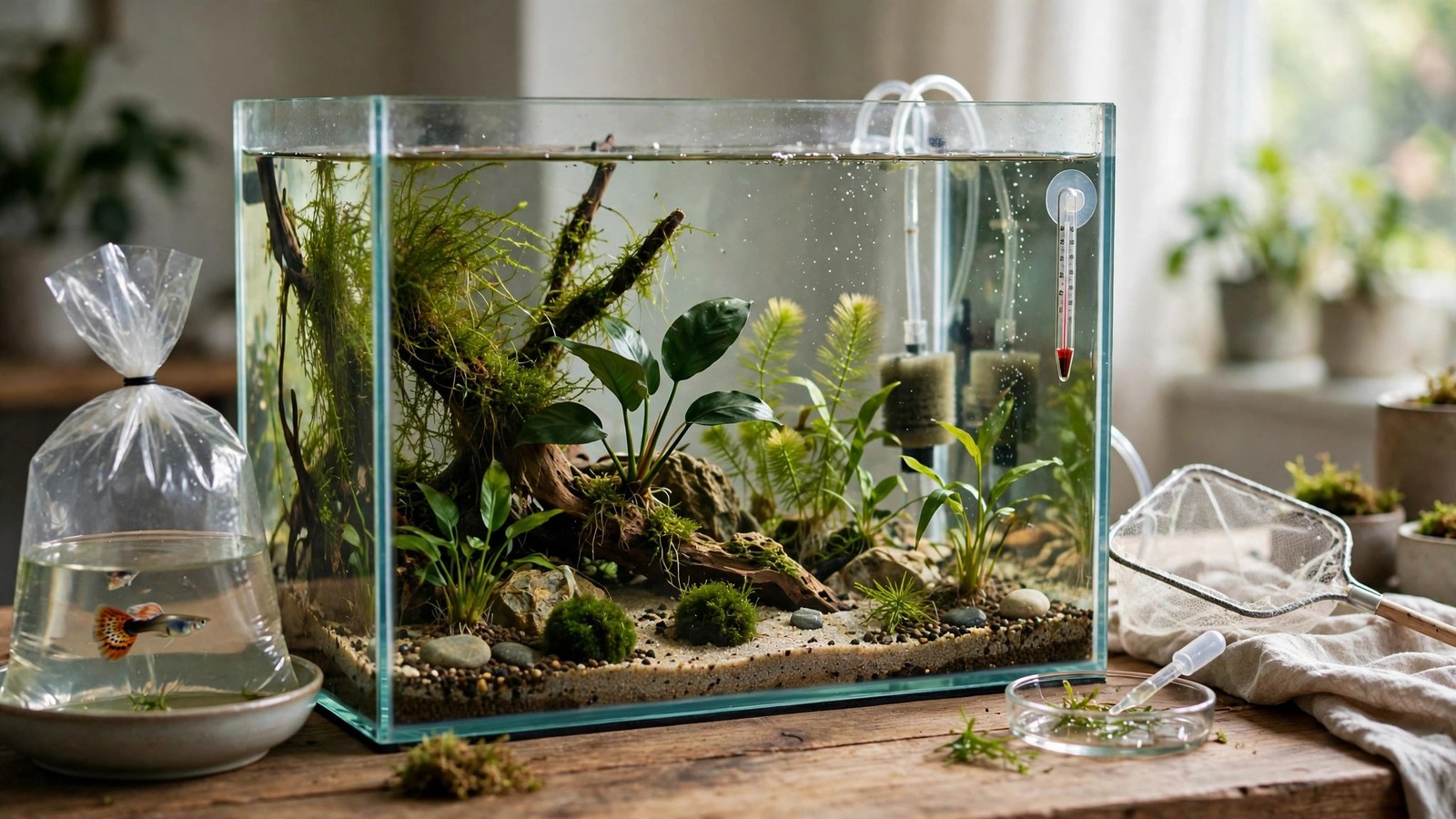
A single new fish can wipe out a thriving community in under a week. Ich, velvet, and internal parasites all travel home in the bag water — and once they reach a densely planted tank, treating them means dosing medications that melt sensitive plants and poison shrimp and snails, or tearing the whole scape apart to catch the fish. This fish quarantine tank guide gives you a calm, repeatable 2–4 week protocol: a simple bare holding tank, a seeded sponge filter, daily observation, and clear rules for when new fish are finally safe to join your display. One note before we start: this is about quarantining new fish, not plants — plant pest dips and snail control are a separate process.
Fish Quarantine Tank Guide: The 2–4 Week Protocol
A planted display tank is the worst place in your home to treat disease. Catching a sick fish out of a dense aquascape is a demolition job; many effective medications melt sensitive species like Rotala and Ludwigia, and copper-based treatments kill shrimp, snails, and beneficial biofilms outright. Quarantine exists so none of that ever reaches the community you built your plants around — the same fish-first thinking behind a fish-first guide to choosing aquarium plants.
The protocol is the hobby standard: new fish go into the quarantine tank, not the display, for 2–4 weeks of watching, testing, and treating only if needed. Two weeks is the practical minimum; four weeks catches slower-developing problems like internal parasites and is the safest rule of thumb. If disease appears, you treat it in the QT — and the countdown restarts from zero on the last symptom.
Setting Up a Simple Quarantine Tank
A quarantine tank doesn't need to be pretty — clean, filtered, and ready before the fish arrive is what matters. Ten gallons covers most nano fish and small schools; step up to a 20-gallon long for larger species or jumpers. Run it bare-bottom: with no substrate you can see waste, uneaten food, and parasite cysts immediately, and dosing is far more precise. It's the same logic behind bare-bottom setups — visibility beats decoration when health is on the line.
Filtration is one job for a sponge filter: gentle, cheap, and shrimp-safe. The single most important preparation is seeding it in your display tank first (see the tip below). Add a reliable heater and a thermometer — small tanks swing temperature fast — plus a tight lid, because stressed fish jump. Keep the light dim or off for the first day. A couple of PVC elbows or overturned terracotta pots give shy fish cover — stress turns harmless pathogens into outbreaks. Fill with dechlorinated water matched to your display tank's temperature and pH so the eventual move is gentle.
The Daily Observation and Testing Routine
Quarantine is mostly watching. Learn what normal looks like — steady swimming, upright fins, alert feeding — so deviations register as data.
| Phase | What you do | Testing & water changes |
|---|---|---|
| Days 1–3: settling | Dim light, no feeding on day one — new fish rarely eat and the food just rots. Watch breathing rate and fin position. | Ammonia + nitrite daily. 25–30% water change if ammonia exceeds 0.25 ppm. |
| Days 4–14: feeding | Feed lightly once a day — only what vanishes in two minutes; siphon uneaten food the same day. Watch for white spots, flashing, clamped fins, stringy feces. | Ammonia + nitrite every 2 days. Weekly 25–30% change regardless. |
| Weeks 3–4: deep watch | Fish should be eating eagerly. Slower problems surface now. Treat only what you actually see — blind dosing adds stress. | Test 2× per week; keep the weekly water change. |
| Transfer window | All fish eating well, no symptoms for the full hold, normal color and activity. | Final check before moving: ammonia and nitrite at zero. |
Medications: Prophylactic Trio vs. Observation-First
Both approaches are defensible. Observation-first keepers run the full hold on clean water and good feeding alone, treating only if symptoms appear. Others prefer prophylactic treatment with a broad-spectrum quarantine medication trio — Maracyn, Ich-X, and ParaCleanse — which Aquarium Co-Op's quarantine protocol describes as tested across thousands of store fish and safe for plants, invertebrates, and biofilters. For shop fish of unknown history the trio is reasonable insurance; for fish from a trusted breeder, observation-first is calmer and cheaper.
A sensible kit: one broad-spectrum antibiotic, one anti-parasitic, one dewormer, plus aquarium salt — sealed, cool, and dark.
One more habit: quarantine tanks share nothing with the display. Use separate nets, siphons, and buckets, or disinfect between uses, and wash your hands and forearms between tanks. Water droplets carry parasites just fine.
Moving Fish to the Display Tank: Transfer Criteria
Fish earn the move when they meet all of these: eating eagerly for at least a week, zero symptoms for the entire hold period, normal swimming, breathing, and color. Float the container for 15–20 minutes to equalize temperature, then net the fish across — never pour quarantine water into your display.
Some species need extra patience. Bottom-dwelling schoolers like sterbai corys often hide for the first days in the display — normal settling, not illness. Delicate fish like clown killifish genuinely benefit from the full four weeks. And use the QT as a temperament check for territorial species — how Bolivian rams or a red-tail shark behave there previews their display-tank manners.
Frequently Asked Questions
How long should I quarantine new fish?
Two weeks is the practical minimum and catches fast-moving problems like ich. Four weeks is the safest standard and covers slower issues like internal parasites. If you're short on time, two weeks of careful observation beats no quarantine — but never go below that.
Does the quarantine tank need to be cycled?
Yes — new fish in an uncycled tank face ammonia burns on top of travel stress. Run a spare sponge filter in your main tank for 3–4 weeks beforehand, then move it to the QT. If you can't plan ahead, test ammonia and nitrite daily and do 25–30% water changes to keep toxins near zero.
Should I medicate fish that look healthy?
Optional. Observation-first quarantine — clean water, light feeding, careful watching — is valid, especially for fish from trusted breeders. Prophylactic treatment makes more sense for store fish of unknown history. Either way, have medications on hand before symptoms appear and treat what you see rather than guessing.
Can I quarantine fish in my planted display tank?
No. A planted display is the worst place to treat disease: medications can melt sensitive plants and kill shrimp and snails, and catching a sick fish out of dense planting is brutal. Quarantine exists precisely so treatments and sick fish never touch your aquascape — always use a separate tank.
What's the difference between quarantining fish and quarantining plants?
Fish quarantine targets diseases — ich, velvet, internal parasites, bacterial infections — through observation and medication over 2–4 weeks. Plant quarantine targets hitchhikers: snails, snail eggs, algae spores, and pest eggs, usually handled with dips over a shorter period. Different processes, different setups.
A Small Tank That Protects a Big Investment
A quarantine tank is the cheapest insurance in the hobby: a spare 10-gallon, a sponge filter, and four weeks of patience between your thriving planted tank and a bag of unknowns. Set yours up before your next fish purchase.