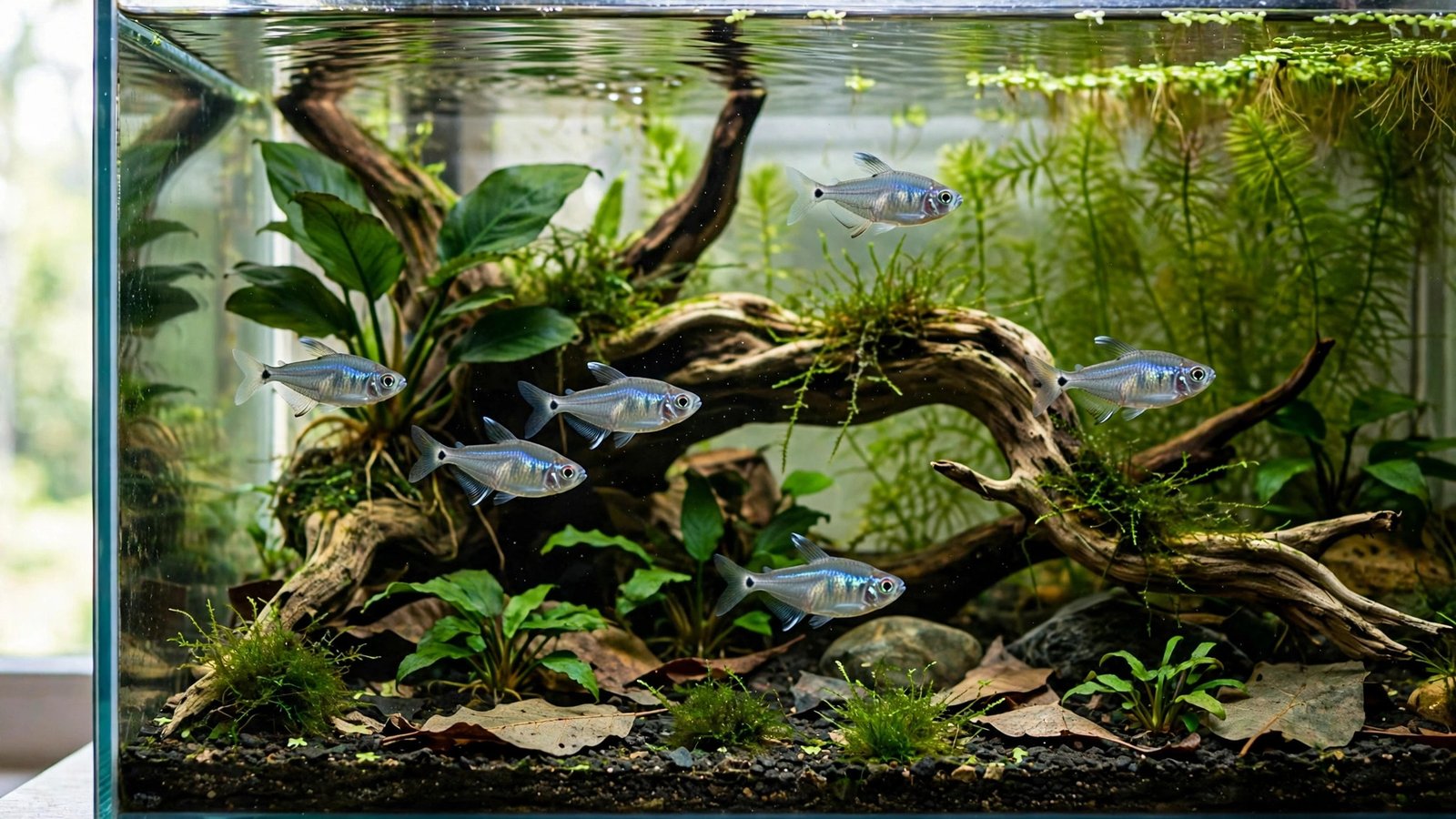
Some fish merely tolerate a planted tank. Blue tetras treat it like home turf. In a blue tetra planted tank, a school of eight to twelve Cochu's blue tetras threads through the leaves in a tight, flashing formation — the way they move through submerged vegetation in Peru's Rio Marañón basin. That wild behavior is why low-tech planted tank setups suit them so well: dense side plantings give them cover, a dark substrate throws their sapphire stripe into relief.
Cochu's blue tetras (Boehlkea fredcochui) are an underrated characin: a glowing blue lateral stripe, an orange-flecked iris, and an active, curious streak. They top out at 4–5 cm, never eat or dig up plants, and reward a well-planted 20–30 gallon tank with schooling displays a bare tank never shows.
Do blue tetras do well in planted tanks? Yes — they are one of the best schooling fish for a planted aquarium. Keep 6–12 in 20–30 gallons of soft, slightly acidic water (pH 5.5–7.6, 72–82°F), with dense side planting, open swimming room, moderate flow, and high oxygen. The species honors Ferdinand "Fred" Cochu, the importer who introduced it to the hobby around 1956.
Why a Blue Tetra Planted Tank Works So Well
Planted tanks solve three needs at once. Cover: these mid-water schoolers want vegetation on at least two sides — with it, they feel safe enough to school in the open middle. Water quality: a cycled, planted tank keeps ammonia and nitrate low, and blue tetras punish swings, especially fresh imports. Backdrop: the blue stripe against dark substrate and green leaves is the entire point.
Neons and cardinals demand soft, acidic water and fade when conditions drift. Blue tetras accept a wide range — up to pH 7.6 — so they stay electric in the neutral-to-hard tap water that washes neons out.
Boehlkea fredcochui: The Fish Behind the Blue
The true Cochu's blue tetra is Boehlkea fredcochui, a Peruvian characin from the Amazon basin — not a Hyphessobrycon. Adults reach 4–5 cm, with a broad blue stripe from gill cover to tail and a warm orange patch on the upper iris. Males are slimmer and bolder; females rounder and paler.
In a proper school they are peaceful and active; underschooled — three or four in a small tank — they turn nippy, especially at feeding time. If you have kept kerri tetras in a planted tank, you will recognize the pattern. FishLore's blue tetra species profile documents the same behavior across hundreds of keeper reports.
Setting Up the Tank for Blue Tetras
Start with 20 gallons for eight, 30 for ten to twelve — the schooling display scales with numbers. Lay down a dark substrate (black or dark brown aquasoil or sand); this single choice matters more for their color than any "color-enhancing" food. Plant the sides and back heavily, but keep a clear lane down the center where the school parades.
Give them moderate current — a hang-on-back or canister filter with gentle circular flow, plus a spray bar or air stone for oxygenation. They come from flowing water and fade in dead-still tanks. Target pH 5.5–7.6, 72–82°F. Cycle before they arrive: your planted tank's first month is when new-fish losses happen.
Best Plants for a Blue Tetra Tank
Blue tetras are genuinely plant-safe — no nibbling, no digging, no uprooting — the question is layout, not compatibility. Build tall background walls (vallisneria, swords, rotala) along the sides and back; set crypts and anubias on driftwood mid-tank as landmarks to weave through. Keep the foreground low and open — they ignore it anyway.
Two additions punch above their weight. Floating plants (frogbit, red root floaters) dim the light, calming the school and intensifying the stripe — just corral them so light reaches below. Keep at least one broad-leafed plant like anubias: tetras lay eggs on the undersides of broad leaves. Choose plants that thrive in fish-first tanks over fussy aquascaping specimens — they forgive a missed water change.
Feeding and Daily Care
Blue tetras are undemanding omnivores. A quality micro pellet or small flake as the staple, once or twice daily in amounts they finish in about a minute, covers it. Twice a week, rotate in frozen or live food — daphnia, baby brine shrimp, bloodworms — for bolder color.
Daily care is mostly observation: a tight school that greets you means they are happy. Scattered fish hovering alone usually means a parameter drifted — test before you medicate. Weekly 25% water changes keep them thriving.
| Parameter | Target |
|---|---|
| Adult size | 4–5 cm |
| Minimum tank | 20–30 gallons |
| School size | 6–12 (8+ recommended) |
| pH | 5.5–7.6 |
| Temperature | 72–82°F (22–28°C) |
| Diet | Omnivore — micro pellets/flakes + live/frozen |
| Temperament | Peaceful in a full school; nippy when underschooled |
| Lifespan | 2–4 years |
Tank Mates: What Works, What Doesn't
Build around other peaceful, similar-sized community fish. Small corydoras patrol the bottom without competing, peaceful rasboras and small tetras school alongside, and dwarf cichlids like apistogrammas add bottom interest. The farlowella twig catfish fits perfectly — calm, no nipping, no plant damage. Bumblebee gobies can work as a second oddball, but they prefer slightly harder water.
Shrimp? Adult cherry shrimp generally coexist with well-fed blue tetras, though shrimplets are snacks. Keep this species out of coldwater setups; they need tropical temperatures year-round. Breeding is straightforward: they scatter adhesive eggs on broad leaves at first light, then eat them — so move the pair to a separate soft, acidic tank the same day. Tropical Fish Keeping's Boehlkea fredcochui notes confirm Florida farms breed them, so tank-bred juveniles occasionally appear in the trade.
Frequently Asked Questions
Are blue tetras good for a beginner's planted tank?
Yes, if the tank is cycled first. Blue tetras are easy feeders, fully plant-safe, and forgiving of pH — but ammonia and nitrite will kill them, so fishless cycling is non-negotiable. Buy eight or more, plant the sides densely, provide moderate current, and change 25% of the water weekly.
Will blue tetras eat my aquarium plants?
No. Blue tetras are completely plant-safe — no leaf-nibbling, shredding, or digging, which makes them safe even for delicate carpeting plants. Plant damage in their tank is almost always caused by a different fish, a nutrient deficiency, or algae-eating snails, not the tetras themselves.
How many blue tetras should I keep together?
Six is the minimum, but eight to twelve is the real answer. Below six they scatter and nip fins; at eight-plus they form the tight, flashing school that makes this species special. Stock eight to ten in a 20-gallon or ten to twelve in a 30-gallon, and the nipping problem largely disappears.
Blue tetra vs ember tetra — which is better for a planted tank?
Both are excellent and fully plant-safe. Blue tetras are bigger (4–5 cm), bolder, and prefer more flow and oxygen; ember tetras are smaller, calmer, and better suited to nano tanks. Choose blue tetras when you want a visible, active mid-water school in a 20–30 gallon tank with moderate current.
Why is my blue tetra losing its blue color?
Fading usually means stress or environment, not disease. Check water quality first, then the setup: bright light with no floating-plant shade washes the stripe out, and light substrate mutes it. Go dark, add floaters or tannins, and color returns within days.
Can blue tetras live with shrimp or snails?
Snails are completely safe with blue tetras. Adult cherry shrimp generally coexist with well-fed tetras too, but the tetras will hunt newborn shrimplets, so a self-sustaining colony will not thrive alongside them. Keep the two species in separate tanks if shrimp breeding is a priority for you.
A blue tetra planted tank is one of the most rewarding 20–30 gallon projects: plant the sides, keep the middle open, feed well, and buy more tetras than you think you need.