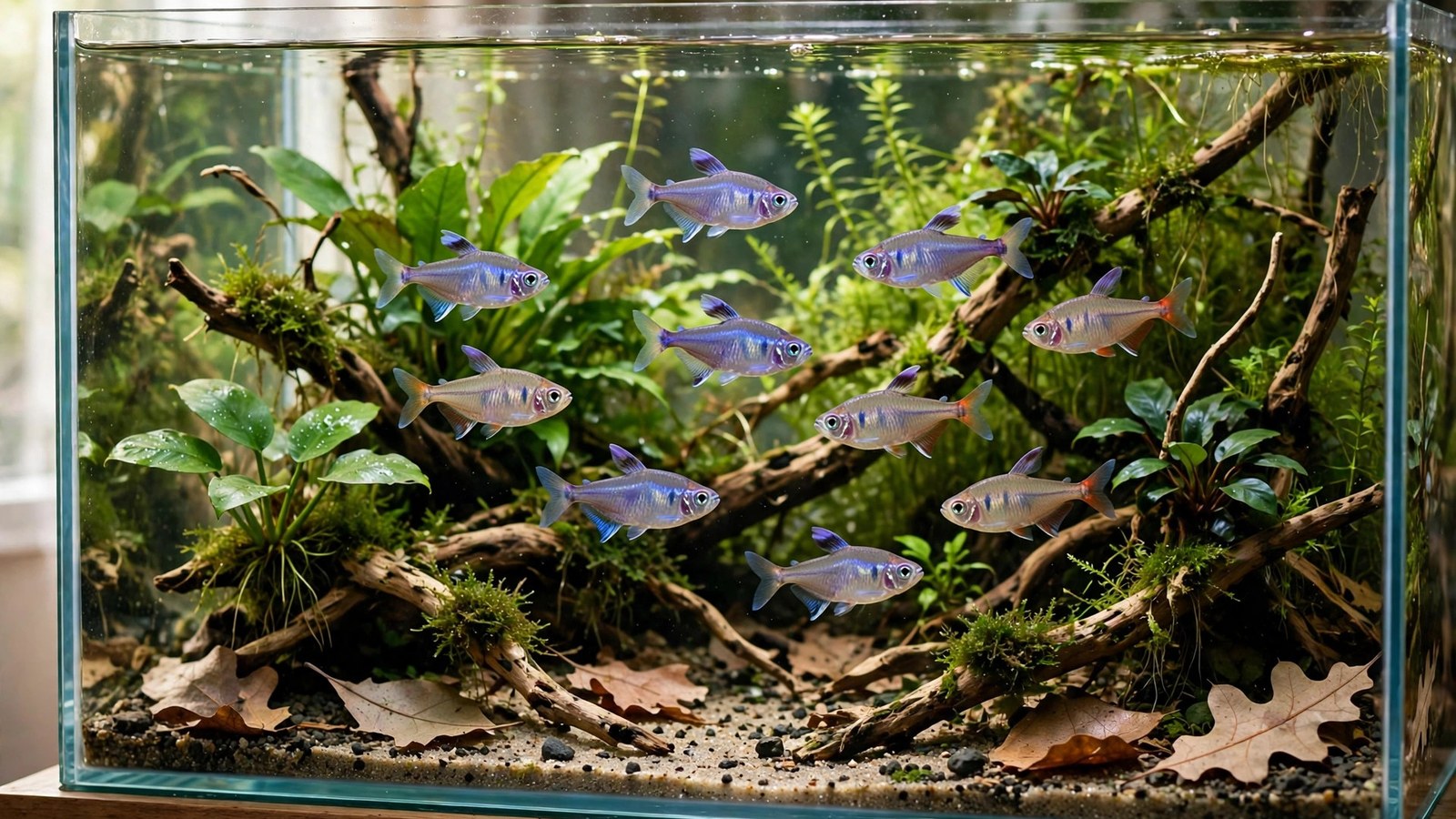
Your kerri tetras are turning pale and skittish, and the bare hardscape tank is the reason. These fish color up only when a layout gives them what their Brazilian forest streams always had: dappled shade and cover to dart into. Build a kerri tetra planted tank around that principle, and the males' blue stripe fires up within days — skip it, and they'll stay washed out no matter how perfect your water is.
Quick answer: A kerri tetra planted tank is a 15-gallon (60 L) or larger fish-first setup with soft, slightly acidic water (24–27 °C, pH 5.5–7.0), a school of 8–12 fish, dense side planting, an open central swimming lane, and floating plants to dim the light.
The Kerri Tetra Planted Tank: A Fish-First Setup Plan
The kerri tetra (Inpaichthys kerri), often sold as the purple emperor or royal tetra, is a Brazilian forest-stream fish — and that is your design brief. Forest streams run slow, warm, and tannin-tinted under a rainforest canopy, so bright open aquascapes are the opposite of what this fish wants. A 15-gallon tank is your floor; a 20-gallon long is the sweet spot for a school of 10–12.
Build three zones: a clear central swimming lane where the school parades and rival males display; dense background planting on both ends (water wisteria, Vallisneria) to break sightlines and shelter shy fish; driftwood for shade pockets and softening tannins. Use dark substrate to make the blue stripe pop, and cycle fully before stocking; the first planted tank shopping list covers heater, filter, and test kit in one pass.
Water Parameters That Keep the Purple Emperor Blue
Kerri tetras are forgiving, but they have one hard line: no alkaline water. If your tap reads pH 7.6 or above, don't fight it with bottled chemicals — blend in RO water or filter through peat. Stability matters more than exact numbers; a steady pH of 7.0 beats one swinging between 6.2 and 7.4.
| Parameter | Target | Notes |
|---|---|---|
| Temperature | 24–27 °C (75–81 °F) | Mid-70s keeps colors strong |
| pH | 5.5–7.0 | The one non-negotiable: no alkaline water |
| Hardness | 1–12 dGH | Softer end is best for breeding |
| Ammonia / nitrite | 0 ppm | Cycle fully before adding the school |
| Nitrate | Below 30 ppm | Plants plus a 30% weekly water change handles this |
| Lighting | Moderate, dimmed by floaters | ~6–8 hours daily; tannins help |
Deeper on testing and tuning? The planted tank water parameters guide covers GH/KH, CO2, and fertilizer interactions step by step.
Plants That Suit an Active Schooling Tetra
Think like a tetra, not an aquascaper: plants chosen for fish-first tanks are furniture — shade overhead, walls at the edges, nothing fragile in the parade lane. Pick tough, low-drama species to match this hardy fish.
| Role in the layout | Best picks | Why it works for kerri |
|---|---|---|
| Surface shade (essential) | Water sprite, frogbit, red root floaters | Dims the light — the #1 color trigger |
| Background walls | Vallisneria, water wisteria, Amazon sword | Breaks sightlines; shy fish retreat here |
| Hardscape cover | Java fern, Anubias on driftwood | Shade pockets without substrate demands |
| Breeding moss | Java moss clumps | Egg-catching texture for dawn spawns |
Skip delicate carpets in the center lane — an active school uproots them, and open substrate flatters the blue stripe. For a broader catalog with difficulty ratings, see the complete freshwater aquarium plants guide. CO2 is optional here.
Feeding the Kerri Tetra
This fish is an easy omnivore with one preference: small food. Feed a quality micro-pellet or crushed flake daily — if the pellet looks too big, it is. Rotate in frozen daphnia, baby brine shrimp, or bloodworm twice a week; a varied diet develops the male's iridescence within a fortnight.
Tank Mates That Won't Outcompete Them
Kerri tetras are peaceful schoolers that lose confidence around boisterous tank mates — they won't compete with larger, pushier fish. Stock calm South American company: Corydoras and otocinclus below, pencilfish or small rasboras mid-water, an Apistogramma pair as a centerpiece. Skip tiger barbs, large gouramis, and anything that sees a 1.5-inch tetra as a snack.
Fin-nipping appears almost only in groups under six; in a school of 8–12, squabbling stays between rival males showing off — when the fish look their best. The planted neon tetra tank guide follows the same fish-first layout logic for more schooling ideas.
Breeding Notes: 100 Eggs in Java Moss
A happy school spawns without much encouragement, usually at dawn after a cool water change. Condition the group for a week on live or frozen foods, then set a 10-gallon breeding tank: dim light, pH 5.5–6.5, very soft water (1–5 dGH), 24–27 °C, with java moss or a mesh grid for eggs to fall through. Remove the parents — they eat the eggs. Expect 100–150 eggs hatching in 24–48 hours; feed fry infusoria first, then baby brine shrimp.
Kerri Tetra vs Emperor Tetra: Clearing Up the Name Confusion
Shops routinely sell Inpaichthys kerri as "blue emperor," "purple emperor," or "royal tetra" — colliding with the true emperor tetra, Nematobrycon palmeri. Different genera, different countries. Tell them apart at the store:
| Kerri / Purple Emperor Tetra | True Emperor Tetra | |
|---|---|---|
| Scientific name | Inpaichthys kerri — sole member of its genus | Nematobrycon palmeri |
| Origin | Brazil: Aripuanã River, upper Madeira basin | Colombia: San Juan and Atrato basins |
| Adipose fin | Blue in males, red/orange in females | Dark-edged; not a sex indicator |
| Stripe | Broad iridescent blue | Blue-green band, dark lower edge |
| Size | To ~4 cm / 1.5 in | ~5 cm / 2 in |
Keep N. palmeri? The emperor tetra planted tank guide covers its needs. The Seriously Fish profile for Inpaichthys kerri backs the parameters above.
Frequently Asked Questions
Is the kerri tetra really beginner-friendly?
Yes, with one caveat. They tolerate a wide hardness range, eat anything small, and shrug off minor wobbles. But they need a school of 6+ and a planted, dimmed tank — kept singly in a bright bare tank they stress, fade, and may nip. Company and cover make them as easy as neon tetras.
How many kerri tetras should I keep together?
Eight to twelve in a 15–20 gallon tank, never fewer than six. Fin-nipping appears almost only in understocked groups of 2–4, where boredom becomes bullying. In a proper school, squabbling stays between rival males showing off — the behavior that peaks their colors.
Will kerri tetras eat my shrimp?
Adult cherry shrimp are usually safe, but newborn shrimplets are snacks for any tetra. In a densely planted tank with moss, enough shrimplets survive to sustain a colony. For a guaranteed breeding colony, give the shrimp their own tank instead.
How do I tell a kerri tetra from an emperor tetra at the store?
Male kerri tetras have a blue adipose fin, females red or orange; true emperor tetras (Nematobrycon palmeri) never show that blue/red split. Kerri also carry a broader, more iridescent blue stripe overall and grow slightly larger, to about 2.5 inches.
Why are my kerri tetras losing their blue color?
Almost always too much light, too few plants, or too small a school. These fish evolved under a rainforest canopy — bright bare tanks wash their stripe out. Add floaters, thicken the background, keep at least six fish; color returns within two weeks.
Your Next Step
A kerri tetra planted tank is one of the rare setups where fish and plants want the same things: soft water, dappled light, dense cover with room to move. Plant the edges hard, dim the surface with floaters, add ten juveniles — and give them two weeks. When the blue stripes light up, you'll see why this fish keeps getting mistaken for royalty.