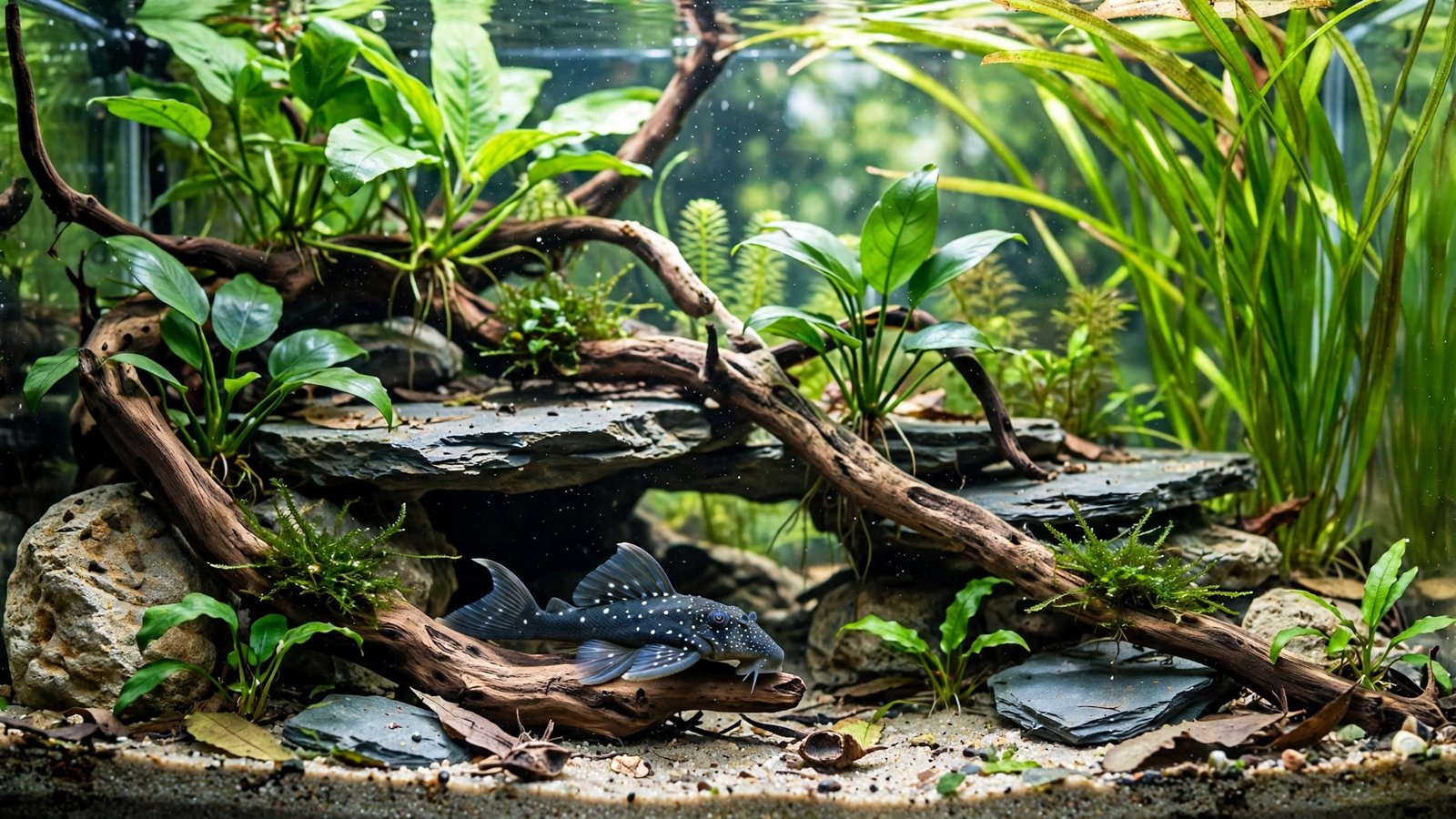
The blue phantom pleco doesn't want your aquascape. It wants rapids — boulder-strewn, cave-riddled, current-swept rapids on the Rio Orinoco, downstream of Puerto Ayacucho, where L128 wedges itself between rocks and feeds in fast, oxygen-heavy water. A blue phantom pleco planted tank that actually works starts by admitting the pleco is in charge: you build the cave district and the current first, then plant around them. Get the hierarchy wrong and the fish will bulldoze every soft stem you plant. Get it right, and you get one of the most striking fish in the hobby holding court inside a living aquascape. Start with the aquarium plants that survive plecos, because your plant list is decided by the fish, not by you.
The short answer: a blue phantom pleco planted tank is a 75-gallon-plus, high-flow aquascape built around caves. Stack slate or ceramic caves under a powerhead-driven current of 8–10× tank turnover, anchor driftwood for grazing, and plant only tough species like Anubias and Java fern. Hobby consensus treats L128 as a southern variation of Hemiancistrus subviridis, and blue-to-green coloration shifts with position along the Orinoco — the taxonomy itself is unsettled, so buy the fish you see, not the name.
Blue Phantom Pleco Planted Tank: The Cave-First Blueprint
In the wild, L128 lives where the Orinoco runs rough. Downstream of Puerto Ayacucho, the river breaks over bedrock and boulders into rapids, and these plecos spend their lives in the gaps between rocks — feeding, hiding, and claiming crevices. Everything about the home aquarium version flows from that fact.
Size, flow, and why they matter
Adults reach roughly 7–8 inches, and they're territorial about resting spots, so 75 gallons is the honest minimum for one or two fish. The bigger requirement is current: a canister filter plus a dedicated powerhead should turn the tank over 8–10× per hour. Fast water does three jobs at once — it holds oxygen, carries waste away from cave mouths, and matches what the fish's body expects. If you've kept a high-flow planted setup for hillstream loaches, the plumbing feels familiar; the pleco just needs bigger caves.
Rockwork and cave construction
Caves are furniture, not decoration. Build them from slate, ceramic pleco caves, or PVC pipe wrapped in rock, and give each fish at least three options — a dominant individual will claim the best one and try to evict everyone else from a single cave. Stack stable, interlocking rockwork directly on the tank glass (never on sand, which shifts), and check every crevice from the fish's point of view: no pinch points where a spooked pleco can wedge itself. Leave open swimming lanes downstream of the rockwork so midwater tankmates have somewhere to be.
Draft is built on a cave-first blueprint with 3+ caves per fish; this clay pleco cave is sized for medium plecos and inert for water chemistry: a proper ceramic pleco cave ★4.6.
Planting Around a Bulldozer
A blue phantom pleco doesn't eat most plants, but it rearranges them. A seven-inch armored fish bulldozing out of a cave at night will uproot anything weakly anchored, and that includes carpeting plants, freshly planted stems, and anything delicate. So the planting strategy is simple: only plants that don't care about substrate.
| Plant | Placement | Why it survives |
|---|---|---|
| Anubias (any variety) | Tied or glued to caves and rock | Thick rhizome, bitter leaves, never in the substrate |
| Java fern | Tied to driftwood and boulders | Tough leaves, anchors itself once established |
| Vallisneria | Deep background, rooted hard | Fast-growing, deeply rooted, cheap to replace |
| Bolbitis | Wood in moderate flow | Loves current, pleco-proof once attached |
| Java moss | Wedges in rock seams | Grows anywhere, no planting needed |
Skip the carpeting species and the delicate stems — the pleco will evict them nightly. For the broader strategy of choosing plants that hold up under rough tankmates, the aquarium plants for fish tank guide and the freshwater aquarium plants complete guide both cover pleco-proof selection in more depth.
Feeding: Protein-Heavy, Sinking, and Plenty of Wood
Blue phantom plecos are omnivores that lean carnivorous. In the tank, feed sinking carnivore pellets or shrimp pellets as the staple, rotated with frozen bloodworms, mysis shrimp, and the occasional blanched zucchini or cucumber for fiber. Drop food after lights-out, near the caves — plecos are nocturnal, and daytime feeding lets bolder tankmates steal everything.
Keep driftwood in the tank permanently. Hobby keepers widely agree L128 grazes wood and that wood aids digestion in wood-feeding pleco species; treat it as furniture the fish uses, not just decoration. One caution: heavy protein feeding means heavy waste, so keep to the water-change schedule below and vacuum the substrate line where pellets settle.
Draft prescribes sinking carnivore pellets as the staple for this lean-carnivorous pleco; high-protein sinking pellet matches exactly: Hikari Sinking Carnivore Pellets ★4.8.
Water, Maintenance, and Tankmates
Keep the water warm and clean: 78–86°F, pH 6.5–7.5, soft to moderately hard. If you're tracking the full parameter set, the planted tank water parameters guide covers pH, GH, and KH targets for exactly this kind of build. Change 30–40% weekly — protein-heavy feeding and big fish make nitrate management a real weekly job, and rapids species genuinely need pristine water.
Choose calm midwater companions that won't compete for caves: tetras, rasboras, or peaceful rainbows suit the temperature range. Avoid boisterous bottom-dwellers that will fight the pleco for the same crevices.
Other L-number plecos follow similar cave-and-current logic — the zebra pleco planted tank setup walks through a Xingu-rapids version of the same idea.
Frequently Asked Questions
Can blue phantom plecos live with live plants, or will they destroy them?
They can, if you plant pleco-proof species. Blue phantoms don't eat most plants, but they bulldoze anything weakly anchored when darting in and out of caves. Use epiphytes — Anubias, Java fern, Bolbitis — tied or glued to rock and wood, plus deeply rooted Vallisneria. Skip carpeting plants and delicate stems; the pleco will uproot them nightly.
How big a tank does a blue phantom pleco need?
75 gallons is the honest minimum for one or two adults. They reach roughly 7–8 inches, are territorial about resting spots, and need multiple caves plus swimming room. Bigger is genuinely better here — more footprint means more rockwork, more caves, and less aggression between tankmates over hiding spots.
Are blue phantom plecos the same species as green phantom plecos?
Maybe — and that's the honest answer the hobby has. L128 is widely treated as a southern variation or subspecies of Hemiancistrus subviridis, with blue-to-green coloration mapping to position along the Orinoco River. The taxonomy is unsettled, so buy the individual fish in front of you rather than a scientific name.
Do blue phantom plecos need a powerhead?
Effectively yes. They come from Orinoco rapids, and hobby consensus is that fast, oxygen-rich water keeps them active and feeding well. Aim for 8–10× hourly tank turnover using a canister filter plus a powerhead. In stagnant, warm tanks they hide constantly and are prone to health issues.
What should I feed a blue phantom pleco in a planted tank?
Sinking carnivore or shrimp pellets as the staple, rotated with frozen bloodworms and mysis shrimp, plus occasional blanched zucchini for fiber. Feed after lights-out near the caves so nocturnal plecos get their share. Keep driftwood in the tank — hobby keepers agree L128 grazes wood, which supports digestion. Never rely on tank algae alone.
Do blue phantom plecos need driftwood?
Keep it in the tank, yes. While they're not obligate wood-eaters like some Panaque species, blue phantoms consistently graze driftwood, and wood-feeding pleco keepers widely report better digestion with wood present. It's also naturalistic cover for a cave-dweller. Choose dense hardwoods that won't foul the water quickly.
Build the rapids, and the rest follows. A blue phantom pleco that has caves to claim, current to cruise, and sinking food at lights-out is an active, visible centerpiece — not the shy rock it becomes in a calm community tank. Give it the Orinoco in miniature and it will reward you for years. Cross-check the species profile against tropical-fish-keeping.com's Blue Phantom profile and aquariumstocking.com's Blue Phantom guide before you buy — and remember the taxonomy is still unsettled, so trust your eyes over the label.