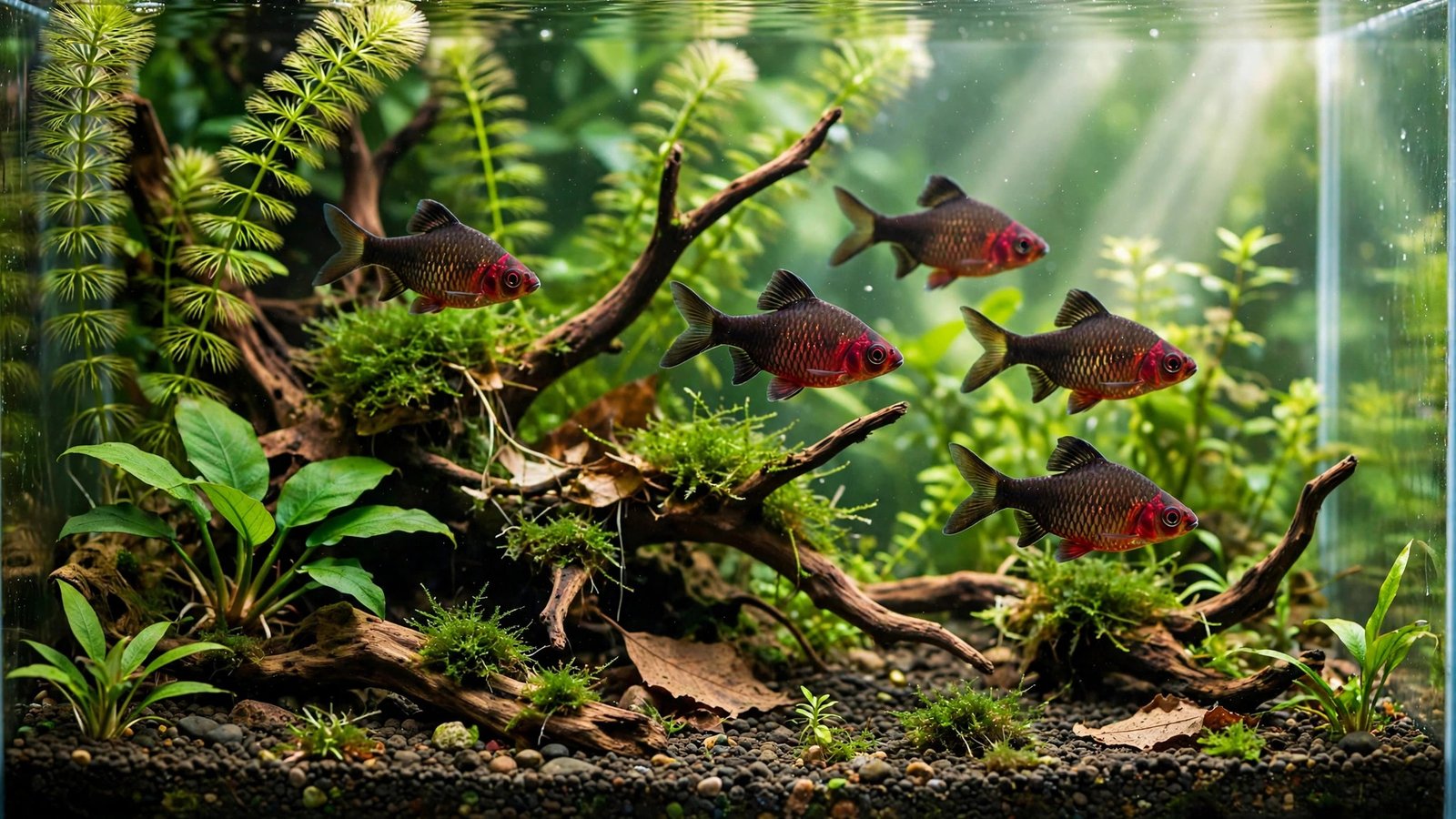
Buy a black ruby barb at the shop and you take home a silver fish with black stripes. Keep it well and it becomes something else: a male Pethia nigrofasciata in display mode goes near-black from snout to tail fin, with a head that glows ruby red. A black ruby barb planted tank is built to trigger that transformation — and it only happens under dim light, dark ground, and a proper school.
A black ruby barb planted tank is built around triggering the male's color change. Keep 8–12 in a 20-gallon tank with dark substrate, floating-plant shade, and an open swimming lane; hold 22–26°C and pH 6–7.5, and mature males darken to near-black with ruby-red heads when displaying — a shift driven almost entirely by low light and dark surroundings. See Seriously Fish's species profile for Pethia nigrofasciata for the wild-habitat reference.
Black Ruby Barb Planted Tank: Your Step-by-Step Setup
Black ruby barbs come from cool, shady forest streams in southwestern Sri Lanka, between the Kelani and Nilwala river basins: dim light under forest cover, dark gravel and sand, faint tannin tint. Every decision below reproduces that environment — in this species, color is not cosmetic: males only show the transformation where they feel shaded and secure.
These active mid-water swimmers need length over height — a 20-gallon long (80 cm) is the working minimum for a school of 8, and a 29-gallon or 40-breeder is better. The aquarium plants for fish tank guide covers the plant basics this setup builds on; black rubies do best in a low-tech planted tank setup, where modest light and easy plants keep the environment stable and dim.
Substrate, Lighting, and Water Flow
Substrate is the single highest-impact choice. A dark sand or fine dark gravel is not decoration here — it is the environmental signal that tells males to color up. Pale gravel washes them out; dark ground against green plants is the backdrop this species evolved to display against. Keep the grain fine enough for easy planting.
Light it low. Black rubies hug the plants and their color dulls under bright, uncovered lighting. The reliable formula: moderate aquarium lighting broken by floating plants — water lettuce, frogbit, or red root floaters diffusing 40–60% of the light, with the plants below getting enough to grow. Add gentle filter flow to match their slow native streams.
Water parameters at a glance
| Parameter | Target | Notes |
|---|---|---|
| Temperature | 22–26°C (72–79°F) | Cool-tolerant |
| pH | 6.0–7.5 | Soft, slightly acidic to neutral |
| Hardness | 5–12 dGH | Native stream chemistry |
| Water changes | 30% weekly | Keeps nitrates under 20 ppm |
Planting Layout: Shade, Lanes, and Spawning Cover
Think in thirds. Leave the middle third as an open swimming lane — males display and circle in open mid-water, not inside the thicket. Plant the back and sides densely with tall background stems like Vallisneria or Amazon swords, and shade the surface with floating plants. Tuck fine-leaved cover — Java moss, hornwort, or spawning mops — into the corners, since black rubies are egg scatterers that spawn among plants.
No CO2 or demanding plants needed; easy, low-light plants are the point, because bright light suppresses the fish. A lightly planted aquarium setup works perfectly — cover half to two-thirds of the tank, keep the lane open, and add driftwood or a few dried leaves for a faint tannin tint.
Feeding for Color and Condition
Black rubies are omnivores with a healthy appetite — in the wild they graze filamentous algae and detritus, and in the tank they take quality flakes, micro pellets, and frozen foods readily. Feed small amounts twice daily, only what the school finishes in two minutes.
For the richest red, rotate in carotenoid-rich foods a few times a week: frozen bloodworms, daphnia, and brine shrimp, plus a vegetable-based flake. Carotenoids are the raw material for red pigment, and males in breeding condition burn through them — a varied diet shows directly in the depth of the ruby head.
Tank Mates: The Peaceful-Barb Advantage
Here is where black rubies stand apart. Black rubies are genuinely peaceful in a school of 8 or more — none of the tiger barb's fin-nipping baggage. Compare them with the nippy tiger barb planted tank to see what the right barb choice changes.
| Tank mate | Why it works | Notes |
|---|---|---|
| Cherry barbs, gold barbs | Peaceful barbs; shared water needs | Schools of 6+ each |
| Rosy barbs, tetras, rasboras | Calm schooling fish; no fin-nipping | Match temperature ~23–24°C |
| Denison barbs | Bigger active cousin for large tanks | Needs 55+ gallons; not for a 20-long |
| Corydoras, bristlenose plecos | Bottom dwellers; ignore the school | Dark sand suits cory barbels too |
Skip very slow, long-finned fish like bettas — any active barb school can stress a slow tank mate by sheer movement. Dwarf shrimp may work in a heavily planted tank, though the school will pick off newborn shrimplets; Amano shrimp and snails are the safe cleanup crew.
Breeding in the Planted Tank
Black rubies are egg scatterers with zero parental care. Condition a group with live and frozen foods for two weeks, then move a pair — the darkest male and the roundest female — to a separate 10-gallon with spawning mops or fine-leaved plants and dim morning light. Spawning usually happens at dawn, scattering 100+ tiny eggs among the plants.
Remove the parents immediately, or the eggs become breakfast. Eggs hatch in 24–48 hours and fry swim free about a day later, taking infusoria, then newly hatched brine shrimp within a week. The species is listed as Vulnerable in the wild, and virtually all aquarium black rubies are captive-bred.
Frequently Asked Questions
How many black ruby barbs should I keep together?
Keep 8–12, with 6 as the absolute minimum. Smaller groups turn skittish, lose color, and may harass each other. In a 20-gallon long, 8–10 is the sweet spot; go bigger in a 29-gallon or above. A larger school also spreads the males' attention, so no single fish is chased.
Why is my black ruby barb not turning red?
Three causes cover almost every case: the light is too bright, the substrate is too pale, or the group is too small. Males color up in display and breeding condition, both triggered by environment — dim the lighting with floating plants, switch to dark substrate, and build the school to 8 or more. Females stay silvery-olive with black bars regardless, which is normal.
Are black ruby barbs fin nippers like tiger barbs?
Not in a proper school. Tiger barbs nip when understocked; black rubies are calmer by nature and peaceful in groups of 8 or more. Keep the school large with open swimming space, and they will leave tetras, rasboras, and other community fish alone.
Can I breed black ruby barbs in a planted tank?
You can, but use a separate breeding tank for the actual spawning. Condition a pair on live and frozen foods, move them to a 10-gallon with spawning mops and dim light, and they will scatter 100+ eggs at dawn. Remove the parents immediately — they eat their own eggs. Eggs hatch in 1–2 days; fry swim free about a day later.
Will black ruby barbs eat my shrimp?
Adult shrimp like Amanos are generally safe, but a hungry school will pick off newborn shrimplets — treat dwarf shrimp as a live-food donation in a barb tank. If you want a breeding colony, house it separately. Snails are a fully safe cleanup crew.
A black ruby barb planted tank rewards patience more than equipment. Dim the light, darken the ground, build the school — and the silver juveniles you bought transform into the ruby-headed display fish the species is named for.