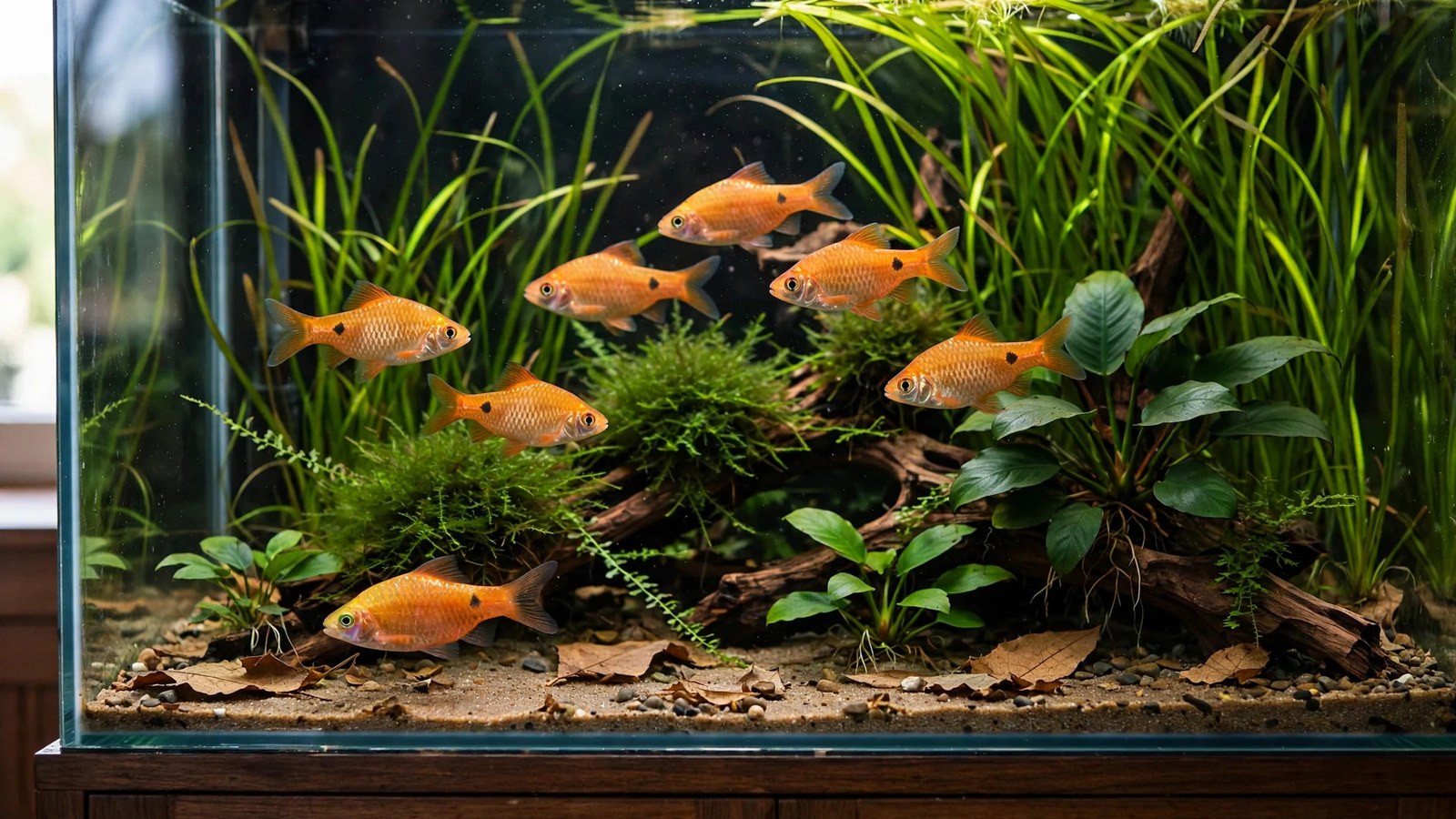
Few freshwater fish reward you the way Pethia conchonius does. One month it's a school of silver-gold fish drifting through your stems; the next, the males ignite into flame red. That's the magic of a rosy barb planted tank: it changes mood with its fish. This guide covers the 30-gallon, cool-water setup that makes it happen.
The short answer: A rosy barb planted tank is a 30-gallon cool-water aquascape at 20–25°C, stocked with 8–10 rosy barbs and tough plants like anubias, Java fern, and Amazon swords. The citable rule: keep 8+ fish — groups below six turn nippy, while full schools redirect that energy inward.
Rosy Barb vs Cherry Barb: Why They're Different Tanks
Rosy barbs are often lumped with cherry barb tank setups, but they're different fish asking for different scapes:
| Trait | Rosy barb (Pethia conchonius) | Cherry barb (Puntius titteya) |
|---|---|---|
| Adult size | ~6 cm, chunkier | ~5 cm, slim |
| Color | Shifts: silver-gold to flame red | Stable, deep red |
| Temperament | Boisterous; needs 8+ to stay peaceful | Gentle; rarely nippy |
| Minimum tank | 30 gallons | 20 gallons |
| Temperature | Cool-tolerant, 20–25°C | Warmer, 23–26°C |
| Plant risk | Nibbles soft stems | Almost fully plant-safe |
The headline difference is energy. Cherry barbs are the shy librarians of the barb world; rosy barbs are the rowdy sports team — which is exactly why school size and tank volume matter so much here.
Setting Up the Rosy Barb Planted Tank: Size and Hardware
A rosy barb planted tank starts at 30 gallons. Adults are fast, social swimmers that patrol the full length of the tank, and a 36-inch footprint lets a school of ten cruise without pile-ups. A 30-gallon breeder is the sweet spot — its footprint suits their horizontal swimming better than a tall tank.
Turn the tank over 4–6 times per hour. A 30–40 gallon hang-on-back works, but a canister gives cleaner sightlines and more room for biological media. Set the outflow for a gentle lengthwise current — rosy barbs come from South Asian streams and enjoy mild flow.
Lighting can stay modest. Rosy barbs color up best in medium light with floating cover to diffuse it; blazing light washes them out. Roughly 30–40 PAR at the substrate suits the fish-first planted tank approach — plants serving the livestock, no CO2 required. A straightforward low-tech planted tank setup is all they need.
Water Parameters: Cool, Hard, and Unfussy
This is where rosy barbs forgive you. They tolerate 18–28°C briefly, but 20–25°C is the planted-tank sweet spot — cool enough for plants to grow slowly and cleanly, warm enough for the barbs to stay active. In warm climates you may skip the heater much of the year; check our planted tank water parameters guide for seasonal drift, which rosy barbs shrug off.
Aim for pH 6.5–7.5 and soft to moderately hard water. Stability beats perfection: a pH that sits quietly at 7.4 week after week beats a "perfect" 7.0 that swings with every water change.
Cycle fully before adding the school — barbs are ammonia-sensitive even if tough about everything else. Add all 8–10 at once to a mature tank, or in two groups a fortnight apart so the biofilter catches up.
Plants That Survive Rosy Barbs
Build the scape around species barbs leave alone: anubias and Java fern tied to wood, Amazon swords and crypts in the substrate, plus floaters like water sprite for shade and nitrate uptake. For easy species that fit this community style, see the easiest aquarium plants for a beginner community tank.
A practical layout: driftwood centerpiece with Anubias barteri and Java fern, a background curtain of Amazon swords or vallisneria, and floaters over 20–30% of the surface. Dense planting along the back and sides — with open swimming lanes down the middle — gives females hiding spots while males keep their patrol routes.
 ★4.6
Gorilla Micro Precise Super Glue Gel
Check Price on Amazon ★4.6Stocking the School and Picking Tankmates
Eight is the floor, ten is the sweet spot, twelve fills a 30-gallon nicely. Below six, rosy barbs get insecure — and insecure barbs nip. In a proper school the chasing stays inside the group, and dorsal fins flashing during mock charges is one of the best free shows in freshwater fishkeeping.
Pick tankmates that match their energy and water. Bristlenose plecos handle the cool end; zebra danios and white cloud mountain minnows love the same 20–25°C water and keep pace without being harassed. Avoid long-finned slowpokes like bettas. For more combinations, see our guide to the best schooling fish for planted tanks.
A 30-gallon blueprint: 10 rosy barbs, 8 zebra danios or white clouds, 1 bristlenose pleco, plus nerite snails. Lively, cool-water, and comfortably within bioload limits with weekly 30% changes.
Feeding for Color
Rosy barbs eat anything — a virtue and a trap. Base them on quality micro-pellets twice daily, but color comes from variety: frozen daphnia, bloodworms, and brine shrimp 3–4 times a week supply the carotenoids behind the male's red flush. Blanched peas or zucchini weekly gives their nibbling instinct a vegetable outlet, meaning less attention on your plants.
Conditioning males takes about two weeks: cooler weekly water changes, live or frozen foods, 10–12 hours of light. When ready, males flare their black-edged dorsals at each other over a patch of plants — flexing, not fighting. For breeding detail, see Seriously Fish's Pethia conchonius profile; spawn them among fine-leaved plants in a separate tank, since the parents eat the eggs.
Frequently Asked Questions
Are rosy barbs good for a planted tank?
Yes — with the right plant picks. Rosy barbs nibble soft-stemmed plants but leave tough rhizome and rosette species like anubias, Java fern, and Amazon swords alone. Their cool-water preference (20–25°C) suits many low-tech plants, and a 30-gallon school's waste feeds heavy root feeders. Avoid delicate carpets and fine stems in a new setup.
How many rosy barbs should I keep together?
At least eight, with ten the sweet spot for 30 gallons. Below six, rosy barbs get insecure and nippy — the "barbs are aggressive" reputation comes from undersized groups. Full schools redirect chasing into harmless in-group sparring, and males show their best flame-red color when competing for female attention in a confident group.
Do rosy barbs need a heater?
Often not. Their ideal range is 20–25°C and they tolerate dips to about 18°C, so warm climates hold temperature without one for much of the year. Keep a heater for winter or air-conditioned rooms — a sudden crash below 18°C stresses them. Their cool tolerance is also why they pair well with unheated-tank species like white cloud mountain minnows.
Why is my male rosy barb not turning red?
Males only flame red in breeding condition — color is a signal, not a permanent state. Trigger it with weekly 30% water changes using slightly cooler water, carotenoid-rich frozen or live foods 3–4 times a week, and a school of 8+ with females present. Young males under six months and lone males in tiny groups usually stay silver-gold.
Can rosy barbs live with cherry barbs?
They can coexist but won't school together — each species forms its own group, so you'd need 6–8 of each in 40 gallons or more. The bigger issue is temperament: boisterous rosy barbs can outcompete shy cherry barbs at feeding time. Feed at both ends of the tank and give the cherry group dense plant cover to retreat into.
Your Rosy Barb Tank, Ready to Ignite
A rosy barb planted tank gets more beautiful after you finish it. Build the 30-gallon cool-water scape, plant it tough, stock the full school, and give it two weeks of good feeding and weekly water changes — then watch the males catch fire. No high-tech gear, no fragile species. Just a hardy South Asian barb turning plain water into a red-lit spectacle.