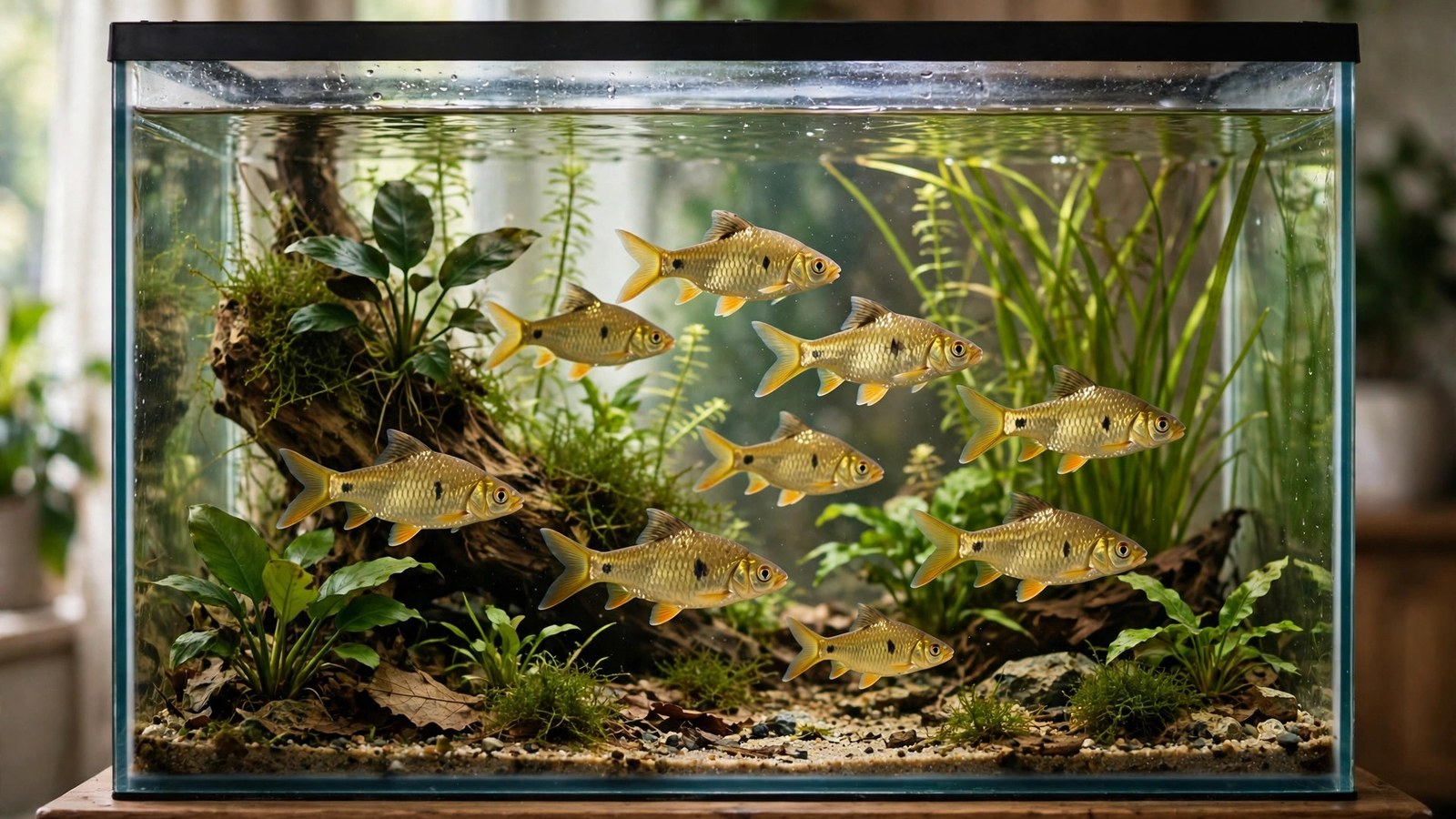
Most beginners buy gold barbs because they are cheap, cheerful, and nearly indestructible — then watch them fade to pale yellow in a bare glass box with one plastic plant. That is the single biggest wasted opportunity in the barb hobby. A gold barb planted tank flips the script: given a school, real plants, and cooler water, these barbs color up to a deep copper-gold, patrol the mid-water like a proper shoal, and stay healthy for years with almost no fuss. Here is how to set one up right the first time.
A gold barb planted tank is a 30-gallon, 64–75°F setup built around a school of 8–10 Barbodes semifasciolatus var. schuberti and tough, fast-growing plants like Java fern, Vallisneria, and Cryptocoryne. With 25–30% weekly water changes and a protein-rich diet, these barbs — one of the few popular barbs comfortable at room temperature — color up to deep copper-gold and live 5+ years, making this one of the lowest-maintenance planted species tanks a beginner can build.
Know your fish: gold barb vs "golden barb"
Before a single plant goes in, sort out the naming mess — it determines everything about your setup. The true gold barb is Barbodes semifasciolatus var. schuberti (Schubert's barb), growing to about 3 inches and living 5+ years. But "golden barb" is also sold for Pethia gelius, the dwarf barb — a timid 1.5-inch species that belongs in a quiet nano tank. Read the tank label and ask for the Latin name; the wrong species will be bullied or simply vanish.
Gold Barb Planted Tank Setup: the 30-gallon blueprint
A gold barb planted tank works best as a species-forward community: the barb school is the star, plants are the set. When choosing aquarium plants for your fish tank, favor tough-leaved, fast-growing species that tolerate the cooler temperatures barbs love and shrug off the occasional nibble.
Go with a 30-gallon tank (36 inches long). Gold barbs are active horizontal swimmers, and that length lets a school of eight to ten cruise without pacing the glass. Add a filter rated for the tank size, a lid (barbs startle and jump), and a heater set to 72°F as a safety net — in a heated home the tank often sits in range on its own, but the heater guards against cold snaps.
Use fine gravel or sand; sand is gentler on the barbels of corydoras tankmates. Hardscape with driftwood and smooth stones, then plant 60–70% of the substrate while leaving a clear open swimming lane down the center. That ratio gives shy fish cover and bold fish room — both color up better with it.
Plants that suit active barbs
Gold barbs are not dedicated plant destroyers, but they are curious. Soft, fine-leaved stems like Myriophyllum can get shredded out of boredom, so build the layout on hardy, fast growers. The easiest aquarium plants for a beginner community tank — Java fern, Anubias, Cryptocoryne, Vallisneria — all thrive in 64–75°F water without injected CO2.
| Plant | Position | Why it works |
|---|---|---|
| Java fern (Microsorum pterotoides) | Attached to wood/rock | Tough, bitter leaves barbs ignore; cooler-water tolerant |
| Anubias (A. barteri varieties) | Attached to hardscape | Nearly indestructible; slow but dependable in low tech |
| Vallisneria (V. spiralis) | Background | Fast runner that fills tall back walls; gives barbs cover |
| Cryptocoryne (C. wendtii) | Midground | Bushy foreground-to-mid clumps; hides egg-laying sites for breeding |
| Water sprite (Ceratopteris thalictroides) | Floating or planted | Floating clumps dim the light — barbs color up under shade |
| Java moss (Taxiphyllum barbieri) | Wood and crevices | Spawning surface and shelter for fry |
Water parameters and weekly maintenance
Gold barbs are among the most forgiving fish sold, but "forgiving" is not "indestructible." Hold temperature at 64–75°F, pH 6.5–7.5, and ammonia and nitrite at zero. Perform a 25–30% water change every week — even in a planted tank, because plants do not remove the hormones and dissolved organics that accumulate over time. Vacuum the open lane lightly; leave planted zones undisturbed so roots stay anchored.
Feeding a school of hungry barbs
Gold barbs are omnivores with bottomless appetites. Feed a quality micro-pellet or small flake twice daily — only what the school eats in two minutes — plus frozen daphnia or bloodworms three to four times a week. That protein rotation is what pushes their color from pale yellow to rich copper-gold. A weekly portion of blanched zucchini satisfies their vegetable side and reduces plant nibbling.
Tankmates for a planted gold barb community
Choose peaceful fish that share the 64–75°F comfort zone. Corydoras catfish (6 or more) work the substrate, kuhli loaches add dusk-time motion, and adult cherry shrimp coexist if dense moss shelters the babies. Avoid long-finned fish like bettas or fancy guppies — curious barbs may nip flowing fins. Keep the barb school at 8 or more and most nipping redirects harmlessly into the group.
Breeding: egg scatterers in a planted tank
Healthy gold barbs spawn readily, and a planted tank is already halfway to a breeding setup. Condition a trio (one female, two males) on frozen foods for a week, then move them to a 10-gallon tank with Java moss, a sponge filter, and 74–77°F water. They scatter several hundred eggs among the fine leaves at dawn; remove the adults immediately afterward or they eat the eggs. Fry hatch in 24–48 hours, take powdered fry food for a week, then graduate to baby brine shrimp.
More planted barb and rainbow setups
Several close relatives make excellent follow-up projects: the rosy barb planted tank runs warmer with bold red males, the tiger barb planted tank needs a larger, tighter school to stay peaceful, the praecox rainbow planted tank offers shimmering contrast, and the odessa barb planted tank brings scarlet markings to a similar layout.
Frequently Asked Questions
How many gold barbs should I keep together?
Keep 8 to 10, with 6 as the absolute minimum. Smaller groups turn skittish, lose color, and may harass other fish. A proper school spreads the energy across the group and produces the tight, synchronized swimming barbs are known for.
Do gold barbs need a heater?
Yes as insurance, even though they thrive at 64–75°F. In a heated home the tank may sit in range on its own, but a heater set to 72°F guards against cold snaps. They are one of the few popular barbs comfortable at room temperature.
Will gold barbs eat my aquarium plants?
They nibble soft, fine-leaved plants out of curiosity but rarely destroy established ones. Java fern, Anubias, Cryptocoryne, and Vallisneria are ignored almost entirely. Feed blanched vegetables weekly; most plant damage comes from bored, underfed barbs.
Can gold barbs live with cherry shrimp?
Adult shrimp coexist fine, but barbs will hunt newborn shrimplets. Plant dense Java moss so babies can hide. Expect the colony to hold steady or grow slowly — barbs are effective, if unintentional, population control.
Why are my gold barbs pale instead of gold?
Pale color usually means stress, a too-small group, or a bland diet. Keep at least 8 fish, hold 64–75°F, and feed frozen daphnia or bloodworms three times a week. Floating plants that dim the light also trigger deeper gold coloration within a week or two.
Set up the school, the plants, and the cooler water, and the gold barb planted tank practically runs itself. For independent confirmation of the species' hardiness and parameters, see the gold barb profile on Seriously Fish and the Tropica plant database for the tough species that anchor this layout.