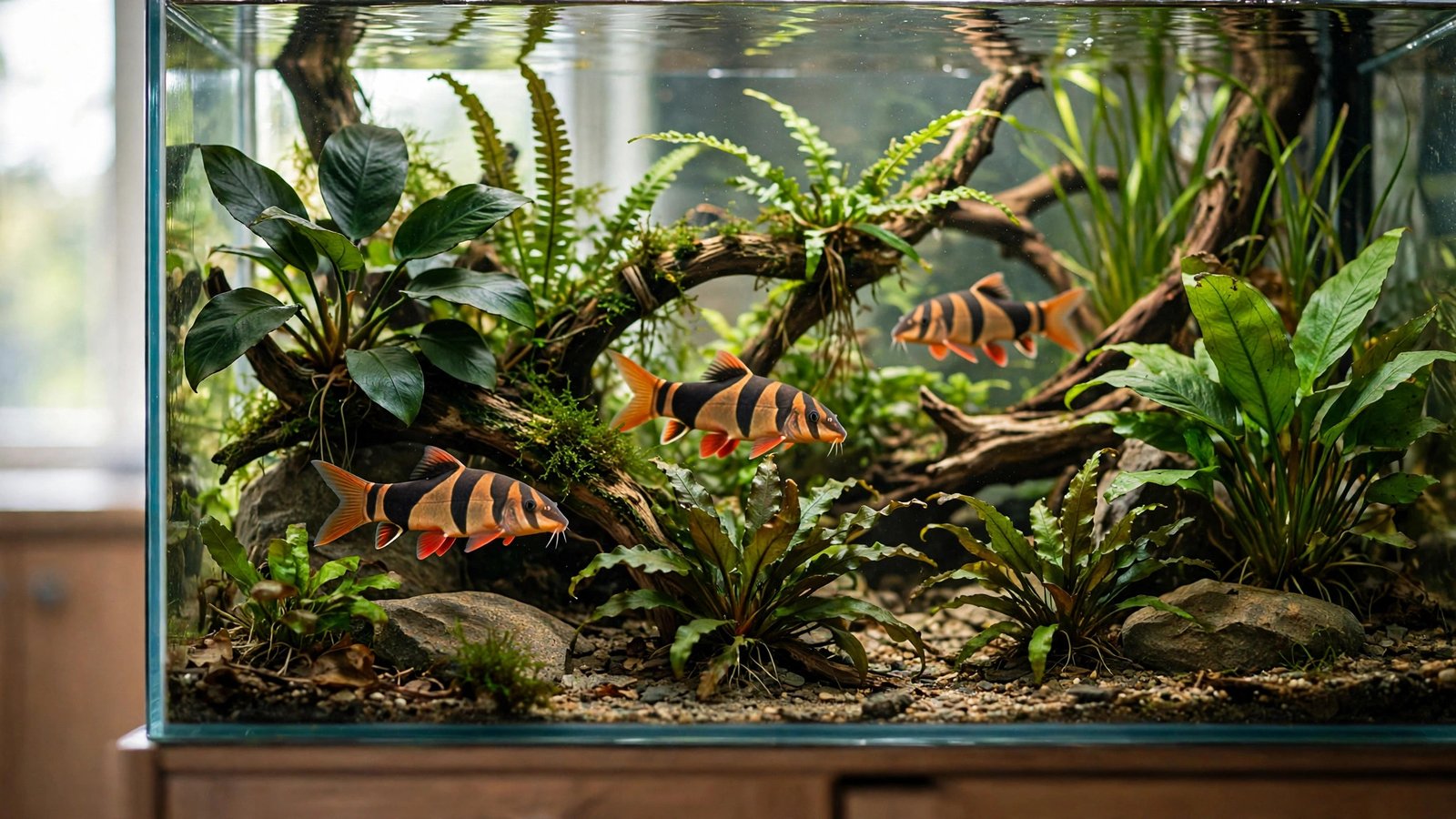
You will wake up one morning to find your new Cryptocoryne floating, a Limnophila stem reduced to a stub, and your clown loach grinning from behind the driftwood. This is the deal with a clown loach planted tank: most digging fish only uproot plants — clown loaches uproot them and eat them. Once you accept that you're stocking a 10-inch herbivore with a bulldozer streak, you can build a tank where the plants genuinely survive. Here's the playbook.
The Two Problems Every Big-Loach Keeper Faces
Most "loach-proof" advice stops at digging. Small diggers nose around gravel and occasionally pop out a weak stem — annoying, but manageable. Clown loaches (Chromobotia macracantha) are a different animal: adults reach 8–12 inches and genuinely eat soft vegetation. In the wild they graze on plant matter alongside snails and insect larvae — so a tank of tender Rotala is essentially a salad bar.
The damage is predictable: they chew soft, thin leaves, nibble exposed rhizomes, and uproot shallowly planted stems during nightly rooting sessions. But they do not touch thick, leathery leaves. That single observation is your entire plant strategy.
Clown Loach Planted Tank Plant Picks: The Survivor Table
Choose from this list and your tank stays green. These are the tough-leaf plant picks that hold up in boisterous community tanks — and all thrive in the low light loaches prefer:
| Plant | How to plant it | Why it survives loaches |
|---|---|---|
| Anubias (A. barteri, A. nana) | Tie or glue to driftwood/stone | Thick, leathery leaves loaches ignore; rhizome stays off the substrate |
| Java fern (Microsorum pterotoides) | Tie to hardscape, never bury the rhizome | Bitter-tasting, tough leaves; nothing digs it up because it isn't planted |
| Crinum (Crinum calamistratum) | Plant the bulb deeply in sand | Ribbon leaves are too tough to chew; heavy bulb resists uprooting |
| Vallisneria (V. spiralis, V. americana) | Plant roots deep in sand, in dense clusters | Grows faster than loaches damage it; runners spread on their own |
| Anubias 'Pangolino'-type smalls | Glue to crevices in rock | Tiny leaves tucked into hardscape are out of reach |
| Floating plants (frogbit, salvinia) | Let them float freely | Loaches never reach the surface foliage; also dims light, which they love |
Skip: Rotala, Ludwigia, Cryptocoryne, most carpets, and any delicate stem plant — all get eaten or uprooted within days. The loach-proof carpet stand-in is Anubias nana petite glued over a stone slab.
Stop the Chewing: Fix the Diet First
Plant-eating spikes when loaches are under-fed on vegetable matter. A loach getting only bloodworms and pellets will graze your Anubias edges out of real need. The fix is embarrassingly cheap:
- Spirulina or algae tabs, 3–4 times per week — press onto the glass or drop in after lights-out (loaches are crepuscular feeders).
- Blanched zucchini or cucumber slices once a week — remove uneaten pieces after 24 hours.
- Keep protein generous too: sinking pellets, frozen bloodworms, snail treats daily. A full, balanced loach is a plant-safe loach.
Owners who feed veggie tabs consistently report plant damage dropping to nearly zero within two weeks.
Low Light Is a Feature, Not a Compromise
Clown loaches stress under bright lighting. Under high-light rigs they hide all day, their colors wash out, and chronic stress makes them more destructive. Dimmer tanks make them bold and active. This is why a clown loach planted tank pairs so naturally with a low-tech planted tank setup: moderate light, no CO2, slow-growing epiphytes — exactly what both the fish and the plants want.
Practical plan: run lights at 50–70% intensity for 6–8 hours daily, with floating plants covering 20–30% of the surface. The floaters dapple the shade loaches love and suppress algae on slow-growing Anubias leaves.
Aquascaping for 12-Inch Bulldozers
A 4-inch juvenile becomes an 8–12 inch adult strong enough to shift unsecured rocks. Aquascape for livestock:
- Sand, not gravel. Coarse gravel injures their barbels; 2–3 inches of smooth sand lets them dig harmlessly and re-settles around plants instead of leaving craters.
- Anchor everything. Tie epiphytes with cotton thread or gel glue; stack rocks so each piece is locked by the one above it. Anything that can be toppled will be.
- Build real caves. Loaches with secure hiding spots — driftwood arches, stacked slate — are calmer and less destructive than exposed ones. One cave per loach is a good rule.
- Leave a digging zone. Keep one open sand area plant-free. They'll root there happily and largely ignore the planted zones.
Compare the scale to other bottom-dwellers: convict cichlids are diggers that excavate pits, while clown loaches are chewers that shred — both demand anchored hardscape, but only the loach tank needs the veggie-diet correction on top.
Stocking and Long-Term Care
Keep 6 or more — smaller groups turn skittish, and skittish loaches hide instead of feeding, which loops back to plant-chewing. Six juveniles fit 75 gallons for a year or two, but commit to 125+ gallons for adults. They prefer warm water, 78–86°F, which suits every plant in the survivor table.
Maintenance stays simple: 30% weekly water changes, a canister filter rated for double your tank volume, and a sand-siphon pass over open areas. Trim Vallisneria runners monthly and wipe Anubias leaves if algae spots appear.
If you want a bold bottom-dweller for a smaller tank, the red tail shark setup covers a territorial cave-lover for mid-size tanks — and for a shy schooling species that barely touches plants, see the glass catfish guide. For authoritative species data, the Seriously Fish profile of Chromobotia macracantha is the reference most experienced keepers use.
Frequently Asked Questions
Will clown loaches eat all my aquarium plants?
Not all of them — but they will eat soft, thin-leaved plants like Rotala, Ludwigia, and Cryptocoryne, and uproot anything weakly planted. Thick-leaved species (Anubias, Java fern, Crinum) are left alone. Chewing also spikes when their diet lacks vegetable matter, so regular spirulina or algae tabs cut plant damage dramatically.
How big a tank do clown loaches really need?
Six juveniles can start in a 75-gallon tank, but adults reach 8–12 inches and a group of six needs 125+ gallons long term. Under-tanking them is the fastest route to stunted, stressed fish that chew plants out of frustration. If the big tank isn't in the cards, choose a smaller loach species.
Why do my clown loaches hide all day?
Usually it's too-bright lighting, too small a group, or too few caves. Dim lights to 50–70% intensity, add floating plants for shade, keep at least six loaches, and give one cave per fish. Warm water (78–86°F) also brings them out — they're far more active at tropical temperatures.
Can I keep clown loaches with a carpeted aquascape?
Honestly, no — traditional carpets like HC Cuba or Monte Carlo will be uprooted within days. The loach-proof alternative is gluing Anubias nana petite onto flat stone slabs for a low "carpet" effect that can't be dug up. With clown loaches, hardscape-first aquascaping beats a doomed carpet.
What should I feed clown loaches so they leave plants alone?
Spirulina or algae tabs 3–4 times a week plus blanched zucchini weekly covers the vegetable side; sinking pellets and frozen bloodworms daily cover protein. Feed after lights-out, when they're most active. Full vegetable nutrition keeps them off even soft plant edges.
A clown loach planted tank isn't a compromise — it's one of the most personality-packed setups in the hobby. Tough plants, low light, veggie-rich diet, anchored hardscape — and you'll have a tank where eight-inch loaches wrestle among Anubias-covered driftwood for twenty years.