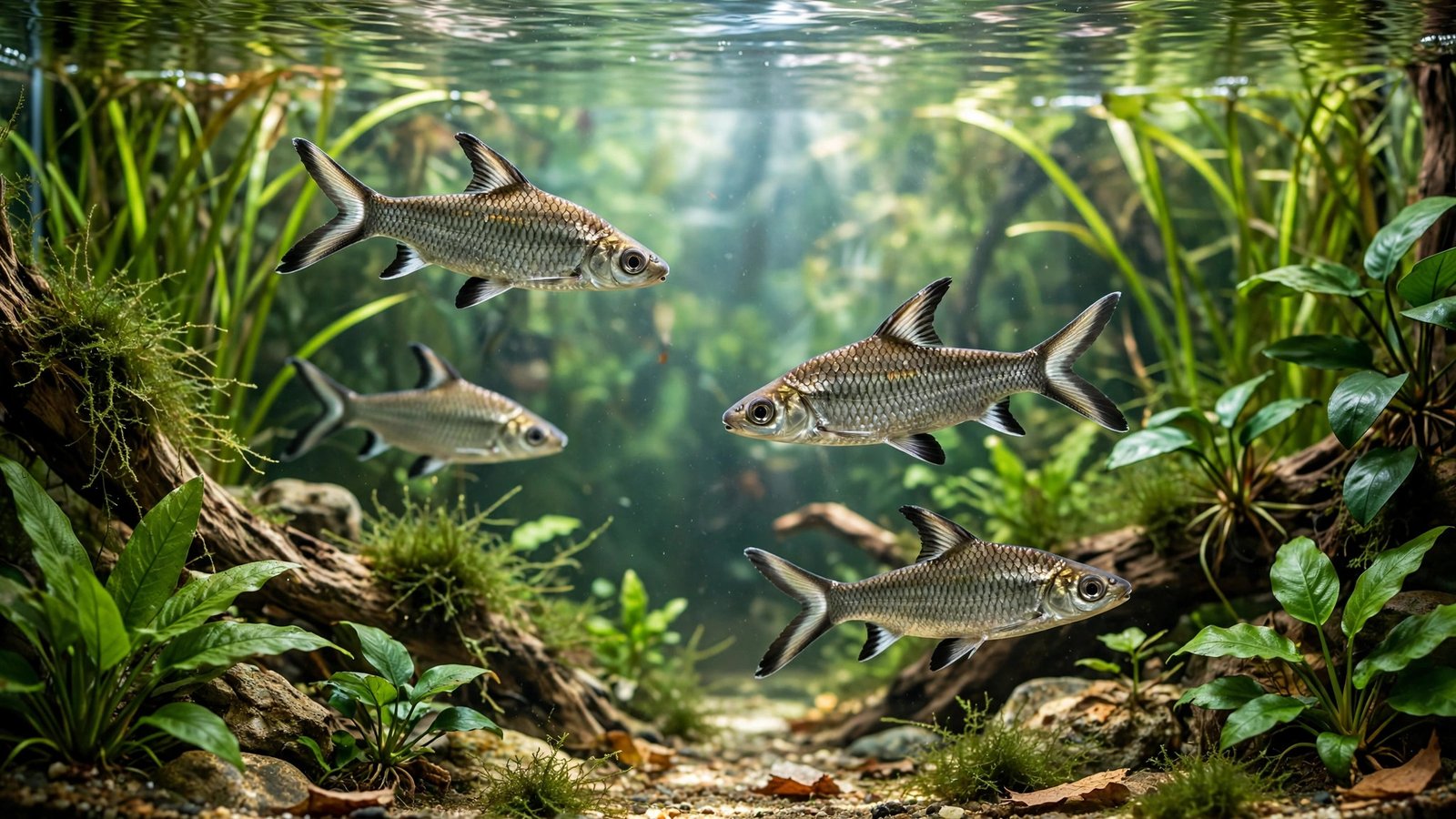
A bala shark planted tank sounds like a contradiction: a fish that tops out at 13 to 14 inches, panics at shadows, and needs 150 gallons minimum, sharing space with plants that snap when something big hits them. It works — but only if you flip the usual aquascape. Plant the edges, keep the middle open, and pick species that shrug off collisions. This guide gives you the layout, plant list, and tank specs to do it right.
Can you keep bala sharks in a planted tank? Yes. Plant dense borders around the glass, leave the center as open swimming water, and stock tough attached plants that survive being bumped. Give six or more sharks 150 gallons or more, keep nitrates under 20 ppm with large weekly water changes, and always use a tight lid — bala sharks jump hard when startled. They reach 13–14 inches, so the tank commitment is the real decision, not the plants.
Designing a Bala Shark Planted Tank That Actually Works
The usual aquascape — hardscape island mid-tank, plants radiating outward — is a hazard for balas. They sprint in straight lines when startled, and a driftwood centerpiece at cruising height is exactly what gets shattered. So design the tank like a running track: keep the middle third open water, substrate to surface, and push all planting into a 6–8 inch band along the back and side glass. The fish read the edges as shelter, which calms them, and you get a lush frame around a clear swimming stage. This is the big-tank plant strategy for active swimmers in its purest form.
Keep low plants out of the swim lane entirely. A front carpet in the corners only — dwarf sagittaria or Cryptocoryne parva where the school rarely ventures — gives you a finished look without anything getting churned. It is less "jungle," more "stadium with green bleachers," and it looks spectacular at this scale.
Size Is Non-Negotiable: The Adult Bala Reality Check
Pet-store balas are 2–3 inches and charming, but Balantiocheilos melanopterus grows to 13–14 inches within three to four years on good food. A lone bala in a 55-gallon tank is not a compromise — it is a fish slowly failing. Six juveniles fit in 150 gallons today, but mature adults are more at home in 200+ gallons.
Skittishness is the second half of the commitment. Balas startle at footsteps and sudden lights-on, then bolt in formation at shocking speed. Without a tight lid they land on the floor; with one, they land in plants. Plan so both outcomes are survivable: no sharp rockwork at their cruising lane, and plants tough enough to take a hit.
The Periphery-Planting Strategy, Step by Step
Work from the glass inward. Start with the back wall: Vallisneria or tall Cryptocoryne in a double row right against the glass, root tabs every 4–6 inches beneath. These deep-rooted species stay put when the school's wake hits them, and their vertical blades form a green wall the balas read as shelter from behind.
Next, the sides: tie or glue Anubias barteri and Java fern to driftwood or rock within a few inches of the side glass. Epiphytes anchored to hardscape cannot be uprooted — there is no loose substrate for a panicked school to tear through. Lighting is simple at this scale: medium light (PAR 40–60 at substrate) grows everything on the bump-proof list below, and CO2 is optional. One fewer variable matters when your real attention belongs to large, hungry fish.
Bump-Proof Plants: The Big-Tank Short List
The filter for this list is single-minded: the plant must survive collisions, uprooting attempts, and heavy waste loads. Tough, bump-proof plants for big tanks are the backbone of any large planted setup — here they are non-negotiable.
| Plant | Placement | Why it survives balas |
|---|---|---|
| Anubias barteri | Attached to wood/rock, sides | Leathery leaves; glued rhizomes can't uproot |
| Java fern | Attached to hardscape, rear corners | Rigid fronds flex instead of snapping |
| Vallisneria spp. | Back glass, double row | Deep runners resist pulling; blades deflect impact |
| Cryptocoryne wendtii | Back and side edges | Deep roots; dense clumps re-root if disturbed |
| Java moss | Tied to wood | Cushions hardscape edges near swim lanes |
Avoid stem plants in the open lanes: a 14-inch fish braking from a sprint turns fine stems into confetti. If you want stems, plant them dense behind the back row where the wake is weakest, and accept ragged front ranks.
Water, Flow, and Feeding in a Big Planted Tank
A 150-gallon canister-filtered tank is wonderfully stable, but six adult balas are eating machines. Feed large sinking pellets, frozen foods, and blanched vegetables twice daily, and export the waste with a 30% weekly water change to hold nitrates under 20 ppm. Standard parameters work: 74–80°F, pH 6.5–7.5, nothing fussy.
Run moderate, unidirectional flow: two canister outflows at opposite back corners create a gentle gyre in the open middle without blasting the planted borders. Use plain gravel with root tabs as your substrate for a large planted tank — Vallisneria and Crypts feed fine via tabs, and you avoid nutrient leaching under a heavy bioload.
Stocking the Giant Tank Beyond the Balas
Tankmates should join the open middle or hide at the edges. Giant danios make ideal companions — fast, hardy, and unbothered by big-tank commotion. The bottom belongs to a clown loach crew, which shares the balas' appetite and fondness for sinking pellets. For more schooling options, the best schooling fish for planted tanks guide lists species that tolerate the current your open-water gyre creates.
For the definitive species profile — wild habitat, natural diet, and the size debate — Seriously Fish's bala shark profile is the most cited reference in the hobby.
Frequently Asked Questions
How big a tank do bala sharks really need?
A school of six needs 150 gallons minimum; adults at 13–14 inches are more comfortable in 200+ gallons. The "75 gallons" figure works only for small juveniles and expires within a year. Buy the final tank first or plan the upgrade before buying the fish — moving a skittish adult school is stressful for everyone.
Will bala sharks eat or destroy my plants?
They rarely graze; damage comes from collisions, not nibbling. A startled school blasting through delicate stems leaves carnage, which is why this strategy uses thick-leaved epiphytes glued to hardscape and deep-rooted border species. With bump-proof plants and an open center, damage stays near zero.
Do I need a lid on a bala shark planted tank?
Yes, unconditionally. Balas are powerful jumpers when startled and can clear several feet. Use a tight glass or mesh lid with no gaps around filter plumbing — cover cutouts with plastic mesh. Open-top aquascapes are a non-starter with this species.
Can I keep a single bala shark in a planted tank?
No — keep six or more. Lone balas become chronically stressed, skittish, and sometimes aggressive, which wrecks both the fish and the scape. The school is the calming mechanism: it gives them confidence to swim openly instead of hiding and bolting. The tank size follows from the school, so there is no shortcut.
Do bala sharks need CO2 and high light?
No. Every plant on the bump-proof list grows well in medium light without injected CO2 — they were chosen for toughness first and are all low-demand species. Your maintenance hours are better spent on water changes for the big bioload than on CO2 equipment.
A Tank Worth the Commitment
A bala shark planted tank is not a beginner project — the fish, not the plants, set the bar. But once you commit to the school size and the 150-gallon floor, the planted part is easy: tough borders, an open center, a tight lid, and weekly big water changes. The reward is a silver, black-finned school gliding in formation across a green frame — a tank you keep for a decade, so plan like it.