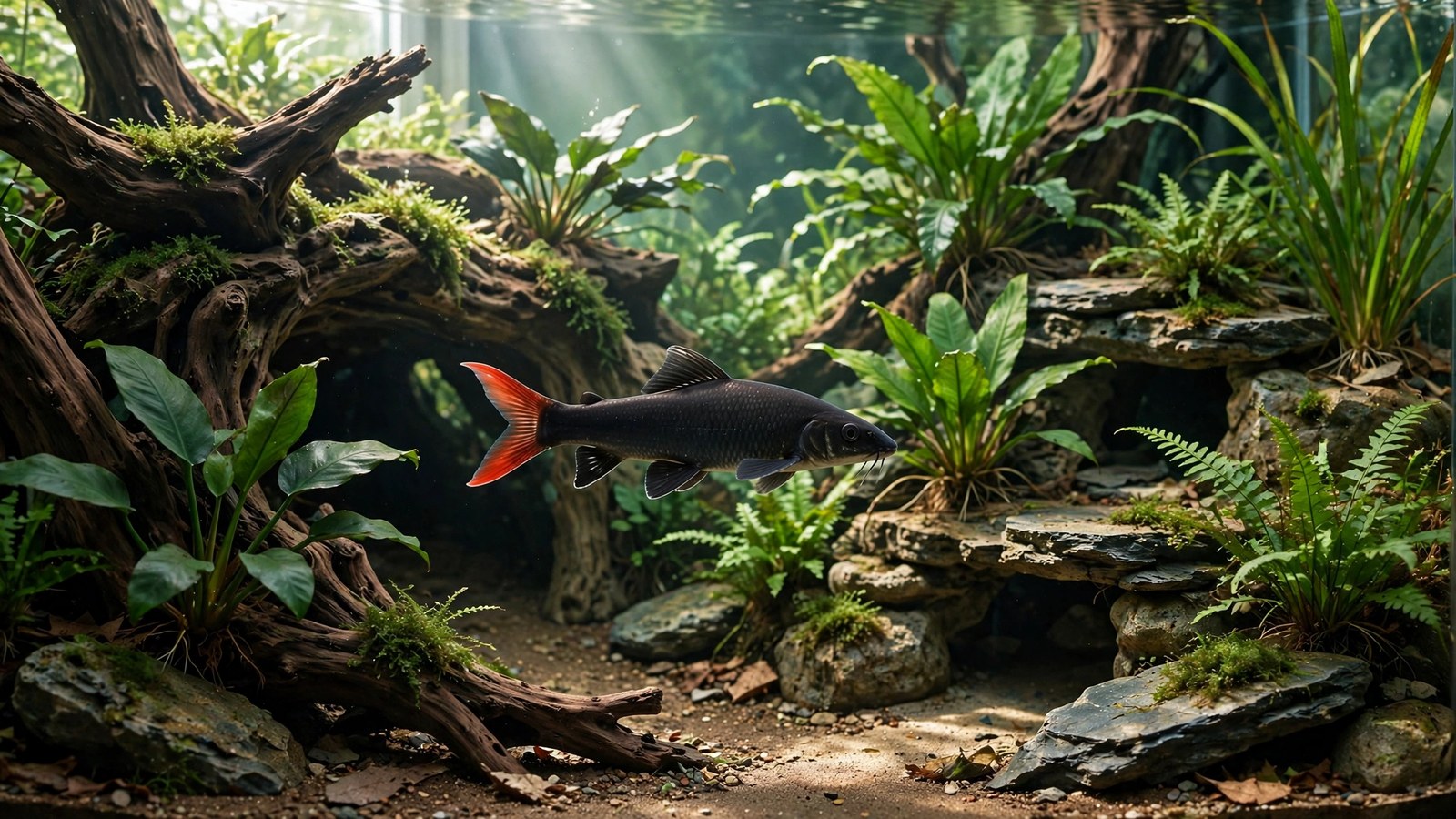
A red tail shark will redecorate your planted tank whether you ask it to or not. These black-and-crimson bottom-dwellers grow to six inches and claim a cave the way a dog claims a couch — any delicate plant in the patrol route gets bulldozed. The good news: a red tail shark planted tank is absolutely doable if you design around the fish first and the aquascape second.
This guide shows you how to lay out caves and sightline breaks so the shark owns its territory peacefully, which plants survive the roughhousing, and which tank mates actually work. If you're still deciding which plants suit a fish-heavy setup, start with these fish-first plant choices. And if you've kept a bristlenose pleco, you'll find familiar rhythms — see another bottom-dweller planted setup for how a mellow bottom-feeder shares a tank differently.
Setting Up a Red Tail Shark Planted Tank Around Territory
In the wild, the red tail black shark (Epalzeorhynchos bicolor) holds a patch of streambed and chases intruders out of it. Your layout job is to give it something worth holding, so it stops trying to hold everything.
Place two to three caves — ceramic hides, coconut huts, or stacked slate — spaced at least 12 inches apart so each reads as a separate territory. The Seriously Fish species profile notes the same pattern keepers see: once a shark claims a cave, most aggression becomes short bluff charges. Add one large driftwood piece per 20 gallons, angled to break the long sightline down the tank; a shark that can't see the whole tank stops patrolling it all at once.
Plant around the caves, not inside them. A dense background wall of Vallisneria or Amazon swords turns each cave into a room with walls, which the shark loves. Keep the front third open sand or fine gravel for foraging — smooth substrate protects the shark's barbels, and barbel damage from sharp gravel invites infections people mistake for "shark disease."
Plants That Hold Up vs Plants That Get Shredded
Red tail sharks rarely eat plants on purpose. They destroy them accidentally — tail-swiping through fine leaves, digging under new plantings, and barging through anything in their patrol lane. Match plant toughness to the shark's traffic zones, anchor your plan with the easiest beginner plants, and you'll lose almost nothing.
| Plant | How to plant it | Verdict with a red tail shark |
|---|---|---|
| Java fern | Tie to driftwood or rock | Excellent — tough leaves, never uprooted |
| Anubias (barteri, nana) | Glue or tie to hardscape | Excellent — leathery leaves ignore bulldozing |
| Vallisneria | Deep in substrate, background | Excellent — runners recover from any damage |
| Amazon sword | Deep root tab feeding | Good once rooted 4+ weeks; guard new plantings |
| Bolbitis heudelotii | Tie to wood, shaded spot | Excellent — slow, sturdy, out of the way |
| Cryptocoryne wendtii | Midground, leave alone | Good — but don't move it; melts then rebounds |
| Rotala / Ludwigia stems | Groups in substrate | Shredded — soft stems snap under tail swipes |
| Dwarf hairgrass / baby tears | Carpet, foreground | Uprooted — dug up before roots establish |
One pattern to respect: freshly planted anything is vulnerable for the first two weeks. Plant heavily from day one with plant weights on stem groups, and keep the shark's caves fully furnished before it arrives — a shark that settles into a finished room doesn't need to supervise construction.
Tank Mates That Work (and Ones That Don't)
Pick tank mates that live in the water column and can out-swim a grumpy bottom-dweller. Robust schoolers in groups of 8–10 are ideal — they act as dither fish, and a shark with busy neighbors spends less time fixating on them. Good options include congo tetras, giant danios, and rainbowfish. For bottom company, bristlenose plecos and larger corydoras schools usually coexist fine. For more schooling-fish ideas, browse schooling fish for planted tanks.
The hard no's: no second red tail shark or rainbow shark — they fight, sometimes fatally, and even a 125-gallon tank rarely ends the feud. Skip lookalike black-and-red fish (they trigger the territorial response) and timid long-finned species that stress under chase pressure. Snails and a sensible cleanup crew round out the bottom as long as you expect the shark to sample baby shrimp.
Feeding: Sinking Food, Not Leaf Salad
Red tail sharks are omnivorous bottom-feeders. Feed sinking algae wafers as the daily staple, rotated with frozen bloodworms or daphnia twice a week and blanched zucchini once a week. A large driftwood piece doubles as a grazing surface, and a big manzanita or mopani piece is one of the most natural first planted tank purchases you'll make. Two small feedings beat one large one; clear uneaten food within a few hours to keep nitrates down.
Frequently Asked Questions
Can I keep two red tail sharks in one planted tank?
No — keep exactly one per tank. Red tail sharks are fiercely territorial toward their own kind and toward rainbow sharks, and pairs in anything under about 125 gallons end with one fish permanently harassed and refusing food. One shark in a 55+ gallon tank with its own caves is a confident, active fish.
Will a red tail shark eat my aquarium plants?
It won't graze them like a herbivore, but it will bulldoze them. Digging, tail-swishing patrols, and cave defense snap soft stems and uproot anything freshly planted. Epiphytes tied to wood or rock — Java fern, Anubias, Bolbitis — are effectively immune, and deep-rooted Vallisneria or established Amazon swords hold up well. Fragile stems and carpets are the casualties.
What size tank does a red tail shark really need?
Fifty-five gallons is the honest minimum, and bigger is genuinely better here. A 4-foot 75-gallon tank gives the shark a real territory to patrol, which visibly reduces aggression. Small tanks force the shark to claim the entire tank, so it harasses everything in it. Pair the footprint with 2–3 caves and broken sightlines and the behavior change is dramatic.
Are red tail sharks compatible with tetras and danios?
Yes — robust mid-water schoolers are the best possible tank mates. Congo tetras, giant danios, and black skirt tetras in groups of 8–10 swim above the shark's claimed zone and act as dither fish. Avoid tiny, timid, or long-finned fish that stress easily, and never add anything shaped and colored like another red tail shark.
Does my red tail shark actually need caves?
A cave isn't decoration — it's the whole behavioral strategy. A shark with nothing to claim tries to claim the entire tank and becomes a menace. Give it 2–3 caves spaced at least a foot apart, let it pick a favorite, and most "aggression problems" disappear. Ceramic hides, coconut huts, and slate stacks all work.
Why does my new red tail shark hide all day?
Hiding for the first week or two is normal — the fish is mapping its territory. Past three weeks, check the basics: water in range (72–79°F, pH 6.5–7.5), a cave it can fully enter, and mid-water schoolers for confidence. Constant bright lighting with no shaded retreats also keeps them pinned. For community behavior background, the Fishkeeping World red tail shark guide documents the same settling pattern.
Give the Shark a Kingdom, and the Plants Survive
The whole formula fits in one sentence: a red tail shark that owns a cave, patrols broken sightlines, and eats sinking food on schedule is a model planted-tank citizen. Build the territory first, plant tough species second, stock confident schoolers last — and you'll get one of the most striking fish in the hobby swimming through a tank that stays intact.