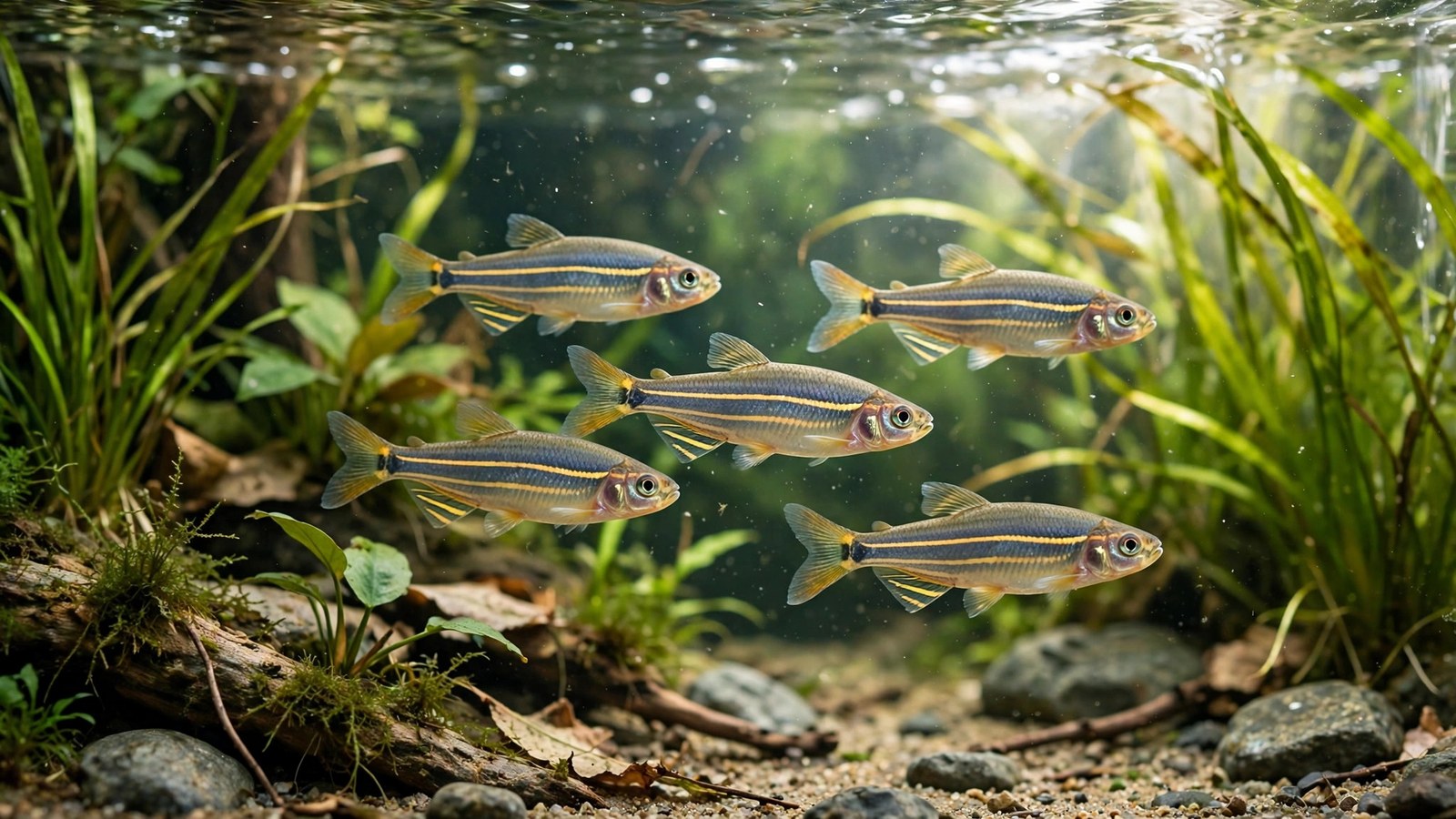
Most danios are nano-sized zippers built for still-water nano tanks. The giant danio plays a different sport entirely: a 3-inch torpedo from clear, fast-flowing hill streams that cruises your tank at full sprint and can clear an open lid like a sprinter hurdles. Building a giant danio planted tank means designing around that energy — planted riverbanks on the edges, a wide-open swimming lane down the middle, and current to push against.
Meet Devario aequipinnatus, the River Runner
Meet Devario aequipinnatus — McClelland, 1839; formerly Danio aequipinnatus, and not to be confused with lookalike cousin D. malabaricus. At 7–8 cm (up to 4 inches wild), it is the largest true danio in the hobby: a torpedo body in metallic blue-green, banded with horizontal yellow-gold lines that break into spots toward the head. In bright light the school flashes like cut steel.
It comes from clear, moderately flowing hill streams in India, Nepal, Sri Lanka, and Indochina — gravel beds, high oxygen, water on the move. That origin dictates the whole setup. Where the zebra danio planted tank setup suits a 2.5-inch still-water zipper, the giant danio needs river conditions: current, open water, and a proper school. This fish-first guide to aquarium plants explains the principle — choose plants around what the fish actually does.
The Giant Danio Planted Tank Layout: River Edges, Open Lane
The layout that works is a riverbank diorama: densely planted edges framing a broad open swimming lane through the middle third of the tank. The plants give nervous danios retreats and sight-line breaks; the lane gives them the 4-foot sprint track they were built for. In a 55-gallon long, plant the back and sides, and keep the center low or bare.
Choose sturdy, flow-tolerant plants — the current will flatten delicate stems. Anubias and Java fern tied to driftwood and rocks handle the flow and the occasional body-slam; Vallisneria along the back sways in the current and doubles as the riverbank silhouette. Floating plants like frogbit at the surface dim the light and give these surface-oriented danios overhead cover, which noticeably calms jumpy schools.
| Plant | Role in the layout | Placement |
|---|---|---|
| Vallisneria | Tall riverbank grass; thrives in flow | Back corners |
| Anubias | Sturdy, flow-proof, driftwood-mounted | Side edges |
| Java fern | Flow-tolerant midground cover | Attached to hardscape |
| Floating plants | Surface cover; calms nervous fish | Water surface, corralled |
| Dark substrate | Makes blue-and-gold colors pop | Entire bottom |
Flow, Tank Size, and Water Chemistry
Current is the most under-appreciated ingredient here. A small adjustable powerhead angled along the tank's length, or a canister filter with a spray bar aimed the same way, gives the school a current to swim against — danios working against flow school tighter, color up stronger, and show far less restlessness. Aim for 6–8× hourly turnover rather than a fire hose.
Size matters for a fish this athletic. Thirty gallons works for a small group, but 8–10 in a 55-gallon, 4-foot-long tank is the setup this fish deserves. Water-wise they are forgiving: pH 6.0–8.0, 22–25°C (they prefer the cooler end of tropical), soft to moderately hard. What they will not forgive is low oxygen and dirty water — keep filtration strong and maintenance regular.
| Parameter | Target |
|---|---|
| Tank | 30 gal minimum; 55 gal, 4 ft long ideal for a school |
| Temperature | 22–25°C / 72–77°F |
| pH | 6.0–8.0 |
| Flow | Moderate–strong; powerhead or spray bar, 6–8× turnover |
| School | 6–10+, more is calmer |
| Lid | Tight-fitting glass canopy — non-negotiable |
Feeding a Boisterous Schooler
Giant danios eat with the same enthusiasm they swim with. In the wild they take insects from the surface, plus worms and crustaceans. In your tank, a quality omnivore diet covers it: tropical flakes or small pellets as the staple, Bug Bites-class insect foods as a natural fit, and frozen bloodworms, brine shrimp, or daphnia two to three times a week to keep the blue-and-gold pattern sharp.
Feed once or twice daily, only what disappears in two minutes. Offer floating foods first — sinking pellets end up with the cleanup crew. They will graze on the tiniest shrimp (cherry shrimp babies are fair game), but ornamental plants are completely safe.
Tank Mates That Tolerate the Bustle
Giant danios are peaceful, not predatory — but they are fast and constant, and a little clumsy about personal space. Tank mates need to be robust enough to shrug off the commotion: rainbowfish, larger barbs, sturdy loaches, and peaceful mid-sized cichlids all hold their own. Good planted-tank companions include the banded rainbowfish planted tank setup and the congo tetra planted tank guide — big, active, and unbothered — or the scissortail rasbora planted tank guide, another current-loving schooler that shares the same river aesthetic.
What to avoid: tiny or timid fish (ember tetras, celestial pearl danios, shy gouramis) get stressed by the endless traffic, and anything mouth-sized will eventually be tested. Keep bottom dwellers hardy — bristlenose plecos and larger corydoras species handle the wake fine.
Frequently Asked Questions
Can giant danios live in a planted tank?
Absolutely — they are fully plant-safe and never graze ornamental plants. The trick is layout, not plant choice: plant the edges densely with sturdy species like Anubias, Java fern, and Vallisneria, and keep a wide open swimming lane through the center where the school can sprint.
How many giant danios should I keep together?
Six is the absolute minimum, but 8–10 is the number that actually works. Bigger schools spread their famous boisterousness into harmless sparring, tighten the schooling display, and calm the nervous dashing that makes under-grouped danios look stressed. Eight to ten is perfect in a 55-gallon, 4-foot tank.
Do giant danios really jump out of the tank?
Yes — prodigious, athletic jumpers. They leap at feeding time, when startled, and seemingly for fun during evening sprint laps. A tight-fitting glass canopy is mandatory, and a waterline a few centimeters below the rim adds a useful second barrier. Seal gaps around filter and heater cutouts.
Do they need a powerhead or strong current?
Not rapids, but moderate current makes a visibly better tank: danios swimming against flow school tighter, show stronger color, and waste less energy on nervous dashing. A small adjustable powerhead or spray bar angled along the tank's length, at 6–8× hourly turnover, recreates their hill-stream habitat.
Will giant danios eat shrimp or small fish?
They ignore adult shrimp and plants entirely, but cherry shrimp babies and the smallest nano fish can become snacks — anything under about 2 cm moving near a hungry school is at risk. Stock amano shrimp or larger cherry colonies where breeding isn't the goal, and keep nano tetras elsewhere.
The giant danio is the planted tank's river come to life — a blue-and-gold school carving laps through open water while Vallisneria sways in the current. Give them the lane, the flow, the lid, and the school, and you get one of the most kinetic displays freshwater has to offer. For deeper reference, the Fish Laboratory species profile for Devario aequipinnatus and the Freshwater Biodiversity Portal's Devario aequipinnatus record both document the wild hill-stream habitat this layout recreates.