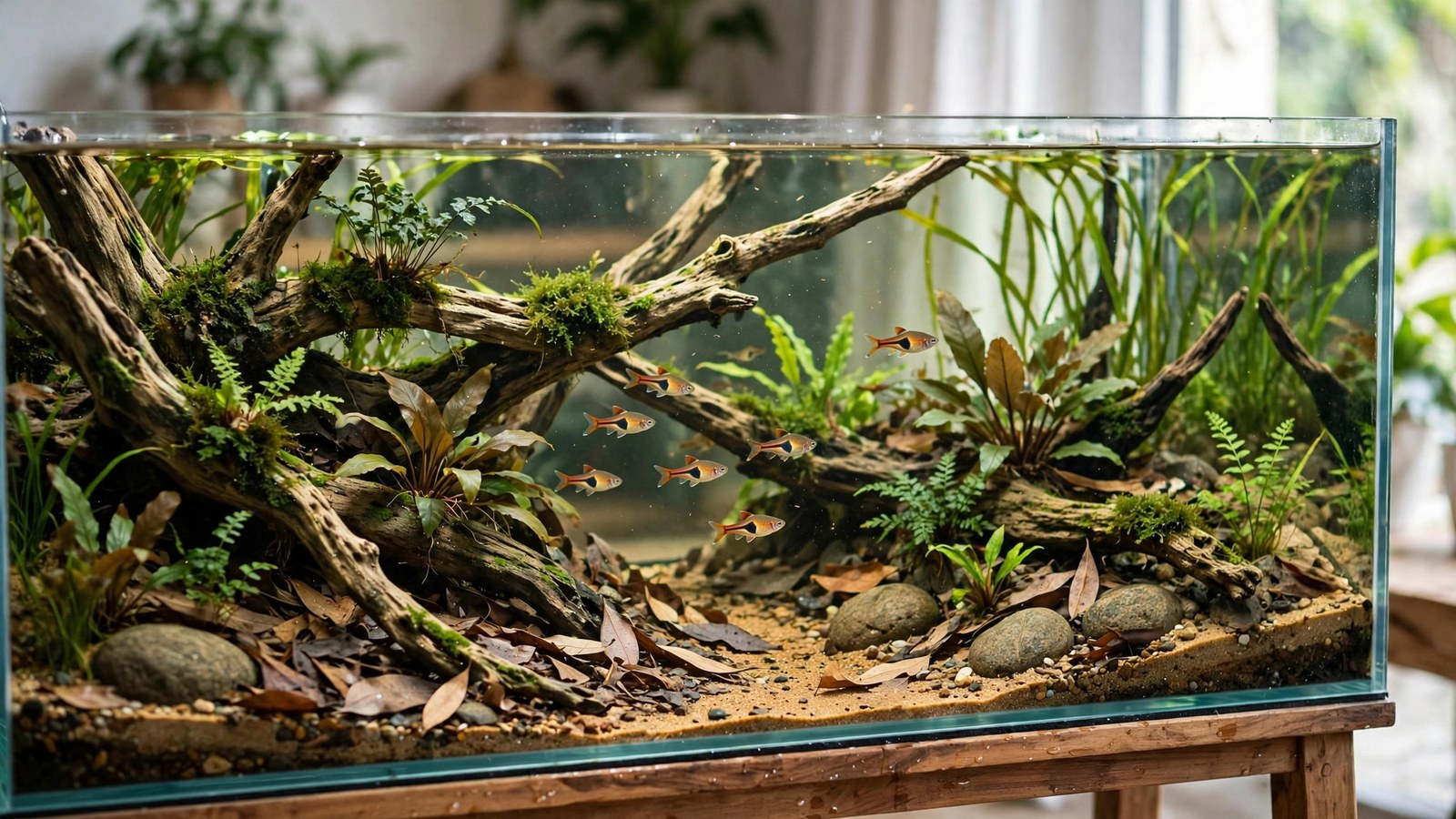
Most biotope tanks fail before they hold water — the builder copied a river's look without picking a river's moment. A mekong biotope aquarium that just means "Southeast Asian plants and driftwood" is decoration. A real one recreates a specific place along the Mekong at a specific point in its seasonal cycle — and this guide gets you there: one of three documented micro-habitats, fish the river actually owns, water tuned to match.
A Mekong biotope aquarium recreates one chosen stretch of the Mekong — China, Myanmar, Laos, Thailand, Cambodia, Vietnam — as a planted tank: river-channel, delta-lake, or pond version, stocked only with basin-native fish like the red-tailed and scissortail rasboras, over sand, river stones, and driftwood at near-neutral pH around 7.0.
Choosing your mekong biotope aquarium micro-habitat
Start here — nearly every Mekong biotope mistake traces back to skipping this decision. Wet season: the river rises and spreads fish across floodplains. Dry season: it concentrates them in the main channel and deep pools. Build the river at one moment and your aquascape makes sense.
Three documented builds give you proven templates: a 100L river-channel example (yellow-gray sand, moderate flow, neutral pH 7.0, sparse planting) and ~290L delta-lake/pond builds with stiller water and heavier margins. This choice matters most — it's the same logic separating good river-basin biotope builds such as the Amazon setup from pretty but rootless scapes.
| Micro-habitat | Flow | Substrate | Planting density | Reference build size |
|---|---|---|---|---|
| River channel | Moderate, directional | Yellow-gray fine sand | Sparse — patches between open sand | 100L |
| Delta lake | Very low, still zones | Sand with leaf litter | Heavy along margins | ~290L |
| Downstream pond / pool | Low | Sand, smooth river stones | Medium — clumps around hardscape | ~288L |
Water: let the flood pulse drive the design
You don't have to raise and lower your water level, but build as though you know which phase you're in. River channel = dry season: lower, clearer water, fish concentrated and visible, directional flow from your filter or a small circulation pump. Delta lake = wet season: abundant margins, calm surface, fish dispersing through cover.
Chemistry stays forgiving: pH 6.8–7.2, 22–26°C, 5–12 dGH. The documented channel example ran a neutral pH of 7.0 — your anchor against chasing Amazon-style softness. Keep tannins light: a few leaves for authenticity is fine, but don't brew tea.
Hardscape and planting: sand, stone, and restraint
Every micro-habitat starts with the same hardscape kit: fine sand (yellow-gray is your reference color), smooth river stones in odd groupings, one or two driftwood pieces that don't look "placed." Lay sand 4–6 cm deep in channel builds for uninterrupted swimming runs; bank it deeper at the back of lake builds.
Cryptocoryne and Vallisneria are your safe, native-style anchors — Vallisneria's ribbons read as river current even in still water; Cryptocoryne fills delta margins without taking over. Plant in clumps, not lawns: the Mekong scours, so vegetation grows in patches. When choosing plants around the fish they suit, remember the rasboras below want open midwater — give them the sky of the tank, not a stem canopy.
Fish: Mekong natives, verified — not vibes
This is the line that separates a biotope from a themed tank: every fish below has its Mekong credentials confirmed by species references.
Red-tailed rasbora (Rasbora borapetensis) — native to the Mekong, Chao Phraya, and Mae Klong basins (Thailand, Cambodia, Laos) — works midwater to the surface in ponds, reservoir margins, and slower river reaches at pH 6.5–7.0 and 22–26°C. A true schooling fish: buy 8–10 minimum or the school never settles. At ~6 cm it fits the 100L channel build. Tropical Fish Keeping's blackline rasbora profile documents its wild habitat in detail.
Scissortail rasbora (Rasbora trilineata) — native to the lower Mekong and Chao Phraya — is the adaptable one: recorded in swift clear streams up to pH 7.5 and in tannin-stained forest water, moving into flooded areas during the wet season. That flexibility makes it the best fish for your flood-pulse story. Reserve it for 120L+ tanks, schools of 8+. Seriously Fish's scissortail species profile lists its full native range and habitat types.
Keep the list river-honest: one rasbora school as the centerpiece, optionally a second smaller school in larger tanks, and basin-native bottom dwellers only. For disciplined species selection in other river systems, compare the Congo biotope setup or the Orinoco biotope setup.
Putting the build together
Week one is hardscape and water: lay sand and stone, position driftwood, fill, and run the filter for 7 days to clear fines — Mekong channel water runs clear, so don't rush cloudy water. Week two, plant the clumps. Then cycle a full 3–4 weeks; treat the first month as its own project.
Add the rasbora school only after ammonia and nitrite read zero for three consecutive days. Feed small, varied meals — micro-pellets plus frozen daphnia matches their wild diet of zooplankton and small insects. Then watch: in a channel build the school should run the tank's length against the drift, tightening when startled. That schooling behavior is your biotope's report card.
If you later want a different Asian river story, the Sri Lanka biotope setup shows the same discipline in island streams.
Frequently Asked Questions
Is a Mekong biotope aquarium good for beginners?
Yes, with one condition: pick the delta-lake or pond micro-habitat first. The forgiving water chemistry (pH near 7.0, moderate hardness), hardy native-style plants, and peaceful rasboras are all beginner-friendly. The only real skill is discipline — researching each fish's native range instead of buying on looks.
What pH and temperature does the Mekong biotope need?
Aim for pH 6.8–7.2, temperature 22–26°C, and hardness of 5–12 dGH. A documented 100L river-channel build ran at a neutral pH 7.0. Resist the urge to push pH down like an Amazon tank — the Mekong's main channel is not a blackwater river, and your rasboras were collected in exactly this near-neutral range.
Red-tailed rasbora or scissortail — which should I choose?
For tanks under 120L, take the red-tailed rasbora (Rasbora borapetensis, ~6 cm, schools of 8–10). For larger tanks, the scissortail (Rasbora trilineata) shows off the Mekong's flood-pulse story — it migrates into flooded zones in the wet season and schools beautifully in open water. Both are confirmed Mekong-basin natives, so either is biotope-honest.
Do I need CO2 for a Mekong biotope?
No. Cryptocoryne and Vallisneria — your two anchor plants — grow perfectly well low-tech, which suits the biotope since the Mekong scours rather than fertilizes. CO2 injection can actually fight the calm, natural look by driving unnatural growth rates. Spend the budget on a better circulation setup instead.
How is this different from a rice-paddy biotope?
Totally different habitat and tank logic. A rice paddy is a shallow, still floodplain system tied to human agriculture — different water depth, different stocking (bettas, ricefish), different seasonal story. The Mekong builds here are riverine: channel, delta lake, or downstream pool. Keep them as separate projects.
How big a tank do I need?
100L is the documented minimum for a river-channel build, and it works because the reference example proved the layout at that size. Go 120L+ for scissortail schools (they're stronger swimmers), and 200L+ for the delta-lake version, where the heavier planted margins need footprint to read as "lake" rather than "bush."
A Mekong biotope wins on specificity: one river, one micro-habitat, one season, fish the basin actually owns. Build that, and the tank stops being decoration — it becomes a window, 4,900 kilometers away, in your living room.