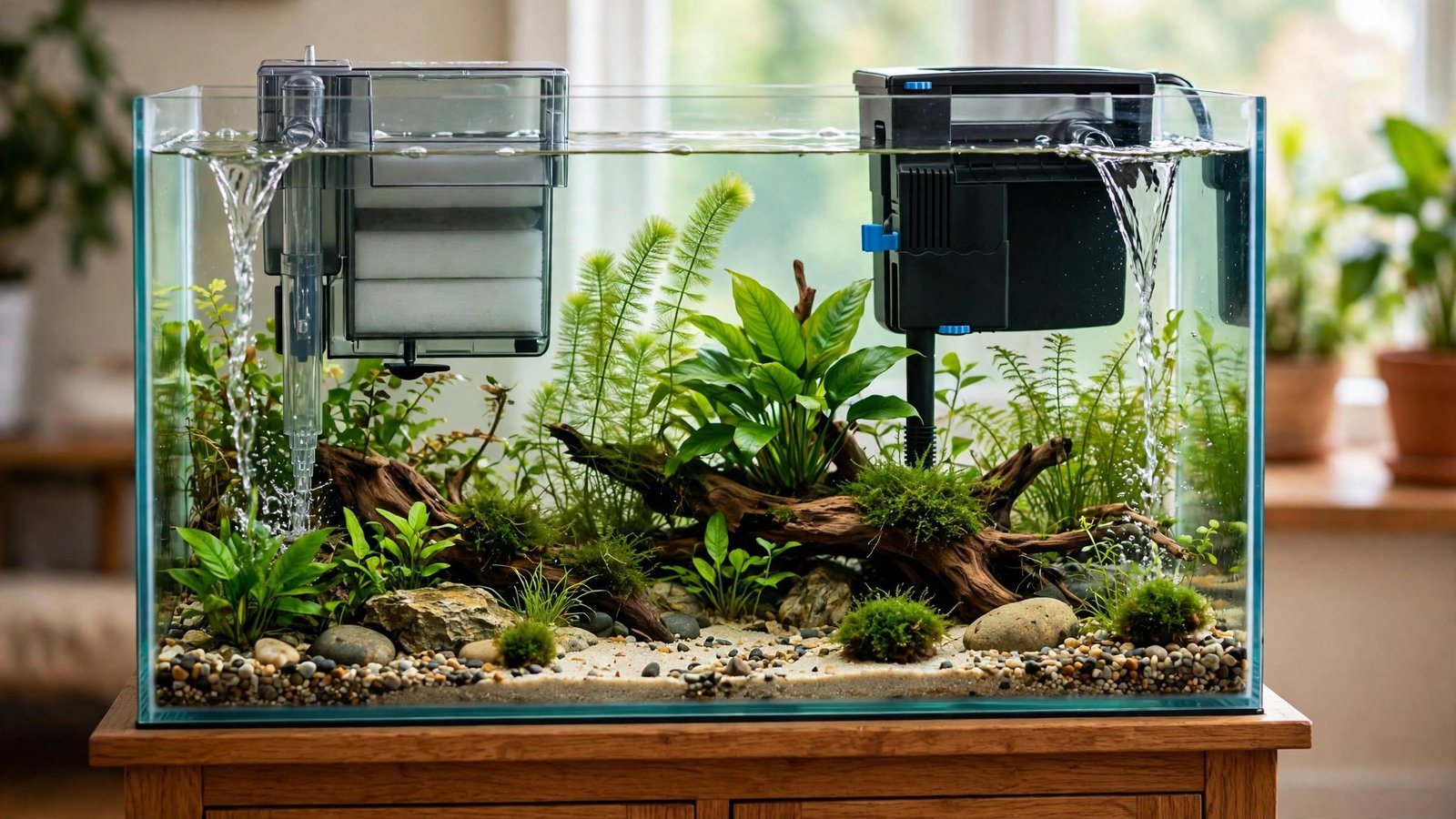
The power goes out for three hours while you're at work. When it returns, one of the two best hang-on-back filters fires itself back up — and the other sits there, impeller spinning in air, until you pour water into it. That difference shapes most of the aquaclear vs tidal hob filter debate. This guide compares Fluval's AquaClear and Seachem's Tidal on self-priming, surface skimming, media design, noise, and shrimp safety, so you buy the right one.
Brand matters less than setup: the right HOB setup tweaks that save CO2 will change your tank more than the logo on the filter box.
The short answer: the Seachem Tidal wins on convenience — its submerged pump self-primes and restarts itself after outages, and the built-in surface skimmer clears oily film. The Fluval AquaClear wins on filtration muscle — its basket holds up to seven times the media of comparable HOBs. Under 40 gallons: the Tidal 55 if you travel or fear outages, the AquaClear AC50 if maximum bio-filtration is the priority.
AquaClear vs Tidal HOB filter: the planted-tank scorecard
| Feature | Fluval AquaClear (AC series) | Seachem Tidal (35–110) |
|---|---|---|
| Pump location | On top of the filter box, outside the tank | Submerged inside the tank |
| Self-priming / auto-restart | No — manual priming needed | Yes — auto-restart |
| Surface skimmer | No | Yes, adjustable skimmer/deep-intake balance |
| Media basket | Staged basket; huge media volume | Open basket, bottom-to-top flow; ships with Matrix + foam |
| Flow per size | AC20–110: 100–500 GPH | Tidal 35–110: 130–450 GPH |
| Noise | Quieter than the old model; lid can still rattle | Near-silent (submerged pump) |
| Shrimp safety | Intake sponge keeps shrimplets out | Skimmer catches shrimplets — needs a cover |
| Heater holder | No | Yes |
| Maintenance reminder | None | Blue peg pops up when clogged |
Self-priming: the outage question
This is the most practical difference and the source of most forum threads. The Tidal's pump lives below the waterline inside the tank, so it never loses its prime — after a power cut, cleaning, or water change, it just starts pushing water again. The AquaClear's motor sits on the box above the waterline; if the box drains during an outage, it runs dry and waits for you to pour tank water into it.
Unreliable power, or travel with a sitter who won't notice a silent filter? The Tidal is the safer choice.
Surface skimmer: film-free water vs CO2 loss
The Tidal's dual intake — a deep tube plus a surface skimmer — pulls in the oily protein film that dulls the waterline and blocks gas exchange. The trade-off for planted tanks is real: strong surface agitation means injected CO2 off-gasses faster. You can dial flow down and balance intake toward the deep tube, which the AquaClear can't offer at all.
The AquaClear has no skimmer, so a film can form — but running the water level high lets the waterfall return break it up, and the calmer surface is gentler on injected CO2. Our Best Filters for Planted Tanks roundup puts both in context against canisters and sponges if you're still choosing a filter type.
Media basket design: volume vs versatility
The AquaClear's superpower is capacity — Fluval claims up to seven times the media volume of comparable filters. Its patented refiltration system is clever: dial the flow slider down and part of the water re-circulates inside the chamber, getting more media contact time instead of one quick pass. Check the current specs on Fluval's official AquaClear AC series page.
The Tidal takes the opposite approach: one big open basket with bottom-to-top flow, so water is forced through every layer with no bypass around the media. It ships with Seachem Matrix and foam but accepts anything — Purigen, extra Matrix, phosphate media. When media clogs, a blue peg pops up on the lid, telling you it's cleaning day. See the full lineup on the Seachem official site.
For pure bio-filtration on a heavily stocked tank, the AquaClear's volume wins. For a flexible, any-media-you-like setup on a typical community tank, the Tidal's basket is easier to customize.
Noise: bedroom-tank reality
The Tidal is the quieter filter and it isn't close. The submerged, insulated pump barely reaches the room — owners consistently call it silent enough for a bedroom. The new-generation AquaClear is noticeably quieter than the old Hagen-era model, but the motor sits outside the tank, so vibration reaches the air directly, and a poorly seated lid can still rattle.
Shrimp safety and intake design
Here's the honest trade-off. The redesigned AquaClear ships with a pre-filter intake sponge that keeps out debris, shrimplets, and fry — genuinely shrimp-safe out of the box, which matters for the beginner shrimp-friendly builds in our easiest plants for a beginner community tank guide.
The Tidal's skimmer slots are wide enough to pull in baby shrimp. Adults are fine, but a breeding colony will lose shrimplets to the skimmer. The fix is a prefilter sponge over the intake — cheap, easy, and it doubles as a grazing surface.
The AquaClear redesign: what's actually new
Fluval overhauled the line into the current AC series: a reconfigured media basket with dedicated space per stage, the CycleGuard system (change one media insert at a time so the nitrogen cycle stays stable), the intake sponge pre-filter, a re-engineered rotor, a sound-dampening cover, and a self-leveling rim connection. It's a meaningful upgrade — but still not self-priming. Buying used? Older AquaClears lack the intake sponge and quieter rotor; for a shrimp tank, get the new AC series.
Which should you buy?
Choose the Seachem Tidal for set-and-forget reliability: self-priming, near-silent, film-free surface, a maintenance alert, and a basket that takes any media. Cover the skimmer if you keep shrimp, and corral your floaters. It fits a lightly planted aquarium setup where stability beats maximum filtration.
Choose the Fluval AquaClear when capacity is the priority: the biggest media volume of any HOB, longer contact time at low flow, and shrimp-safe intake out of the box. Accept that you'll prime it after outages.
Size either to the tank, not the label: the AC50 or Tidal 55 (200–250 GPH) suit most 29–40 gallon planted tanks with flow dialed back.
Frequently Asked Questions
Does the AquaClear self-prime after a power outage?
No. The motor sits above the waterline, so it loses its prime when the box drains and runs dry until you pour tank water into it. The Tidal's pump is submerged inside the tank, so it self-primes and restarts automatically every time.
Is the Seachem Tidal shrimp-safe?
Mostly. Adult shrimp are fine, but the skimmer slots can pull in newborn shrimplets. Cover the skimmer and intake with a fine prefilter sponge and a breeding colony is safe. The new AquaClear is shrimp-safe out of the box thanks to its intake sponge.
Will a surface skimmer hurt my CO2 injection?
It can increase CO2 off-gassing, since surface agitation drives gas exchange. The Tidal lets you balance intake toward the deep tube and dial flow down, limiting the loss. The AquaClear disturbs the surface less, so it's gentler on injected CO2.
Which size do I need for a 40-gallon planted tank?
The Tidal 55 (250 GPH) or the AquaClear AC50 (200 GPH) both suit a 40-gallon planted tank with flow reduced at the dial. Planted tanks want gentle flow — 4–6 tank turnovers per hour is plenty for most community setups.
Are replacement parts easy to find for both?
Yes. Both are mainstream brands — impellers, intake tubes, foam inserts, and media refills are stocked at most aquarium retailers. The Tidal's impeller is self-cleaning by design, both are easy to maintain, and both carry a 3-year warranty extendable to 5 with registration.
The bottom line
Both are excellent filters; they solve different problems. The Tidal solves the human problem — outages, noise, forgotten maintenance, surface film. The AquaClear solves the chemistry problem — maximum media, maximum contact time, maximum bio-filtration.