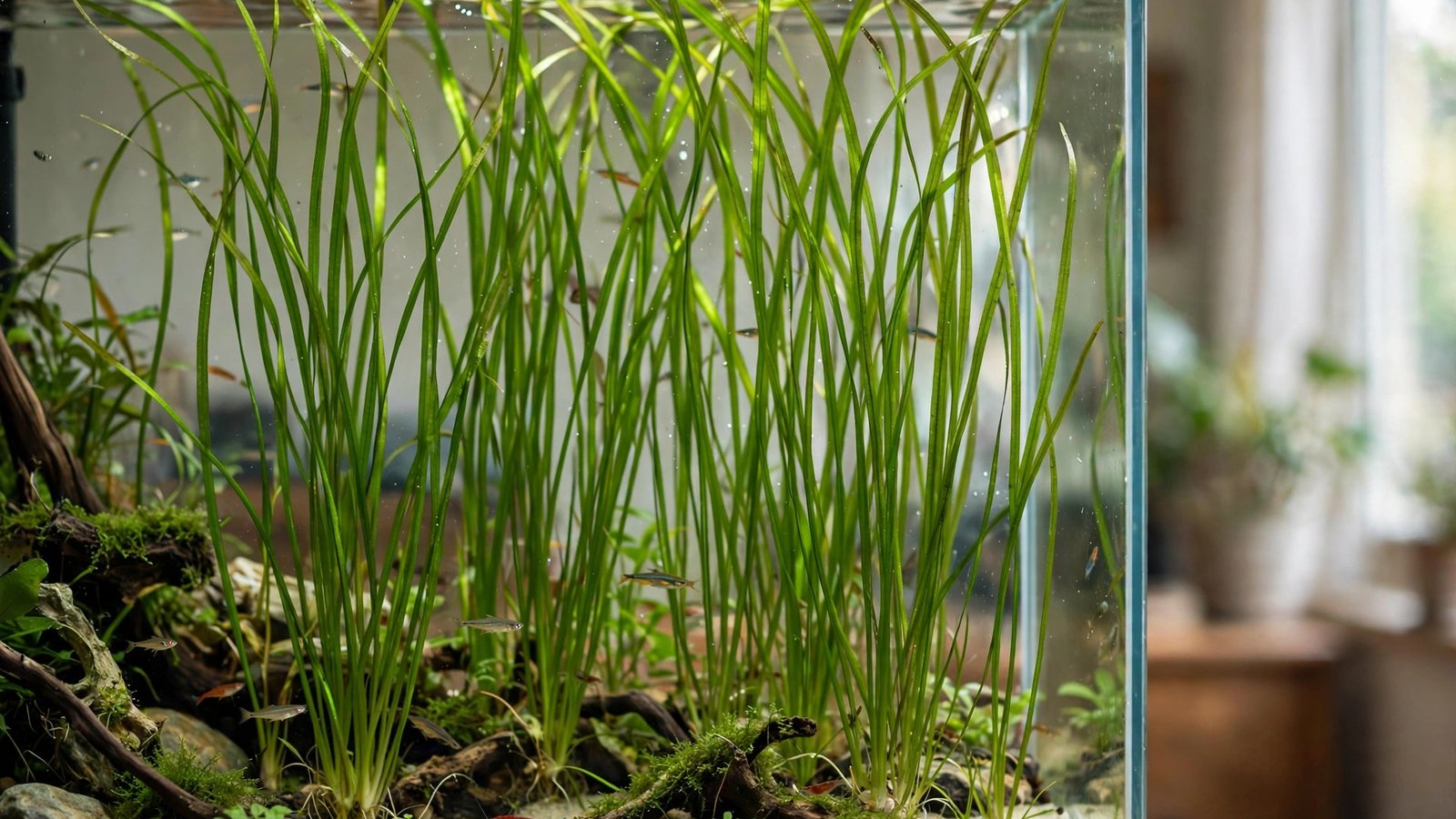
Most tall planted tanks have the same flaw: a bare back wall and an empty top third of the water column, because ordinary background plants top out at 40cm. Learning giant vallisneria care solves exactly that — the giant form of Vallisneria americana sends ribbon leaves 100–150cm long in a healthy tank, filling a 60cm+ aquarium like a living green curtain. By the end of this guide you will know how to plant it in deep substrate, manage the runners that can swallow a tank in weeks, trim leaves without butchering them, and pull a melting plant back from the brink.
Giant Vallisneria vs. Standard Val: What's Actually Different
Giant vallisneria is not just a bigger standard val — it behaves differently enough that treating it like one is the fastest way to fail. Standard V. spiralis or V. nana top out around 30–50cm, perfect for midground or short-tank backgrounds, but they leave tall aquariums looking hollow at the top. Giant Val keeps growing until leaves fold along the surface, creating a canopy that shades everything beneath it.
The taxonomy confuses everyone. It is sold as Vallisneria gigantea, V. americana "Gigantea", or plain "giant vallisneria" — all the same aquarium plant, the broad-leafed giant form of Vallisneria americana (see the Flora of the Southeastern US entry for Vallisneria americana for the accepted botanical naming). What matters to you: 2–3cm wide leaves with slightly serrated margins, a heavy root system demanding deep substrate, and runners thick enough to see clearly. If your "giant" val never exceeds 50cm, you were probably sold mislabeled standard V. americana — a common mix-up. For the smaller varieties, see our general vallisneria care guide.
Giant Val also melts harder than its smaller cousins when transplanted. Longer leaves mean more biomass dying back, so the die-off looks dramatic — and it tempts people to rip the plant out on day ten, right before it would have recovered. Give it a full three weeks before judging.
Setting Up for Tall Tanks (60cm+)
Everything about giant Val scales with tank height, so setup mistakes compound fast. You need 7–10cm of substrate at the back of the tank, not the 3–5cm that suffices for carpet plants. A slope — 4–5cm at the front glass rising to 9–10cm at the back — gives you the depth where it counts while keeping the front clean-looking. Shallow substrate lets big plants uproot when a pleco bulldozes past or when you thin the colony.
At 60cm of water, light intensity drops roughly 50–60% from surface to substrate, so aim for 40–60 PAR at substrate level — usually a quality LED at 60–80% power over a 60cm-deep tank. Below 30 PAR the plant survives but grows thin, pale leaves. Do not blast the tank either: excess light mostly grows algae on the slow lower leaves. If your tank exceeds 70cm, light compensation becomes the real project — our Bucephalandra deep water care guide covers rhizome plants you can pair on hardscape in the same deep tank.
Plant crowns along the back 15–20cm of the footprint, spaced 8–10cm apart, in a gentle arc rather than a rigid line. Five crowns in a 120cm tank look sparse on day one and perfect by week eight once runners fill the gaps. Planting too densely at the start causes the classic failure: inner leaves shade each other, lower leaves rot, and the whole stand collapses into mush that fouls the water.
Water Parameters That Suit Giant Val
Giant Val has one non-negotiable preference: it hates soft, acidic water. Below pH 6.5 with very low carbonate hardness, growth stalls and leaves develop transparent patches. Keep it neutral to slightly alkaline and it powers ahead:
| Parameter | Target range | Why it matters |
|---|---|---|
| Temperature | 22–28°C (72–82°F) | Growth stalls below 20°C; optimal at 24–26°C |
| pH | 6.8–8.0 | Below 6.5 growth collapses; prefers slight alkalinity |
| GH / KH | 4–12 dGH / 3–8 dKH | Uses bicarbonates as a carbon source; hates near-zero KH |
| Ammonia / nitrite | 0 ppm | New crowns melt faster in cycling tanks — plant after the cycle completes |
| Flow | Low–moderate | Gentle sway is ideal; jetting flow tears long leaves |
One quirk worth knowing: Vallisneria species are bicarbonate users, drawing carbon from dissolved carbonates when CO2 is scarce. That is why giant Val thrives in moderately hard water without injected CO2, while it sulks in ultra-soft setups — match the plant to your water, not the other way around. It pairs well in hard-water tanks with cryptocoryne species that share its parameter range.
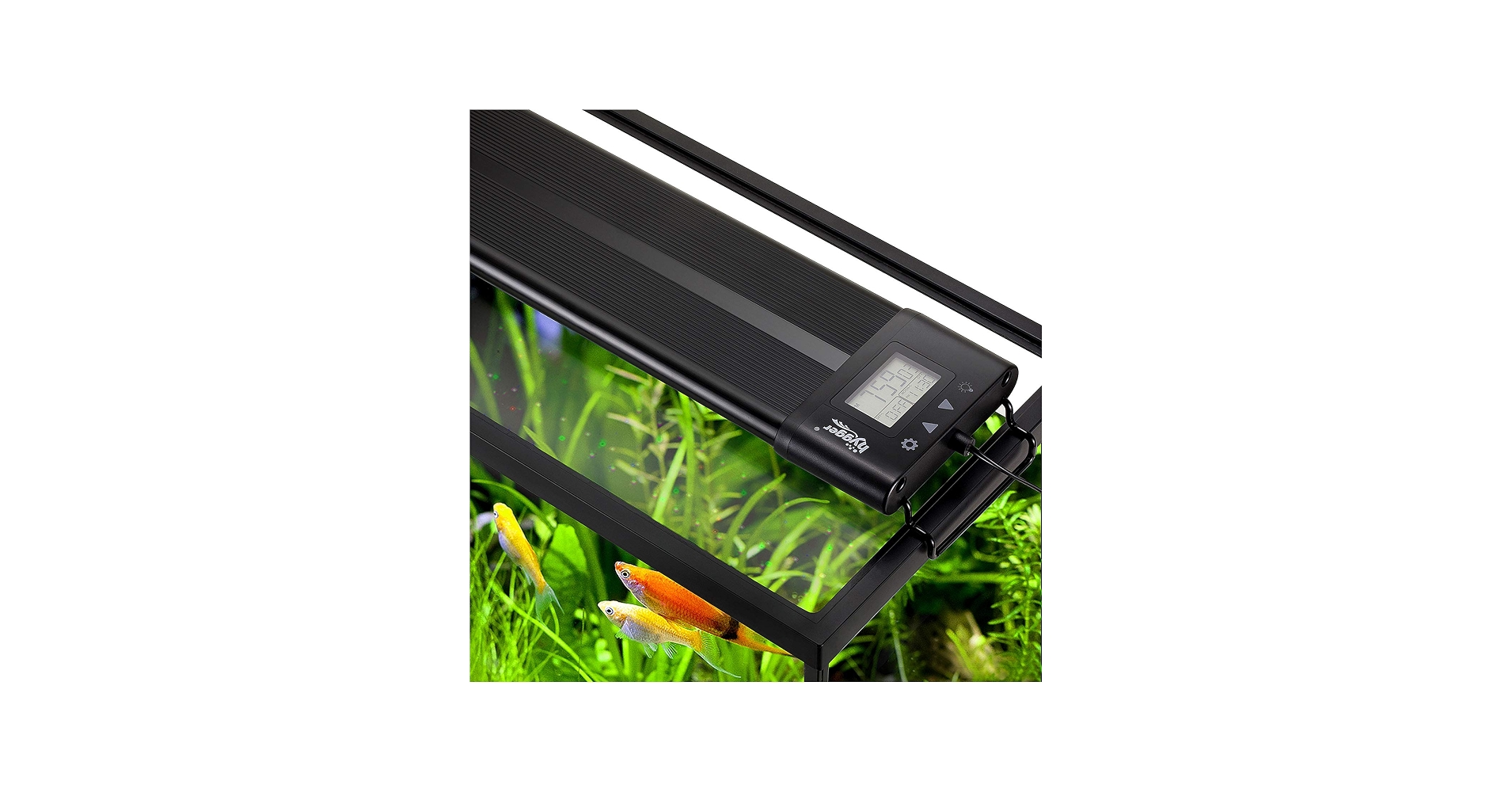
Tall tanks need long fixtures that throw light 60cm+ deep — the section's core equipment need: a long LED fixture like the hygger 957 (48-55 in).
 ★4.4
hygger 957 Auto On Off LED Aquarium Light
Check Price on Amazon ★4.4Giant Vallisneria Care: Light, CO2, and Nutrients
Giant Val is a committed root feeder, and explosive runner growth is driven by nutrients at the root zone — water-column fertilizers help the leaves, but substrate feeding does the heavy lifting. Here is how it compares to the other common background plants:
| Plant | Substrate depth | Root feeding | CO2 needed? | Leaf length |
|---|---|---|---|---|
| Giant Vallisneria | 7–10cm | Heavy — root tabs essential | No (helpful) | 100–150cm |
| Standard V. spiralis | 4–6cm | Moderate — benefits from tabs | No | 30–50cm |
| V. nana (dwarf) | 3–5cm | Light | No | 20–30cm |
| Amazon sword | 7–10cm | Very heavy | Helpful | 40–60cm |
Root tabs are the single highest-impact feeding move. Push one tab per crown, 3–4cm deep, about 5cm from the crown — closer risks fertilizer burn on new roots. Refresh every 2–3 months. A commercial tab like Seachem Flourish Tabs works, or make your own following a DIY root tabs recipe — giant Val's heavy appetite makes homemade tabs especially economical, since a 120cm background stand eats through commercial tabs fast.
CO2 is optional but honest about the trade-off: it shortens establishment from ~3 weeks to ~10 days and thickens leaves, yet giant Val grows fine without it in hard water. In soft water below 3 dKH, CO2 matters much more, since the plant's backup bicarbonate pathway is weakened.
Giant val is a heavy root feeder; commercial root caps are the ready-made benchmark for the tabs the section discusses: ThriveCaps root tabs under the crown.
Planting and Runner Management
Plant each crown so the white base sits just at the substrate surface with roots buried — a buried crown rots, a floating one drifts. Use long tweezers: grip the crown low, push to depth at a slight angle, then pinch the substrate closed around it. New plants float relentlessly for the first week, so weigh problem crowns down with a small pebble until roots take hold (5–7 days).
Runners are giant Val's signature behavior and its biggest management headache. Within 3–5 weeks, a healthy crown fires thick white runners horizontally through the substrate, each producing a daughter plantlet 5–15cm from the mother. One crown can generate 4–8 daughters in two months, expanding as a widening front — this is how you get the full curtain for free, and how the plant strangles slower neighbors like dwarf sagittaria if you ignore it.
Manage runners on a biweekly schedule. Slide a finger along the substrate surface at the colony's front line, feel for the thick white runners, sever unwanted ones with scissors, and lift out the daughter plantlet. Leave wanted runners until the daughter has 4–5 leaves, then snip the connector — it is self-sufficient at that point. Never yank a runner: it tears the mother's crown and can uproot half the colony.
How to Trim Long Leaves Without Ruining Them
Giant Val punishes the habits people bring from stem plants. You cannot pinch-and-replant it like Bacopa, and you should not snip leaf tips like trimming hair — a cut Vallisneria tip browns within days, rots slowly from the wound, and looks terrible for the rest of the leaf's life.
The correct technique: remove entire leaves at the base. Follow the leaf to the crown and cut cleanly at the base or give a gentle upward twist-pull — the leaf separates at its natural point. Target the oldest, outermost leaves first; they yellow, collect algae, and bend at the surface. Remove no more than 30% of a crown's leaves per session, and never touch the inner 2–3 newest leaves unfurling from the center — they are the growth engine.
Once leaves reach the surface, they fold and spread into a mat that can cut light to the lower tank by 40–60%. Thin the canopy every 2–3 weeks by removing the longest surface-lying leaves entirely. If you like the shaded look for shy livestock, keep coverage to 30–40% of the surface — full coverage suffocates gas exchange and starves the leaves below.
Melt, Recovery, and Troubleshooting
Giant Val melt looks alarming because there is so much leaf to lose. In the first 2–3 weeks — especially for emersed-grown stock transitioning to submerged form — outer leaves turn translucent, go limp, and dissolve. This is the plant reallocating resources to submerged-form leaves, and it is normal. What matters is the crown: if the white base stays firm and new leaves emerge from the center, the plant is recovering.
Melt beyond the transition window signals a fixable problem. Check in order:
- Water too soft/acidic. pH under 6.5 or KH near zero is the top cause of chronic melt. Raise KH to 3+ dKH.
- Starved roots. Pale, thin new leaves with stalled runners mean exhausted root tabs. Re-tab and wait 2 weeks.
- Buried crown. Excavate gently until the white base sits at the substrate surface.
- Leaf damage. Mid-blade trimming or chewing fish (goldfish, silver dollars) keeps leaves in perpetual wound-response. Switch to base removal and reassess livestock.
- New-tank syndrome. Ammonia spikes melt new crowns fast — never plant during the first 2–3 weeks of a cycle.
Recovery timelines are predictable once the cause is fixed: new center leaves in 7–10 days, runners resuming in 3–4 weeks, full density back in 8–12 weeks. A crown with firm roots almost always comes back — patience is the treatment. Our vallisneria care guide covers the species-wide melt and recovery patterns in more depth.
Tank Mates and Placement Strategy
Giant Val's scale makes it a habitat plant. Small schooling fish — tetras, rasboras, danios — use the leaf forest as a security corridor, schooling tighter and coloring up more boldly than in open water. Shrimp colonies thrive too: leaf surfaces grow biofilm that cherry shrimp graze constantly, and dense lower growth shelters shrimplets. Bottom dwellers like corydoras patrol the open substrate in front of the Val wall without disturbing established crowns.
The fish to avoid are the leaf-wreckers: goldfish and silver dollars shred long leaves as a hobby, large cichlids uproot even deep-planted crowns while digging, and common plecos bulldoze young stands (bristlenoses are fine). Snails are allies — nerites and mysteries clean algae off long leaves without damaging them.
Think in three bands. The Val wall occupies the back 20cm. The middle band holds contrast plants — broad-leaf Amazon swords or the crinkled straps of Crinum calamistratum break up the Val's vertical lines, and a single dwarf aquarium lily bulb adds a broad-leafed rosette. The front stays open: low carpet or bare sand gives schooling fish their lane and a clean sightline to the back wall.
Frequently Asked Questions
How tall does giant vallisneria actually get in an aquarium?
Leaves reach 100–150cm in a healthy setup — long enough to cross a 120cm tank diagonally and fold along the surface, growing 2–5cm per week once established. If yours stalls at 50–60cm, check light at substrate level (needs 40+ PAR), water hardness (it sulks in soft, acidic water), and root feeding — exhausted root tabs are the most common cause.
Does giant vallisneria need CO2 injection?
No — it grows well without CO2 because it can use bicarbonates from moderately hard water as a carbon source. CO2 helps during the 2–3 week establishment phase, producing thicker leaves and faster runners, but it is a luxury rather than a requirement. In soft water below 3 dKH, though, CO2 makes a much bigger difference.
Why is my giant vallisneria melting after planting?
Transplant melt is normal for 2–3 weeks, especially with emersed-grown stock switching to submerged leaves — the crown redirects energy into new growth while outer leaves dissolve. As long as the white crown stays firm and new leaves emerge from the center, leave it alone. Melt past week four points to soft acidic water, a buried crown, or exhausted root tabs.
How do I stop giant vallisneria runners from taking over?
Inspect the colony front every two weeks: run a finger along the substrate to find the thick white runners, snip unwanted ones with scissors, and lift out the daughter plantlets. Always cut rather than yank, since pulling tears the mother's crown. Consistent small trims beat one massive annual teardown that crashes the tank's balance.
Can I trim giant vallisneria leaves shorter?
Cut entire leaves at the base near the crown — never snip leaf tips mid-blade, because the cut end browns and rots within days. Remove the oldest outer leaves first, no more than 30% of a crown's leaves per session, and spare the newest center leaves. Thin the longest surface-folding leaves every 2–3 weeks instead of shearing everything to one height.
Give It Height, Depth, and Patience
Giant vallisneria asks for three things: a tank tall enough to matter (60cm minimum), substrate deep enough to anchor a real root system (7–10cm), and a patient owner who waits out the transplant melt. Provide those, feed the roots every few months, and trim by whole-leaf removal, and the plant pays you back with the most dramatic background in freshwater aquascaping — a living green wall that widens itself every month through runners. Few plants deliver this much impact for this little effort; giant Val just needs you to respect its scale.