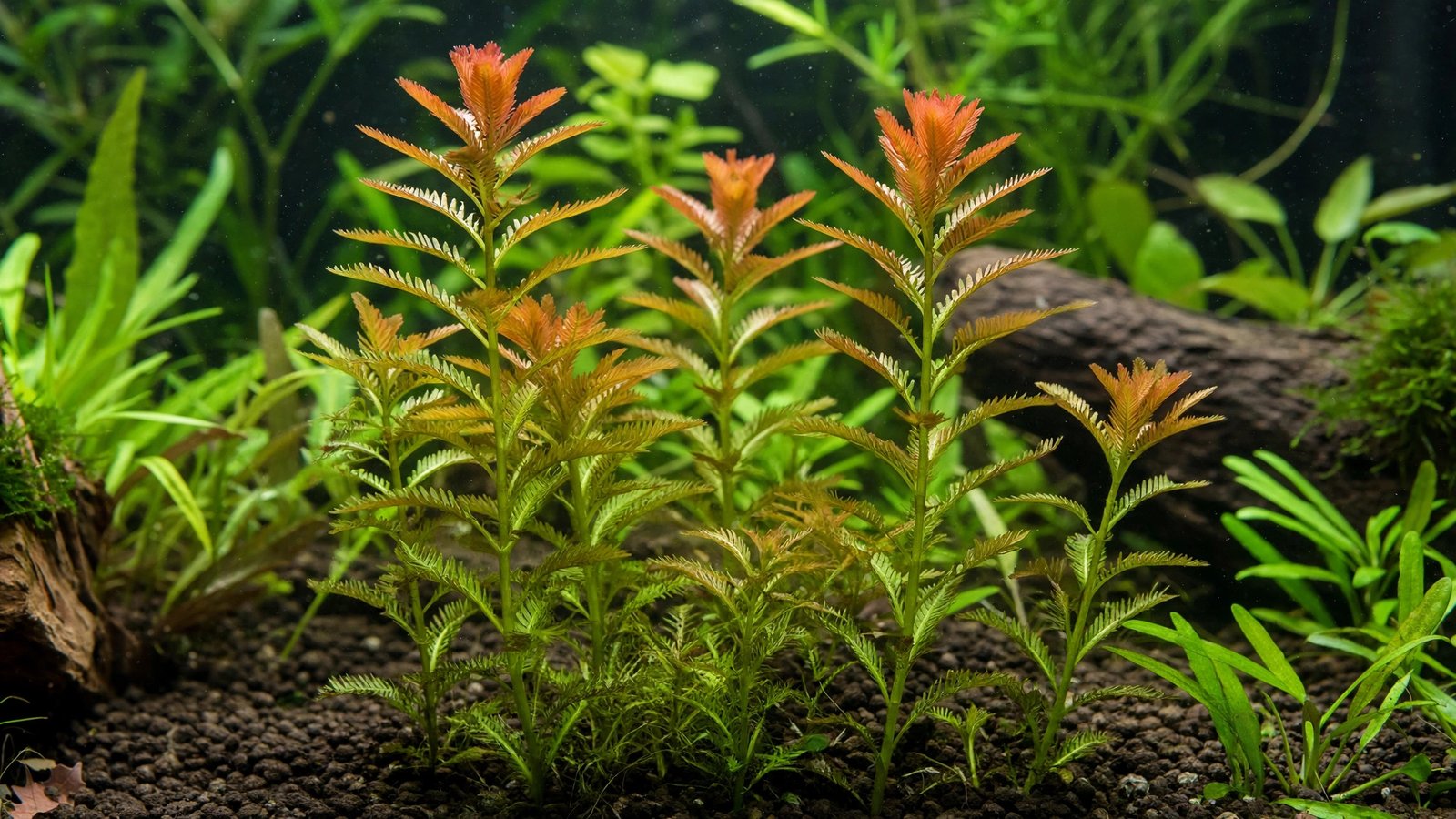
Most aquascapers walk straight past Proserpinaca pectinata in the shop and buy another bunch of limnophila instead — and that is exactly why the ones who do try it end up with something none of their friends can name. This needle-leafed stem plant turns from plain green to a blazing reddish-orange under strong light, at half the price of the trendy rare stems. This Proserpinaca pectinata care guide shows you how to grow it thick and colorful instead of leggy and pale.
What makes Proserpinaca pectinata different
Proserpinaca pectinata is not just a green version of its better-known cousin. Its submerged leaves are thin needles arranged in whorls that give it an almost feathery texture — a look closer to limnophila aromatica than to any other Proserpinaca.
Do not confuse it with Proserpinaca palustris 'Cuba', the copper-orange cultivar most hobbyists mean when they say "proserpinaca." Pectinata's foliage is finer and its color runs redder; they share a genus but not a look, and care advice for 'Cuba' does not automatically transfer.
Proserpinaca pectinata care: light is everything
The headline care rule for Proserpinaca pectinata care is simple: light decides what it looks like. Under medium light it grows fine but stays plain green. Push intensity to 40–60 PAR at the substrate and the new growth turns that coveted reddish-orange from the tips down. The numbers behind this are covered in our guide on how much light aquarium plants actually need.
Run a quality LED panel 7–8 hours a day at 80–100% over a tank 40–60 cm deep, on a timer. Pectinata punishes erratic light with stunted tips. If the lower leaves shed while the tops look fine, the stems are self-shading: thin them and replant the tops.
CO2, water, and nutrients
Technically this plant survives without injected CO2. Practically, you should not grow it without it. With CO2 at 25–30 ppm the stems thicken, the needle leaves lengthen, and coloration intensifies dramatically; without it the plant grows slowly, stays green, and drops lower leaves within weeks. Liquid carbon helps but is no substitute for a pressurized system and a serious fertilization routine.
Pectinata wants soft, acidic water: pH 5.5–7.0, GH 3–8, KH 1–4. Good aqua soil (ADA Amazonia, UNS Controsoil, or similar) buffers pH down and feeds the roots at the same time.
This plant is hungry for iron and micronutrients — pale new growth that never reddens usually means iron is low. Dose a complete micros formula (APT 3, Tropica Specialised Nutrition, or equivalent) 3–4 times weekly at full strength, plus macros to keep NO3 at 10–20 ppm and PO4 at 1–2 ppm.
| Parameter | Target | Watch out for |
|---|---|---|
| Light (PAR at substrate) | 40–60 | Below 30: green and leggy |
| CO2 | 25–30 ppm | Brown or stunted tips signal low CO2 |
| pH | 5.5–7.0 | Above 7.5: slow, faded growth |
| GH / KH | 3–8 / 1–4 | GH above 10 stalls growth |
| Temperature | 22–28 °C | Above 30 °C: melts quickly |
| Nitrate / Phosphate | 10–20 ppm / 1–2 ppm | Zero nutrients: translucent new leaves |
What you need to set it up right
The essentials: a pressurized CO2 system, a strong full-spectrum LED light that reaches 40+ PAR at the substrate, nutrient-rich aqua soil, an iron-rich complete fertilizer, and 30–50% weekly water changes to keep algae from beating this plant to the light.
Buy tissue-culture cups when you can find them — one cup plants out into 15–20 stems, enough for a good midground clump in a 60 cm tank, with no snail eggs or algae spores. Potted stems work too, but quarantine them in a bucket for a week first: emersed-grown stems often melt, and you want to see that before they take down a scape.
Planting and trimming for a dense bush
Separate every stem and plant them individually, 1–2 cm apart. Bunching them the way shops sell them guarantees the inner stems rot and the lower leaves fall off; spacing gives you a full feathery column instead of a bare stalk with a colored tip.
Trim aggressively. When a stem reaches the surface, cut it halfway and replant the top — the stump grows two or three sideshoots within a week. Repeat every 2–3 weeks and a clump becomes a solid bush in about six weeks. Never let stems hit the surface and fold over: bent stems shade everything below and the shaded leaves melt.
Aquascaping with Proserpinaca pectinata
Pectinata shines as a midground focal clump where its fine texture contrasts with broad-leaf plants. Place it 8–12 cm in front of your background stems, beside dark hardscape where the red-orange color contrast is strongest.
It also works as a Dutch-style street: plant three to five rows in a staggered grid for a formal row that reads as a single textured mass. Pair it with other fine-leaf stems like tonina fluviatilis or the new limnophila hippuridoides, and back the group with something bold like sunset hygrophila for a full color gradient from midground to background.
Troubleshooting common problems
Leggy growth with big gaps between leaf whorls: not enough light. Raise intensity, then replant the tops — stretched stems never tighten up on their own.
Green plant, no coloration: light first, iron second. Confirm 40+ PAR at the substrate, then bump micros dosing.
Lower leaves melting: self-shading or low CO2. Thin the clump, and check the drop checker is lime-green during the photoperiod.
Tips browning or curling: a sudden parameter swing — usually a big water change with much harder water, or new fertilizer dosed too heavily. Pectinata tolerates steady sub-optimal conditions but hates sudden change.
Frequently Asked Questions
Is Proserpinaca pectinata hard to grow?
It is intermediate difficulty: hardy as a plant, but demanding if you want color. In a low-tech tank it survives as a plain green stem. For the reddish-orange foliage it is bought for, you need medium-high light, injected CO2, soft acidic water, and steady iron-rich fertilization — a classic high-tech setup.
What's the difference between Proserpinaca pectinata and Proserpinaca palustris 'Cuba'?
They are different species, not color variants. Pectinata has fine needle-like leaves, grows more vertically, and colors red-orange under strong light. Palustris 'Cuba' is a cultivar with broader, comb-like leaves and a copper tone. They look different enough that care advice written for one does not automatically apply to the other.
Does Proserpinaca pectinata need CO2?
It survives without injected CO2 but does not thrive: growth is slow, leaves stay green, and lower leaves shed within weeks. With CO2 at 25–30 ppm, stems thicken, needle leaves lengthen, and coloration intensifies. If you are buying this plant for its look rather than its name, treat CO2 as essential, not optional.
How fast does Proserpinaca pectinata grow?
Moderate by stem-plant standards: expect 3–6 cm per week under high light with CO2. A midground clump becomes a dense bush in roughly six weeks if you trim and replant tops every 2–3 weeks. In low-tech conditions growth nearly stalls.
Why are the lower leaves on my pectinata falling off?
Almost always self-shading or low CO2. Stems planted too close together block light from their own lower leaves, which then melt — space stems 1–2 cm apart and thin the clump when dense. If the whole plant sheds leaves from the bottom up, CO2 is likely too low; confirm a lime-green drop checker during the photoperiod.
One plant, one clear payoff
Proserpinaca pectinata will never be the easiest stem in your tank, but few plants reward good care this visibly: a plain green bunch turns into a feathery red-orange centerpiece in a few weeks of strong light, CO2, and regular trims. Give it space, iron, and stability, and it earns its spot.
For deeper technical detail on this genus, the Tropica plant database covers related Proserpinaca species, and 2hr Aquarist's plant guide is the best free resource on diagnosing coloration issues in red stems.