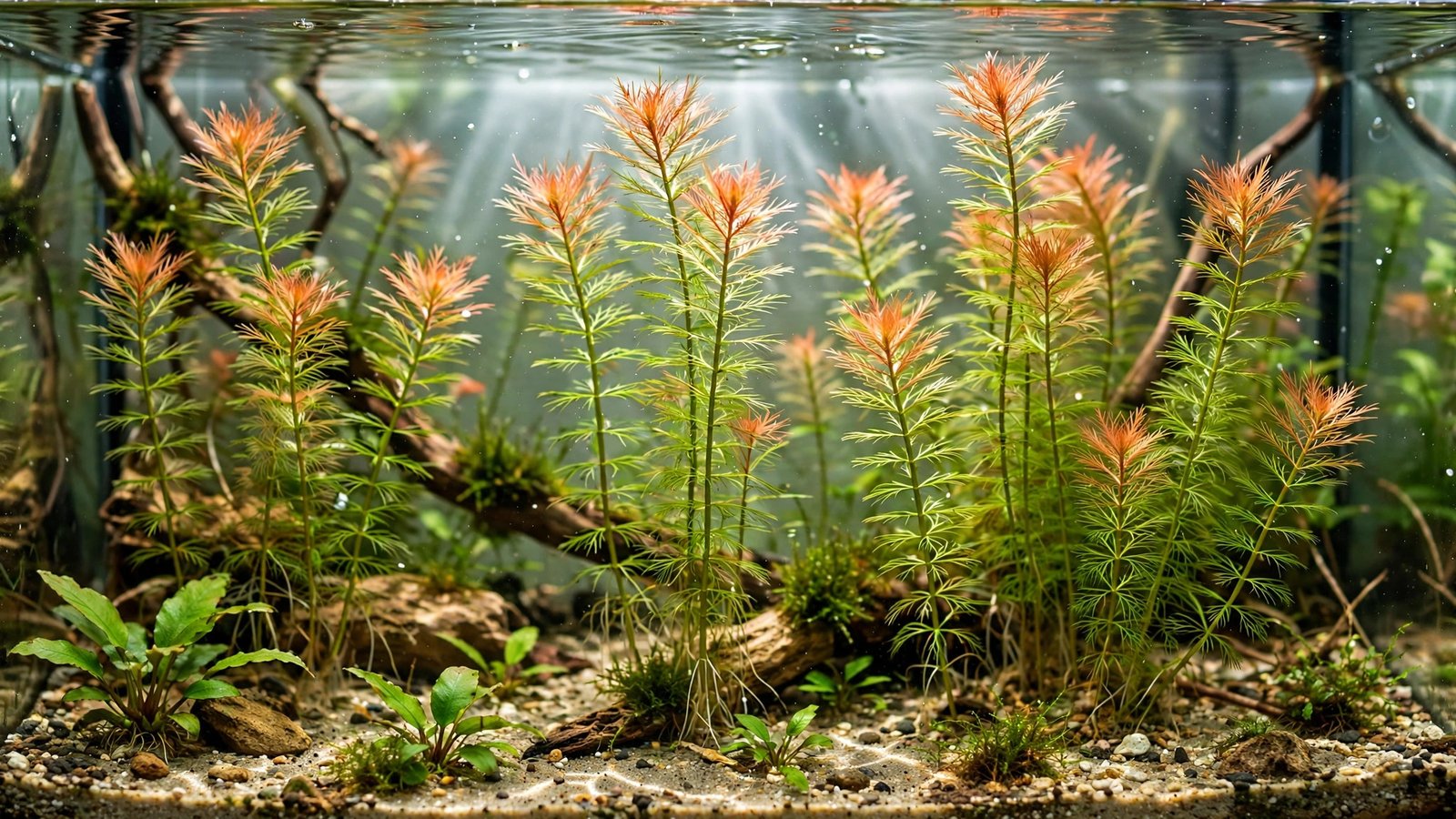
Few aquarium stem plants change their look as dramatically as Proserpinaca palustris 'Cuba'. Out of the cup it arrives with stubby, saw-toothed leaves, and within weeks of settling into a planted tank it transforms into a feathery, needle-leafed plant whose new growth glows in coppery orange-pink under strong light. This proserpinaca palustris Cuba care guide walks you through everything the species needs: high light, pressurized CO2, steady feeding, planting technique, trimming, and the exact conditions that bring out its famous coloration.
What Is Proserpinaca Palustris 'Cuba'?
Proserpinaca palustris is a true aquatic species from the Americas, better known in the United States as mermaid weed, where several native forms grow wild in swamps, ditches, and shallow ponds. The 'Cuba' cultivar is the aquarium-trade form collected from Isla de la Juventud off the coast of Cuba, and it is the one most shops sell today, usually as a sterile tissue-culture cup.
Its signature trait is dimorphism — the emersed and submerged leaf forms look like two different plants. The tissue-culture cup arrives with short, broadly lobed, saw-toothed leaves. After a week or two of acclimation in your tank, those are replaced by long, finely denticulated, needle-like submerged leaves on upright stems, and the whole bush takes on its prized copper tone. Mature stems reach 10–40 cm tall and 5–10 cm wide, making it a true midground-to-background stem for tanks of about 50 litres and up.
One honest caveat up front: this is not a beginner plant. Tropica rates both its light and CO2 demand as high, and aquarists consistently report it as one of the more demanding collector stems. If you are still running a low-tech tank, consider an easier stem like Bacopa caroliniana first, and come back to 'Cuba' once your setup is upgraded.
Quick Care Reference
| Parameter | Target range | Notes |
|---|---|---|
| Light | High, 8–10 h/day | Strong LED with good spread; the single biggest color driver |
| CO2 | ~15–25 mg/L (drop checker green) | Pressurized injection recommended; start low, observe livestock |
| Temperature | 20–28 °C (68–82 °F) | Thrives mid-range around 22–25 °C |
| pH | 5.5–7.0 | Slightly acidic suits it best |
| GH / KH | Soft to moderately soft (GH 3–8) | Tolerates harder water but colors best soft |
| Nitrate / phosphate | Lean but never zero | Starving the plant stalls and pales it |
| Iron / micros | Steady micro dosing | Supports deep red pigmentation in new growth |
| Growth rate | Medium | Slower than most red stems; patience required |
| Placement | Midground / background | 10–40 cm height; plant in groups of 6–8 stems |
| Difficulty | Advanced | High light + CO2 are effectively non-negotiable |
Light Requirements
Light is the single most important variable for Proserpinaca palustris 'Cuba'. Under weak or moderate light the plant survives but grows leggy, keeps its broader leaf form, and stays a dull greenish-brown — you never see the copper foliage that makes it worth growing. Under genuinely strong light, internodes stay tight, the pinnate submerged leaves develop fully, and new growth flushes copper-orange.
Aim for a modern LED fixture known for planted-tank output and run it 8–10 hours daily, with a gentle ramp at both ends of the photoperiod. If you are upgrading specifically for this plant, Rotala H'ra shares almost identical light demands, so guides written for it transfer well here. Dense stands can self-shade lower leaves, so site the group where the fixture's spread reaches it rather than under an overhang or beside hardscape.
Orange-red color needs genuinely strong light: a high-output LED like the NICREW ClassicLED Plus.
 ★4.6
NICREW ClassicLED Plus planted aquarium light
Check Price on Amazon ★4.6CO2 and Fertilizer Needs
This plant's CO2 demand is rated high — roughly 15–25 mg/L during the light period, which in practice means pressurized CO2 with a diffuser and a drop checker sitting at green by lights-on. Without CO2, growth crawls, leaves stay broad and coarse, and the plant is far more vulnerable to algae taking hold on its fine foliage.
The conservative approach matters here. When you first add CO2, start low and raise it gradually over several days while watching your livestock: shrimp and fish are the canaries, and if they show stress, dial it back. Never crank CO2 chasing color — the color follows good overall health, not gas levels alone.
Fertilization should be steady and balanced rather than extreme. A complete liquid fertilizer covering macros (nitrogen, phosphorus, potassium) plus micros (iron, manganese, trace elements) dosed consistently outperforms sporadic heavy dosing. This plant visibly sulks when starved: stunting, pale new growth, and lost leaves at the stem bases. Rich aquasoil as the substrate does a lot of the heavy lifting, but don't rely on it alone in an established tank — keep the water column dosed too. A lean-but-complete regime similar to what works for Rotala wallichii is a good starting template.
Steady water-column feeding supports the color transition: a comprehensive liquid fertilizer.
Proserpinaca Palustris 'Cuba' Care: Planting Guide
Most 'Cuba' is sold as a tissue-culture cup, which arrives pest-free but needs proper handling. Rinse the culture gel off under running water, then divide the mass into 6–8 small portions with sharp scissors or your fingers. Each portion should be a few stems — plant these into a nutrient-rich aquasoil using tweezers, spaced about 3–5 cm apart so light reaches every stem.
Plant the portions deep enough that they won't float out, roughly 2–3 cm into the substrate. Expect a rough first two weeks: the emersed leaves will melt back as the plant switches to its submerged leaf form. This is completely normal — don't pull the stems out thinking they died. As long as the stem bases stay firm and you see tiny new needle leaves emerging, the plant is transitioning correctly.
Trimming, Replanting, and Propagation
Proserpinaca palustris 'Cuba' propagates the way all stem plants do: trim and replant. When a stem nears the surface or the lower leaves start looking ragged, cut it with sharp aquascaping scissors and push the healthy top portion back into the substrate. The cut base left behind will usually sprout two or more side shoots, thickening the bush.
Follow these habits for the cleanest results:
- Trim little and often rather than one harsh cut — regular topping keeps the group bushy and the lower stems lit.
- Replant only firm, healthy tops. Mushy or melting tops rarely recover; compost them and replant sound material.
- Remove melt debris promptly. Dead leaves decaying among fine foliage invite algae and bacteria.
- Thin crowded groups. If a stand gets dense, pull a few whole stems from the center so light and flow reach the interior — circulation matters as much here as it does in any water wisteria thicket.
Because the growth rate is only medium, don't expect the explosive regrowth of fast stems. Give replanted cuttings a full two to three weeks to anchor and resume growing before judging them.
Getting the Orange-Red Coloration
That copper glow is the reason most people buy this plant, and it comes from stacking several favorable conditions at once — not from any single trick.
The color stack, in order of importance
- Strong light. This is the master switch. No amount of fertilizer or CO2 compensates for dim light.
- Consistent CO2. Stable dissolved CO2 keeps new growth vigorous, and vigorous new growth is where the color shows.
- Adequate iron and micronutrients. Iron supports red pigmentation; dose it as part of a complete micro mix, not as an overdose on its own.
- Lean-to-moderate nitrate. Some aquarists push reds by running nitrate lean. Do this carefully: too lean stalls the plant, which kills the color faster than excess nitrate ever would.
- New growth, not old. The color lives in the youngest leaves near the stem tips. A bush that's mostly old, shaded foliage will look drab even in a perfect tank — regular trimming keeps fresh growth coming.
Set expectations honestly: 'Cuba' colors as copper, amber, and orange-pink rather than the screaming scarlet of something like Ludwigia repens. Its beauty is subtler and more textured — a burnished glow rather than a red flag.
Common Problems and How to Fix Them
Transition melting
Emersed tissue-culture leaves melting in the first two weeks is normal and expected. Only worry if the stem bases turn to mush or no new submerged leaves appear after three weeks. Ensure strong light reaches the planting zone and that the stems were planted firmly; replant any that came loose.
Stunting and pinhole leaves
New leaves emerging deformed, tiny, or riddled with pinholes usually points to a nutrient gap — classically potassium or general under-dosing — or to unstable CO2. Check your dosing consistency first, then whether CO2 delivery is actually stable through the whole photoperiod. Similar stunting shows up in Persicaria 'São Paulo' for the same reasons, and the fix is the same: feed the plant and stabilize the gas.
Green, coarse, and leggy growth
When stems stretch with long internodes and keep their broad leaf form, light is the shortfall — raise intensity or move the group into the brightest zone. This is the plant telling you plainly that it can't reach its potential where it is.
Algae on fine foliage
Thread and hair algae love settling on the dense, fine leaves of slow-growing stems. Prevention beats treatment: don't let the group become an impenetrable mat, keep phosphates and organics in check, and trim off badly affected tops rather than fighting them. A shrimp colony can be a helpful cleanup crew, but only add sensitive shrimp once the tank is fully stable.
Lower-leaf loss
Bare, browning stem bases under a healthy canopy are usually shading. Thin the group, trim and replant the tops, and make sure flow moves nutrients to the lower stems.
Tank Mates and Placement
As a 10–40 cm stem, 'Cuba' belongs in the midground of a tall tank or the background of a shallow one, planted in a group so the unusual texture reads from a distance. It pairs beautifully against broad-leafed contrast plants: the soft, round leaves of Bacopa caroliniana or the feather-light spray of Myriophyllum make the copper color pop by contrast.
For livestock, it's an excellent community-tank plant: fully shrimp-safe (tissue-culture stock arrives snail- and pesticide-free) and fine with tetras, rasboras, livebearers, and most peaceful nano fish. Avoid boisterous herbivores and goldfish, which will shred the fine foliage. Large plecos that rasp on fine leaves can also be rough on it. Corydoras and otos are ideal companions — they don't touch it, and their scavenging keeps the lower stems free of debris.
Check the official plant data for the 'Cuba' cultivar, including height, spread, and Tropica's difficulty ratings, on Tropica's Proserpinaca palustris 'Cuba' plant page — a solid cross-reference for everything in this guide.
Frequently Asked Questions
Is Proserpinaca palustris 'Cuba' hard for beginners?
Yes — it's genuinely advanced. It needs strong lighting, pressurized CO2, and consistent fertilization to grow well and color up; without that trio it grows green, coarse, and slow, or melts away. Beginners should build experience with forgiving stems like Bacopa caroliniana or Ludwigia repens first, then graduate to 'Cuba' once their setup supports it.
Can I grow it without CO2 injection?
You can keep it alive without injected CO2, but you won't get the plant you're paying for: the fine needle leaves stay coarse, growth is painfully slow, and the copper color never develops. Liquid carbon products are not a real substitute for a collector stem at this difficulty level. If CO2 isn't an option, pick an easier stem instead of fighting this one.
Why is my plant melting after planting?
Almost certainly it's the emersed-to-submerged transition. Tissue-culture cups grow emersed, and those saw-toothed leaves dissolve over the first one to two weeks as the plant grows its needle-like submerged form. Leave the stems in place as long as the bases stay firm and new leaves appear. If everything melts including the stems, the cause is more likely too little light or unstable conditions.
How do I make it turn copper-colored?
Stack the color drivers: strong light first, then stable pressurized CO2, then steady micro nutrients including iron, with nitrate lean-but-present. The color shows on new growth, so keep trimming and replanting healthy tops to keep fresh foliage coming. Expect copper, amber, and orange-pink tones rather than fire-engine red — that's this plant's natural palette.
How fast does it grow?
Medium-paced — noticeably slower than fast red stems like Rotala or Ludwigia. In good conditions you'll be trimming every few weeks, but it never becomes a maintenance monster. The moderate speed is actually a plus: once a stand is established, it holds its shape longer between trims than fast-growing stems do.
Is it safe for shrimp and sensitive fish?
Yes. The plant itself is completely shrimp-safe, and tissue-culture stock arrives free of snails, algae, and pesticide residue, so there's no contamination risk from the cup. Just be cautious with CO2 levels — high injection rates that don't bother hardy fish can stress sensitive shrimp species, so raise CO2 gradually and watch your livestock.
Bringing It All Together
Proserpinaca palustris 'Cuba' rewards the aquarist who can give it what it asks for: bright light, steady CO2, consistent feeding, and a little patience through the transition. Do that, and you get one of the most texturally unusual red stems in the hobby — a copper-glowing, feathery bush that elevates the whole scape. Skip the CO2 or skimp on light, and you'll own a green, sulking mystery plant. Match the plant to your setup honestly, follow the steps in this guide, and this Cuban native will become the talking point of your tank.