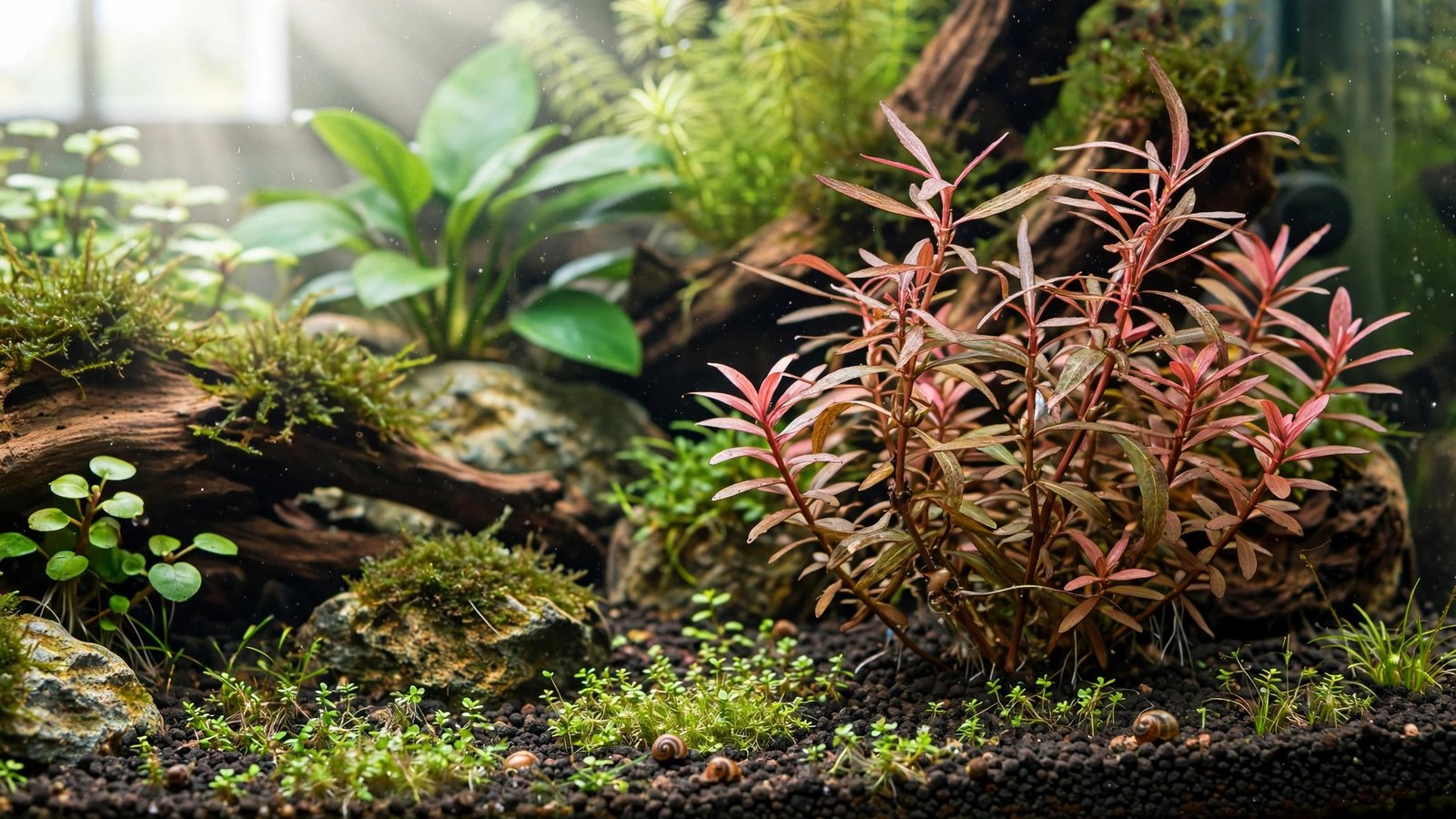
Most "red" stem plants are liars: they arrive green, stay green, and only blush red in the marketing photos. Hygrophila lancea 'Araguaia' is the rare exception that keeps its bargain — but only if you give it what it asks for. This guide to Hygrophila Araguaia care walks you through the exact light, CO2, iron, and trimming rhythm that turns this compact 2–5 inch stem plant from Brazil's Araguaia River into a creeping, bushy patch of reddish-brown to purple. If you're weighing stem-plant options, start with our guide to the best stem plants for beginners, then come back — because this little Brazilian is worth the extra effort.
Hygrophila Araguaia care: Light, CO2, and Water Parameters
Araguaia is no giant. Unlike its towering cousin Hygrophila corymbosa, H. lancea stays a modest 2–5 inches and spreads sideways rather than upward — exactly why aquascapers prize it for foreground-to-midground transitions. It demands no exotic water chemistry: standard tropical conditions (pH 6.0–7.5, 72–82 °F) suit it fine.
Light is the master variable. At medium light the plant grows perfectly well but stays green; at high light the lance-shaped leaves flush reddish-brown to purple, and the undersides turn a violet shade that photographs beautifully against green hardscape. Aim for roughly 50+ PAR at the substrate if color is your goal. CO2 follows the same pattern: the plant survives in low-tech tanks, but pressurized CO2 keeps internodes short, growth dense, and color saturated — the difference here is genuinely dramatic.
| Parameter | Target | Why it matters |
|---|---|---|
| Light | Medium–high; 50+ PAR for color | Strong light is what flips green to red-brown |
| CO2 | ~25–30 ppm (pressurized ideal) | Shorter internodes, denser creeping form — start low, around 15–20 ppm, and increase gradually while you observe your livestock |
| Iron + micros | Dose per product label, weekly | Iron drives the reddish-brown to purple pigment |
| pH | 6.0–7.5 | Undemanding; avoid alkaline swings |
| Temperature | 72–82 °F | Standard tropical range |
How to Get the Red Color (and Keep It)
The most common disappointment is the "green phase": a plant that arrived coppery-purple fades to plain green within a month. That is a light and nutrition signal, not a sick plant. The advertised two-tone look (green tops, purple-violet undersides) shows up only under strong light with steady iron and micronutrients.
The practical fix is simple and works within 2–3 weeks: raise the light intensity (or move the patch closer to your light source), keep CO2 stable, and dose an iron-rich liquid fertilizer on a schedule instead of "when I remember." Plants under bright light without enough iron can look washed-out yellow-red rather than rich brown-purple — color needs both. Feed weekly, keep nitrates and phosphates in normal ranges, and judge only by new growth: old leaves won't change color, but fresh tips tell the truth.
Trimming for the Creeping, Compact Form
Araguaia's signature low, bushy mat doesn't happen on its own. Untrimmed stems reach upward, space their leaves out, and look stringy. The compact form is built entirely by trimming: cut tops every 2–3 weeks just above a node, and the plant answers with side shoots at each cut point. Each trim cycle doubles the bush.
Replant the best trimmings into gaps; the rest propagate the patch outward for free. Never pull or twist stems when thinning — snip and lift, or you'll disturb roots and cloud the tank. Compared to marathon growers like Hygrophila polysperma, Araguaia's slower pace means each trim holds for weeks.
 ★4.7
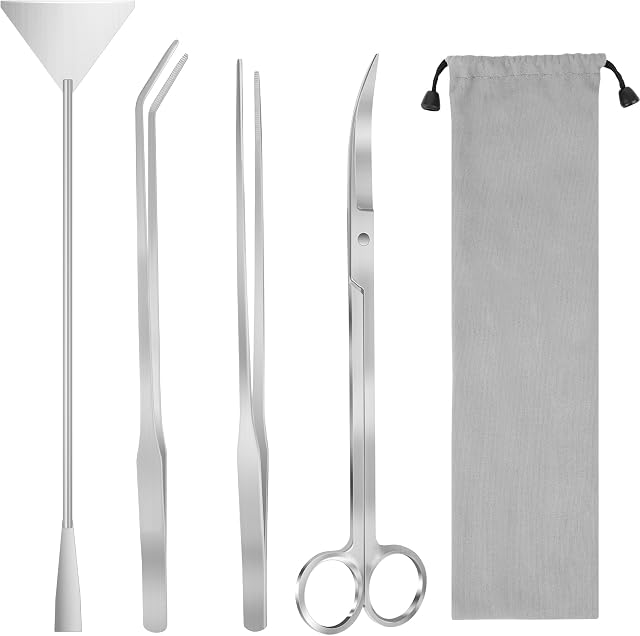
Liveek 4-in-1 Aquascaping Tool Kit
Check Price on Amazon ★4.7Propagation: Side-Shoot Cuttings
Forget seeds — Araguaia multiplies the easy way. Established stems sprout lateral side shoots along lower nodes. Snip one with 3–4 leaf pairs, strip the lowest leaves, and press it into the substrate an inch from its neighbors. Roots form at buried nodes within a week or two.
A single tissue-culture cup fills roughly a 6-inch circle in 6–8 weeks under decent light and CO2. Because each cutting is a clone, color habits carry over — buy stock that already looks the way you want. Tissue cultures are the cleanest start: no pests, no algae hitchhikers.
Where to Place It in Your Aquascape
Araguaia earns its keep in the midground-to-foreground band, where its reddish-brown tones break up green drifts. Pair it with a bright green contrast — Bacopa monnieri or Murdannia keisak — and the color contrast does the design work for you. In larger layouts, use it to edge a "street" of fine-leafed stems the way Rotala indica 'Bonsai' edges miniature tree forms.
Fish and shrimp pose no problems — cherry shrimp grazing the leaves help keep spot algae off the slow-growing foliage. For more Hygrophila texture at the back of the same tank, Hygrophila pinnatifida and Hygrophila siamensis make excellent same-genus companions.
Frequently Asked Questions
Is Hygrophila Araguaia easy to grow?
It is easy–moderate. The plant stays alive in low-tech tanks with basic light and fertilizer, which puts it within reach of beginners. Getting the famous red color and compact creeping form is the moderate part — that requires strong light, stable CO2, and regular iron dosing. Treat it as an easy plant to keep alive and a moderate plant to perfect.
Does Hygrophila Araguaia need CO2?
Not strictly — it grows without injected CO2. But CO2 transforms it: internodes stay short, the bush stays dense and low, and the reddish-brown color intensifies. Without CO2, expect greener, slightly leggier growth and a slower fill-in. If you're running low-tech, compensate with stronger light and leaner expectations rather than skipping the plant entirely.
Why is my Hygrophila Araguaia staying green?
Green Araguaia is a light-and-iron signal, not a sick plant. Medium light keeps it healthy but green; only strong light (roughly 50+ PAR at the substrate) plus steady iron and micronutrients produce the red-brown to purple tones. Check new growth after 2–3 weeks of higher light and weekly iron dosing — fresh tips reveal whether your changes worked.
Why is my new Hygrophila Araguaia melting?
Emersed-to-submerged transition. Growers cultivate Araguaia above water, and those air-grown leaves dissolve within 1–2 weeks of submersion while submerged-adapted leaves sprout from the nodes. It's normal and not a water-quality problem. Leave the stems alone, keep conditions stable, and you'll see fresh growth within about 10 days.
How do you propagate Hygrophila lancea 'Araguaia'?
Snip side shoots with 3–4 leaf pairs, strip the bottom leaves, and plant them an inch apart with tweezers. They root at buried nodes in 1–2 weeks. Trimming the tops also works — replant the cuttings. A single cup becomes a 6-inch patch in roughly 6–8 weeks under good light and CO2.
The Bottom Line on Araguaia
Hygrophila lancea 'Araguaia' is one of the few "red" plants that actually delivers its color in a home tank — provided you pay the price of admission: strong light, stable CO2, weekly iron, and a trim every couple of weeks. Treat it as an easy keeper with moderate ambitions and it will reward you with the compact, coppery-purple midground drift most stem plants only pretend to offer. One responsibility note: some Hygrophila species are invasive or regulated in certain regions, so never release trimmings into local waterways and check your local regulations before buying. For retailer care notes, check the Hygrophila lancea 'Araguaia' page at Buce Plant and the Hygrophila Araguaia profile on Fish Laboratory for a second opinion.