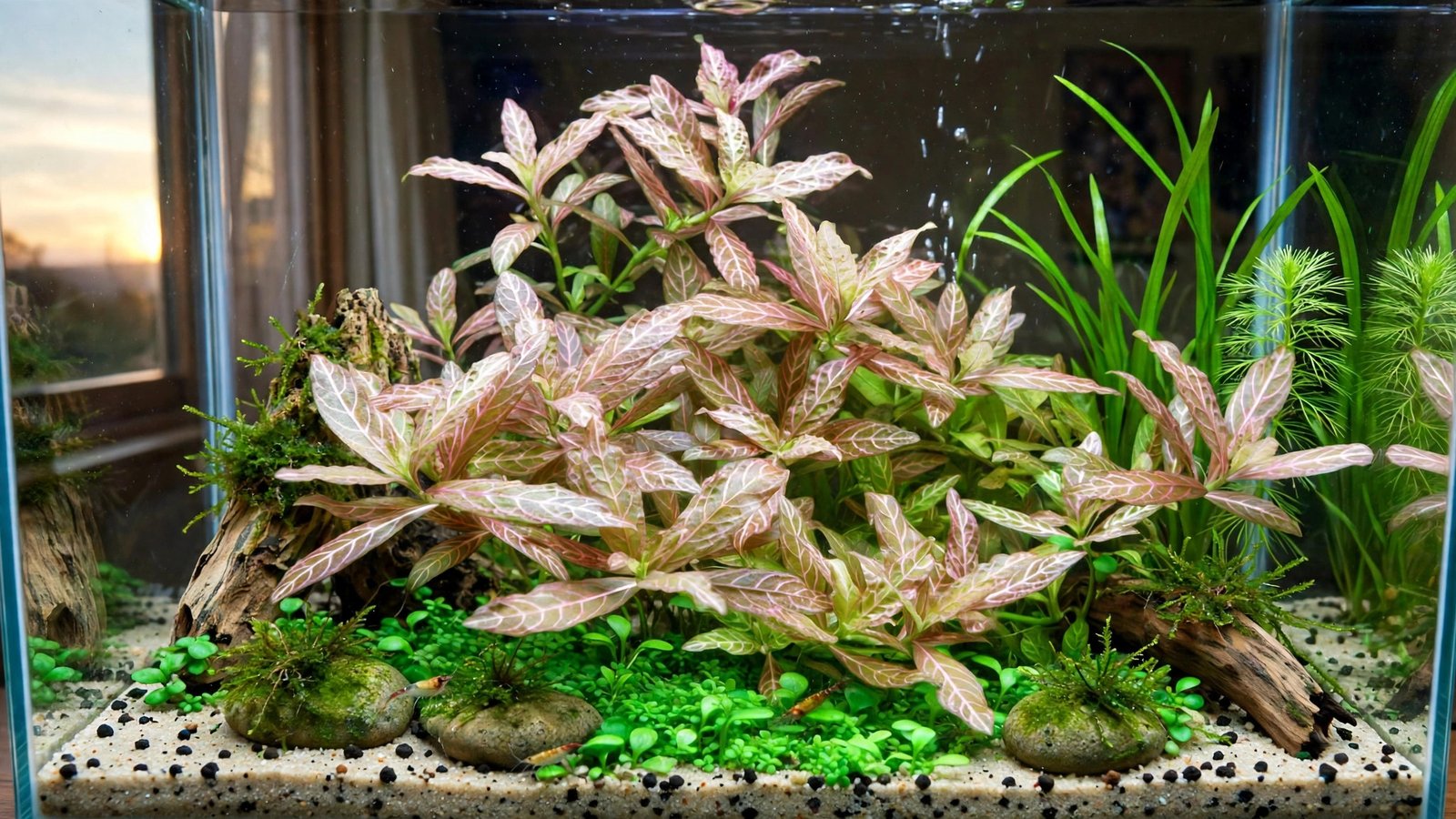
Imagine a plant with the toughness of the world's easiest aquarium weed, painted with pink-streaked white veins that glow under bright light. That is Sunset Hygro — and this Sunset Hygro care guide shows you how to keep that pink variegation glowing instead of watching it quietly revert to plain green.
What Makes Sunset Hygro Different From Regular Polysperma
Sunset Hygro — sold in Europe as 'Rosanervig' ("red-vein") — is a lab-selected cultivar of Hygrophila polysperma developed by the Danish nursery Tropica in the 1980s. It inherits the parent's near-indestructibility, so if you know the Hygrophila polysperma care guide basics, you already know most of what this plant needs. The difference is the variegation. The white-and-pink leaf veins are believed to be caused by a virus that blocks chlorophyll production around the veins — a virus specific to this cultivar and harmless to every other plant in your tank. Flowgrow's aquatic plant database confirms this and notes that strong light plus CO2 drives the deepest color. Because of it, 'Rosanervig' is a fast-growing weed with a cosmetic condition you must actively maintain. Left alone, the plant slowly overcomes the variegation, green shoots appear, and within a few months the "sunset" is gone. Green polysperma is a pet; Sunset Hygro is a garden you prune.Sunset Hygro care: Light and Color
Light is the single biggest lever on this plant. It survives anywhere from 20 to 120+ PAR, but the pink you paid for only appears in a specific window:| Light at leaf level | What you get |
|---|---|
| Low (20–35 PAR) | Mostly green, faint white veins, leggy |
| Medium (40–60 PAR) | White marble veining; pink blush near the light |
| High (60–90 PAR) | The "sunset": deep pink-salmon tops with white veins |
| 100+ PAR | No extra color — just faster growth and algae risk |
 ★4.6
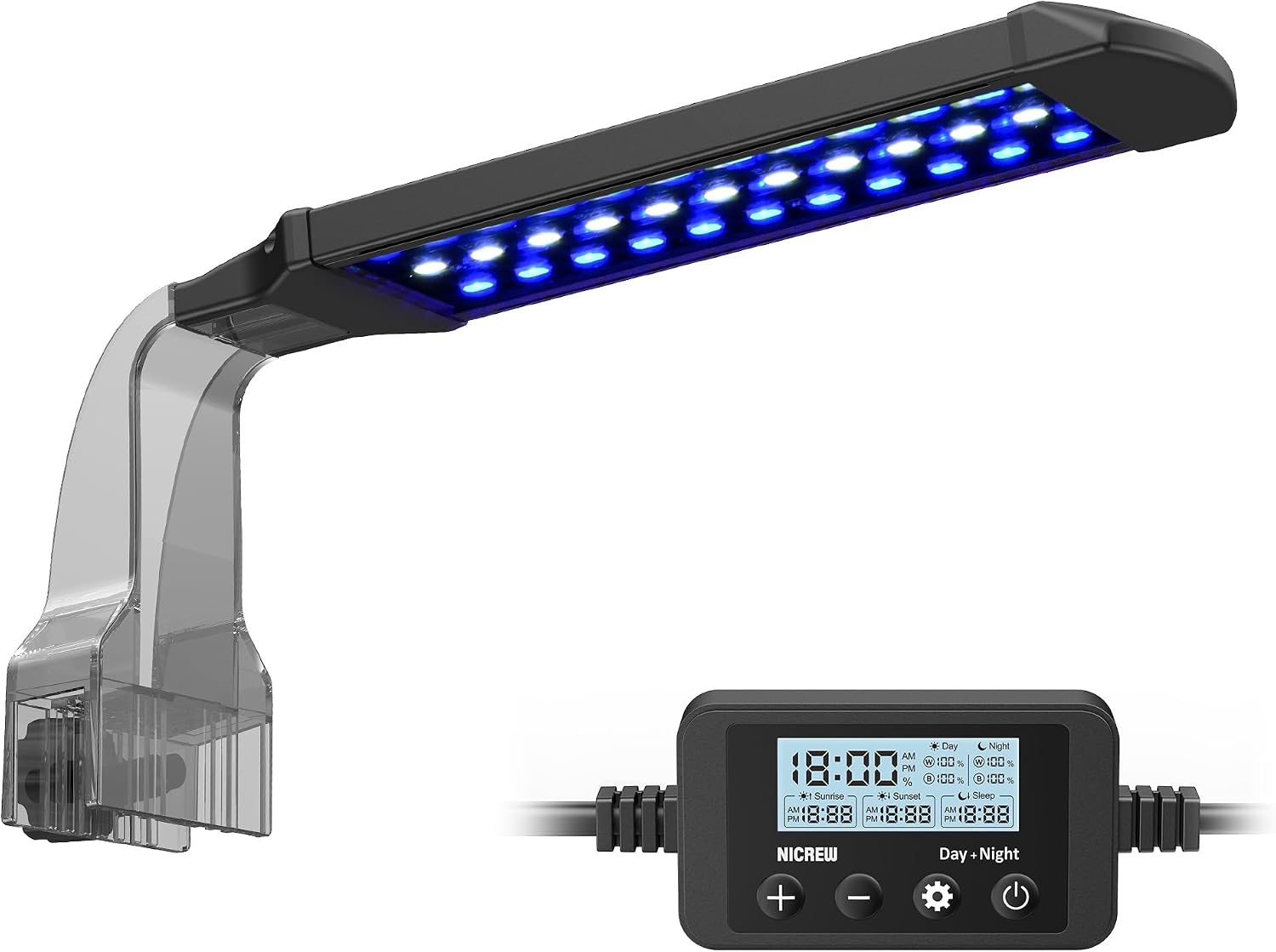
NICREW ClassicLED Plus planted aquarium light
Check Price on Amazon ★4.6Planting and Tank Setup
Plant it like any stem: push each stem 2–3 cm into the substrate, spaced 3–4 cm apart in groups of 5–7. Planting densely from day one matters — crowded stems grow up instead of creeping horizontally along the substrate, a habit this cultivar shares with its parent under strong light. It roots in sand, gravel, or aquasoil and tolerates the full 18–28 °C range plus soft-to-hard water, which is why it ranks among the easiest aquarium plants for a beginner community tank and fits comfortably into any aquarium plants for fish tank guide setup. Site it midground-to-background in the brightest column of the tank: it reaches 20–40 cm and forms a dense pink bush within 4–6 weeks.Trimming, Reversion Control, and Propagation
Two things happen on a timer, and you must intervene for both. Reversion first. Every week or two, scan for any shoot that is entirely green — no white veins, no pink. It has more chlorophyll, so it grows faster than your pink stems and will outcompete them. Cut reverted shoots at the base the day you spot them, and propagate only from stems showing the full pattern. Cuttings taken from green shoots grow into plain H. polysperma forever. Then the trim cycle. Cut stems 8–10 cm above the substrate every 2–3 weeks, replant the pinkest tops, and leave the rooted bases — each cut node sprouts 2–3 lateral shoots within a week. Hedging the whole bush every 3 weeks gives the densest result. The Hygrophila siamensis care guide follows the identical top-and-replant rhythm, while the Hygrophila pinnatifida care guide shows the contrasting epiphytic trimming style. Floating broken leaves also sprout plantlets at their nodes — fish them out if you don't want volunteers.Fertilizer and CO2
Sunset Hygro survives on fish waste alone, but looking like the photos needs more. Keep nitrates at 10–20 ppm and phosphates at 1–2 ppm; slightly higher phosphate (2–3 ppm) also helps suppress the horizontal creeping habit under strong light. Dose a complete liquid fertilizer 2–3 times weekly at label rates, plus the iron supplement on alternate days. If older leaves develop pinholes, add potassium. CO2 is optional for growth but transformative for color: 20–30 ppm (drop checker light green) deepens the pink within 2–3 weeks and produces much bushier branching. Running low-tech? Maximize light and iron instead — you can still get attractive marble-white variegation.The Invasive-Species Question (Read This)
Honesty matters: 'Rosanervig' carries the same invasive-species status as regular H. polysperma — a federal noxious weed in the United States, established in Florida, Texas, and other warm states. The pink leaves don't make it any less capable of choking a waterway. Never release trimmings into drains, ponds, or local waterways — bag and bin them, and check your local rules before ordering. If you want similar fast stems with less fraught legal status, the Hygrophila Araguaia care guide and the Hygrophila corymbosa care guide are good starting points.Frequently Asked Questions
Why is my Sunset Hygro turning completely green?
It is reverting — the cultivar's variegation is unstable, and under lower light the plant can grow out fully green shoots. Remove every all-green stem at its base immediately, since these outcompete the pink ones. Keep light at 50–80 PAR on the top leaves and propagate only from stems showing the full white-vein pattern.
Do I need CO2 for Sunset Hygro?
No — it grows fast without CO2. But CO2 is the difference between a green-white plant and a deep-pink one: 20–30 ppm combined with 60+ PAR deepens the pink within 2–3 weeks and produces bushier branching. If you run low-tech, maximize light and iron dosing instead; you can still get attractive marble-white variegation.
How do I propagate Sunset Hygro?
Cut a healthy top 8–10 cm long and replant it — it roots in 7–10 days. The rooted base sprouts 2–3 lateral shoots from each cut node within a week. Always take cuttings from the pinkest, most variegated stems; cuttings from reverted green shoots grow into plain H. polysperma.
Is Sunset Hygro invasive like regular H. polysperma?
Yes — same species, same status, including federal noxious weed listing in the US. The variegation doesn't reduce its ability to establish in warm waterways. Never release trimmings outdoors or into drains; bag and bin them. Check your state or country rules before ordering, and buy sterile tissue-culture cups.
How much light does Sunset Hygro need to turn pink?
Target 50–80 µmol PAR at the top leaves with a 7–8 hour photoperiod — medium-high light, usually the center column under a decent LED on a 60 cm tank. Below ~35 PAR you get green leaves with faint veins; above 60 PAR the pink intensifies. Iron at 0.05–0.1 ppm is the other half: without it, well-lit leaves wash out pale white instead of pink.