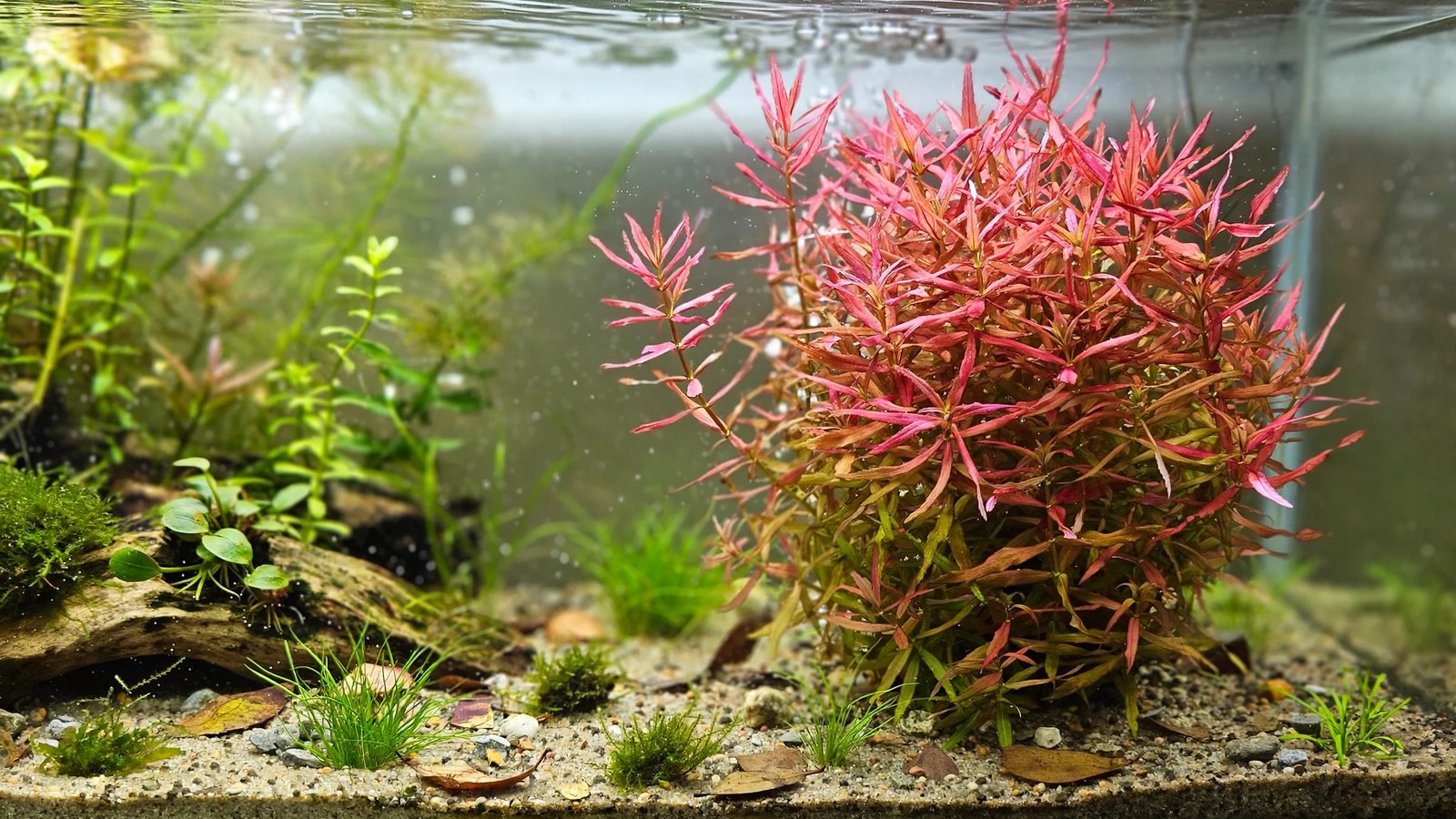
Here is a plant that punishes lazy placement but rewards effort like almost nothing else in the hobby: add enough light and CO2, and Limnophila aromatica care pays you back with glowing red shoot tips and a citrusy scent that no other stem plant offers. Most people fail with it for one simple reason — they treat it like its easy-going cousin L. sessiliflora, when this species demands a genuinely high-tech tank. By the end of this guide, you will know exactly what aromatica needs to turn crimson, how to plant and trim it for dense bushes, and how to stop the dreaded bottom-up melting.
What Limnophila Aromatica Actually Is
Limnophila aromatica is a marsh herb from Southeast Asia — Vietnam, Cambodia, Malaysia and beyond — where it grows in flooded rice paddies during the wet season and on damp harvested fields afterwards. That is why it carries the common name "rice paddy herb," and why Vietnamese cooks know it as ngò ôm, a fragrant garnish for soups and curries. It was introduced to the West through Vietnamese communities and later adopted by aquarists who discovered its submerged form is one of the most colorful stem plants available.
Underwater, the plant transforms completely. It produces upright stems clad in narrow, pointed leaves that grow in opposite pairs along the whole length. The leaf tops run green to rust-red, and the undersides carry a purple blush that intensifies under strong light. Crushed leaves release a distinctive citrusy aroma, which is where the species name comes from.
Why Aquascapers Love It (and Why It Stings Beginners)
Aromatica earns its place in high-end layouts for three reasons no single alternative offers together: color (shoot tips shifting green through rust-red to crimson under high light), texture (fine, feathery opposite leaves that contrast against broad-leaf plants), and a citrusy scent you can smell when you run your fingers through the water. The sting is that this is a high-tech plant wearing a humble herb's name. Shops sell it alongside easy stems, and newcomers who treat it like sessiliflora get leggy, leaf-dropping disappointment. Treat it as demanding from day one and you will never be disappointed.
Care Parameters: The Numbers That Matter
Stop guessing and give the plant measurable targets. The table below is the setup aromatica reliably thrives in:
| Parameter | Target range | Why it matters |
|---|---|---|
| Light (PAR at substrate) | 60–80+ µmol/m²/s | Below ~50 PAR, internodes stretch and lower leaves drop; red color never develops. |
| CO2 concentration | ~30 ppm (drop-checker lime green) | The single biggest lever for compact growth and color; poor distribution causes base melt. |
| Nitrate / phosphate | 10–20 ppm NO3 / 1–2 ppm PO4 | Aromatica is a heavy feeder; starvation shows as pale new growth. |
| Substrate depth | At least 5 cm, nutrient-rich | Thin, delicate stems break and rot when forced into shallow or inert gravel. |
| Water flow | Gentle, tank-wide circulation | Stagnant lower layers starve the base of CO2 and nutrients, triggering melt. |
| Temperature | 22–28 °C | Matches its tropical paddy habitat; cooler tanks slow growth noticeably. |
Light: the non-negotiable
Aromatica is one of those plants where light is not just about growth speed — it is the color switch. Run your lights 7–8 hours daily at high intensity and you will see the top 5 cm of every stem flush rust-red within 2–3 weeks of planting. Raise lights higher off the tank if algae appears; 10–15 cm of extra height dramatically reduces the CO2 and nutrient load the tank must carry, and this trick is one of the fastest ways to stabilize a new aromatica layout.
CO2: recommended means required
Sellers often write "CO2 recommended" for this plant. In a display tank, read that as required. Pressurized injection targeting roughly 30 ppm, on one hour before lights-on and off one hour before lights-off, transforms aromatica from a spindly survivor into a dense, upright bush.
Fertilization: feed the column and the roots
Feed from both directions. A nutrient-rich aquasoil or dirted base gives roots what they need, while a full water-column routine (EI or PPS-Pro style) keeps the demanding upper growth deep green-to-red. Add root tabs near each planting group every 8–12 weeks, because aromatica's dense root mass exhausts local substrate nutrients fast.
The 60-80+ PAR demand needs a real planted-tank light: a full-spectrum planted light like the NICREW ClassicLED Plus.
 ★4.6
NICREW ClassicLED Plus planted aquarium light
Check Price on Amazon ★4.6Planting Technique: Delicate Stems Need a Gentle Hand
Limnophila aromatica has famously fragile stems that snap at the nodes if you bully them. Handle each stem by its top, not its base, and follow this sequence:
- Prepare a nutrient-rich substrate bed at least 5 cm deep where the group will go.
- Trim off any mushy or blackened lower portions from each stem, leaving at least 10 cm of healthy growth.
- Space stems 2–3 cm apart in loose groups of 5–7 — crowding shades the bases and invites rot.
- Push each stem just deep enough to stand upright, about 2–3 cm. Never force it down hard; a damaged stem rots and lifts within days.
- Push one root tab into the substrate under every group before you flood the tank.
Planting deeper substrate and spacing stems generously are the two steps beginners skip, and both are the difference between a group that takes root in a week and one that floats up on day three.
Trimming and Propagation: How to Build the Bush
Aromatica responds to pruning better than most red stems. When a stem reaches the surface or the lower half starts looking sparse, cut the top 10–15 cm off just above a leaf node and replant the cutting beside the parent. The parent stump almost always pushes out two or more side shoots from the nodes below the cut, so one trimming pass thickens your group instead of merely resetting its height.
Repeat this cut-and-replant cycle every 3–4 weeks and a starter group of five stems becomes a dense background hedge within two months. Remove and discard only the genuinely exhausted stumps — woody, leafless sections that no longer sprout after two trims.
Heavy trimmers need steady water-column feeding: a weekly liquid fertilizer like API Leaf Zone.
The Emersed Form: Flowers and Fragrance
Taken above the waterline — in a paludarium, a riparium planter, or a damp nursery tray — Limnophila aromatica grows its original marsh form. Leaves become broader, rounder and more deeply scented, and the plant rewards you with small orchid-like purple-blue flowers. If you run an open-top tank, let a few stems break the surface and watch the transition happen over 2–3 weeks. Emersed-grown cuttings planted back underwater convert within a week or two — a normal, if slightly alarming, adaptation. Many aquascapers keep an emersed mother tub going as a free, endless source of cuttings.
Troubleshooting: Stopping the Melt
Aromatica's failure modes are specific and fixable. Diagnose by symptom:
| Symptom | Likely cause | Fix |
|---|---|---|
| Bottom-up stem rot, leaves disappearing from the base | Poor flow/CO2 distribution in the lower layer | Redirect filter output or add a small powerhead; confirm drop checker is lime green at the substrate |
| Leggy stems, long gaps between leaf pairs, no red color | Insufficient light (under ~50 PAR at substrate) | Raise intensity or lower the fixture; aim for 60–80+ PAR |
| Pale, yellowish new growth | Macronutrient or iron deficiency | Increase nitrate/phosphate dosing; check iron levels and dose a chelated iron supplement |
| Stems float up days after planting | Stems forced into shallow or compacted substrate | Replant gently into at least 5 cm of loose substrate; add root tabs |
| Algae coating the upper leaves | Excess light relative to CO2/nutrients | Raise the light fixture 10–15 cm, shorten photoperiod to 7 hours, verify 30 ppm CO2 |
One rule of thumb from veteran growers: if the tops look great but the bases melt, the problem is almost never the substrate — it is CO2 or flow not reaching the lower leaves. Fix gas distribution and water movement before tearing up the tank.
Aromatica vs. Sessiliflora: Do Not Confuse Them
These two Limnophila species are sold side by side and look similar in the shop, but they are different plants with different demands. If you have already grown the sessiliflora care guide's subject, reset your expectations:
| Trait | L. aromatica | L. sessiliflora |
|---|---|---|
| Light demand | High (60–80+ PAR) | Low–medium |
| CO2 | Injected ~30 ppm strongly advised | Optional; thrives without it |
| Color potential | Crimson-red shoot tips, purple undersides | Mostly green, slight red at tips |
| Aroma | Distinct citrus scent when crushed | None notable |
| Leaf arrangement | Opposite pairs | Fine whorls |
| Difficulty | Moderate–hard | Easy |
Beginners who want a guaranteed win should start with sessiliflora and graduate to aromatica once CO2 is dialed in. For other red accents with different temperaments, Rotala rotundifolia gives pink-red tones at medium light, Ludwigia repens offers bold red leaves with simpler demands, and a red tiger lotus adds a broad-leaf crimson centerpiece without needing stem-plant trimming.
Where It Fits in Your Layout
Aromatica is a background plant in standard tanks — 40–60 cm deep layouts let its 20–45 cm stems form a proper rear hedge. In nano tanks under 30 cm, treat it as a midground accent and trim aggressively, or it will shade everything beneath it within weeks. Its fine texture pairs well with bold foregrounds and broad midground plants: try it behind a carpet and beside Cabomba caroliniana, whose whorled fans make aromatica's opposite-paired leaves look even sharper. If the whole high-tech package feels like too much, Hygrophila polysperma survives almost anything, and Bacopa caroliniana even shares a light lemon scent when crushed — a gentle aromatic alternative while you build your skills.
Externally, the Limnophila aromatica species overview covers its botany and culinary history, and Buce Plant's aromatica care sheet gives a retailer's parameter summary that lines up well with the targets above.
Frequently Asked Questions
Can Limnophila aromatica grow without CO2?
It can survive without injected CO2, but it will not thrive or color up. Expect leggy green growth, slow spread, and frequent base melt in a low-tech tank. Liquid carbon helps marginally but is no substitute for gas. If you are committed to no-CO2, choose sessiliflora instead and revisit aromatica once you add pressurized CO2 — the difference is night and day.
Why are my aromatica stems melting from the bottom up?
Bottom-up melt almost always means poor CO2 or nutrient delivery to the lower leaves, not bad substrate. Dense groups shade their own bases, and stagnant water lets the lower layer starve. Thin the group, improve flow toward the planting zone, and verify your drop checker reads lime green near the substrate — then replant fresh cuttings of the healthy tops.
How do I get the red tips?
Red tips need three things together: high light (60–80+ PAR at substrate), stable CO2 around 30 ppm, and adequate nitrate and iron. Light alone gives a rusty tint; CO2 and nutrients unlock the true crimson. Give the plant 2–3 weeks after any parameter change before judging color, since new growth must emerge under the improved conditions.
Is Limnophila aromatica the same as Limnophila sessiliflora?
No — they are different species often confused in shops. Aromatica has opposite-paired pointed leaves, a citrus scent, red color potential, and high light/CO2 demands. Sessiliflora has fine whorled leaves, no scent, and grows easily in low-tech tanks. Check the comparison table above before buying, so you bring home the plant your tank can actually support.
Can I eat Limnophila aromatica from my tank?
Emersed-grown aromatica is sold as the herb ngò ôm in Vietnamese cooking, but do not eat plants from your aquarium. Tank water contains fertilizers, algaecides, and fish medications that are not food-safe. Grow a separate emersed pot in clean soil if you want the culinary version — it is easy and produces the strongest aroma.
How fast does it grow, and how often should I trim?
Under high light and CO2, expect 3–5 cm of new growth per week — medium-fast for a demanding stem. Trim every 3–4 weeks by cutting the top 10–15 cm and replanting the cuttings. The parent stumps branch from lower nodes, so each trim pass thickens your group. Remove only stumps that stay bare after two trims.
Final Word
Limnophila aromatica is a plant that tells the truth about your tank: give it strong light, honest CO2, and real fertilizer, and it answers with crimson tips and citrus on your fingers. Skimp on any one of those and it will tell you about that too, usually by melting from the base up. Dial in the parameters above, plant it gently, trim it boldly, and you will have one of the most rewarding background stems in the hobby.