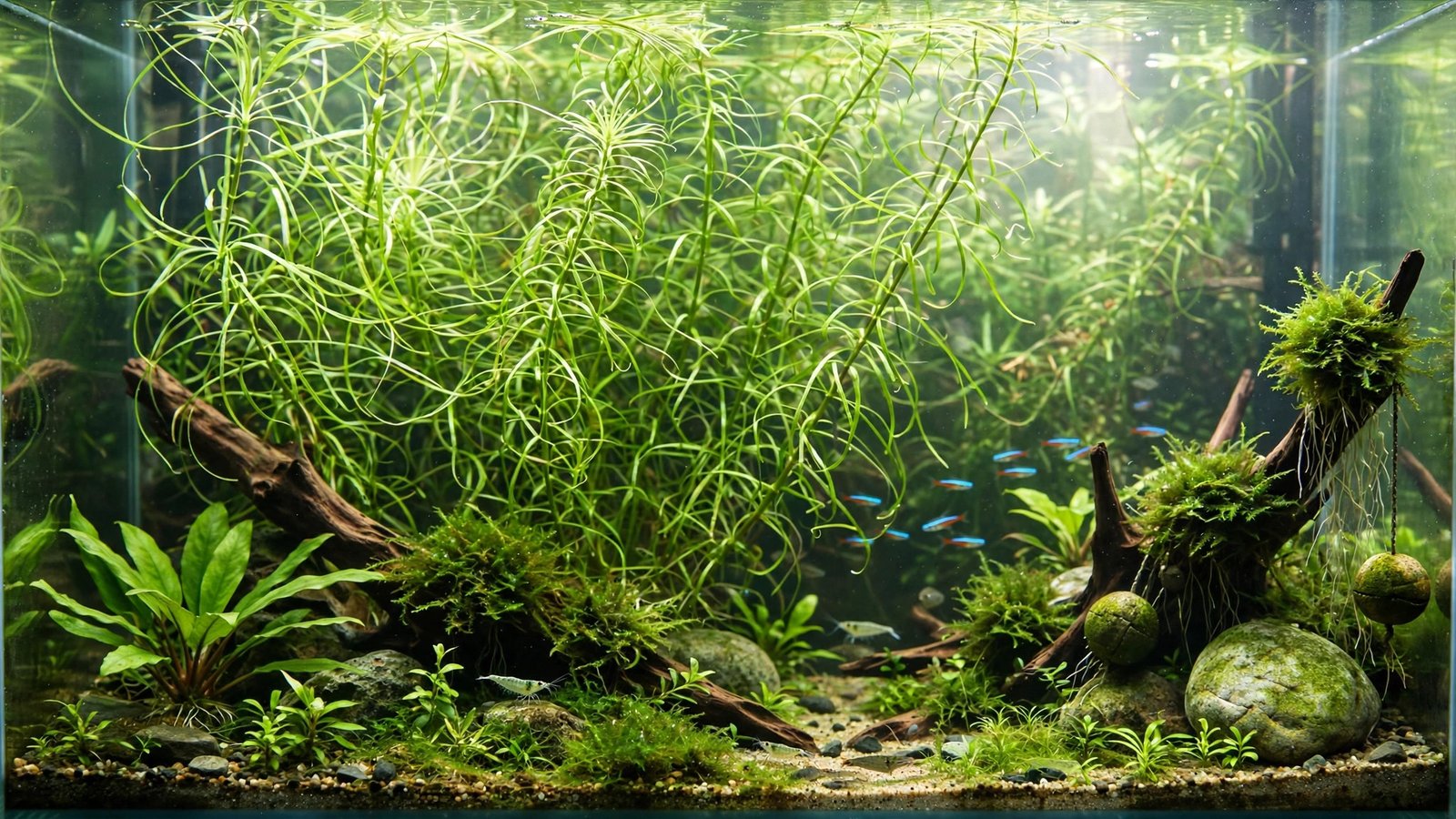
Most fast-growing background stems look alike — straight, green, forgettable. Pogostemon stellatus 'Octopus' is the exception. Its fine, whorled leaves twist and curl like corkscrews, and under strong light the whole stem blushes bronze. By the end of this Pogostemon stellatus care guide, you'll know exactly how much light and CO2 this curly showpiece demands, how to stop its lower leaves melting, and why it punishes skimping on iron.
Pogostemon Stellatus Care: Light, CO2 and Trimming
Pogostemon stellatus 'Octopus' is a cultivar of the Southeast Asian stem plant, selected for leaves that stay narrow, rippled, and densely whorled around the stem. Tropica rates the species as advanced — but in a well-lit CO2 tank it behaves like one of the best stem plants for beginners: it roots fast, forgives a rough trim, and fills the background in weeks.
Light: the non-negotiable
Light is where this plant is won or lost. At 60–100 PAR at the substrate with an 8–9 hour photoperiod, 'Octopus' grows compact with tight whorls and bronze-tipped new growth. Below ~40 PAR the internodes stretch, the leaves flatten and lose their signature curl, and the lower third of the stem goes bare within a month. If you are unsure what your fixture delivers, check how much light aquarium plants need — under-lighting is the most common reason this plant fails.
CO2 and fertilizing
CO2 at 25–30 ppm (a full green drop checker) is where growth turns explosive — 2–3 cm of new growth per week is realistic. It survives at ambient CO2, but growth is slow, lanky, and the curl never fully develops. 'Octopus' is a hungry feeder: nitrate 10–20 ppm, phosphate 1–2 ppm, and critically, chelated iron dosed 2–3 times per week. The classic deficiency signal is unmistakable: new leaves emerge pale, almost translucent. That means iron or micronutrients are short — dose a complete micro mix. A nutrient-rich substrate (aquasoil) plus lean-but-complete water-column dosing is the safest setup.
Planting and first two weeks
Buy bunches or pots, strip any rockwool, and plant individual stems 4–6 cm apart with tweezers, burying 2–3 cm of the base. Crowding them is a false economy — the lower leaves starve for light and melt within days. In the first week, expect some transition melt as emersed leaves are shed; don't panic. Pick off the melted leaves, leave the stems in place, and you should see firm new submerged whorls within 10–14 days.
Water Parameters
| Parameter | Target range | Notes |
|---|---|---|
| Temperature | 22–28°C (72–82°F) | Growth stalls below ~20°C |
| pH | 6.0–7.0 | CO2 injection naturally lands here |
| GH / KH | 3–8 dGH, 2–5 dKH | Prefers soft to moderately soft water |
| Nitrate (NO3) | 10–20 ppm | Hungry plant — don't starve it of N |
| Phosphate (PO4) | 1–2 ppm | Balance with nitrate 10:1 |
| Iron | 0.3–0.5 ppm | Pale new leaves = dose more micros |
Trimming and Propagation Schedule
Fast growth means frequent scissors. A two-week rhythm keeps the background dense instead of leggy:
| When | Task | How |
|---|---|---|
| Day 0 | Plant out | Stems 4–6 cm apart, 2–3 cm buried |
| Week 2–3 | First trim | Cut tops just above a node when stems reach 15–20 cm |
| Same day | Replant tops | Top cuttings (8–10 cm) replant next to the bases |
| Every 10–14 days | Maintenance trim | Alternate: trim the front row one week, back row the next |
| Monthly | Rejuvenate | Pull the oldest woody bases; they sprout side shoots but never look new again |
The cut tops replant instantly — within a week they throw roots and keep growing, so one bunch becomes a full stand in a month. The leftover bases sprout two or three side shoots from the cut node, doubling the clump. It layers well with other fast backgrounds — Rotala wallichii or Limnophila sessiliflora — but put the slowest grower at the front so nothing gets shaded out.
Common Problems and Fixes
| Symptom | Likely cause | Fix |
|---|---|---|
| New leaves pale or white | Iron / micronutrient deficiency | Dose complete micros 2–3× weekly; target 0.3–0.5 ppm Fe |
| Bare lower stems | Too little light reaching the base | Space stems wider, raise PAR to 60+, stagger trims |
| Stems suddenly stop growing | CO2 dip or nutrient exhaustion | Check CO2 (green drop checker), resume EI dosing |
| Heavy melt in first week | Emersed-to-submerged transition | Normal — remove melted leaves, wait 10–14 days |
| Holes in older leaves | Potassium shortage | Raise K to ~20 ppm via K2SO4 |
One quirk worth knowing: even in dialed-in tanks, stellatus occasionally pauses growth for a week or two for no visible reason, then resumes. As long as stems stay firm and green, ride it out. For contrast planting, many aquascapers pair its fine curl with a bold red — Alternanthera reineckii pops against the bronze-green whorls. If you wanted something smaller, remember this is the opposite end of the Pogostemon family from the compact foreground rosette Pogostemon helferi (Downoi) — same genus, nothing else.
Frequently Asked Questions
Does Pogostemon stellatus 'Octopus' need CO2?
It survives without CO2 but never thrives. At 25–30 ppm it grows 2–3 cm per week with tight curly whorls; without CO2, growth is slow, stretched, and the curl largely disappears. For a low-tech tank, look at the easiest aquarium plants for a beginner community tank instead.
Why are the bottom leaves of my stellatus melting?
The lower leaves are light-starved — the canopy above shades them out. Space stems 4–6 cm apart, keep PAR at 60+ at the substrate, and stagger your trims so heights vary by 5–10 cm. In the first week, some melt is normal emersed-to-submerged transition; persistent bare stems mean the light genuinely isn't reaching down.
How fast does 'Octopus' grow?
Fast in the right conditions: 2–3 cm of new growth per week with strong light, CO2, and complete fertilization. One bunch can become a full background stand in 4–6 weeks through the cut-and-replant cycle. Without CO2, expect a quarter of that pace at best.
What's the difference between Pogostemon stellatus and Pogostemon helferi?
They share a genus and nothing else. P. stellatus is a tall (30–60 cm), curly-leaved background stem that grows fast and needs strong light and CO2. P. helferi (Downoi) is a compact, curly-leafed foreground rosette that stays under 10 cm, grows slowly, and is far less demanding. Buying one expecting the other is a common, expensive mistake.
Why did my stellatus turn pale almost overnight?
Sudden pale or white new leaves almost always mean micronutrients — usually iron — ran out. 'Octopus' burns through micros fast. Dose a complete chelated-iron micro mix 2–3 times per week and target 0.3–0.5 ppm iron. You should see normal green growth at the tips within 7–10 days. Check the full reference data on Tropica's Pogostemon stellata plant page for the baseline requirements.
The Curly Background That Rewards Commitment
Pogostemon stellatus 'Octopus' is not a plant you buy for an easy life — it's one you buy because nothing else looks like it. Give it the light and CO2 it asks for, feed it iron on schedule, and trim every two weeks, and it pays you back with one of the most distinctive background textures in the hobby. Starve it and it tells you exactly what's wrong: pale means micros, bare stems mean light, a stall means CO2. Read the plant, answer the complaint, and enjoy the curls. For the botanical background, see the Wikipedia entry on Pogostemon stellatus.