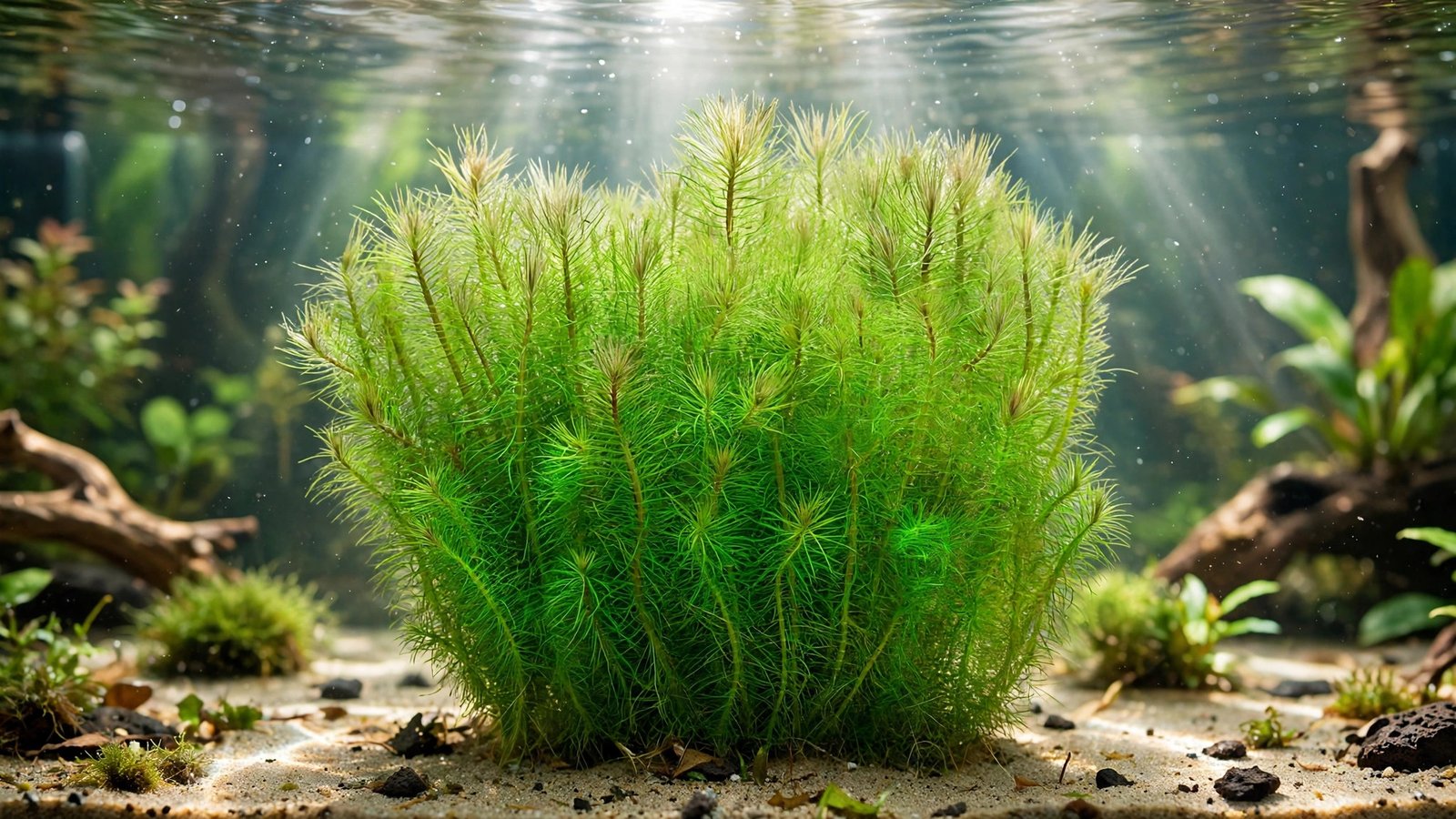
No other aquarium stem looks like a miniature conifer forest. Pogostemon erectus care rewards you with columns of bright green, needle-thin leaves arranged in perfect whorls around each stem — a living pine tree that tops out around 30 cm. The catch: this plant negotiates hard on light and CO2 — without them, those crisp columns turn into gappy, leggy shadows.
Pogostemon Erectus Care: The Non-Negotiables
Before anything else, decide whether your tank can give this plant what it wants. Pogostemon erectus is a medium-difficulty stem whose entire appeal — the tight, symmetrical needle whorls — depends on energy input. Two factors decide everything.
Light is the defining question. Aim for medium–high light: roughly 60–100 µmol/m²/s (PAR) at substrate level, on a 7–8 hour photoperiod. Under intense light the internodes stay short and each column keeps its conifer silhouette. Under weak light the stems stretch, the needle leaves thin out, and you get a lanky green weed instead of a pine tree. If you are unsure what your fixture actually delivers, understanding how much light aquarium plants really need is worth reading before you plant.
CO2 is near-mandatory. A pressurized system holding a steady 25–30 ppm (lime-green drop checker) gives erectus the carbon it needs to build all that dense needle foliage. Without injected CO2 the plant often survives but stalls: stems stay short, growth crawls, and old needles melt. Liquid-carbon products are not a substitute here; this plant noticeably prefers dissolved gas.
Planting It for Pine-Tree Columns
Erectus earns its looks in groups. Plant one stem and you get a stick; plant ten and you get a forest. Separate your pot or tissue-culture cup into individual stems and space them 3–5 cm apart — generous spacing lets light reach the lower whorls so the whole column stays green.
Push each stem 2–3 cm into a nutrient-rich substrate and it will anchor fast. Erectus grows vigorous roots once settled, so an active aquasoil or a plain sand bed enriched with root tabs both work. Plant in slightly deeper spots of the background slope — the 15–40 cm height makes it a natural rear-screen plant, and planting on a back-slope hides any bare lower stems behind the group.
Keep the group away from fast, broad-leafed spreaders. A wall of Limnophila sessiliflora or Rotala wallichii grown right up against it will shade the lower whorls and steal the light erectus needs to stay compact. Give the forest its own patch of background with clear water above it.
The Trim-and-Replant Bush Technique
Here is the part that turns a good planting into a great one: erectus branches wherever you cut it. Cut the top third of each stem with sharp aquascaping scissors, then push the cuttings into the substrate beside the mother stems. Within days, each cut base pushes out two or more side shoots, and the planted tops root and keep growing.
Run this cycle every 2–3 weeks once the group is established, and the bush compounds — 8 stems become 20, then 40, taking on the layered, cloud-like density that wins aquascaping contests. Never trim more than the top third at once; erectus recovers best when the remaining stem still carries healthy whorls.
| Trimming move | What it does | When |
|---|---|---|
| Top-third cut + replant | Each cut stem branches; cuttings root into new stems | Every 2–3 weeks |
| Remove melted bottoms | Clears dead tissue, frees space for new shoots | During the same session |
| Thin the center | Pull out 1 in 5 stems if the bush gets impenetrable | Monthly, in mature groups |
| Re-scape overgrown groups | Pull, replant only the best tops, discard leggy bases | Every 2–3 months |
 ★4.6
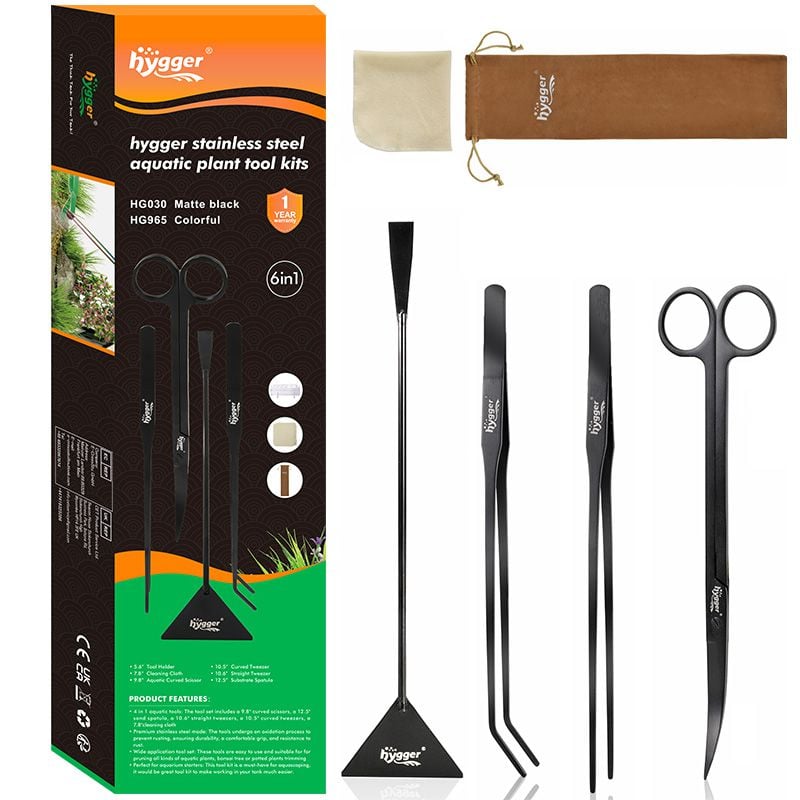
hygger 6-in-1 Long Aquarium Aquascaping Tools Kit
Check Price on Amazon ★4.6Not Rotala Verticillaris: The Identity Story
For years, hobbyists bought this plant under the wrong name. It circulated in the trade as "Rotala verticillaris" — a misidentification that stuck because the needle-whorl habit vaguely resembles some Rotala forms. Its true identity is Pogostemon erectus, a member of the mint family (Lamiaceae) native to India, and Tropica now lists its 053F tissue-culture line as Pogostemon deccanensis.
Why does this matter to you? Because care advice filed under the old Rotala name can mislead — real Rotalas and Pogostemons respond differently to trimming and nutrients. And because the Pogostemon shelf now holds three plants beginners confuse: Pogostemon helferi (Downoi), a crinkly foreground rosette; Pogostemon stellatus "Octopus", a loose, curly background stem; and erectus, the only one with tight conifer columns. If the label just says "Pogostemon," look for the needle whorls.
Water, Nutrients, and Keeping Columns Tight
Erectus is adaptable on water chemistry but picky about consistency. It thrives in pH 6.0–7.5 and 22–28 °C, and tolerates soft to moderately hard water. What it dislikes is instability — swinging CO2 or fluctuating fertilization shows up fast as stunted new whorls and melting lower leaves.
Feed it like a high-tech stem. A full-spectrum liquid fertilizer for aquarium plants, dosed for CO2-injected tanks, covers the water column; root tabs under the group add insurance. Nitrate around 10–20 ppm, phosphate 1–2 ppm, and steady micros keep the needles bright green. If new growth comes in pale while older whorls melt, you are almost always under-dosing or short on CO2 — fix carbon first, then nutrients.
Troubleshooting the Columns
| Symptom | Likely cause | Fix |
|---|---|---|
| Long bare gaps between whorls | Light too weak | Raise PAR to 60+; trim and replant tops |
| Stems stall, no new needles | CO2 too low or fluctuating | Stabilize at 25–30 ppm, lime-green drop checker |
| Lower whorls melting | Shading by own growth or neighbors | Thin the group; move competing stems back |
| Pale, yellow-green new growth | Iron or general micros shortage | Full-spectrum dosing at high-tech rates |
| Tissue-culture portions melting | Normal emersed-to-submerged transition | Leave planted; new needles appear in 10–14 days |
One more source of confusion worth clearing up: if you search for this plant under its newer name, Tropica's official plant database entry for code 053F confirms it is now cataloged as Pogostemon deccanensis — "previously known as Pogostemon erectus." Care advice filed under either name applies to the same conifer-like stem.
Frequently Asked Questions
Does Pogostemon erectus need CO2 to survive?
It can survive without injected CO2, but it rarely thrives. Expect slow growth, short stalled stems, and sparse needle whorls in low-tech tanks. Pressurized CO2 at 25–30 ppm transforms it — the single biggest upgrade you can make for this plant.
How fast does Pogostemon erectus grow?
Roughly 3–5 cm per week under medium-high light with CO2 and full fertilization. It is faster than many expect once settled, which is why the every-2–3-week trimming cycle exists. Without CO2, growth can slow to a near-standstill.
Can I plant Pogostemon erectus in the foreground or midground?
Background is its natural home at 15–40 cm tall, but it works in the midground of deep tanks (50+ cm front to back) if you keep it trimmed short with intense light. It is too tall and too light-hungry for a true foreground role.
Why are the bottoms of my stems melting?
Almost always a light problem — the plant's own dense top shades its lower whorls, or a neighbor does. Space stems 3–5 cm apart, keep competing plants back, and thin the group monthly so light reaches the bases.
Is Pogostemon erectus the same as Pogostemon deccanensis?
Tropica currently catalogs its 053F tissue-culture line as Pogostemon deccanensis, formerly sold as Pogostemon erectus. Retailers use both names for the same conifer-like stem. Historically it was also mislabeled as Rotala verticillaris — three names, one plant.
Give erectus real light, steady CO2, and the trim-and-replant rhythm, and it becomes one of the most architectural plants you can grow — a bright green forest column no broad-leafed stem can imitate.