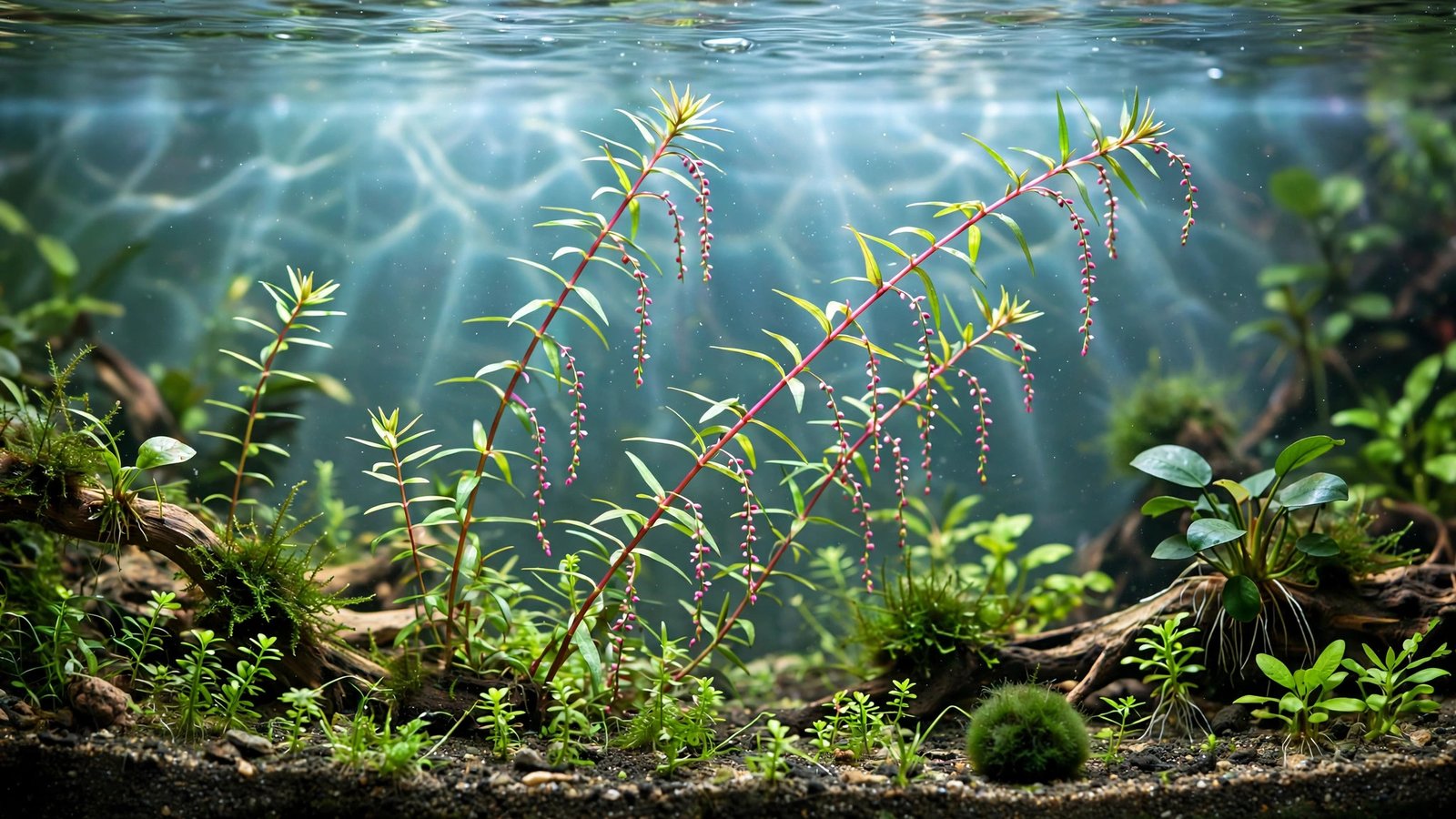
Most stem plants reach for the light. Persicaria praetermissa slouches sideways at 45 degrees — and that sprawl is what makes it one of the most striking colorful midground accents for a fish-first planted tank. Sold as ruby smartweed, Polygonum 'Ruby', or 'Vietnam pink', this tropical marsh plant from Asia and Australia shifts from plain green to copper, reddish-brown, and deep magenta underwater with real light and CO2. Getting persicaria praetermissa care right means working with its diagonal habit instead of fighting it.
Persicaria praetermissa — ruby smartweed, Polygonum 'Ruby', "Vietnam pink" — is a fast-growing Asian–Australian stem plant whose sparsely branched shoots sprawl diagonally to nearly horizontal at roughly 45°, passing 35 cm, with narrow spear-shaped leaves up to 7.5 cm that turn copper, reddish-brown, and deep magenta underwater. Persicaria praetermissa care means medium–high light, injected CO2, and iron-rich feeding; without them it survives but stays green. It is a different species from Persicaria 'Sao Paulo', which grows straight upright — so "Vietnam pink" is not Sao Paulo under another name.
Persicaria Praetermissa Care Starts With Its Growth Habit
Unlearn one thing first: this plant does not behave like a normal stem. Instead of climbing vertically, Persicaria praetermissa throws out squarrose shoots that run diagonally to nearly horizontal — firm, wiry stems about 1.5 mm thick carrying alternate spear-shaped leaves with small basal lobes, each up to 7.5 cm. The whole plant leans, and keeps leaning.
That lean is an aquascaping gift once you accept it. Stems planted at slight angles fuse into a creeping, layered midground drift no upright stem can imitate. Plant each stem 1–2 inches deep, angled toward where you want it to travel, with lower leaves stripped so bare stem anchors cleanly — crowded vertical planting fights the plant's nature and leaves you with bare, leggy stems.
Ruby Smartweed vs. Persicaria 'Sao Paulo'
The trade has a naming problem with this plant. Persicaria praetermissa has been sold as Polygonum 'Ruby', 'Vietnam pink', and occasionally — wrongly — as Persicaria 'Sao Paulo'. They are different species with different bodies: praetermissa sprawls sideways with copper-brown foliage; Sao Paulo grows straight up with brighter magenta tones. Our Persicaria 'Sao Paulo' care guide covers the upright species; this guide is strictly about the sprawler.
Buy the habit, not the name. The mix-up matters because they do different jobs: Sao Paulo is a background pillar, praetermissa is a midground drift.
Light and CO2: the Color Recipe
The trade-off is plain, and Buce Plant's Persicaria praetermissa profile states it well: the plant stays predominantly green under lower light, but medium-to-high light with pressurized CO2, a nutrient-rich substrate, and regular liquid feeding — especially iron — brings out deep red, brown, and copper tones.
| Conditions | What to expect |
|---|---|
| Low–medium light, no CO2 | Survives, grows slowly, stays mostly green |
| Medium–high light plus CO2 | Copper and warm brown tones on new growth |
| High light, CO2, iron-rich micros | Deep magenta and reddish-brown foliage, fastest growth |
Judge light by what plants receive — see how much light aquarium plants need — and if you are new to gas, read how to set up CO2 in a planted tank before you start. CO2 is the biggest lever for this plant's color after light. Upgrade light and gas before chasing iron — extra iron at a light-limited plant does nothing.
Fertilizer: Start Low, Observe Livestock
Ruby smartweed is hungry — fast growth and dense color pull nutrients hard — but "hungry" is no license for a full label dose on day one. New setups carry little plant biomass and immature biology, so start below the label, watch plant and animals, and step up only when new growth stalls or pales.
| Input | Conservative starting point |
|---|---|
| Liquid all-in-one fertilizer | Half the label dose for the first 2–3 weeks |
| Iron | From a complete micro mix only — never a separate iron megadose |
| CO2 | Steady lime-green on a drop checker, never yellow |
| Water changes | 30–50% weekly in the first month |
Planting, Trimming, and Propagation
- Remove the pot or wrap, and strip lower leaves so bare stems enter the substrate — buried foliage rots and takes the stem with it.
- With pinsettes, push stems 1–2 inches into nutrient-rich substrate, angled in the direction you want them to spread, spaced slightly apart.
- Give strong light from day one and keep parameters stable; emersed-grown stock sheds its stiff green leaves as soft colored underwater growth replaces them.
- Snip tops once stems hit your target height and replant the trimmings directly — cuttings root fast.
- Pull out old, water-rooted lower shoots instead of nursing them: regrowth after severe pruning is sparse, so remove the stumps and replace them with fresh shoot-tip cuttings.
Aquascape Placement and Companion Plants
Praetermissa earns its keep as a midground accent, where its dark copper-brown color and diagonal lines contrast against fine-leaved, light-green plants. A drift of five to eight stems carries more visual weight than a single upright clump of the same biomass.
Good companions: an upright red stem like Ludwigia glandulosa behind it for a red gradient from drift to pillar, a soft red midground partner like Alternanthera reineckii, or a fine-leafed filler like Hydrocotyle verticillata for maximum texture contrast. Keep it clear of tall background shadows — shaded lower leaves are this plant's one consistent failure mode.
Common Problems, Solved
| Symptom | Likely cause | Fix |
|---|---|---|
| Lower leaves dropping, bare stems | Shading from overcrowding | Space stems apart; keep it clear of tall background plants |
| Stays green, never colors up | Light or CO2 below the color threshold | Raise intensity; add CO2 before chasing iron |
| Melts in the first two weeks | Emersed-to-submerged transition | Keep parameters stable; trim away spent emersed leaves once new growth arrives |
| Stem rot at the substrate line | Leaves buried during planting | Replant with lower foliage stripped |
Frequently Asked Questions
Is Persicaria praetermissa the same as Persicaria 'Sao Paulo'?
No — different species, different habits. Praetermissa (ruby smartweed, "Vietnam pink") sprawls diagonally at roughly 45° with copper-brown foliage; 'Sao Paulo' grows straight upright with brighter magenta tones. Trade names blur the two, so buy based on the plant's growth habit, not the label.
Can ruby smartweed grow without CO2?
Yes, it survives and grows without injected CO2, but it stays mostly green and grows more slowly. CO2 is the biggest lever for its copper and magenta coloration after light itself. In a low-tech tank, treat it as a textured green midground drift rather than a red showpiece.
How do I get the deep red and copper colors?
Stack all four: medium–high light, pressurized CO2, a nutrient-rich substrate, and regular dosing of complete liquid micro and macronutrients with iron. Iron only helps once light and CO2 are adequate, so upgrade in that order. Allow two to three weeks of new growth before judging the result.
How fast does it grow?
Fast. With good light and CO2, shoots run 35 cm or longer, and one pot becomes a full midground drift in six to eight weeks. Trim tops regularly and replant the cuttings to multiply it. After a severe chop, old stumps regrow sparsely — replace them with fresh tip cuttings for denser results.
Can it grow emersed in a paludarium?
Yes. Emersed it stays green with stiffer foliage and suits paludariums and Wabi-Kusa. Moving it underwater, expect the old stiff leaves to shed over a few weeks as soft, colored submerged growth replaces them — keep conditions stable during the transition.
Plant it sideways, light it hard, feed it gently: ruby smartweed gives you a red drift that creeps instead of climbs. Respect the 45-degree habit, don't confuse it with its upright cousin, and you'll wonder why every midground doesn't sprawl.