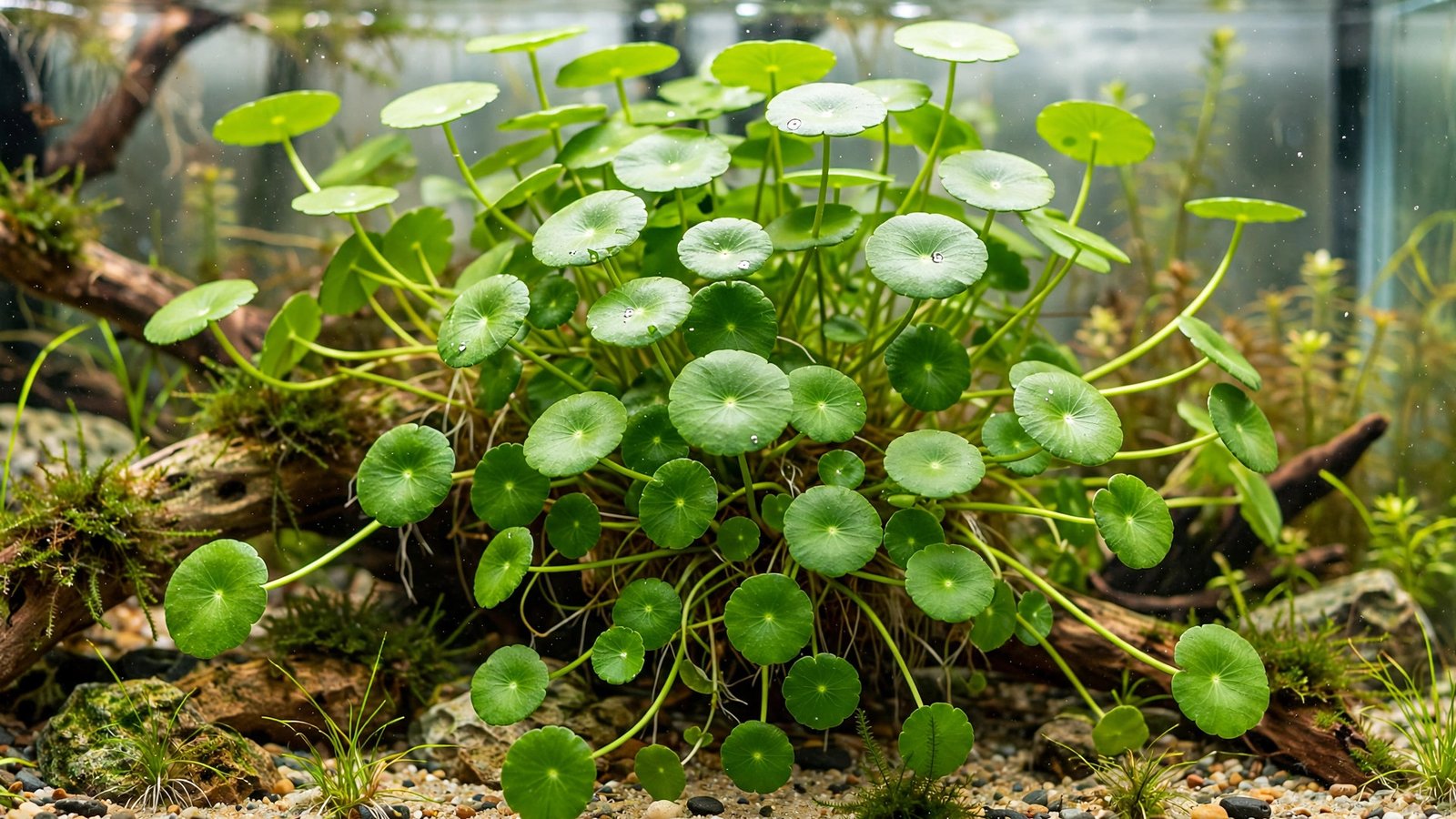
Some aquarium plants fill space; whorled pennywort stops people mid-scroll. Its tiny round leaves sit like green half-dollars stacked in rings around thread-thin upright stems, turning an ordinary foreground into something that looks deliberately designed. Getting hydrocotyle verticillata care right comes down to two things: enough light to keep those rings tight, and patience while the runners knit together.
Whorled pennywort (Hydrocotyle verticillata) is an easy marsh plant that adapts well to aquariums. Give it medium light, optional CO2, a nutrient-rich substrate or root tabs, water at 68–78 °F, and pH 6.0–7.5. Under strong light it stays low and compact, topping out near 10 cm (about 4 inches) tall, and spreads by runners you can snip apart and replant wherever you like.
Hydrocotyle Verticillata Care: Light, CO2, and Parameters
In the wild, Hydrocotyle verticillata is a bog and marsh plant from the Americas, growing along shorelines and in shallow water. That origin explains its aquarium personality: wet feet, steady nutrition, moderate light, and it rewards you with a tidy miniature-umbrella look nothing else in the hobby quite matches. It fits naturally into a fish-first planted tank, where plants serve the layout and water quality together — our fish-first guide to aquarium plants for fish tanks covers that planning approach if you are building around livestock.
| Parameter | Target | Notes |
|---|---|---|
| Light | Medium | Bright enough to keep whorls tight; low light stretches it tall |
| CO2 | Optional | Skip it and it still grows; add it for dense, compact rings |
| Temperature | 68–78 °F (20–26 °C) | Fine in most unheated and heated tanks |
| pH | 6.0–7.5 | Slightly acidic to neutral |
| Hardness | Soft to moderately hard | No special requirements |
| Substrate | Fine gravel or aqua soil | Avoid very coarse gravel or compacted fine sand |
| Height | Up to ~10 cm | Low under strong light; taller when light is weak |
Parameter ranges above cross-checked against the Aqua-Fish database entry for Hydrocotyle verticillata.
Light and CO2: What Keeps the Whorls Tight
Light is the single biggest lever on how this plant looks. Under medium light the stems stay short and each ring of round leaves sits close to the next — the miniature-umbrella effect everyone buys the plant for. In dim corners the same plant stretches upward, the whorls space out along an increasingly bare stem, and the effect is lost. If your planting goes leggy, the answer is more light and more frequent trimming, not different water chemistry. Our breakdown of how much light aquarium plants really need will help you place it in the right zone.
CO2 is a dial, not a requirement. Without it the plant grows steadily but slower and looser; with CO2 and good light, the rings stack denser and repeated trimming can hold it as a low carpet. In a low-tech tank, enjoy the gentle upright stems; in a high-energy scape, CO2 builds the dense hedge.
Planting and Feeding: Treat It Like a Root Feeder
Press small rooted runner sections about an inch apart, just deep enough to stay put — burying the whorls themselves invites rot at the base. Fine gravel or nutrient-rich aqua soil works best; very coarse gravel gives the thin roots nothing to grip. Because this plant pulls most of its nutrition from below, a root tab under the planting does more work than extra liquid dosing, though a balanced water-column fertilizer keeps leaves a healthy green. Our roundup of the best liquid fertilizers for aquarium plants covers reliable options for both approaches.
Not Brazilian Pennywort, Not Tripartita: Know Your Pennyworts
Brazilian pennywort (Hydrocotyle leucocephala) is a vigorous climbing stem with lobed, notched leaves like tiny lily pads — often sold as a floater or background stem. Hydrocotyle tripartita is the creeping clover carpet: small three-lobed leaves spreading sideways across the substrate, as described in the Hydrocotyle tripartita care guide. Only H. verticillata gives you the whorled-disc look.
| Trait | H. verticillata (this plant) | Brazilian pennywort | H. tripartita |
|---|---|---|---|
| Leaf shape | Round disc, attached at the center | Lobed and notched, like a tiny lily pad | Three-lobed, like clover |
| Arrangement | Whorls around thin upright stems | Alternate along a climbing stem | Creeping sideways across the ground |
| Best use | Foreground or midground accent | Background or surface cover | Foreground carpet |
Trimming, Training, and Propagation
Whorled pennywort spreads by runners, with new plantlets forming at each node. To propagate, cut a runner into sections — each with at least one leafy node — and press them lightly into the substrate; they root within a week or two. Topping the stems every two to three weeks encourages branching below the cut, so the whorls stack tighter and the planting fills out sideways instead of going leggy.
Trained as a foreground hedge, it pairs well with other low plants that do not compete for the same niche: Helanthium quadricostatus running along the glass, or the low rosette of Cryptocoryne beckettii breaking up the rhythm of the discs. For a backdrop that shows off the foreground, the tall ribbon leaves of Vallisneria spiralis make a clean green wall behind the miniature umbrellas.
Troubleshooting: Leggy Stems and Rotting Bases
- Stems thinning and dropping lower whorls — the classic low-light complaint. Move the planting into brighter light and trim the tops; new growth under better light comes in compact.
- Mushy or rotting at the base — planted too deep or buried under debris. Lift the runners slightly, clear detritus from the nodes, and replant shallower.
Frequently Asked Questions
Is whorled pennywort the same as Brazilian pennywort?
No. Whorled pennywort (Hydrocotyle verticillata) grows low with round disc leaves in whorls on thin upright stems. Brazilian pennywort (H. leucocephala) is a fast climbing stem with lobed, notched leaves, often sold as a floater or background plant. Different placement, different habit — buy by the scientific name.
Does Hydrocotyle verticillata need CO2?
Not strictly. It grows in low-tech tanks without injected CO2, just more slowly and with a looser habit. Adding CO2 speeds growth and produces tighter, denser whorls — the difference is mostly compactness, not survival. Root tabs or nutrient-rich substrate matter more than CO2 for day-to-day health.
Why is my whorled pennywort growing tall and thin instead of compact?
Weak light. The plant stretches upward to reach more light, spacing the whorls along a bare stem. Move it into medium light, trim the leggy tops, and let it regrow — the new growth comes in compact. Topping every two to three weeks keeps it dense once the light is adequate.
How do I propagate whorled pennywort?
Snip the runners. Each node along a runner can root and form a new plant, so cut runners into sections with at least one leafy node each and press them lightly into the substrate. Within a week or two they anchor themselves. Topped stems also work: each trimmed top replanted becomes an independent plant.
Can whorled pennywort grow out of the water?
Yes — it is naturally a marsh plant and does well emersed, often growing larger leaves above the waterline than it does submerged. It suits paludariums, pond edges, and open-top tanks where runners climb out. Emersed plants can even flower, which they will not do fully underwater.
A Quiet Showpiece for the Foreground
Whorled pennywort will never be the fastest plant in your tank, and that is part of its charm. Medium light, fed roots, and a regular trim buy you one of the most unusual textures in the hobby — rings of miniature umbrellas no other plant replicates. Give it the right spot and keep the scissors handy.