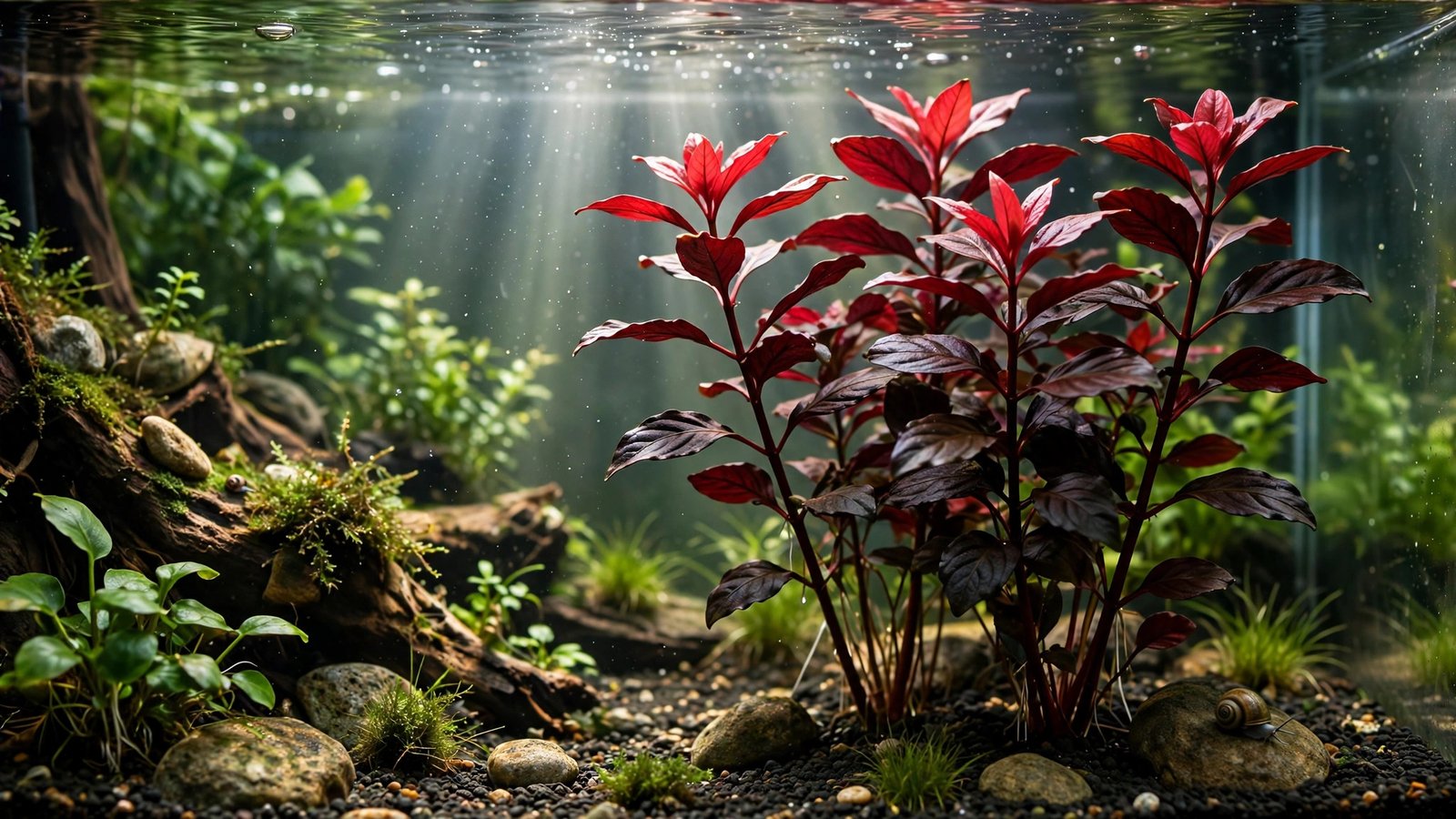
Few plants pull an aquascape together like a well-grown stand of Ludwigia 'Rubin' — tall stems of near-black ruby that make every green around them glow. The catch: most hobbyists never see that color, because "easy red plant" is only half true. This complete ludwigia rubin care guide gives you the numbers that matter: PAR ranges, nitrate and iron targets, CO2 response, and trim cycles.
Why Ludwigia 'Rubin' Wins Red-Plant Tanks
Rubin deserves its reputation: where Ludwigia repens gives warm orange-red and Ludwigia 'Super Red' a brighter cherry tone, Rubin's leaves mature into a deep wine-red so dark the veins look black. Reaching 30–50 cm on sturdy upright stems, it anchors backgrounds and tall midgrounds — our complete guide to freshwater aquarium plants rates it a top red choice for layout impact.
Sold variously as Ludwigia glandulosa or a selected L. repens cultivar, it has notably broader, lance-shaped leaves than most stems. Shaded older leaves sometimes revert to olive — normal — while the growing tips carry the color.
Ludwigia Rubin Care: Light and PAR Requirements
Light is the single biggest lever on this plant. Here's the honest scale, measured in PAR at the leaf surface:
| Light level | PAR | What you get |
|---|---|---|
| Low | 20–35 | Olive-green, slow, eventually leggy |
| Medium | 35–50 | Bronze-red tops, moderate pace |
| Medium-high | 50–80 | Deep ruby to near-black — the goal |
| Very high | 80–120 | Little extra color, much more algae — skip it |
Aim for the 50–80 window — roughly a quality LED at 70–80% over a 40–50 cm deep tank. You don't need the punishing 120+ PAR that plants like Rotala macrandra demand, which is exactly why Rubin is such a smart pick: it delivers near-black red at light levels your whole tank tolerates. Keep the photoperiod at 7–8 hours; pushing past 10 rarely improves color and invites algae.
CO2: What It Actually Changes
Rubin grows without injected CO2, but slowly — a few centimeters a month in olive-green to bronze form. Inject 20–30 ppm and growth roughly doubles, stems thicken, and red deepens noticeably within 2–3 weeks. It's forgiving of fluctuating CO2, which makes it a good first red plant for a newly injected tank, though big daily swings stunt it more than a modestly low constant level. For a gentler starting point before chasing reds, our easiest aquarium plants for beginners guide forgives dosing mistakes.
Feeding for Color: Iron and Nitrate
Red here is driven less by "more of everything" and more by the right ratios:
| Nutrient | Target | Off-target symptoms |
|---|---|---|
| Nitrate | 5–10 ppm | Above ~15 ppm: fast green growth, red fades. Near 0: stunted, pale tips |
| Iron | 0.1–0.2 ppm per dose, 2–3× weekly | Deficiency: pale new growth with green veins |
| Phosphate | 0.5–1.5 ppm | Near 0 stalls everything |
| Potassium | 10–20 ppm | Pinholes in older leaves signal shortage |
The classic mistake is dosing a heavy all-in-one while running modest light, then wondering why the plant stays green. Nitrate is the strongest color antagonist: rich-nitrate tanks produce fast, green, perfectly healthy-looking Rubin. To chase color, lean the nitrates first, keep iron consistent, then evaluate light. Rubin is a heavy root feeder too — a root tab under the stand every 2–3 months visibly thickens stems and leaf size.
Planting, Trimming, and Replanting
Plant stems 3–4 cm apart with the lowest node buried — Rubin roots from every node, and shallow planting sends stems floating by day two. Expect visible roots within a week.
Trimming is non-negotiable. Once stems near the surface (3–4 weeks with CO2, 6–8 without): cut 10–15 cm below the surface, replant the colorful top directly, and discard or retire the old lower stem — bare bottoms rarely recover their color. On a CO2 tank, run this cycle every 10–14 days; low-tech, every 3–4 weeks. Each trim restarts the color clock: replanted tops come back slightly green for a week, then darken. Trim before the stand gets dense enough to shade itself into melting. The rhythm matches its cousin in our Ludwigia arcuata care guide, but Rubin punishes neglect with bare stems faster.
Emersed vs Submerged Growth
Nursery and tissue-culture stock arrives emersed — small, roundish olive leaves that look nothing like the final plant. Submerged, it sheds them over 1–3 weeks and pushes the broad ruby blades. Keep light moderate (30–40 PAR) during transition; melting is the plant abandoning its old leaf shape, not dying. Note that emersed leaves stay olive-green regardless — the dark red is an underwater light-adaptation response.
Troubleshooting: Why Yours Won't Turn Red
- Stays green despite "good" light: Nitrate above ~15 ppm is the usual culprit. Cut dosing, keep 30–40% weekly water changes, target 5–10 ppm, and watch new growth for two weeks.
- Leggy stems with leaf gaps: Too little light at the leaves. Raise intensity, remove shading floaters, or move the stand to a brighter zone.
- Melting lower leaves: Self-shading from dense tops or a sudden parameter change. Thin the stand — bare bottoms won't recover.
- Stunted, pale new growth: True exhaustion — check nitrate isn't at zero and iron is actually being dosed.
- Curling, deformed leaves: Calcium/magnesium shortage in very soft water (below 3 dGH). A GH booster fixes it within weeks.
For contrast plants that stay red under the same lean-nitrate regime, Alternanthera reineckii and red tiger lotus respond to near-identical feeding, while Proserpinaca palustris 'Cuba' rewards the same high-light discipline with orange-red spiky texture.
Frequently Asked Questions
Is Ludwigia 'Rubin' good for beginners?
Yes — it's one of the most forgiving red plants a beginner can try. It survives low-tech tanks, tolerates CO2 swings, and propagates easily from cuttings. You won't see the signature near-black red without medium-high light and lean nitrates, but even a modest setup yields attractive bronze-green stems. Think of it as beginner-tough with intermediate color demands.
Why is my Ludwigia Rubin staying green?
Excess nitrate is the most common cause — above roughly 15 ppm, Rubin grows fast but stays green. Reduce fertilizer dosing, hold 30–40% weekly water changes, and aim for 5–10 ppm nitrate alongside 50–80 PAR of light and iron at 0.1–0.2 ppm per dose. Improvement shows in the newest leaf pairs within two weeks.
Does Ludwigia Rubin need CO2 to turn red?
No, but CO2 makes a large difference. Without it, Rubin stays olive-green to bronze and grows slowly. With 20–30 ppm injected CO2, growth roughly doubles and red deepens noticeably within 2–3 weeks. Light and lean nitrates are the primary color drivers; CO2 is the amplifier.
How often should I trim Ludwigia Rubin?
Every 10–14 days in a CO2-injected tank, every 3–4 weeks in low-tech setups. Cut the colorful top, replant it, and discard the bare lower stem. Skipped trims lead to shading, legginess, and melting. Recovery is quick — replanted tops root within a week.
Can Ludwigia Rubin grow in sand or gravel?
It survives but never thrives there. Rubin is a heavy root feeder and performs dramatically better in nutrient-rich aqua soil with root tabs every 2–3 months. In inert substrates, dose a complete water-column fertilizer and add root tabs under the stand — but expect thinner stems and weaker color than in aqua soil.
How do I propagate Ludwigia Rubin?
Stem cuttings — one of the easiest red plants to multiply. Cut a healthy stem, strip the bottom 2–3 leaf pairs, and push the bare node into the substrate; roots emerge from every buried node within a week. Side shoots forming at trimmed nodes can be separated once they reach 5–8 cm.
A Red Plant That Rewards Discipline
Ludwigia 'Rubin' asks little for aquarium-dark red: 50–80 PAR, nitrates at 5–10 ppm, steady iron, and a trim every two weeks. Keep those four dials honest and you get one of the most dramatic stems in the hobby. Cross-check your dosing against Tropica's Ludwigia glandulosa database entry and the 2hr Aquarist guide to growing red aquarium plants — then go cut your first stems.