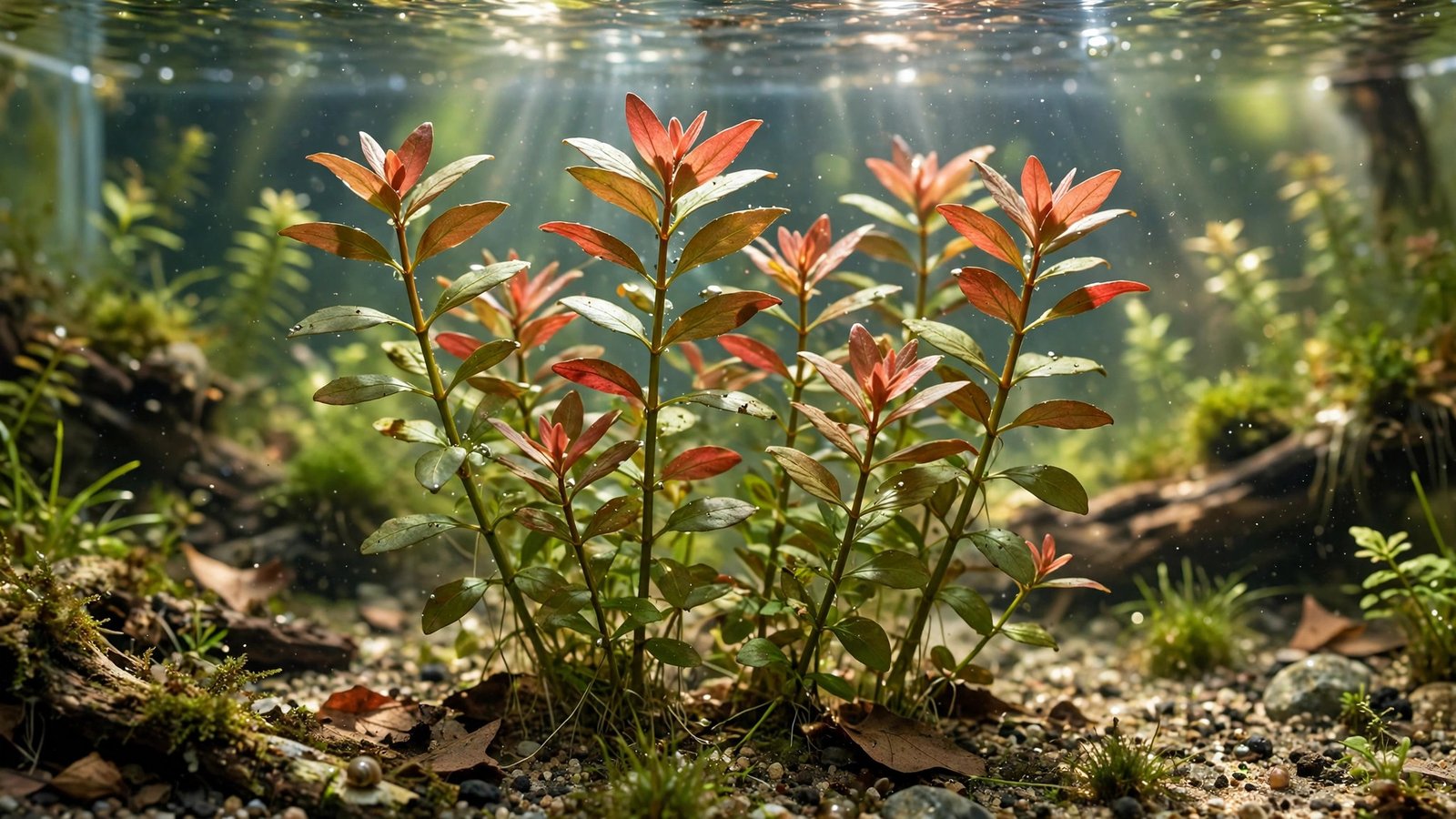
Green on the bottom, sunset-red on top — few beginner plants deliver a two-tone show like this one. Ludwigia repens care is about as forgiving as aquarium plants get: it thrives in low-tech tanks, tolerates a wide range of water parameters, and turns genuinely red under strong light without demanding CO2. Native to slow waters of North and Central America, it's been a hobby staple for decades for good reason.
This guide walks through everything Ludwigia repens needs: light and color, CO2 and fertilizer, planting and propagation, trimming strategy, and solutions to the common problems like bottom-leaf loss and leggy stems.
Quick Care Reference
| Parameter | Requirement |
|---|---|
| Light | Low to high (30+ PAR; color improves with intensity) |
| CO2 | Optional; improves color and growth rate |
| Growth rate | Fast |
| Placement | Background to midground |
| Difficulty | Easy |
| Temperature | 65–80°F (18–27°C) |
| pH | 5.0–8.0 |
| Height | 12–20 inches (30–50 cm) |
What Makes Ludwigia Repens Special
Ludwigia repens is one of the few genuinely easy plants that can turn red. Most red plants demand high light, CO2, and lean nitrates — Ludwigia repens just wants decent light. Under moderate light it grows lush and green with reddish undersides; under strong light the upper leaves go orange-red, creating a gradient effect that's gorgeous in person and photographs beautifully.
It's also nearly indestructible by aquarium-plant standards. It tolerates cooler water than most stems (down to the mid-60s°F), handles hard alkaline water that stunts fussier species, and bounces back from neglect that would kill a Rotala wallichii. For a first red plant, nothing else is this forgiving.
Planting Ludwigia Repens
You'll usually buy Ludwigia repens as emersed-grown bunches with roundish green leaves, or as submersed cuttings. Separate the bunch into individual stems — this is the step beginners skip, and it matters enormously. A tight bunch shades its own lower leaves, which then rot and make the whole planting look ragged.
Strip leaves from the bottom inch of each stem and plant about an inch deep, spacing stems 1–1.5 inches apart. It roots enthusiastically in any substrate, from plain gravel to aquasoil; root tabs under the planting zone speed up establishment in inert substrates. Ludwigia repens works as a background plant in taller tanks or a midground bush in smaller ones — it's one of the few stems flexible enough for both. Pair it in the midground with Cryptocoryne wendtii for a green-and-bronze composition that needs almost no maintenance.
Light: The Color Dial
Think of light as a dial for this plant. At low light (under ~30 PAR), Ludwigia repens grows slowly, stays green, and stretches a bit — healthy but plain. At medium light (40–60 PAR), growth picks up and the leaf undersides and stem tops develop a red-orange blush. At high light (70+ PAR), the upper half of each stem goes properly red-orange while lower leaves stay green, producing the classic two-tone look.
An 8-hour photoperiod suits it well. Because it grows fast, Ludwigia repens is actually useful as an algae indicator: if its fast growth stalls while algae increases, something in the balance has shifted — usually light outpacing nutrients or CO2.
Light is literally the color dial; stronger light = more red: a stronger full-spectrum light like the NICREW ClassicLED Plus.
 ★4.6
NICREW ClassicLED Plus planted aquarium light
Check Price on Amazon ★4.6CO2 and Fertilizer
Ludwigia repens does not need CO2 injection, and it will color up red under strong light even in a low-tech tank — a rare combination. Add CO2 and you'll see thicker stems, tighter leaf spacing, faster growth, and deeper reds, but consider it optional rather than required.
Nutrient-wise it's a moderate feeder. In low-tech setups, fish waste plus an occasional comprehensive liquid fertilizer is plenty. In high-tech tanks, dose a full routine — Ludwigia repens is a nitrate hog and will happily absorb the excess that would otherwise feed algae. Iron helps the red pigments, but as with Rotala rotundifolia, light does the heavy lifting for color. If new leaves emerge pale or yellowish while veins stay green, that's iron deficiency — dose accordingly. Pinholes in older leaves indicate potassium shortage.
Red stems need iron-rich water-column feeding for color: an iron-inclusive liquid like Seachem Flourish.
Trimming and Propagation
Ludwigia repens grows fast enough to need trimming every 2–4 weeks in most tanks. Cut stems just above a leaf node — two new shoots will sprout from the node below the cut, so each trim doubles your stems over time. Replant the cut tops to thicken the stand or start new groupings.
Propagation is trivially easy: any stem section with a couple of leaf nodes will root when planted or even floated. Roots often sprout from nodes while stems are still growing, which looks odd but is completely normal — you can trim them off for appearance or leave them; the plant doesn't care. One $5 bunch can become a full background within two months, making Ludwigia repens one of the best value plants in the hobby.
Troubleshooting Common Problems
Lower leaves falling off, bare stems at the bottom
The classic Ludwigia complaint. Lower leaves drop when they're shaded by the plant's own upper growth — the plant abandons leaves that cost more energy than they produce. Fix it with wider stem spacing at planting, regular trimming to keep the stand from getting too tall and self-shading, and adequate light penetration. Hiding the bare lower stems behind midground plants like Staurogyne repens is standard aquascaping practice.
Leggy, stretched growth
Long internodes (big gaps between leaf pairs) mean the plant is reaching for more light. Increase intensity rather than photoperiod — stretching is a response to dim light, not short days. Trim the leggy tops and replant them; the rooted bases will resprout more compactly under the improved light.
Staying green instead of turning red
More light, first and foremost. Ludwigia repens needs genuinely strong light for real redness — medium light gives a blush, not a transformation. Make sure older shaded leaves aren't your reference point; judge color on the newest growth near the surface. Moderate nitrates and good iron help, but they can't substitute for light.
Melting or rotting stems
Healthy Ludwigia repens rarely melts. If stems turn mushy from the bottom up, check for ammonia (new tanks), stems planted too deep and rotting at the substrate line, or bunches left tied together. Plant individual stems, keep the crown area clean, and remove any mushy material immediately.
Holes in leaves
Pinholes that enlarge over time are potassium deficiency — common in fast-growing stems. Increase potassium dosing (or switch to a fertilizer with adequate K). Ragged, chewed-looking edges instead suggest hungry livestock: some plecos, goldfish, and large snails rasp on Ludwigia leaves. For tanks with plant-nibbling fish, tougher species like Anubias or Java fern hold up better.
Placement Ideas and Tankmates
Ludwigia repens is a natural background plant, but don't overlook it as a midground bush in nano tanks, where a trimmed cluster adds warm color at eye level. It contrasts beautifully with fine-leaved green stems — try it beside Limnophila sessiliflora for a red-against-green texture pairing that looks far more expensive than it is.
It's an excellent companion for shrimp tanks: the dense stems offer grazing surfaces and shelter for shrimplets, and its fast growth absorbs the nitrates shrimp are sensitive to. In community tanks, schools of neon tetras or ember tetras against red Ludwigia tops are a timeless combination.
Frequently Asked Questions
Does Ludwigia repens need CO2 to turn red?
No — this is one of its best traits. Ludwigia repens develops red-orange coloration under strong light even without CO2 injection, unlike most red plants. CO2 improves growth speed, stem thickness, and color depth, but it's genuinely optional. If you want a red plant for a low-tech tank, this should be at the top of your list.
Why are the bottom leaves of my Ludwigia falling off?
Self-shading. The upper leaves block light from the lower ones, and the plant sheds unproductive foliage. Space stems wider when planting, trim regularly to prevent excessive height, and ensure good light penetration. This is normal behavior for the species, not a disease — aquascapers simply hide the lower stems behind midground plants.
How fast does Ludwigia repens grow?
Fast — 1–3 inches per week depending on light and CO2. It's one of the best plants for new tanks because it quickly absorbs excess nutrients and outcompetes algae. Expect to trim every 2–4 weeks, and expect every trimming to become new plants if you replant the tops.
Can Ludwigia repens grow in low light?
Yes, it survives and grows slowly in low light, staying green. It won't be colorful or fast, but it stays healthy — which is more than most stems manage. For the red coloration it's famous for, you'll need medium-high to high light. Think of low light as survival mode and strong light as show mode.
Is Ludwigia repens good for beginners?
It's one of the best beginner stem plants available. It tolerates a huge range of water parameters, doesn't need CO2, propagates from any cutting, and forgives irregular fertilizing. The only skill it teaches is trimming — and it's a forgiving teacher, since mistakes just grow back within weeks.
What's the difference between Ludwigia repens and Ludwigia Super Red?
Ludwigia repens is the easy, adaptable species that turns red-orange on top under strong light. Ludwigia Super Red is a cultivated variety selected for intense, uniform crimson color — but it demands high light, CO2, and good iron to achieve it. Start with repens; graduate to Super Red when you add CO2.
Bringing It All Together
Ludwigia repens is the plant that proves red doesn't have to mean difficult. Plant it in individual stems, give it the strongest light your setup offers, trim it regularly, and it will reward you with sunset-colored tops and a tank full of cuttings to share. For beginners it builds confidence; for experienced aquascapers it's a reliable workhorse that fills backgrounds fast. Few plants offer this much show for this little fuss.