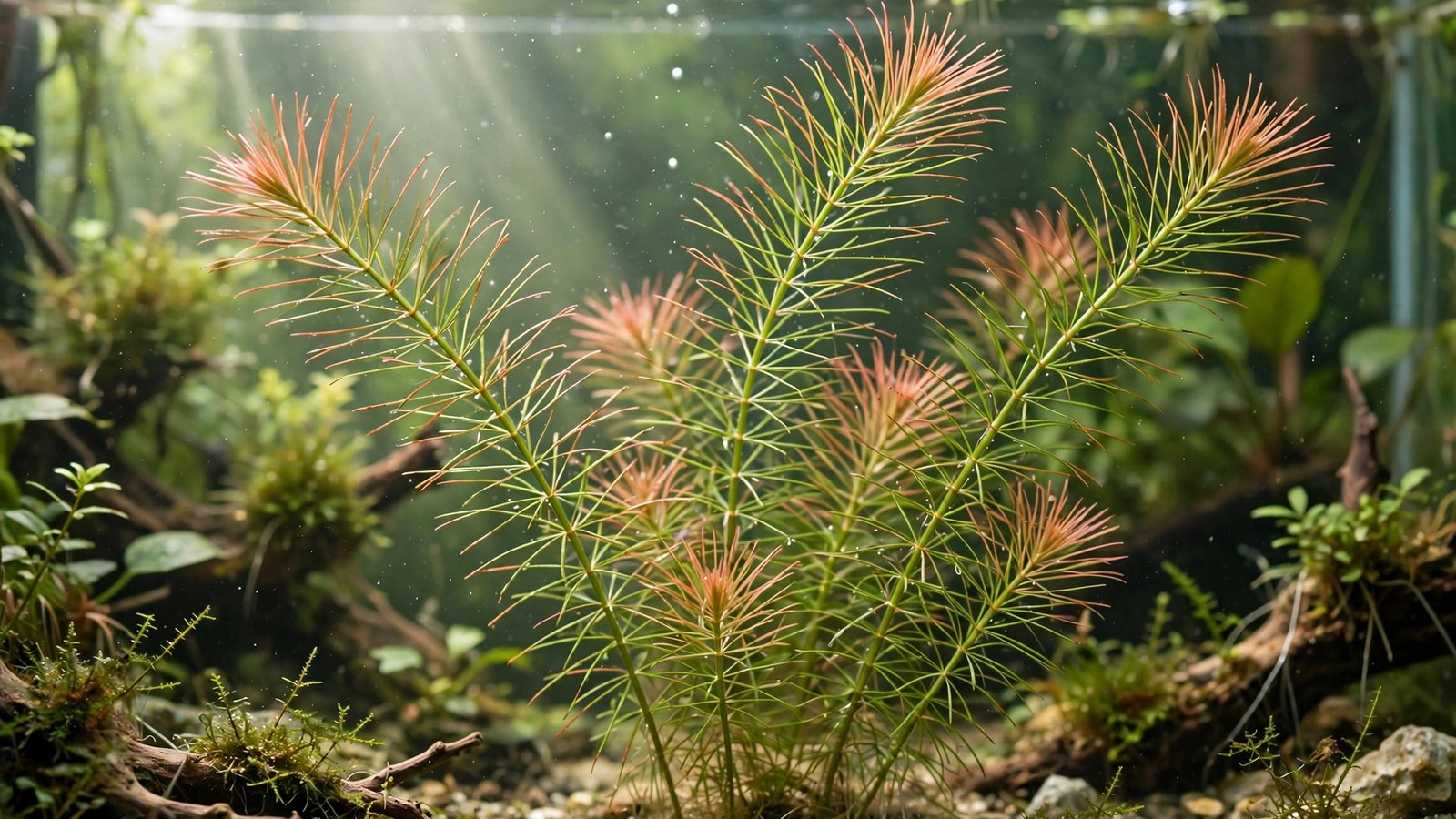
Few aquarium plants reward good husbandry as visibly as Ludwigia arcuata. This North American native — often called needle Ludwigia for its fine, tapering leaves — grows plain green under modest conditions but ignites into copper, orange, and crimson tones when given strong light and steady nutrition. Getting ludwigia arcuata care right isn't difficult, but it does demand a deliberate approach to lighting, trimming, and nutrient balance. In this guide, you'll learn exactly how to plant, prune, and position this graceful stem plant so it delivers its signature autumn-red show, whether in a high-tech Dutch layout or an emersed wabi-kusa bowl.
At a Glance: Ludwigia Arcuata Care Profile
| Attribute | Detail |
|---|---|
| Scientific name | Ludwigia arcuata (syn. Didiplis diandra in older literature) |
| Common names | Needle Ludwigia, fine-leaf Ludwigia |
| Origin | Southeastern United States (Florida and surrounding wetlands) |
| Growth form | Submerged stem plant; also grows emersed |
| Leaf size | 2–3 cm long, just 1–2 mm wide — the finest foliage in the genus |
| Height | 20–50 cm; spreads with side shoots |
| Placement | Midground to background; wabi-kusa foreground/midground |
| Growth rate | Medium to fast under good conditions |
| Difficulty | Easy to moderate — green is easy, red takes effort |
| Temperature | 18–28 °C (64–82 °F) |
| pH / hardness | pH 5.5–7.5; soft to moderately hard water |
| Light | Medium for green growth; high for red coloration |
| CO2 | Optional, but recommended for compact, colorful growth |
What Makes Ludwigia Arcuata Special
The aquarium hobby's Ludwigia shelf is crowded. Ludwigia repens gives beginners broad, easy leaves; Ludwigia 'Super Red' delivers saturated crimson for high-tech showpieces. Ludwigia arcuata occupies a different niche entirely: texture. Its leaves are true needles — pairs of slender, arching blades that whorl around a delicate stem. A healthy stand sways in current like an underwater field of grass, catching light in a way broad-leafed stems simply cannot.
That texture is why scapers reach for it. In a Dutch-style "plant street" — a corridor of one species flanked by contrasting plants — arcuata's fine grain sets off everything around it: pair it against the feathery fans of Limnophila sessiliflora and the contrast of line against plume reads beautifully from across the room. It also plays a starring role in the current wabi-kusa revival, where its emersed form produces tiny yellow flowers and shades of rust that look deliberately seasonal, like a miniature autumn marsh.
Beneath the elegance, arcuata is a genuinely hardy North American wetland plant. It tolerates cooler water than most tropical stems, recovers from aggressive pruning, and adapts between submerged and emersed growth. The one thing it won't forgive is neglect of light: starve it of photons and the internodes stretch, the needles thin out, and you get a leggy green ghost of the plant it could be.
Tank Requirements
Ludwigia arcuata is adaptable, but color and compactness respond directly to how generous you are with light and nutrients. Decide which look you want before you plant, because the maintenance path differs.
Lighting: The Decisive Factor
Under medium light (roughly 30–50 PAR at substrate), arcuata grows a clean, healthy green with moderate speed. It will live, multiply, and look pleasant — just not red. Push light into the high range (70+ PAR), and new growth begins blushing copper, then orange, and finally the deep autumn red that makes the plant famous. The red pigments (anthocyanins) are a sunscreen: the plant produces them to shield its photosynthetic machinery from intense light, so more light literally equals more color.
Keep the photoperiod to 7–8 hours daily. Fine-leafed stems are among the first plants to flag an imbalance, and their dense foliage traps detritus that feeds algae. A consistent schedule, a siesta-free routine, and clean leaves matter more than raw wattage.
CO2 and Fertilization
Supplemental CO2 is not mandatory — arcuata will grow in a low-tech tank — but it is the single biggest upgrade you can make. With injected CO2, stems stay compact, internodes shorten, and the red coloration intensifies because the plant can actually use the high light you're giving it. Without CO2, run lower light and accept green growth; pushing high light without carbon is an algae invitation.
Feed it like the stem plant it is. A nutrient-rich aquasoil gives roots a strong start, and a complete liquid fertilizer keeps the fast-growing tops supplied with iron and potassium — the two nutrients most tied to red pigmentation. A useful strategy: keep nitrate moderate (5–15 ppm) rather than high. Mild nitrate limitation often deepens red tones in Ludwigia species, though starving the plant entirely will stall growth and invite problems, so treat this as a gentle dial, not an off switch. Supplement iron if new leaves look pale despite good light; Rotala wallichii keepers will recognize the pattern, since both species show iron hunger as washed-out tips.
Water Parameters
As a temperate-zone native, arcuata is forgiving: pH 5.5–7.5, soft to moderately hard water, and temperatures from 18 to 28 °C. It handles unheated room-temperature tanks better than most tropical stems, which makes it a natural pick for a planted tank that runs cool. Stability matters more than any magic number — sudden swings in CO2 or fertilizer dosing will show as stalled tips within days.
Substrate
Any fine-grained substrate works, but a nutrient-rich aquasoil noticeably improves early establishment and root development. If you're running inert gravel or sand, place root tabs near each planting cluster; arcuata feeds through its roots more than many hobbyists assume, and a rich bed keeps lower leaves from melting off as the plant redirects energy upward.
Needle-leaf stems need steady water-column nutrients: Seachem Flourish for steady nutrients.
Strong light develops fiery autumn reds: a high-output light like the NICREW ClassicLED Plus.
 ★4.6
NICREW ClassicLED Plus planted aquarium light
Check Price on Amazon ★4.6Planting Your Ludwigia Arcuata
Arcuata usually arrives as cuttings — bundles of stems with cut bases and no roots yet. Strip any mushy or damaged lower leaves, then plant each stem individually (or in groups of two or three) with aquascaping tweezers, spacing stems about 2–3 cm apart and burying the bottom 1–2 cm of each stem. Spacing matters: planted too densely, the innermost stems get shaded, drop their lower leaves, and rot from the base up.
Expect a transition period. Nursery-grown stems are often raised emersed, with thicker, rounder leaves than the submerged form. Those emersed leaves will melt back over the first one to two weeks — this is normal, not failure. Don't uproot the stems to "check": leave them anchored and watch for fresh needle-like submerged leaves sprouting from the nodes. Once new submerged growth appears, the plant is settled and you can trim away any remaining melted foliage.
For wabi-kusa or paludarium use, arcuata transitions beautifully in the other direction. Planted in the moist soil ball of a wabi-kusa, it grows semi-emersed with slightly broader leaves and, under good humidity and bright light, rewards you with tiny four-petaled yellow flowers at the leaf axils — a detail that makes it one of the most charming flowering choices for open-top bowls. To compare nursery specs and growth forms across stem plants, Tropica's aquarium plant database is a reliable reference.
Trimming and Propagation
Left alone, arcuata grows upward toward the light, eventually shading itself into a top-heavy, bare-based column. Regular topping keeps it dense and colorful from substrate to surface.
- Top and replant: When stems reach 4–5 cm below the waterline, cut them at roughly half their height. Replant the healthy tops in front of or beside the old bases; the rooted bottoms will sprout two or three new side shoots from the topmost nodes, which is how a sparse planting becomes a bush.
- Never scalp: Cutting a stem down to a leafless stub kills it. Always leave several healthy leaf pairs below the cut so the base can regenerate.
- Stagger trims: Don't top every stem on the same day. Trim half the stand one week and the other half the next to keep the scape looking full throughout.
- Replant frequently: After several rounds of topping, old bases get woody and sparse. Every few months, replace the oldest bases with fresh tops to reset the stand — this is the secret to the permanent lushness you see in contest tanks.
Propagation is effectively free: every healthy top you trim is a new plant. Float trimmings for a few days if you want them to develop roots before planting, or plant them straight into the substrate — arcuata roots eagerly either way.
Ludwigia Arcuata vs. Its Cousins
Newcomers sometimes confuse arcuata with its more famous relatives, so here's the practical distinction. Ludwigia repens is the beginner-friendly broadleaf: thicker leaves, tolerant of lower light, slower to color. Ludwigia 'Super Red' is the high-tech showpiece: intensely crimson but demanding of light, CO2, and lean nutrients to stay red rather than green. Arcuata sits between them in difficulty but offers something neither has — grass-like texture and genuine autumnal orange-copper tones rather than pure red. If repens is the workhorse and 'Super Red' the diva, arcuata is the artist.
It also pairs differently. 'Super Red' needs the spotlight; arcuata works as connective tissue. Run it as a transition between a fine carpet and a bold background stem, or let it soften a hardscape edge. Rotala rotundifolia and Myriophyllum species are good texture neighbors — similar fineness, compatible trimming rhythms, and shared nutrient appetites that let you fertilize one stand for all of them.
Troubleshooting Common Problems
- Leggy growth with long internodes and small leaves: Not enough light. Raise intensity or shorten the distance between the fixture and the plant. This is the most common arcuata complaint and almost always a light issue.
- Green instead of red: Either light is too low or nitrate is too high. Confirm high PAR first, then try holding nitrate in the 5–15 ppm range and dosing iron steadily. Color change takes 1–2 weeks to show in new growth — old leaves won't change.
- Melting lower leaves while tops look fine: The stand is too dense and the base is shaded, or the substrate under it is exhausted. Thin the planting, trim and replant tops, and refresh root tabs.
- Stunted, twisted new tips: Usually a CO2 or calcium issue. Verify CO2 levels are stable and adequate; in very soft water, add a small amount of calcium/magnesium supplementation.
- Hair algae coating the needles: Fine leaves are algae magnets. The cause is almost always an imbalance — too much light for the available CO2 and nutrients, or poor flow trapping debris. Reduce the photoperiod slightly, increase water changes, and manually remove affected tips; healthy new growth will outrun the algae once the imbalance is fixed. Amano shrimp and Otocinclus help as a cleanup crew but don't substitute for fixing the root cause.
- Stems rotting at the base: Planted too deep, planted too densely, or the substrate has gone anaerobic around them. Replant with proper spacing and make sure the substrate isn't compacted.
Frequently Asked Questions
Is Ludwigia arcuata good for beginners?
Yes, with a caveat. Keeping it alive and green is genuinely beginner-friendly — it's hardy, adaptable, and propagates freely. Achieving the red coloration and dense bushy form takes more skill: higher light, CO2, consistent fertilization, and regular trimming. Beginners should start with moderate light and green growth, then dial up intensity once the fundamentals are solid.
Does Ludwigia arcuata need CO2?
It grows without injected CO2, but supplemental CO2 transforms it. Carbon injection produces tighter internodes, faster growth, and deeper red coloration because the plant can fully exploit high light. Without CO2, run lower light and accept green, looser growth — forcing high light without carbon leads to algae faster than it leads to color.
Why is my Ludwigia arcuata turning brown or transparent?
Transparent, disintegrating leaves are usually melting — common in newly planted emersed-grown stems and temporary. Brown, mushy stems indicate rot, often from planting too deep or too densely. Trim away affected tissue, space stems 2–3 cm apart, and ensure good flow around the stand. If melting follows a big parameter change, stabilize CO2 and dosing first.
How fast does Ludwigia arcuata grow?
Under high light with CO2 and good fertilization, expect 2–5 cm per week — fast enough to need trimming every 2–3 weeks. In low-tech setups, growth slows to roughly half that. Regular topping keeps the stand compact; untrimmed stems will reach the surface and shade everything below.
Can Ludwigia arcuata grow emersed or in a wabi-kusa?
Absolutely — it's one of the best Ludwigia species for emersed culture. In a humid wabi-kusa or paludarium it grows upright with slightly broader leaves and produces small yellow flowers under bright light. Keep the soil ball consistently moist and give it humidity above 70% to prevent the fine leaves from drying at the tips.
How do I get the red color in Ludwigia arcuata?
Three things, in order of importance: high light (70+ PAR) drives anthocyanin production; supplemental CO2 lets the plant use that light productively; and moderate nitrate (5–15 ppm) with steady iron deepens the hue. All three must be in place — high light alone just grows algae, and iron alone can't compensate for dim lighting.
Is Ludwigia Arcuata Right for Your Tank?
If you want an easy green stem, plenty of plants demand less. But if you want texture nobody else at the club has, autumn colors that develop before your eyes, and a plant that earns its keep in both submerged Dutch layouts and open-air wabi-kusa bowls, Ludwigia arcuata is worth the learning curve. Give it light, feed it well, trim it often, and it will repay you with the finest foliage — and the finest fall show — in the Ludwigia family. Start with a modest bunch, learn its rhythm in your water, and let the stand tell you when it's ready for more light. Like every great red plant, it colors up for keepers who pay attention.