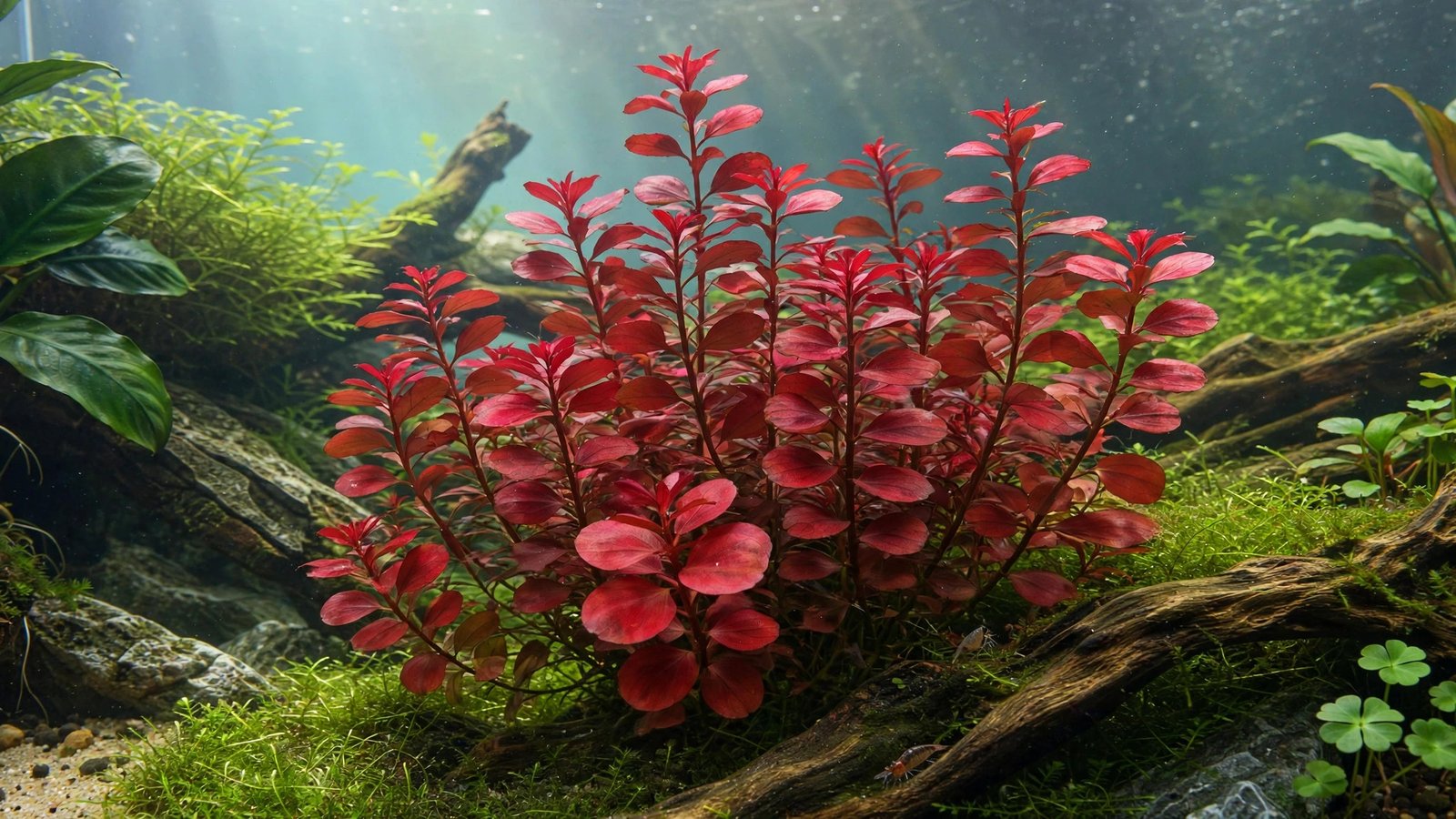
You bought the most crimson-red stem plant in the shop, planted it, and watched it dissolve into a mushy brown puddle within ten days. Welcome to the club — nearly everyone melts their first batch of Rotala macrandra, the most demanding red stem commonly sold. Mastering rotala macrandra care means accepting four non-negotiables: high light, pressurized CO2, soft acidic water, and a rich substrate paired with steady iron and micronutrient dosing. Get those right, and you get cherry-red, ripple-edged leaves no other stem plant can match.
Why It Melted: The Emersed-to-Submersed Crash
Almost every stem sold in stores was grown emersed — roots wet, leaves in humid air. Emersed leaves are thick, waxy, and built to breathe air; they cannot survive submerged. When you plant the pot, the plant must abandon those leaves and grow entirely new submersed foliage. That melt is not your fault — it is a scheduled rebuild, and winning means pushing new growth faster than the old leaves rot. That only happens when every parameter is dialed in before planting day. Planting into a cycling tank with fluctuating CO2 and half-strength light is a death sentence — the stems cannot photosynthesize enough energy to fund the rebuild, and they rot from the bottom up.
Use this planting protocol. Separate the pot into individual stems — never plant the whole plug. Trim off the bottom 2–3 cm of each stem; the emersed base is already dying and will rot in the substrate. Plant each stem 2–3 cm deep at a slight angle, and expect 60–80% of the original leaves to melt over 2–3 weeks. Do not pull stems out to "check" them — every disturbance resets root development. You are winning when tiny new leaves emerge from the top buds while the lower leaves disintegrate. Once new growth hits 8–10 cm, trim and replant the tops; the original emersed portions have done their job and will never color up.
The Non-Negotiables: Light, CO2, Water, and Substrate
Rotala macrandra refuses to compromise on four things at once. Most stem plants bend when one parameter is off; this one breaks. Treat the four as a package.
Light. You need genuinely high light: at least 60 PAR at the substrate, ideally 80–120 PAR in the upper third of the tank where the tops will reach. On a 45 cm deep tank, that typically means a quality LED fixture running 7–8 hours daily at 80–100% intensity. Under ~50 PAR you get green, stretched stems with 3–4 cm gaps between leaf nodes — the plant's polite way of saying it is starving.
Pressurized CO2. Liquid carbon and DIY yeast setups cannot deliver the stable, high-volume CO2 macrandra demands. You need a pressurized system holding a 1.0 full-point pH drop from degassed baseline — for example, 7.4 degassed to 6.4 at peak injection, reached 1–2 hours before lights-on and held steady through the photoperiod. Fluctuating CO2 does more damage than slightly low CO2, so never fiddle with the needle valve mid-week.
Soft, slightly acidic water. Macrandra comes from soft-water habitats and struggles above GH 8. Hard water (GH 10+) triggers the classic symptom: new leaves emerge small, curled, and stunted at the growing tip while lower leaves look fine. Cut hard tap water 50/50 with RO or run remineralized RO at GH 4–6, and keep pH between 5.5 and 7.0. Temperature is forgiving: 22–28°C, with 24–26°C the sweet spot for growth and color.
Nutrient-rich substrate. An active aquasoil (ADA Amazonia, UNS Controsoil, Tropica Soil) is close to mandatory. These hold pH and KH down in the soft range macrandra wants while feeding roots ammonia and micronutrients during establishment. Inert gravel or sand removes your margin for error. Note that fresh aquasoil leaches ammonia for 3–4 weeks — plant macrandra only after the initial spike settles, or cycle the tank with hardy stems first.
Rotala Macrandra Care: Iron, Micros, and the Water Column
Rotala macrandra is an iron hog. Its red comes from anthocyanin pigments built under high light, and it needs abundant iron plus a full spectrum of trace elements to make them. What the plant actually needs is consistent, daily micro-nutrient availability, not weekly iron dumps.
Dose a complete micro fertilizer (chelated iron, manganese, zinc, boron, molybdenum, copper) every day at the lean-to-moderate EI range. A proven starting point: 0.2–0.3 ppm chelated iron (Fe) per day from the micro mix, plus macros keeping nitrate at 10–25 ppm and phosphate at 1–2 ppm. Use DTPA-chelated iron over EDTA if your pH runs above 6.5, since EDTA iron breaks down and becomes unavailable in less acidic water. Weekly frame for a 60-liter high-tech tank:
| Nutrient | Daily target | Weekly total (60 L) | Notes |
|---|---|---|---|
| Iron (Fe, DTPA) | 0.2–0.3 ppm | 1.4–2.0 ppm | Daily doses, never one weekly dump |
| Potassium (K) | ~2 ppm | ~15 ppm | Pinholes in older leaves = potassium deficiency |
| Nitrate (NO3) | — | 10–25 ppm | Near-zero nitrate bleaches new growth pale |
| Phosphate (PO4) | — | 1–2 ppm | Stunted tips + dark algae = check phosphate |
| Magnesium (Mg) | — | 5–10 ppm | Old-leaf yellowing between veins points here |
An auto-dosing pump pays for itself with this plant, because the daily micro routine is exactly the chore humans skip. Consistency beats quantity: a tank dosed at 70% of these targets every day outperforms one dosed at 150% twice a week. Watch new growth for 10–14 days after any dosing change before judging — leaves already formed will not repair themselves.
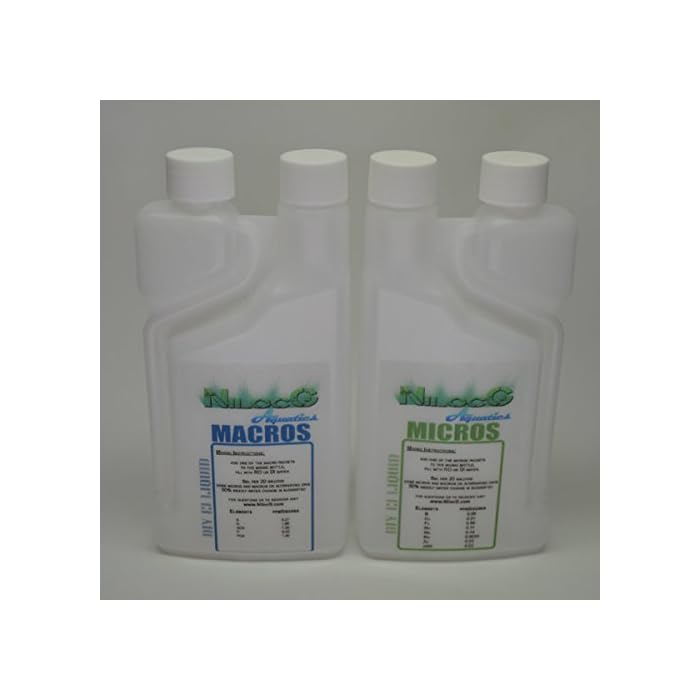
NilocG Aquatics Liquid Refill Set
Check Price on AmazonPlanting It Right: Density, Spacing, and the Red Backdrop
Rotala macrandra earns its place as a background plant, where a dense block of cherry-red stems becomes the focal wall of the scape. Getting that wall right is a spacing exercise.
Plant individual stems 2–3 cm apart in a block, not a single row. A proper backdrop for a 60 cm (20-gallon) tank uses 25–35 stems arranged 5–6 deep. This density hides the bare lower stems macrandra inevitably develops, keeps internodes tight through upward competition, and creates the layered gradient — deep red at the lit tops fading to bronze-green below — that makes the block look three-dimensional.
Push each stem into the substrate at roughly 70 degrees rather than perfectly vertical. The lean encourages side shoots from lower nodes, thickening the block from the base. After 3–4 weeks, top the tallest stems and replant the cuttings between the originals — that is how a 25-stem block becomes a 50-stem wall without buying more plants. Expect 8–10 weeks from planting to a "finished" backdrop.
Trimming and Replanting for Bushy Tops
Left alone, Rotala macrandra grows as a single spindly stem racing for the surface. Bushiness — the pom-pom tops and branching that define a great stand — comes entirely from strategic cutting. The rule: cut early, cut low, and always replant the tops.
Make the first trim when stems reach 12–15 cm, cutting just above the second or third healthy node from the base. Each cut stem responds by pushing two (sometimes three) new shoots from the nodes below the cut. Let those grow 8–10 cm, then trim again above their second node. After two rounds, one stem becomes four to six growing tips. Never trim into bare, leafless lower stem — nodes without leaves rarely resprout, and the stump will rot.
Always replant the cut tops. Macrandra tops root within 5–7 days in aquasoil, and they carry the best color of the stand — every generation of top-replanting selects for the reddest, most vigorous growth. The practical rhythm: trim every 2–3 weeks, replant tops to fill gaps, and pull the oldest, woodiest stumps every 2–3 months before they decay and foul the substrate.
Rotala Macrandra vs. 'Mini Type 4': Which One Do You Have?
Two plants circulate under the macrandra name. Standard Rotala macrandra grows 20–40 cm tall with wavy, ripple-edged leaves up to 3 cm wide. Rotala macrandra 'Mini Type 4' stays more compact, with smaller rounder leaves and tighter internodes — usable as a midground plant at 10–20 cm.
| Trait | Macrandra (standard) | 'Mini Type 4' |
|---|---|---|
| Mature height | 20–40 cm | 10–20 cm |
| Leaves | Up to 3 cm, wavy ripple edges | 1–2 cm, rounder, smoother edges |
| Placement | Background | Midground |
| Light demand | Very high (80+ PAR ideal) | High (60+ PAR usually enough) |
| CO2 demand | Strict — full 1.0 pH drop | High but slightly more forgiving |
| Emersed melt | Severe — expect 60–80% leaf loss | Moderate — often keeps more leaves |
Everything in this guide's dosing and water parameters applies to both, but the standard form is meaningfully more demanding — it is the one that melts dramatically and punishes weak CO2. If you want the classic red wall and have the light and CO2, buy the standard form. If your tank is smaller or you want red in the midground, 'Mini Type 4' is the smarter buy. Shops mislabel these constantly, so buy from a vendor that specifies the variant — and cross-check against the Tropica plant database photos before you pay.
Reading the Plant: Failure Modes and Fixes
Rotala macrandra is one of the hobby's most communicative plants — it tells you exactly what is wrong in a language of leaf shapes and colors.
| Symptom | Diagnosis | Fix |
|---|---|---|
| Green stems, stretched, 3–4 cm between nodes | Too little light | Raise to 60+ PAR at substrate; 8 h photoperiod |
| New leaves tiny, curled, tip stalls | Low/unstable CO2 or hard water | Verify 1.0 pH drop; dilute with RO if GH above 8 |
| New growth pale pink/white, not red | Nitrate bottomed out or iron low | Hold NO3 10–25 ppm; raise daily Fe to 0.2–0.3 ppm |
| Pinholes in older leaves, yellow edges | Potassium deficiency | Raise K to ~15 ppm weekly |
| Lower stems melt while tops grow fine | Normal aging or over-dense shading | Trim and replant tops; thin to 2–3 cm spacing |
| Whole plant dissolves within 2 weeks | Transition + unstable parameters | Replant into a stable tank per the protocol above |
| Stunted tips + dark hair algae on leaves | CO2/flow distribution | Reposition diffuser; get gentle flow to the backdrop |
The most common failure cascade: moderate light causes green growth, the grower "fixes" it with more fertilizer, the extra nutrients feed algae, the grower cuts light to fight algae, and the plant melts. The real fix always follows the same order — light first, then CO2 stability, then water softness, then dosing. For deeper reading, the 2hraquarist freshwater plant guide covers macrandra's requirements in detail and matches the numbers above: high light, heavy CO2, soft water, rich micros.
Frequently Asked Questions
Why is my Rotala macrandra melting after planting?
It was grown emersed (leaves in air), and those leaves cannot survive underwater — 60–80% leaf loss in the first 2–3 weeks is normal. Keep light, CO2, and dosing stable, and watch for tiny new submersed leaves at the stem tips. Once new growth reaches 8–10 cm, trim and replant the tops and discard the melted emersed portions.
Can Rotala macrandra grow without CO2 injection?
No — not in any form worth growing. Without pressurized CO2 it stays green and stunted, then melts, even under strong light. Liquid carbon cannot substitute; you need a pressurized system holding a full 1.0 pH drop. For a red stem in a low-tech tank, grow Ludwigia Super Red or Rotala rotundifolia instead.
How do I get Rotala macrandra really red instead of green?
Red needs three things together: high light (60–80+ PAR), strong CO2, and enough iron with moderate nitrate — kept at 10–15 ppm rather than 25+. Dose 0.2–0.3 ppm chelated iron daily. The reddest leaves are always the newest ones near the light, so trim and replant tops regularly to keep the whole stand colorful.
What water parameters does Rotala macrandra need?
Soft, slightly acidic water: pH 5.5–7.0, GH 3–8 dGH, KH 0–4, temperature 22–28°C. Hard water above GH 8 curls and stunts new leaves — dilute hard tap water 50/50 with RO or run remineralized RO. An active aquasoil helps by buffering pH and KH down into the range this plant prefers.
How fast does Rotala macrandra grow?
After the emersed transition finishes (3–4 weeks), expect 2–4 cm of new growth per week under high light and CO2 — a stem can go from 10 cm to the surface of a 45 cm tank in 6–8 weeks. That speed is why trimming every 2–3 weeks matters: without regular cutting, the stand shades itself and the lower half melts away.
Is Rotala macrandra harder than Rotala wallichii or Rotala H'ra?
Yes, noticeably. Rotala wallichii is demanding but more forgiving of brief CO2 dips, while Rotala H'ra colors up under merely moderate light and CO2. Macrandra sits a full tier above both — treat it as the final exam after keeping those species thriving for a few months.
The Final Exam Worth Taking
Rotala macrandra has a reputation for humbling experienced aquascapers, and it earns it honestly — it is the least forgiving red stem you can buy. But that difficulty is the reward: when your backdrop turns cherry-red and holds for months, you know every parameter in your tank is genuinely dialed in, because this plant accepts nothing less.
Building a red scape around it? Put easier reds in front — Alternanthera reineckii for midground contrast and Limnophila aromatica for texture — so one struggling species never sinks the composition. And once macrandra thrives, the other demanding reds, like Nesaea pedicellata, suddenly feel within reach. That is the real payoff of the final exam: it certifies your tank.