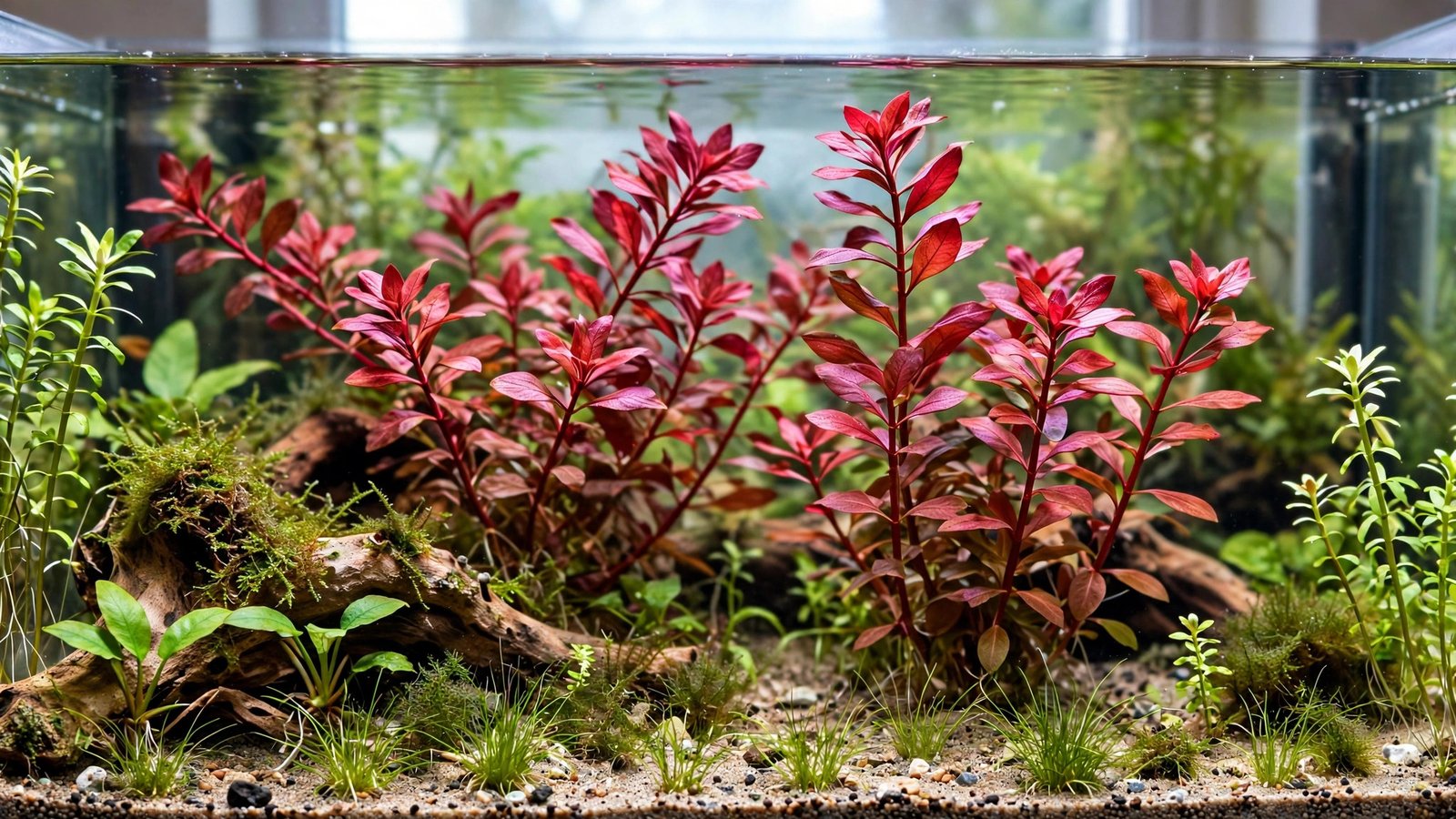
When aquascapers talk about a true crimson stem plant, this is usually the one they mean. Ludwigia Super Red care sits a clear step above its easygoing cousin Ludwigia repens: the color payoff is dramatically deeper, but so are the demands. Strong light, injected CO2, and consistent fertilization are non-negotiable if you want the intense, uniform red that makes this plant famous. Get those right, and few plants photograph as well.
Ludwigia Super Red is a cultivated variety of Ludwigia palustris, selected for maximum red pigmentation. This guide covers the high-tech conditions it needs, how to plant and trim it for dense color blocks, propagation, and how to diagnose the pale, greenish growth that signals something is off.
Quick Care Reference
| Parameter | Requirement |
|---|---|
| Light | High (70+ PAR); color fails below this |
| CO2 | Required for best color (25–30 ppm) |
| Growth rate | Moderate to fast (with CO2) |
| Placement | Midground to background |
| Difficulty | Moderate to difficult |
| Temperature | 68–80°F (20–27°C) |
| pH | 5.5–7.5 |
| Height | 8–20 inches (20–50 cm) |
Super Red vs Ludwigia Repens: Know What You're Buying
These two are constantly confused, and the difference matters. Ludwigia repens is the forgiving beginner plant that blushes red-orange on top under strong light. Ludwigia Super Red is a different cultivar bred for saturated, all-over crimson — stems, leaves, and all — and it simply will not deliver that color in a low-tech tank.
Buy Super Red only if you run (or plan to run) CO2 and strong lighting. In a low-tech setup it survives but grows greenish-bronze and leggy — a disappointing, expensive version of what repens does better for less money. Be honest about your setup before purchasing.
Planting for Dense Color Blocks
Super Red looks best planted as a tight group — a block of crimson reads far more powerfully than scattered stems. Buy enough to plant a real cluster: 8–15 stems minimum for a meaningful patch. Separate every stem, strip the lower leaves, and plant about an inch deep with roughly an inch of spacing. It will fill in fast once established.
Use a nutrient-rich substrate. Super Red is a heavy root feeder for a stem plant, and aquasoil or a good planted substrate plus root tabs gives the deep, even coloration that inert gravel struggles to match. Plant it where it gets unobstructed light — midground in taller tanks where the tops sit in the brightest zone, or background in shallower setups. Avoid shading it under Amazon frogbit or other floaters; even partial shading washes the red out of covered stems.
Light: The Non-Negotiable
This is where Super Red succeeds or fails. It needs genuinely high light — 70+ PAR at the substrate, more near the surface — for 8 hours daily. Under medium light it grows, but stays olive-green to bronze, and no amount of fertilizer will fix that. If your light can't deliver high PAR, grow Ludwigia repens instead and save yourself the frustration.
Light quality matters too: full-spectrum fixtures with strong red output render and support the red pigments best. If your Super Red looks dark or muddy rather than vivid, check whether your light leans heavily blue-white without red wavelengths.
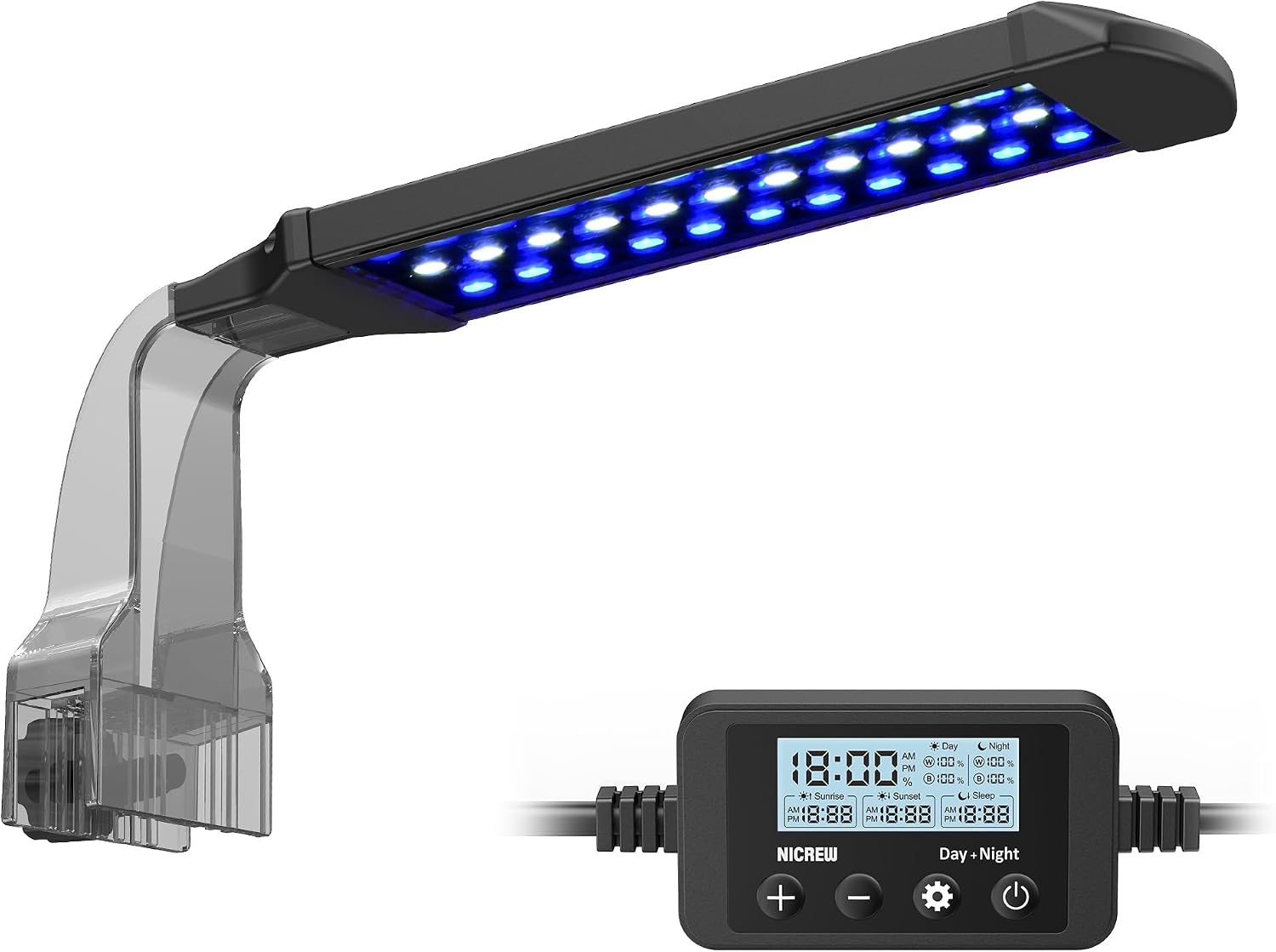
High light is non-negotiable for true crimson: a high-output light like the NICREW ClassicLED Plus.
 ★4.6
NICREW ClassicLED Plus planted aquarium light
Check Price on Amazon ★4.6CO2 and Fertilization Strategy
Injected CO2 at 25–30 ppm, stable through the entire photoperiod, is the second pillar. Fluctuating CO2 causes the stunted, crinkled new growth that plagues this plant — a drop checker showing consistent green-yellow during lights-on is your target. Inconsistent CO2 with Super Red produces deformed tips faster than almost any other stem.
Fertilization needs to be complete and consistent. Super Red is hungry: dose a full comprehensive fertilizer routine, and pay special attention to iron and micronutrients, which directly support red pigmentation. Keep nitrates in the moderate range (10–20 ppm) — sky-high nitrates push growth green and leggy, while near-zero nitrates stall the plant entirely. The sweet spot is "enough to grow fast, not so much that color washes out."
Magnesium deserves a mention: it's central to chlorophyll function, and red plants show magnesium deficiency as pale, washed-out new growth. If your dosing routine is solid but color stays flat, a GH booster or magnesium supplement is worth trying.
Crimson color demands consistent nutrient supply: Seachem Flourish as the base of the dosing strategy.
Trimming and Propagation
Trim Super Red by cutting stems just above a leaf node and replanting the tops — the classic stem-plant technique. Each cut doubles stems over time as the base resprouts. For the densest color blocks, trim frequently (every 2–3 weeks) rather than letting stems get tall and sparse; short, frequently-trimmed stands pack more red per square inch.
An advanced technique: when the stand gets too tall, uproot the whole group, trim the tops, and replant only the fresh tops in the same spot. This "reset replant" keeps the block perpetually young and colorful, since older lower stems gradually lose vigor. Propagation from cuttings is easy — every node roots within days.
Troubleshooting Common Problems
Growing green instead of red
Walk the checklist in order: (1) Is light genuinely high — 70+ PAR? (2) Is CO2 stable at 25–30 ppm through the photoperiod? (3) Are nitrates moderate, not excessive? (4) Is iron dosing adequate? Most "green Super Red" cases fail at step 1. Remember that existing green leaves won't turn red — judge only new growth after fixing conditions.
Stunted, curled, or deformed new growth
Almost always CO2 fluctuation or calcium deficiency. Verify CO2 stability first — a drop checker that swings between blue and yellow during the day is the classic culprit. In very soft water, add a GH booster for calcium and magnesium. Compare with the same symptom in Rotala rotundifolia, where the diagnosis follows the same logic.
Lower leaves dropping, bare stems
Self-shading, the universal stem-plant issue. Super Red's broad leaves shade aggressively, so space stems at planting and trim before the stand gets top-heavy. Plant a midground screen like Staurogyne repens in front to hide inevitable bare lower stems.
Algae on leaves
Broad, slow-to-moderate leaves under high light are algae magnets when anything is imbalanced. Hair algae and green spot algae are the usual offenders. Don't reduce light — the plant needs it — instead verify CO2 stability, confirm fertilizer dosing matches plant mass, and consider shortening the photoperiod to 7 hours temporarily. Amano shrimp and otocinclus help with cleanup.
Melting after planting
Emersed-grown Super Red melts its nursery leaves like any stem. Submersed stock that melts usually signals a rough transition — big parameter differences, ammonia in a new tank, or damaged stems. Keep water stable, remove mush, and give it two weeks.
Aquascaping With Super Red
Use Super Red as a color accent, not a filler. A single dense block — say 6×6 inches of crimson — becomes the focal point of an entire aquascape. The classic Dutch arrangement alternates it with green fine-leaved stems like Rotala wallichii or Limnophila sessiliflora, letting the red block pop against feathery green.
It also works as a midground "red bush" in front of taller green backgrounds — trim it into a dome shape by cutting outer stems shorter than inner ones. Against a dark background and a Monte Carlo carpet, a Super Red dome is one of the highest-impact compositions a mid-size tank can carry.
Frequently Asked Questions
Does Ludwigia Super Red need CO2?
For the color it's named for, yes. It survives without CO2 but grows greenish-bronze and leggy — a poor return on a premium plant. Stable CO2 at 25–30 ppm is what unlocks fast growth, compact form, and saturated crimson color. If you're not running CO2, buy Ludwigia repens instead; it's the better plant for that setup.
How much light does Ludwigia Super Red need?
High light — 70+ PAR at the plant's level, 8 hours daily. This is the single most important factor for redness. Medium light produces green-bronze growth regardless of fertilizer or CO2. If you're unsure about your fixture's output, it's worth measuring with a PAR meter or choosing a known high-output light before investing in this plant.
Why is my Super Red growing green?
Check light intensity first, then CO2 stability, then nitrate levels (too high washes out red), then iron. Fix conditions and judge only new growth — old green leaves won't change color. Note that tissue-culture and emersed stock often arrive green and need 3–4 weeks of good conditions to color up.
How do I get bushier Super Red?
Trim frequently — every 2–3 weeks — cutting just above leaf nodes so each stem doubles. Replant the tops into the same group. Don't let stems get tall and sparse; short, often-trimmed stands are dramatically denser. The "reset replant" technique (replanting only fresh tops) keeps old stands vigorous.
Can Ludwigia Super Red grow in a nano tank?
Yes, and it's actually excellent in nanos — the broad red leaves read well at small scale. Keep it trimmed as a midground bush, and make sure the small water volume doesn't cause CO2 or nutrient swings, which show up fast in this species. A 5–10 gallon high-tech nano with a Super Red focal group is a classic winning formula.
Is Ludwigia Super Red harder than Alternanthera reineckii?
They're comparable — both are high-light, CO2-demanding red plants. Alternanthera reineckii is arguably fussier about stable conditions and slower to recover from setbacks, while Super Red grows faster and forgives trimming mistakes more readily. Most aquascapers find Super Red the easier of the two red showpieces.
Bringing It All Together
Ludwigia Super Red is a commitment plant: it asks for high light, stable CO2, and consistent feeding, and it pays back with the deepest red any stem plant offers. Don't buy it hoping your low-tech tank will be the exception — match the setup to the plant, and it becomes the effortless-looking crimson centerpiece that makes visitors ask what your secret is. The secret is just giving a demanding plant exactly what it demands.