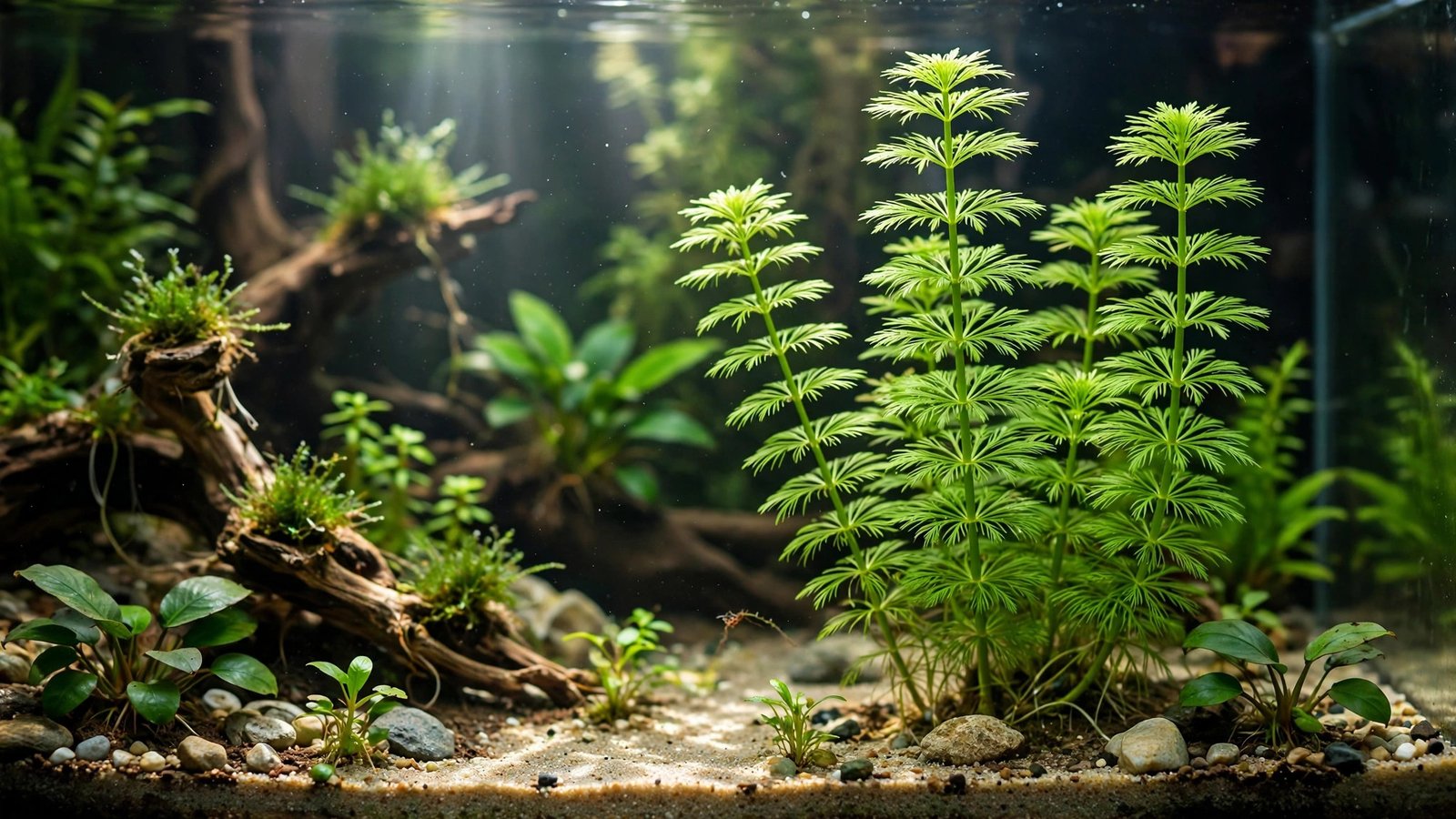
It looks like cabomba, grows like a weed, and asks for almost nothing — no wonder beginners love it. Limnophila sessiliflora care (sold as "Asian ambulia") is one of the easiest feathery background plants in the hobby: fast-growing, tolerant of low light and no CO2, and quick to fill a new tank with soft green texture. Native to South and Southeast Asia, it's the practical alternative to fussy fine-leaved plants.
This guide covers planting, light and nutrient needs, trimming for dense growth, propagation, how it compares to cabomba, and troubleshooting its few common problems.
Quick Care Reference
| Parameter | Requirement |
|---|---|
| Light | Low to high (30+ PAR) |
| CO2 | Not required |
| Growth rate | Very fast |
| Placement | Background |
| Difficulty | Very easy |
| Temperature | 64–82°F (18–28°C) |
| pH | 5.5–8.0 |
| Height | 12–24 inches (30–60 cm) |
Ambulia vs Cabomba: Why Beginners Should Choose This
Limnophila sessiliflora looks remarkably like Cabomba — feathery, fan-like whorls of fine leaves — but it's dramatically easier. Cabomba demands strong light, soft acidic water, and CO2 to avoid shedding; ambulia thrives in plain tap water, moderate light, and no CO2. If you've killed cabomba (most of us have), ambulia gives you the same aesthetic without the heartbreak.
Its common names — Asian ambulia, dwarf ambulia — reflect its origins in Asian rice paddies and slow streams. Like many marsh plants it's adaptable by nature, which translates to aquarium toughness. It's also notably less brittle than cabomba: stems bend rather than snapping during handling.
Planting Limnophila Sessiliflora
Usually sold as bunches of emersed or submersed stems. Separate into individual stems — this matters more for feathery plants than most, because crowded fine leaves rot fast without flow between them. Strip the lower leaves and plant an inch deep, spacing stems 1–1.5 inches apart. Fine stems plant easiest with tweezers.
It roots in any substrate; nutrient-rich substrate speeds establishment but isn't required. Give it the background where its height and soft texture create depth. It looks superb behind bolder plants — try feathery ambulia behind broad Ludwigia repens or Alternanthera for the classic fine-against-bold contrast. In new tanks, plant it heavily from day one: its explosive growth is excellent algae prevention during cycling.
Light, CO2, and Fertilizer
Light is flexible: ambulia grows in low light (staying a fresh green, slightly leggier) and thrives in medium to high light (denser, more compact, sometimes with reddish tips under very strong light). An 8-hour photoperiod suits it. Under truly dim light it stretches — increase intensity rather than duration if you see legginess.
CO2 is unnecessary. It grows fast without it, making it one of the best low-tech background plants. In high-tech tanks it grows even faster — almost comically so — and helps absorb the excess nutrients that fuel algae.
Fertilizer needs are light to moderate. Fish waste often suffices in stocked tanks; add comprehensive liquid fertilizer if growth pales. Like Hygrophila polysperma, its speed makes it an early indicator of nitrogen shortage — pale older leaves mean the tank is hungry. Iron isn't critical, though it enriches color under strong light.
Feathery fast grower needs steady water-column nutrients: Seachem Flourish for steady growth.
Trimming and Propagation
Trim every 1–3 weeks — ambulia grows inches per week in good conditions. Cut above a node; bases resprout bushier. Replant tops to thicken the stand. For the densest look, trim frequently rather than letting stems get tall: short, often-cut stands develop the lush, cloud-like density that makes this plant beautiful.
Propagation is trivially easy — any cutting with nodes roots within days. It also produces side shoots freely. One bunch becomes a background forest within two months. Give trimmings to fellow hobbyists; ambulia is among the most-shared plants because everyone succeeds with it.
Troubleshooting Common Problems
Lower portions turning brown or bare
The classic feathery-plant issue: dense upper growth shades the lowers, which brown and shed. Space stems at planting, trim before stands get top-heavy, and periodically replant fresh tops to renew old stands. Hiding bases behind midground plants like Staurogyne repens is standard practice — every aquascaper does this with ambulia.
Leggy, sparse growth
Too little light. Ambulia stretches with long internodes when PAR is low. Increase intensity, trim leggy tops, and replant — the regrowth under better light will be dramatically denser. Compare with Rotala wallichii, which goes leggy under medium light where ambulia still looks decent — that's the practical hardiness gap.
Melting after planting
Emersed-grown stock sheds lower leaves while converting — normal, and faster than many stems. Submersed stock rarely melts. If melting persists past two weeks, check for ammonia (new tanks) or severe parameter differences from the source.
Leaves closing or "sleeping"
Ambulia's leaves fold upward at night — completely normal nyctinastic behavior, not a problem. You'll see the feathery whorls close in the evening and reopen with the lights. It's actually a charming trait once you know to expect it.
Algae in the fine foliage
Hair algae loves feathery plants when balance slips. Keep the photoperiod at 8 hours, don't over-fertilize, and maintain good flow through the stand (spacing matters). Manual removal with a soft toothbrush works; amano shrimp graze it well. Fix imbalances rather than cutting light — the plant needs it.
Best Uses
Ambulia is the ultimate background filler: fast, soft, undemanding. It excels in new tanks (nutrient sponge during cycling), low-tech setups, breeding tanks (fry shelter), and as a "nurse" plant in new scapes while slower specimens establish. Its fine texture also makes it a great contrast plant in Dutch layouts, alternating with bold reds and broad greens.
Shrimp love it — the fine leaves offer enormous grazing surface and hiding spots for shrimplets. In community tanks, schools of small tetras weaving through ambulia fronds are a timeless sight.
Meet the Limnophila Family
If ambulia wins you over, its relatives offer upgrades in color and form — with a step up in demands:
- Limnophila aromatica — the colorful cousin. Narrower leaves that turn pink-purple under strong light with CO2. Beautiful, but needs high light and stable CO2 — think of it as ambulia's high-tech sibling.
- Limnophila hippuridoides — compact, with reddish tones and a tidier growth habit. A good midground choice in high-tech tanks.
- Limnophila sessiliflora (this plant) — the easy one. When in doubt, start here.
The pattern is consistent across the genus: the plain green species are bulletproof, the colorful ones want CO2 and strong light. Master sessiliflora first, then graduate to aromatica when your setup — and your trimming discipline — is ready.
Seasonal Behavior and Outdoor Growing
In warm climates, Limnophila sessiliflora grows enthusiastically in outdoor tubs and ponds during summer, often flowering with small pale-purple blooms above the surface. It appreciates the intense natural light and grows faster outdoors than in most tanks. Bring it inside before temperatures drop below 60°F — it's tropical and won't survive frost. Outdoor-grown stems transition back indoors easily; quarantine them first to avoid importing pests or algae into your aquariums.
Frequently Asked Questions
Is Limnophila sessiliflora good for beginners?
Excellent — it's one of the best beginner background plants. It grows in low light, needs no CO2, tolerates most water, propagates from any cutting, and fills tanks fast. The only maintenance is regular trimming. If you can keep any plant alive, you can keep ambulia thriving.
What's the difference between Limnophila sessiliflora and Cabomba?
They look similar — feathery fan-like foliage — but ambulia is far hardier. Cabomba needs strong light, soft acidic water, and CO2 to avoid shedding its leaves; ambulia thrives in average tap water, moderate light, and no CO2. Ambulia stems are also less brittle. For 95% of hobbyists, ambulia is the better choice.
Why do the leaves close at night?
It's nyctinasty — a natural daily rhythm where the leaf whorls fold upward in darkness and reopen with light. Completely normal and healthy. Many fine-leaved plants do this; ambulia just shows it clearly because of its feathery structure. Watching this daily rhythm is one of the small joys of keeping the plant.
Does it need CO2?
No. Limnophila sessiliflora grows vigorously without CO2 — it's a top-tier low-tech plant. CO2 accelerates growth further, which is useful in high-tech tanks for nutrient uptake but unnecessary for health or appearance. Its low-tech vigor is exactly why beginners succeed with it so reliably.
How do I keep it bushy instead of leggy?
Strong-ish light, frequent trimming (every 1–3 weeks), and good spacing at planting. Cut above nodes so bases branch; replant tops into the same stand. Dense ambulia comes from regular haircuts, not from leaving it alone — neglect produces tall sparse stems, trimming produces clouds.
Can it grow floating?
Yes — cuttings float and grow fine, rooting from nodes. It's handy for holding trimmings, but floating ambulia shades the tank and grows emersed-type foliage at the surface. Don't leave it floating long-term in a planted tank. Just remember that floating stems shade everything growing beneath them.
Bringing It All Together
Limnophila sessiliflora is proof that easy doesn't mean boring: fast, feathery, forgiving, and genuinely beautiful when trimmed into dense stands. Plant it in the background, give it reasonable light, trim it often, and enjoy the soft green texture that makes every scape feel alive. For beginners it's training wheels that look like a showpiece; for experts it's the reliable workhorse that fills space while the divas take their time.