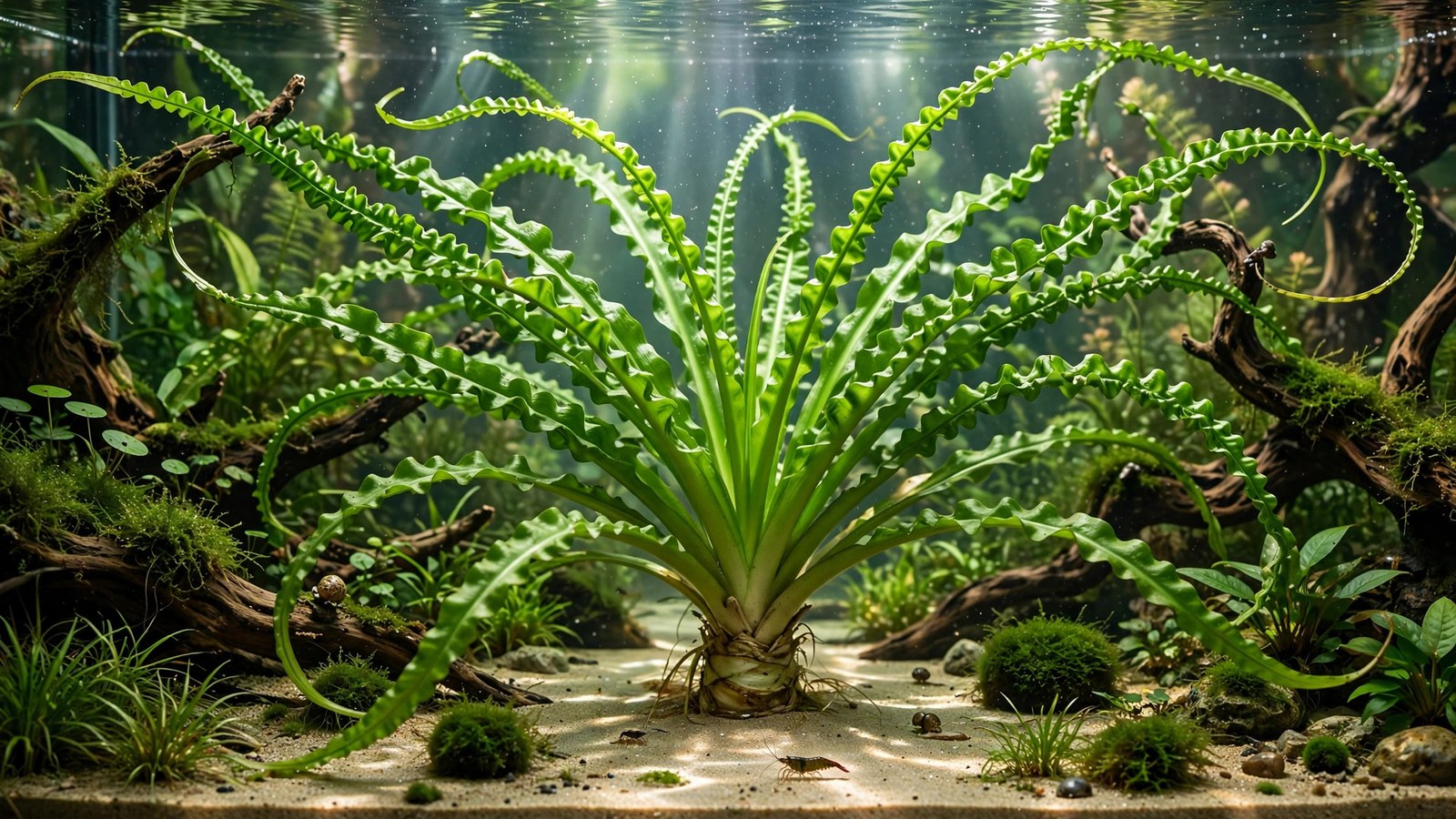
Sixty inches of rippling green ribbon, surging from a single bulb, can turn the back glass of your tank into a living curtain — which is exactly why retailers sell Crinum natans as "The Ultimate Monster Plant." But that same bulb will melt into mush within weeks if you plant it the way you'd plant anything else. Getting crinum natans care right comes down to a few non-negotiables: the bulb neck stays above the substrate, the roots get fed like champions, and the tank has to be tall enough to survive it.
Mastering crinum natans care: The Bulb Is the Whole Game
Everything in crinum natans care starts at the bulb — and almost everyone plants it wrong the first time. This is a true bulb plant, typically sold as a wild-collected specimen 3–5 inches across, and it must never be buried whole. Push the bulb 2–3 inches into your substrate, but keep the neck and upper third proudly above the surface, the way you'd plant an amaryllis. Buried neck tissue stays airless and rots in 2–4 weeks — the classic "melted overnight" story.
Before you plant, inspect the bulb like you're buying produce. Trim any mushy roots back to firm white tissue with clean scissors, then settle the bulb into a planting hole and gently firm the substrate around — never pack it. Dustin's Fish Tanks sells it as "The Ultimate Monster Plant", and once you see the strap-like leaves it pushes out, the name makes sense. If you're still weighing which giants belong in your background, our guide to choosing background statement plants walks through how to balance a tall-tank scape around one dominant species.
A 60-Inch Plant Needs a Monster Tank
Respect the numbers: mature Crinum natans sends 40–60 inch ribbon leaves arcing toward the surface and trailing along it. In practice that means a 75-gallon tank is the realistic minimum, and a 120-gallon or taller 24-inch-deep setup is where it truly belongs. Give it a corner or back-center position and let a single specimen own it.
It earns its place in West Africa biotope scapes, where it grows in flowing rivers and tolerates current that would shred fussier plants. Moderate flow is fine — in fact the leaves look their best swaying gently, and strong circulation delivers nutrients to the leaf surface.
Natans vs. Calamistratum vs. Thaianum: Know Your Crinum
Three crinums show up in the trade, and mixing them up means buying the wrong monster. Same bulb-neck rule, sharply different size and temperament:
| Trait | C. natans | C. calamistratum | C. thaianum (water onion) |
|---|---|---|---|
| Max leaf length | Up to 60 in (150 cm) | Up to 40 in (100 cm) | Up to 36 in (90 cm) |
| Leaf character | Broad, rippled ribbon; wild-collected drama | Narrow, tightly crinkled like a ribbon curl | Straight, smooth onion-like straps |
| Growth pace | Slow start, then unstoppable | Glacial — the slowest of the three | Steady and predictable |
| Best tank | 75+ gal, 24+ in tall | 40+ gal | 30+ gal |
| Provenance | Mostly wild-collected specimens | Farmed or wild | Widely farmed, most available |
Choose natans when you want maximum spectacle and have the tank to hold it. If your setup tops out at 40 gallons, Crinum calamistratum gives you the same rippling texture at a manageable 40 inches — and if you just want the easiest bulb plant in the family, Crinum thaianum, the water onion, establishes faster and forgives more mistakes. The planting and feeding rules below work for all three, but the size advice is natans-specific: do not scale it down.
Feeding the Monster: Substrate, Root Tabs, and Water
Crinum natans is a heavy root feeder, full stop. Liquid fertilizer in the water column barely registers with it — the bulb's thick root system wants to eat from the substrate. Lay 2–3 inches of nutrient-rich aquasoil or capped topsoil, and press one root tab into the substrate 2–3 inches from the bulb every 2–3 months. A single well-fed specimen can push a new 12-inch leaf every 7–10 days once it's rolling.
Water parameters are refreshingly undemanding: pH 6.5–8.0, temperature 72–82°F (22–28°C), and it tolerates genuinely hard water up to 20 dGH without complaint. Low to medium light is plenty — resist the urge to blast it with high light, which just invites algae onto the older straps. For the full rundown on getting the foundation right, see our guide to the best substrate for planted tanks — a root feeder this hungry punishes a thin or inert bed more than almost any other plant.
The Slow Start and the Flower Payoff
Do not panic during the first 4–8 weeks. Wild-collected bulbs sulk: old leaves may melt back, growth stalls, and the plant looks like an expensive mistake. Leave it alone — disturbing the bulb to "check the roots" resets the clock. As long as the bulb stays firm and the neck isn't buried, new leaves will emerge from the crown, then grow progressively longer and greener.
The reward for patience can be spectacular. In open-top tanks, a mature natans occasionally sends up a flower stalk that breaches the surface and opens white, lily-like blooms — one of the great sights in the planted-tank hobby. Plants that reach the surface also make excellent companions for other giants; Madagascar lace plant and Aponogeton ulvaceus share the background-giant niche and the heavy-feeding habit, and they look stunning flanking a crinum.
Frequently Asked Questions
Can Crinum natans grow in a 20-gallon tank?
No. With leaves reaching 40–60 inches, natans overwhelms anything under 55 gallons — it needs 75+ gallons with at least 24 inches of height. In small tanks the leaves pile at the surface, block all light, and rot. For smaller setups, Crinum calamistratum or Crinum thaianum deliver the ribbon-leaf drama at half the size.
Why are my Crinum natans leaves melting after planting?
Some melt is normal transition shock — wild-collected bulbs shed old leaves while growing new ones adapted to your water. The red flag is a soft, foul-smelling bulb, which means the neck was buried and rot has set in. Trim to firm white tissue, replant with the neck above the substrate, and give it 4–8 undisturbed weeks.
Does Crinum natans need CO2 injection?
No. It grows perfectly well in low-tech setups without injected CO2, pulling carbon from the water and nutrients from the substrate. CO2 speeds growth slightly, but root nutrition is the real limiting factor — invest in rich substrate and regular root tabs instead of a CO2 rig.
How do you propagate Crinum natans?
Mature bulbs produce daughter bulbs at their base. Once a pup reaches one-third of the mother's size with its own roots, twist or cut it free with a clean blade. Replant it with the neck above the substrate in a nutrient-rich spot. Expect one or two pups per year — this is a slow multiplier, not a fast one.
Why won't my Crinum natans flower?
Flowering needs three things: a mature bulb (usually 12+ months established), leaves long enough to reach the surface, and an open-top tank so the stalk can emerge. Covered tanks almost never see flowers. Keep feeding the roots and be patient — maturity triggers blooms, not forced conditions.
Your Tank's New Centerpiece
Crinum natans is not a plant you fit into a scape — it's a plant you build the scape around. Plant the bulb proud, feed the roots generously, give it a tall tank, and leave it alone through the sulky first weeks. Do that and you'll own sixty inches of living green curtain — and maybe a lily-like flower for your patience.