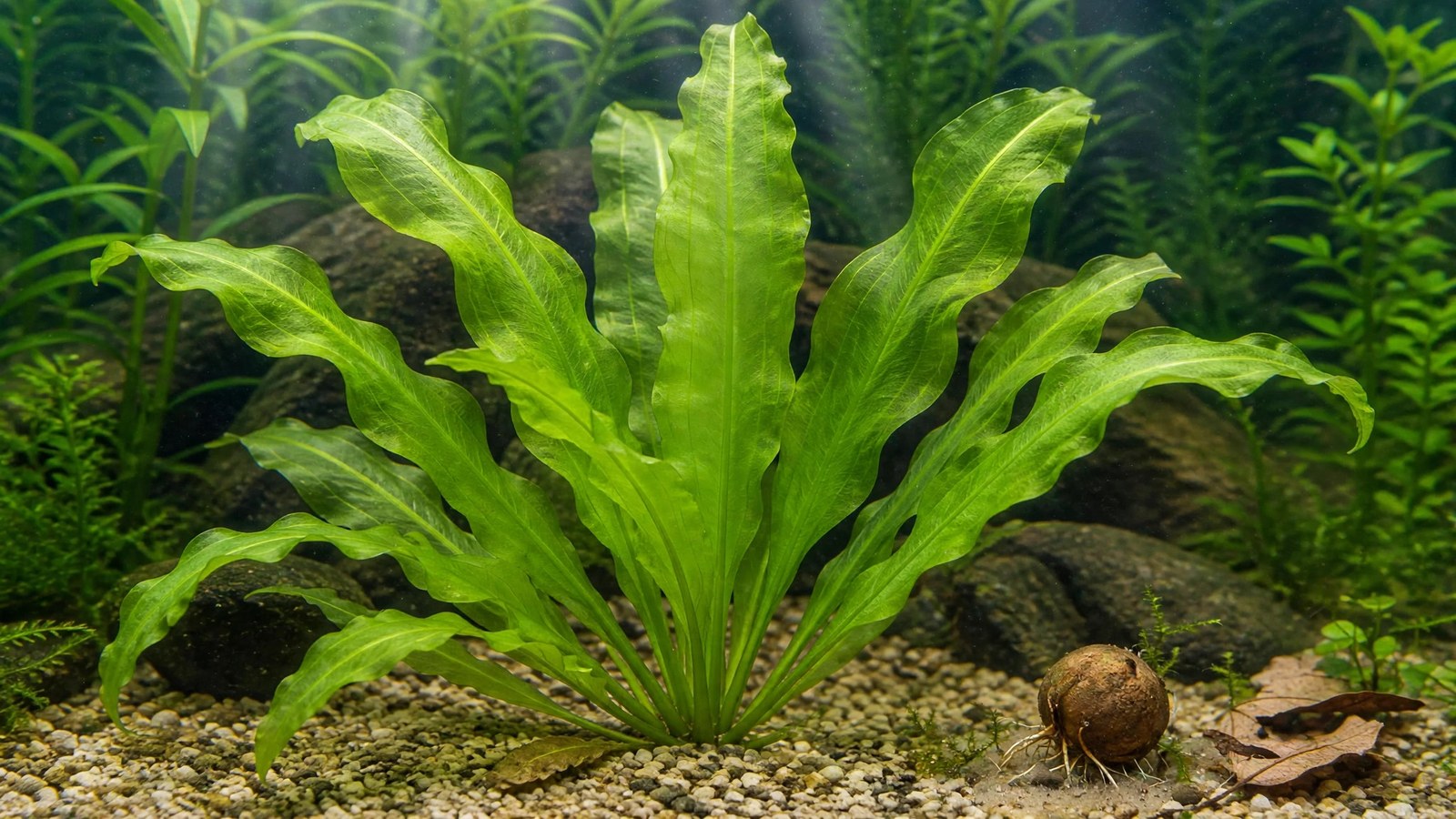
Every year, thousands of keepers throw a perfectly healthy bulb in the bin. Their Aponogeton ulvaceus drops its leaves over a few weeks, the tank looks bare, and they assume the plant is dead — when in fact it has simply clocked out for its natural rest. This guide to aponogeton ulvaceus care will help you avoid that mistake, and show you how to grow one of the hobby's most dramatic background plants: a Madagascar bulb whose wide, wavy, almost translucent leaves can reach 40–60 cm and glow like tissue paper when backlit.
Size is the first thing to understand about this plant. Aponogeton ulvaceus is not a midground accent — it is a statement piece. A mature rosette can span 60 cm with leaves long enough to brush the surface of a 50 cm-deep tank, which is why it belongs at the back of anything smaller than 200L or as the centerpiece of a larger aquascape. That scale is also its superpower: a healthy specimen anchors a freshwater aquarium plants complete guide layout the way a big driftwood focal point would, only alive and growing. For more on feeding heavy root feeders, see do aquarium plants really need fertilizer — bulb plants feed almost entirely through their roots, not the water column.
Aponogeton Ulvaceus Care: Tank Setup and Parameters
Give ulvaceus medium to high light for the fastest growth and the widest, most translucent leaves. It survives moderate lighting, but growth slows and leaves stay narrower and darker. Unlike its famous cousin, the Madagascar lace plant, ulvaceus has solid leaves — no lacy fenestration — making it slightly less demanding. Tropica's Aponogeton ulvaceus plant profile likewise rates it as medium light with low CO2 need.
Water chemistry is forgiving. Anything in the pH 6.0–7.5 range works, and the plant tolerates soft to moderately hard water. Keep temperature between 20 and 28°C, with 22–28°C as the sweet spot; sustained heat above 29°C can push it into dormancy early. CO2 injection is optional — this species grows fast without it — though steady CO2 will thicken leaves in high light.
The substrate decision matters more than anything else. Ulvaceus is a bulb plant, and bulb plants are root feeders: a nutrient-rich aquasoil or plain sand/gravel loaded with root tabs both work. Insert 2–3 root tabs in a 15 cm radius around the bulb at planting time and refresh every 2–3 months. Liquid fertilizer alone will leave it pale, because the feeding happens underground, not through the leaves.
Planting: The Shallow-Bulb Rule
Planting technique is where most failures start. The bulb must sit SHALLOWLY with its top half to top third exposed — never fully buried. A buried bulb suffocates and rots within days. Check it is right-side up before planting: the sprouting end faces the surface. An upside-down bulb rarely recovers. New bulbs typically send up their first leaf within 7–14 days at 24–26°C.
Space the rosette at least 20–25 cm from glass and other plants. At 3–5 inches of new growth per day under strong light, a ulvaceus that starts as a fist-sized bulb can dominate a 100L tank within two months. Plant it behind Vallisneria or beside a crinum, and leave open water above for the leaves to unfurl.
Dormancy: Why Your Plant Isn't Dead
Here is the anxiety every buyer eventually faces: your glorious ulvaceus slows down, the older leaves yellow and melt, and within weeks only a bare bulb remains. This is dormancy, the plant's built-in rest cycle, and it is completely normal for the Aponogeton genus. Do not throw the bulb away.
You have two options. The lazy one works fine: leave the bulb exactly where it is. In most tanks it will sit quiet for a few weeks and then push fresh leaves on its own. The controlled option is to remove the bulb, rinse it gently, and store it in moist sand in a cool, dark spot for 6–8 weeks, then replant shallowly.
One caveat: hybrids vary. Purple-flowering ulvaceus hybrids frequently skip dormancy and grow year-round, while pure wild-type stock is more likely to rest. Neither outcome signals a problem — just genetics.
| Situation | What to do |
|---|---|
| Planting a new bulb | Bury shallowly, top 1/2–1/3 exposed, sprout end up; 24–26°C for fastest sprouting (7–14 days) |
| Leaves yellowing from tips | Check for dormancy onset; don't uproot — wait or reduce light slightly |
| All leaves melted | Leave the bulb in place; it regrows in weeks, or store in moist sand 6–8 weeks and replant |
| Floating leaves forming | Trim them at the base — they shade everything below |
Pruning and Flowering
Pruning is simple but frequent. Remove outer leaves as they age by cutting the petiole at the bulb base — never rip leaves off. When the plant sends leaves to the surface to float, cut them; floating leaves block light from everything beneath the rosette.
Under good conditions it sends up a tall spike bearing fragrant white, yellow, or purple blooms, depending on the strain. Let the spike develop — it won't harm the plant — and remove the stalk once it dies back naturally.
Frequently Asked Questions
Why did my Aponogeton ulvaceus lose all its leaves?
It has entered dormancy, a normal rest cycle for the Aponogeton genus. The leaves melt back and the bulb goes quiet for a few weeks to a few months. Leave it in the substrate — it will regrow on its own. Only discard the bulb if it has turned soft and mushy, which indicates rot rather than dormancy.
Does Aponogeton ulvaceus need CO2?
No. CO2 is genuinely optional for this species. It grows fast — up to 3–5 inches per day — without injected CO2. Adding CO2 will thicken leaves and increase growth in high-light setups, but a medium-light tank with root tabs produces a perfectly healthy, large plant without any carbon supplementation.
How do you plant an Aponogeton ulvaceus bulb?
Push it shallowly into the substrate with the top half to third exposed, sprout end facing up. Never bury it completely — a fully buried bulb rots. Place 2–3 root tabs within a 15 cm radius, since bulb plants feed through their roots. Expect the first leaf within 7–14 days at 24–26°C.
How big does Aponogeton ulvaceus get?
Large. Leaves reach 40–60 cm long, and a mature rosette can span 60 cm across, so it suits tanks of 100L and up as a background plant or centerpiece. In smaller tanks it quickly shades everything else, which is why regular thinning is part of keeping one.
Will Aponogeton ulvaceus flower in an aquarium?
Yes, readily. Healthy specimens send up tall flower spikes with fragrant white, yellow, or purple blooms, depending on the strain. Flowering doesn't harm the plant — let the spike develop, enjoy it, and remove the stalk once it dies back naturally.
Is Aponogeton ulvaceus good for beginners?
Mostly yes, with one condition: you need a big enough tank and you must understand dormancy so you don't panic when the leaves melt. Beyond that, it tolerates a wide pH and temperature range, needs no CO2, and forgives imperfect lighting — as long as the bulb is planted shallowly and fed with root tabs.
One Bulb, Seasons of Showpieces
Ulvaceus rewards simple, correct setup with years of performance. Plant the bulb shallowly, feed it through the substrate, give it room to stretch, and respect the rest cycle — and it will fill the back of your tank with translucent, waving green. Compared with the lacy intricacy of Madagascar lace or the surface-spreading drama of the red tiger lotus, ulvaceus is the reliable giant: fast, undemanding, and — once you know dormancy is normal — unkillable by calendar.