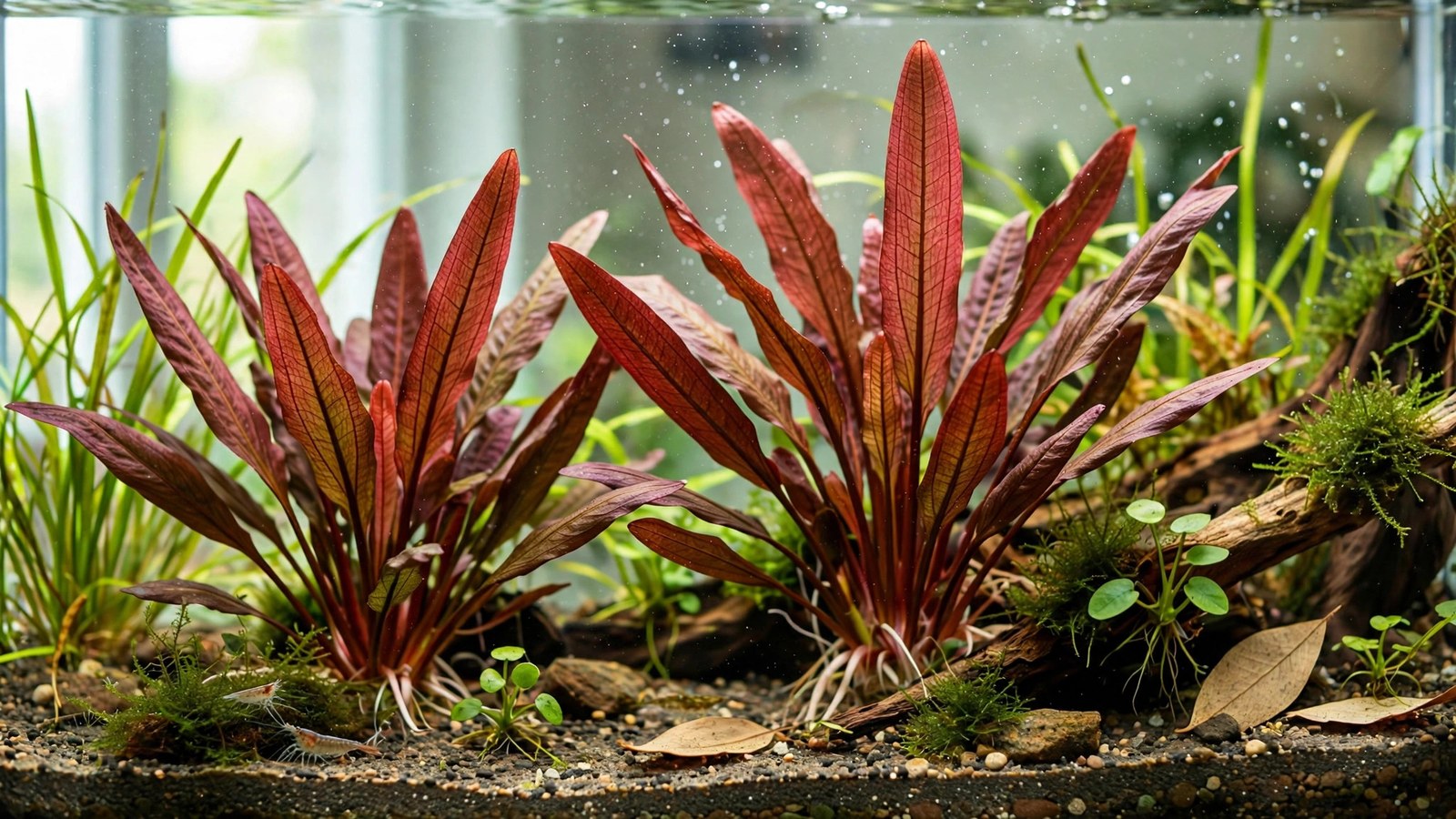
You bought it because the shop pot was deep, wine-red and gorgeous. Three weeks later your tank holds a perfectly healthy green sword. That red-to-green fade is the central frustration of echinodorus rubin care: keeping the new leaves coming in red.
The twist that explains everything: Echinodorus 'Rubin' is not a wild species from some river. It is a hybrid cultivar bred by German sword-plant breeder Hans Barth from Echinodorus horemanii 'Red' crossed with E. 'Barthii'. The red is the trait; green is what the plant defaults to when conditions are merely adequate. If you are still choosing plants, it earns its place among a red centerpiece pick — and this guide will show you how to keep it one.
echinodorus rubin care: why your Rubin loses its red
Watch one leaf's life cycle and the mystery ends. A new blade unfurls from the center in rich reddish-brown, holds its color for two to four weeks, then darkens to olive green as it ages and drifts to the outer ring. The plant puts its red pigment (anthocyanins) into young, tender growth — that is normal and never stops.
The problem is when the new leaves stop coming in red: the plant has downshifted from "display" to "survive," for three measurable reasons — weak light at the crown, iron starvation, or a root zone with nothing left to eat. A Rubin in plain gravel with dim light never dies dramatically; it just quietly stops being the plant you paid for.
The fix addresses all three at once: medium-high light at the crown, two to three root tabs in a ring around the plant, and liquid iron at the label's low end. Within one leaf cycle — three to six weeks — new blades should emerge noticeably redder.
Planting it right: the crown rule
More swords die from bad planting than from bad water. The crown — the pale, thick knot where roots and leaves meet — must sit on top of the substrate. Bury it and it rots: first a brown smudge at the base of the leaves, then the whole rosette detaching from the roots.
Buy a potted portion when you can — nursery pots protect the root ball in transit — then slide it out, rinse the rockwool off completely, and trim roots to about 5 cm. Spread the roots radially in a shallow depression and backfill so the crown sits just proud of the substrate; a gentle tug should meet light resistance.
Rubin survives in almost any substrate but earns its keep in a nutrient-rich one. Aquasoil gives the strongest first two months of red; plain gravel with root tabs is an honest budget path, refreshed every two to three months. Swords are heavy root feeders — this is the plant that made root tabs famous, and water-column dosing alone rarely keeps one ruby.
Light, feeding and CO2: what the red actually needs
You do not need CO2 to grow a healthy Rubin, and low-tech tanks suit it fine. But for saturated, photographable red, conservative CO2 at 15–25 mg/L plus strong light is the most reliable combination. Start low, watch livestock for a week, then creep up — livestock comfort is the ceiling, and color is never worth gassing your fish.
| Parameter | Target range | Why it matters for color |
|---|---|---|
| Light at crown | 40–60 PAR, 7–9 h/day | Red pigment is light-driven; under ~30 PAR new leaves come in green |
| Temperature | 22–28 °C | Warmth speeds leaf turnover, replacing green elders faster |
| pH / hardness | pH 5.5–7.5, 0–20 dGH | Very adaptable; soft water keeps iron available |
| Iron (water column) | 0.05–0.1 mg/L | Pale new growth is the signal to dose up gently |
| Root feeding | 2–3 tabs, every 2–3 months | Swords take most nutrition through roots |
| CO2 | Optional; 15–25 mg/L if injected | Deepens color, speeds growth; start low, observe livestock |
Size, spacing and propagation
Treat Rubin like furniture, not decoration. A mature plant stands 25–40 cm tall with a rosette up to 30 cm wide — taller than the Amazon sword but narrower in leaf, which is why it reads as an elegant centerpiece. Give it a full 25 cm of empty radius at planting; anything closer gets shaded out within two months, and a crowded crown traps detritus that invites algae.
Pruning is monthly, not weekly: snip outer leaves at the base as they turn fully green or algae-specked, with curved aquascaping scissors as close to the crown as you can without nicking it. Never top the rosette — there is no stem to trim.
The reward for good care is propagation. A thriving Rubin periodically sends up a flower spike that develops daughter plants along it. Let the plantlets reach 5–8 cm with a few roots, then snip the spike and plant them individually. One happy plant can hand you three or four free Rubins a year.
The melt you should expect (and not fear)
Shop plants are usually grown emersed, with rounder, thicker leaves than they will ever make underwater. Once submerged, Rubin sheds most of those over two to four weeks and replaces them with longer, narrower blades. Do not move it or "fix" the water chemistry mid-transition — judge it only by what emerges from the center after week three.
A Rubin that melts on a parameter swing and restarts from the crown is behaving exactly like its cousin Ozelot sword and the rest of the Echinodorus clan: dramatic, then fine.
Frequently Asked Questions
Why is my Echinodorus Rubin turning green?
Old leaves always fade to green with age. The real test is the new growth: if new leaves emerge green, raise light at the crown to 40–60 PAR and add iron both to the water column (0.05–0.1 mg/L) and to the substrate via root tabs. Wait one leaf cycle of three to six weeks for the red to return.
Does Echinodorus Rubin need CO2?
No — it grows well without injected CO2, which makes it a strong low-tech pick. CO2 at 15–25 mg/L deepens the red and speeds growth if maximum color is your goal. Start low, observe livestock for a week, and treat their behavior as the hard ceiling.
How big does a Rubin sword get?
Expect 25–40 cm tall with a rosette up to 30 cm wide; rich, high-light setups can push past 50 cm. It is a background or large-midground centerpiece, not a nano plant — give it a 25 cm clear radius or it will shade its neighbors within a couple of months.
Is Echinodorus Rubin safe for shrimp?
The plant itself is perfectly shrimp-safe. The caution is copper: swords are copper-sensitive, and some fertilizers, trace mixes and ich medications contain copper at levels that stress both the plant and shrimp. Check labels before dosing and prefer copper-free options in shrimp tanks.
My new Rubin is melting — is it dying?
Almost certainly not. Store plants are usually grown emersed, and they shed those above-water leaves over two to four weeks after submersion. Keep parameters stable, do not move it, and judge only the new leaves emerging from the center after week three. A firm crown plus new growth means it is on track.
Your one-page Rubin routine
Crown on the substrate, root tabs quarterly, iron dosed gently, real light on the center — and prune the green veterans so the red newcomers get the spotlight. For the full breeder history, see the EchiPedia entry on Echinodorus 'Rubin' and Florida Aquatic Nurseries' Rubin cultivar profile — and keep the red coming with the right liquid fertilizers for aquarium plants.