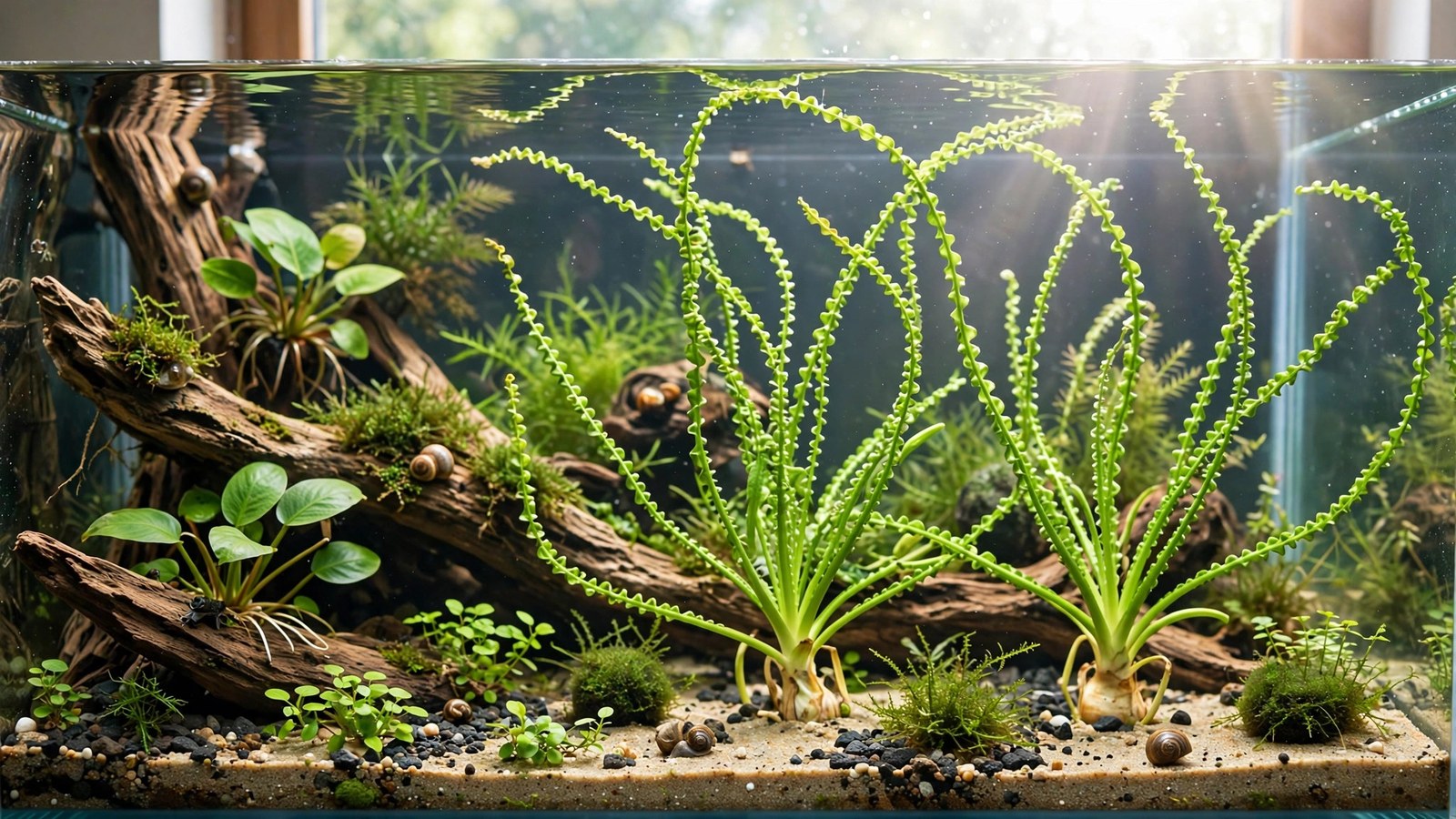
Long, crinkled ribbons rising from a bulb like green Medusa hair — nothing else looks like this. Crinum calamistratum care is about patience with a living sculpture: this West African bulb plant grows extremely slowly into a spectacular specimen of curly, strap-like leaves, hates being moved, and rewards a permanent home with decades of presence. It's the plant you buy once and keep forever.
This guide covers planting the bulb, its glacial growth and what to expect, light and nutrient needs, the cardinal rule against moving it, propagation, flowering, and troubleshooting melt and stalled growth.
Quick Care Reference
| Parameter | Requirement |
|---|---|
| Light | Low to medium (30–50 PAR) |
| CO2 | Not required |
| Growth rate | Very slow |
| Placement | Background (specimen) |
| Difficulty | Easy to moderate |
| Temperature | 72–82°F (22–28°C) |
| pH | 5.5–7.5 |
| Height | 20–40 inches (50–100 cm) |
A Living Sculpture
Crinum calamistratum is less a plant than an installation: a large bulb sends up dozens of narrow, intensely crinkled leaves that can reach 3 feet, curling and twisting as they grow. Each leaf is unique — no two curl the same way — and the overall effect is a fountain of green ribbons that moves hypnotically in the current. It's native to West and Central African streams, where it anchors in sandy substrates with massive root systems.
It's a true specimen plant: one Crinum commands a corner of even a large tank. Aquascapers use it as the gravitational center of nature-style layouts — the thing the whole composition orbits. And it's a commitment: this plant can live for decades, growing slowly more magnificent every year.
Planting the Bulb (And Then Never Moving It)
Plant the bulb with its neck and growing tip exposed above the substrate — bury the bulb body about two-thirds deep, leaving the top third visible. Like all bulb plants — see the Aponogeton crispus planting guidance — a fully buried Crinum rots. Use a deep, nutrient-rich substrate: Crinum develops an enormous root system and feeds heavily through it — aquasoil or a deep sand bed with root tabs is ideal.
Choose the spot as if forever, because it nearly is: Crinum calamistratum famously resents disturbance. Moving an established plant triggers melt, sulking for months, and sometimes decline. Plant it in the background corner where it can grow undisturbed for years, with 12+ inches of clearance — those leaves go everywhere, beautifully.
One-time setup for decades; nutrient-rich substrate pays off long-term: a nutrient-rich substrate like Fluval Stratum.
Light, CO2, and Water
Low to medium light (30–50 PAR) — Crinum evolved in shaded streams and its slow leaves algae-spot under strong light. It does beautifully in the dimmer corners of tanks where fussier plants fail. Eight hours daily max; in Crinum-focused tanks, less is fine.
CO2 is unnecessary — its glacial metabolism barely notices. Water should be warm (72°F+, it sulks in cool tanks), soft to moderately hard, pH 5.5–7.5. Stability is everything: this plant punishes abrupt changes with melt, so keep parameters steady and avoid the temptation to "improve" things around it.
Fertilizer: Feed the Roots Deeply
Crinum is a heavy root feeder with a root system to match — think deep. Place root tabs well under and around the bulb (not touching it) every 2–3 months in inert substrates; in aquasoil, supplement as the soil ages. Comprehensive liquid fertilizer helps, but root nutrition is what drives the big curly leaves.
Because growth is so slow, deficiencies appear over months: gradually yellowing older leaves (nitrogen), pale new growth (iron). Feed consistently rather than reactively — by the time you see hunger, the plant has been hungry for weeks. A well-fed Crinum produces steady new leaves; a starved one simply stops, sitting unchanged for months.
Deep-rooted bulb monster; tabs are exactly 'feed the roots deeply': deep-placed Seachem Flourish Tabs.
Growth: The Long Game
Set expectations honestly: Crinum calamistratum is one of the slowest aquarium plants. A new bulb may produce just a handful of leaves in its first six months. Year two brings real presence; year three and beyond bring magnificence. This is a plant you buy for what it becomes, not what it is.
The slowness is also its virtue: once established, it needs almost no maintenance. Old leaves occasionally yellow — remove them at the bulb. That's the entire care routine for years. Buy the largest bulb you can afford; with Crinum, you're buying time, and time is the whole plant.
Flowering
Mature, happy Crinums flower — spectacularly. A thick flower stalk rises above the water bearing large, white, lily-like blooms with a sweet fragrance, often opening at night. Flowering needs maturity (usually 2+ years), warm water, good nutrition, and an open top or enough clearance. It's one of the most dramatic blooms in the hobby — a genuine event worth waiting years for.
Propagation
Daughter bulbs form around the mother over years — Crinum is in no hurry about reproduction either. Separate daughters once they're substantial (several leaves, good roots), knowing the disturbance will set both back months. Seed propagation from flowers is possible but a multi-year project. Practically: buy bulbs, wait, and eventually divide. Patience isn't just a virtue with Crinum; it's the entire method.
Troubleshooting Common Problems
Melting after planting or moving
Expected — Crinum melts dramatically when disturbed, sometimes losing all leaves. The bulb is what matters: firm means alive. Keep it planted, maintain stable warm conditions, and wait — regrowth takes weeks to months. This is why you plant it once and never move it.
No growth for months
Normal, especially in year one. But if an established plant stalls completely with deteriorating leaves, check root nutrition (feed it), temperature (warm enough?), and whether something changed (it hates change). A Crinum that's merely slow is healthy; one that's declining needs investigation.
Leaves turning brown or algae-covered
Too much light for its slow leaves, or old age. Move it to a shadier spot (or shade it with taller plants), keep photoperiod ≤8 hours, and remove spent leaves. Nerite snails help with spot algae. Prevention is placement — Crinum belongs in gentle light.
Bulb softening
Buried too deep, damaged, or rotting from poor water quality. Expose the bulb neck, ensure good water quality, and remove any bulb that's soft and foul-smelling. A firm bulb with no leaves is dormant or recovering, not dead — give it months before judging.
Leaves breaking or kinking
The long leaves are delicate — strong direct flow whips them against hardscape, causing kinks. Position out of direct filter blast; gentle ambient current is ideal. Broken leaves don't heal — remove them at the base and let replacements grow.
Aquascaping With Crinum
One Crinum, one corner, done. It's a specimen that needs no companions to justify itself, though it pairs beautifully with dark wood, smooth river stones, and a dark substrate that makes the green ribbons glow. Surround its base with Anubias nana petite or Bolbitis on nearby wood, or a dwarf lily rosette in the substrate beside it, for a layered composition, and keep the foreground simple — a Monte Carlo carpet or bare sand lets the Crinum dominate.
Scale matters: in tanks under 30 gallons, Crinum overwhelms — its leaves reach the surface and sprawl. It's a 40+ gallon plant at maturity. Plan the tank around it, not it around the tank.
Frequently Asked Questions
Why is my Crinum calamistratum not growing?
It's probably growing — just very slowly. New bulbs may produce only a few leaves in six months; that's normal. True stalls with deteriorating leaves point to hunger (feed the roots), cold water (needs 72°F+), or recent disturbance (it sulks for months after moves). Judge in seasons, and never move it to "check."
Can I move an established Crinum?
Avoid it — Crinum famously resents disturbance, often melting completely and sulking for months. If you must move it, keep the maximum root mass intact, replant immediately at the same depth, and expect a long recovery. The golden rule: plant it where it will live for years.
Does Crinum calamistratum need CO2?
No. Its extremely slow metabolism makes CO2 irrelevant — it grows the same glacial pace with or without it. Spend your efforts on rich root nutrition, warm stable water, and appropriate low-medium light instead. Rich root nutrition and stable warm water deliver far better results.
Will it flower in my aquarium?
Mature plants (2+ years) in warm, well-fed conditions can produce spectacular white lily-like blooms on stalks rising above the water. It needs an open top or clearance, and patience. Flowering Crinum is one of the hobby's great achievements — worth the years of waiting.
How big does it get?
Large — leaves reach 20–40 inches, sprawling across the surface in most tanks. It's a background specimen for 40+ gallon tanks; smaller tanks get overwhelmed. Give it a corner with 12+ inches of clearance and plan the aquascape around its mature size, not its nursery size.
Why are the leaves turning brown?
Usually too much light (its slow leaves algae-spot and brown under strong light) or natural aging of old leaves. Provide low-medium light, remove spent leaves at the bulb, and ensure good water quality. New leaves emerging green and curly mean the plant is healthy.
Bringing It All Together
Crinum calamistratum is the opposite of instant gratification: a bulb you plant once, in the right spot, and then watch become magnificent over years. Give it rich deep substrate, gentle light, warm stable water, and above all, leave it alone — and it becomes the living sculpture your tank is built around, flowering spectacularly when it finally decides you're worthy. Some plants you keep; Crinum you inherit to yourself.