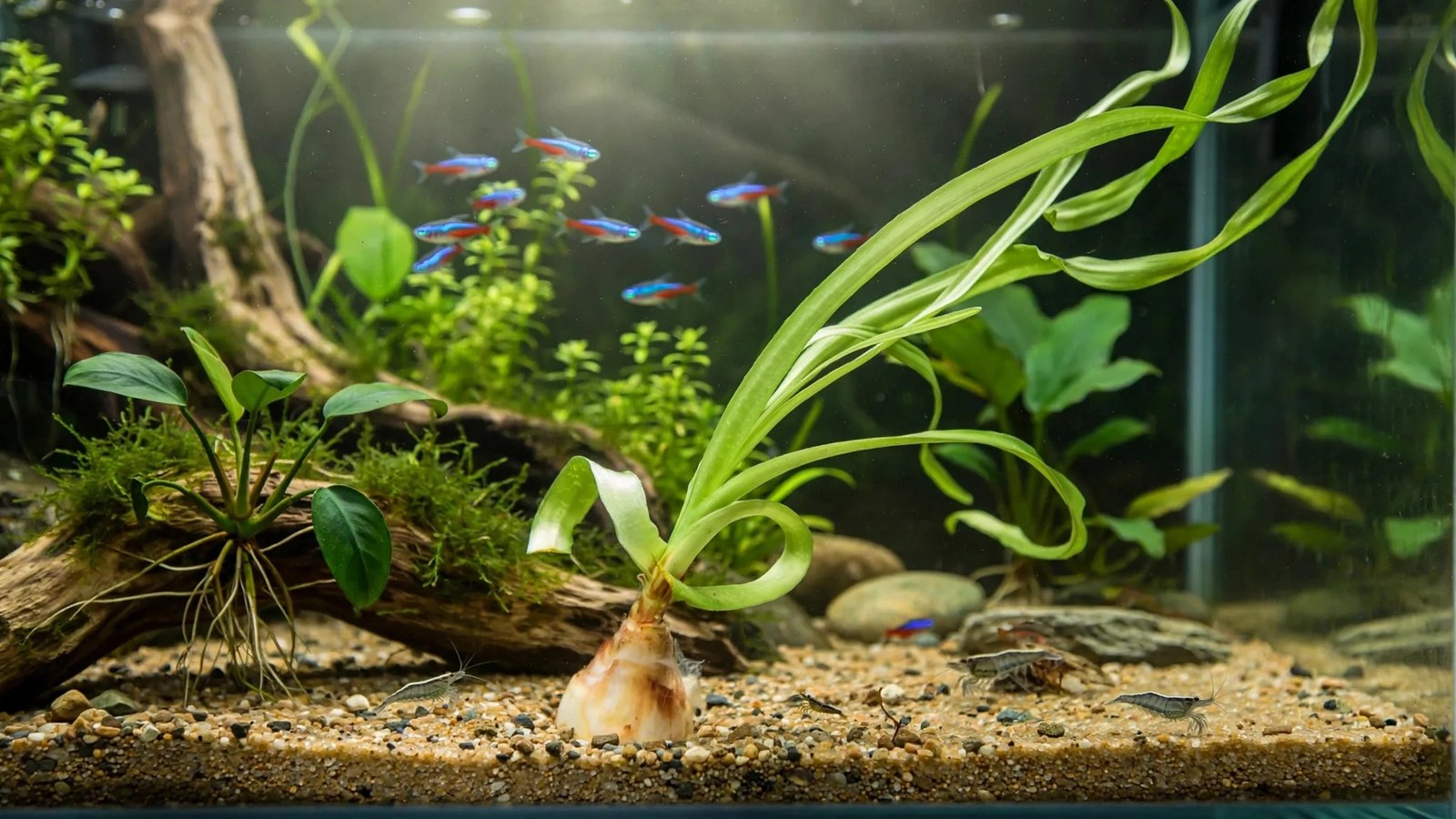
The water onion can make you look like an aquatic genius or a serial plant killer, and the entire difference comes down to one decision in the first sixty seconds: how deep you plant the bulb. This crinum thaianum care guide covers planting, the maddeningly quiet first month, true mature size, and which fish leave those ribbed straps alone. One clarification first: this is the Thai water onion with wide, upright strap leaves, not the curly-leaf oddity — if you want the curly-leaf one, that's the curly-leaf Crinum calamistratum, a completely different plant.
The golden rule of crinum thaianum care: two-thirds of the bulb stays visible
Almost every water onion failure traces back to planting depth. This plant evolved with its bulb half-sitting in stream sediment and its neck in open water — it will not tolerate being smothered. Bury the whole bulb and trapped moisture attacks the soft tissue, turning it to mush within a few weeks, long before you realize what went wrong.
Plant it like this: trim any black or mushy roots, dig a shallow depression, and seat the bulb so only the bottom third is anchored in the substrate. The neck and crown stay clear of the gravel. Press substrate gently around the base — enough to hold it upright, not to bury it. Then don't touch it for two to three weeks; the new roots are fragile and wiggling the bulb breaks them.
What the water onion actually needs
The good news: this is one of the least fussy bulb plants in the hobby. It adapts to a wide range of conditions and doesn't demand high light or injected CO2. Like other heavy root-feeders such as the Amazon sword, it cares far more about the substrate than the water column.
| Parameter | Target range |
|---|---|
| Light | Low–medium (20–40 PAR) |
| Temperature | 22–28°C (72–82°F) |
| pH | 6.5–7.8 |
| Hardness | Soft to moderately hard |
| CO2 | Optional — boosts growth, not required |
| Substrate | Nutrient-rich; fine gravel or sand cap |
| Minimum tank | 40 gallons (150 L), 18+ inches tall |
A nutrient-rich substrate makes a real difference: the bulb stores energy, but steady nitrogen, iron, and potassium through the roots produce thicker, greener leaves. Push one root tab 5 cm deep about 10 cm from the bulb every two to three months. Injected CO2 is optional — Tropica lists both light and CO2 demand as low — though it speeds up leaf production once established. Full specs are on Tropica's Crinum thaianum plant profile.
The slow start, then the explosion
Fair warning: your water onion will look like it's doing nothing for the first month, and that is completely normal. A new bulb spends its first weeks building roots before committing energy to leaves. Many growers panic at week three, assume the bulb is dead, and throw it away — right before it would have sprouted.
Here's the rough timeline to expect:
- Weeks 1–3: roots only. The bulb may shed its old outer leaves — let them go.
- Weeks 3–6: the first new strap leaves emerge from the crown, growing 2–5 cm per week.
- Months 2–3: leaves reach toward and often break the water surface in taller tanks.
- Month 4+: the bulb firms up, leaf production steadies, and offsets may appear at the base.
Plan for a giant
Mature water onion leaves reach 60–200 cm long and 2–3 cm wide, and they keep coming. In a deep tank this creates a spectacular flowing canopy; in a 20-gallon starter tank it creates a tangle that drapes across the surface and shades everything beneath. The fix: plant it in the back corner of a 40+ gallon tank from day one, where it belongs as a background statement piece.
Maintenance is refreshingly minimal. When an outer leaf yellows, cut it off at the bulb — never snip leaf tips mid-blade, because cut ends brown and look ragged for months. If you're pairing it with a low foreground, the fine texture of dwarf sagittaria makes a beautiful contrast to these giant ribbons, and another bulb plant like the dwarf aquarium lily can share the back without competing for the same look.
Will fish eat your water onion?
For most hobbyists, the answer is no — and that's exactly why this plant is famous. The leaves are thick and leathery, so herbivorous fish that demolish softer plants typically take one exploratory nibble and move on. The Aquarium Wiki's Giant Crinum entry notes it's not usually eaten by herbivorous fish, matching keeper reports with silver dollars, mbuna, severums, and goldfish.
That said, fish-proof doesn't mean tank-proof. Boisterous diggers like large cichlids won't eat the leaves but will happily bulldoze the substrate around the bulb, exposing or dislodging it. In a digger tank, anchor the bulb between two heavy stones from the start and check the planting depth weekly.
Flowering and multiplying
Give it a year or two of settled growth and a mature water onion may reward you with one of the hobby's best surprises: a flower stalk that rises to the surface and opens into fragrant, white, lily-like blooms. Propagation is more predictable: daughter bulbs sprout around the mother bulb's base. Once an offset is 10–15 cm tall with its own roots, twist or cut it free and replant it the same way — neck exposed, top two-thirds out. If you've ever wondered whether dry-sold aquarium bulbs actually grow, this is the payoff done right: a single crinum bulb can quietly become a small colony within a year.
Frequently Asked Questions
How deep should I plant a water onion bulb?
Plant it shallow: only the bottom third of the bulb should sit in the substrate, with the top two-thirds and the neck exposed. A fully buried bulb traps moisture against its tissue and rots within weeks. If it won't stay put, wedge stones around the base rather than burying it deeper.
How long does a water onion take to start growing?
Expect 3–6 weeks of near-silence while roots establish underground, with the first strap leaves appearing around week 3–6. Old leaves may melt during this transition — that's normal energy reallocation, not a dying plant. Don't move the bulb; disturbing it breaks the fragile new roots and restarts the clock.
Will goldfish or cichlids eat crinum thaianum?
Usually not. The leaves are thick and leathery, and herbivorous fish generally nibble once and lose interest. It's one of the most reliable plants for goldfish and cichlid tanks. Watch out for diggers instead — large cichlids can uproot the bulb by bulldozing the substrate, so anchor it between heavy stones from day one.
Does water onion need CO2 or root tabs?
Neither is required — it grows in low light without injected CO2 — but root tabs noticeably improve leaf thickness and color. Push one tab 5 cm deep about 10 cm from the bulb every two to three months. Injected CO2 mainly accelerates leaf production on established plants; skip it while the plant is still settling in.
Why are my water onion leaves turning brown or melting?
Some melt is normal in the first month as the bulb sheds leaves grown in different conditions. Ongoing browning usually points to a buried bulb rotting at the base, nutrient deficiency (try root tabs), or algae on slow-growing leaves. Check the bulb first: firm and pale is healthy; soft or foul-smelling means it was planted too deep.
Final word: a slow giant worth the wait
Crinum thaianum asks for three things — a shallow-planted bulb, patience through the quiet first month, and a tank big enough to hold its ambitions. Deliver those and you get a near-indestructible background giant that herbivores ignore, low light satisfies, and a fragrant flower stalk may crown.