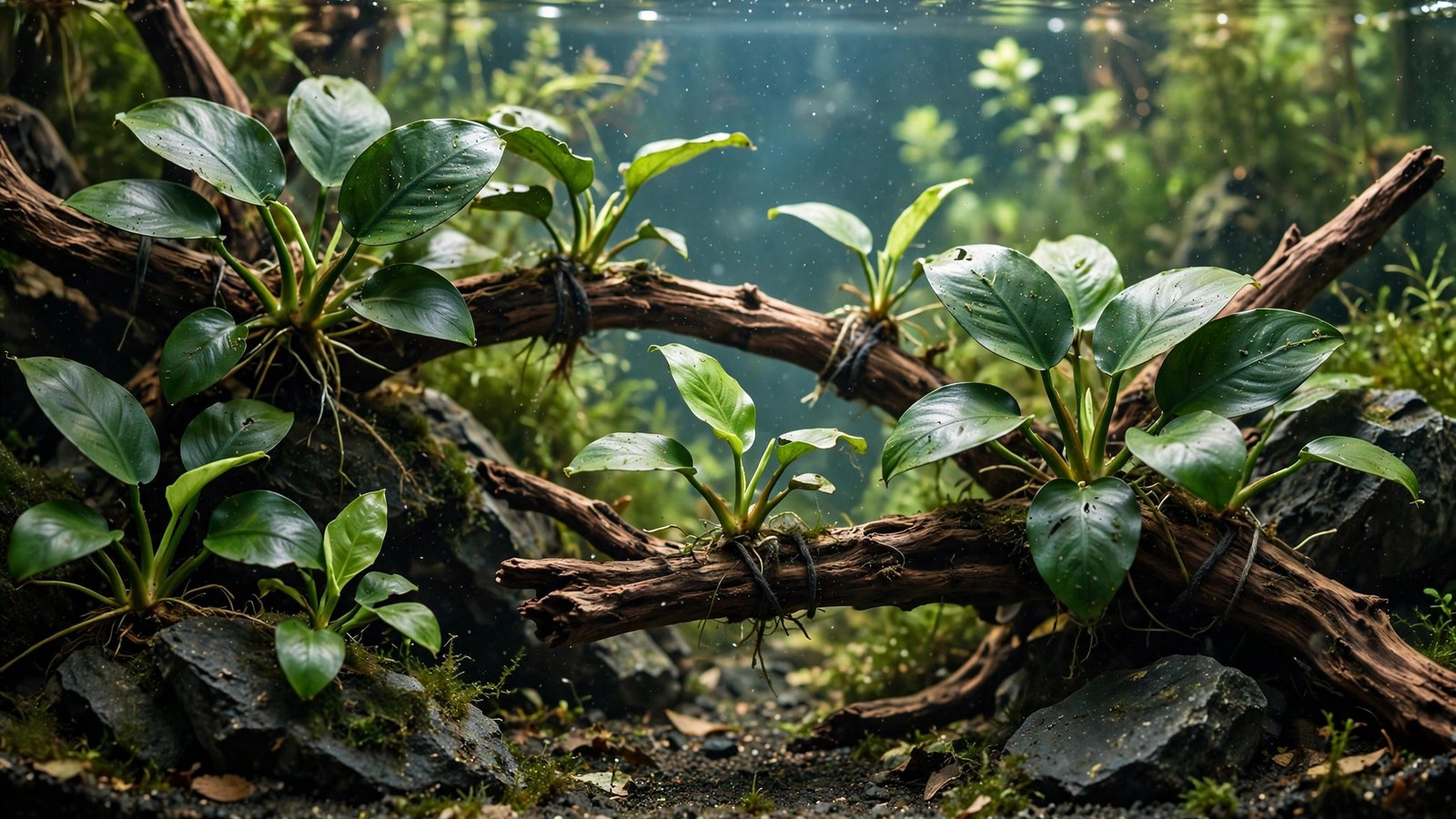
Here's the mistake that kills more anubias than any disease: someone buys a healthy little plant, pushes its thick green rhizome down into the gravel like every other plant, and two weeks later it's a mushy brown mess. Anubias isn't a substrate plant at all — it's an epiphyte, built by nature to cling to fallen wood and stones in shady African streams. So what should you attach anubias to? Driftwood and lava rock are the gold standard, but slate, coconut hides, and even filter-safe decor all work — as long as the rhizome stays fully exposed to the water. If you're coming from the substrate world, first read our guide on how to plant aquarium plants in substrate, then forget almost all of it for this one plant — anubias plays by its own rules.
What Should You Attach Anubias To? The 5 Surfaces That Work Best
Anubias grows wild on rocks and fallen branches along shaded riverbanks, so your goal is to recreate that perch inside your tank. Any hard, aquarium-safe surface with a bit of texture will do — the plant's feeder roots will grip into crevices over a few weeks:
| Surface | Grip | Looks | Notes |
|---|---|---|---|
| Driftwood | Excellent | Natural, dramatic | The #1 choice. Pre-attached anubias on driftwood is the zero-mistake option. |
| Lava rock | Excellent | Rugged | Very porous — roots anchor in 2–3 weeks. Often the cheapest per pound. |
| Slate / flat stones | Good | Clean, modern | Flat slabs make great low bases for petite varieties. |
| Coconut shell / hides | Good | Natural cave | Widely sold pre-mounted; shrimp love the hide too. |
| Aquarium-safe decor | Varies | Stylized | Works with texture — avoid glass-smooth surfaces roots can't grip. |
Driftwood is the classic for a reason: rough crevices let anubias roots penetrate and self-anchor better than anything else. Mopani, spider wood, and Malaysian driftwood all work, and pre-attached anubias on a small driftwood piece is the zero-mistake option. Lava rock is the workhorse alternative: dirt cheap and very porous, so roots grip in 2–3 weeks — just sand any sharp points that might rub fish fins.
How to Attach Anubias (3 Methods That Actually Work)
1. Gel super glue (fastest, strongest)
Gel cyanoacrylate — sold as Seachem Flourish Glue or any plain aquarium-safe gel super glue — is the method most experienced aquascapers reach for. Dab a pea-sized drop of gel onto the decor, press the roots (not the rhizome) into it, and hold 30–60 seconds. It cures in about a minute out of water, so do this on a damp towel, then place the whole piece in the tank. Only glue the fine feeder roots — keep glue off the rhizome and leaf bases, where it can burn tissue.
2. Cotton thread or fishing line (gentlest)
Wrap cotton thread or clear fishing line around the roots and decor — snug enough to hold, loose enough that the rhizome can swell as it grows. Cotton is the beginner-friendly pick because it rots away in 4–8 weeks, right as the plant's own roots take over. Fishing line holds forever but must be removed once the plant self-anchors, or it can cut into the growing rhizome. If your plant just arrived, acclimate your new aquarium plants first, then tie it down.
3. Wedging (zero supplies needed)
Find a crack, fork, or hole in your driftwood or rock pile and wedge the root ball in firmly. Anubias roots grip surprisingly well within 2–4 weeks of stillness — just don't jam the rhizome itself into the crack, where it can be bruised.
Surfaces to Skip (and Why)
Most hard surfaces are fine, but a few are poor choices:
- Glass-smooth decor — roots can't bite into glazed ceramic or polished surfaces; the plant stays dependent on thread or glue forever and shifts when bumped.
- Metal objects — untreated metals leach into the water; stick to aquarium-rated materials.
- Live coral or seashells from the beach — they leach calcium and raise pH/hardness, fighting the soft-water conditions anubias prefers. Only freshwater-tested stone and wood.
- The substrate itself — burying the rhizome is the classic killer. Even where you're growing aquarium plants in sand, the rhizome must rest on top of it. Roots can go under; the rhizome stays out.
After You've Attached It: What Happens Next
Leave the plant completely alone for 2–4 weeks while the roots extend into the surface's pores. Avoid blasting the new mount with a strong filter output for the first few days, and resist repositioning it — every move resets the clock.
Maintenance is minimal. Anubias grows one new leaf every few weeks, so trimming aquarium plants here just means snipping the occasional old leaf. Because the leaves are long-lived, they collect algae — if a film builds up, see our guide on cleaning algae off plant leaves. And when the rhizome eventually creeps past the edge of its mount, you can propagate aquarium plants by cutting the rhizome into sections — each piece becomes a free plant for new decor.
For the botanical background — parameters, growth rate, and mounting advice — the Aquatic Community's Anubias nana profile is a solid authoritative reference.
Frequently Asked Questions
Can I just leave anubias floating in the tank?
Temporarily, yes — anubias won't die while floating, and short-term floating is fine during a rescape. Long-term it's a bad idea: floating plants shade the leaves, stunt growth, and look untidy. Attach it to driftwood or rock within a few days for healthy growth and a finished look.
How do I attach anubias without glue?
Use cotton thread or fishing line wrapped around the roots and the decor, or wedge the root ball into a crevice in driftwood or stacked stone. Cotton thread is the easiest no-glue option because it dissolves on its own after the plant's roots have gripped, usually in 4–8 weeks.
Should the anubias roots be buried in the substrate?
The fine feeder roots can touch or lightly enter the substrate — only the thick green rhizome must stay exposed. If you want a substrate look, rest the rhizome on top of the gravel or sand and let the roots reach down. Burying the rhizome causes rot within one to three weeks.
Can anubias attach to a sponge filter or plastic decor?
Yes, if the plastic is aquarium-safe and has some texture. Coarse sponge filters actually make decent anchors since roots grip the pores. Smooth plastic ornaments are less reliable — the plant will sit on them but never truly self-attach, so it stays dependent on glue or thread.
How long does it take anubias to attach to driftwood?
Expect visible root attachment in 2–4 weeks on rough driftwood or lava rock, assuming you leave the plant undisturbed. Growth is slow, so full self-anchoring takes about a month. Strong water flow over a fresh mount can delay this, so keep current gentle for the first few days.
Is it safe to glue anubias with regular super glue?
Yes, provided it's pure cyanoacrylate gel with no fragrances, colors, or rubber additives. Gel bonds far better than runny liquid versions. Aquarium-branded aquascape glue is the same cyanoacrylate gel in hobby packaging — both are fish-safe once cured.
Anubias is one of the easiest aquarium plants you can own. Pick a rough surface, keep the rhizome in the open, glue or tie the roots, and walk away for a month. Mounting instead of planting is what turns anubias from a plant that "mysteriously dies" into one you'll still have five years from now.