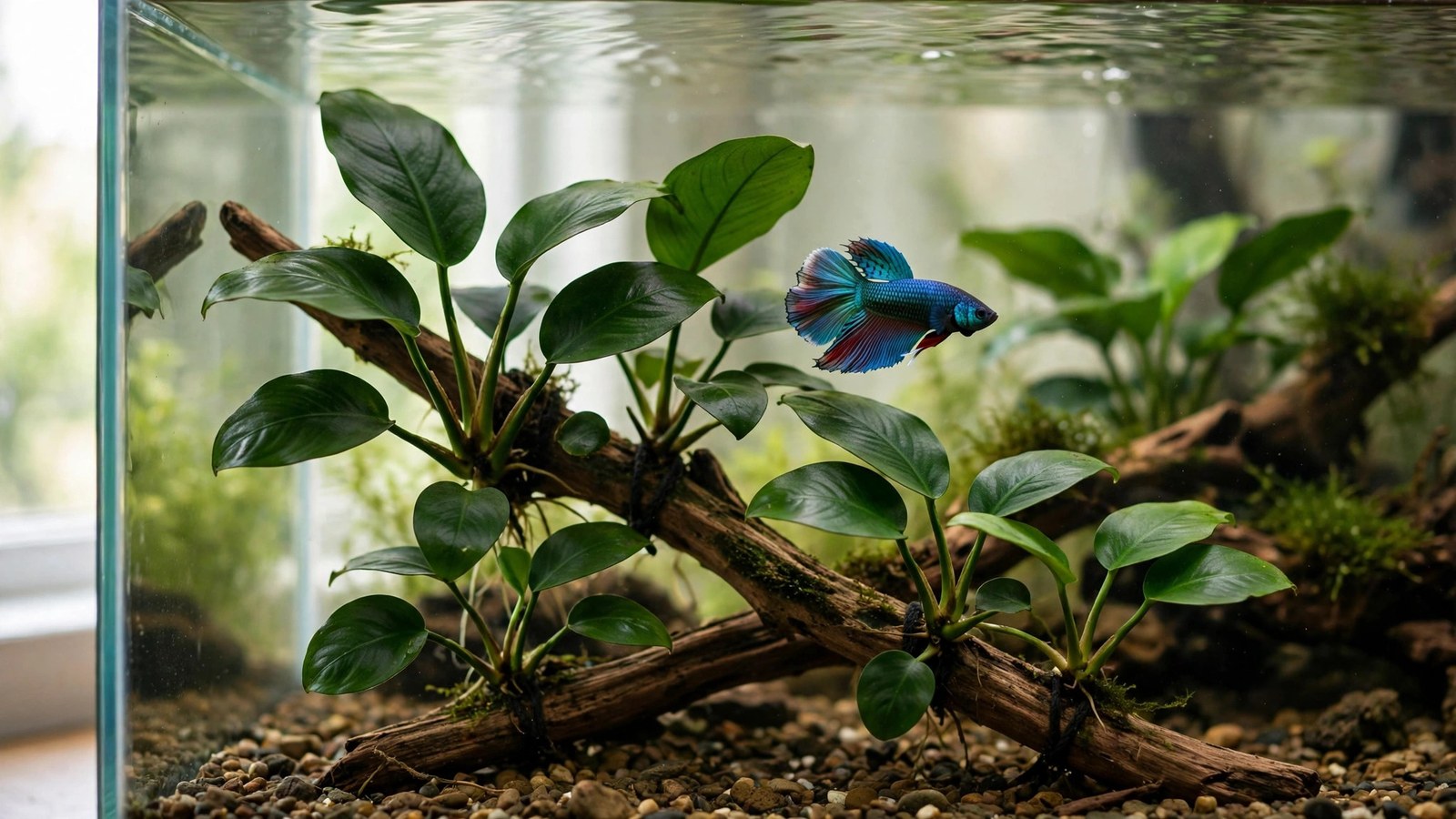
Most betta owners discover the hard way that "soft plant" labels in stores mean nothing. A betta's fins can snag on a leaf edge thinner than a grain of sand, and the wrong plant can shred a halfmoon's tail in a single night. So are anubias safe for bettas? Yes — with one caveat about where you buy them and which variety you choose. Here's the full safety breakdown: fin-friendly leaf anatomy, the rest-spot behavior bettas love, and the pesticide issue nobody warns you about.
Are Anubias Safe for Bettas? The Answer
Betta fins tear on rough, serrated, or needle-pointed surfaces — the reason experienced keepers ban most plastic plants. Anubias sidesteps all three. The leaves are thick and leathery with a smooth waxy coating, and their edges are softly rounded rather than toothed, as shown in the complete Anubias care guide. Run a leaf between your fingers: it feels like polished leather, with nothing for a delicate caudal fin to snag on.
This matters more than it sounds. A betta's tail can be 3–4 inches of flowing fin membrane, and in a small tank the fish brushes past decor dozens of times a day. Torn fins invite fin rot, the most common betta illness. Choosing a plant whose anatomy can't tear fins removes that entire chain of problems at the source.
The Rest-Spot Behavior: Bettas Actually Use These Leaves
Here's something product reviews never tell you: bettas sleep near the surface, resting on anything stable and horizontal. In a planted tank, broad anubias leaves at the right height become the natural version of the suction-cup "betta hammock" sold in stores — and most bettas prefer the real leaf.
To set this up, attach your anubias to driftwood or a rock so that one broad leaf sits 2–3 inches below the water surface. Don't bury the rhizome (the thick horizontal stem) — it rots when buried. Within a week or two, most bettas find the spot. It's also a useful health signal: a betta that suddenly stops using its favorite leaf may be telling you something is wrong.
Anubias Variety Comparison for Betta Tanks
Not every anubias suits every betta setup. Leaf size and stiffness vary between cultivars, and matching the variety to your tank size is what separates a thriving tank from a crowded one.
| Variety | Leaf size | Leaf feel | Best tank size | Betta use case |
|---|---|---|---|---|
| Anubias nana | 2–3 in | Firm, smooth | 5–10 gal | Best all-rounder; leaves strong enough to hold a resting betta |
| Anubias nana 'Petite' | 0.5–1 in | Soft, flexible | 3–5 gal | Nano betta tanks; the Nana Petite care profile covers its slower growth |
| Anubias 'Pangolino' | 0.25–0.5 in | Delicate, small | 3–5 gal | Foreground detail; see the Pangolino care profile — too small to serve as a rest spot |
| Anubias barteri | 4–6 in | Very stiff | 10+ gal | Big broad leaves make excellent betta perches in larger tanks |
| Anubias barteri 'Coffeefolia' | 3–5 in | Firm, textured | 10+ gal | Textured leaves grip well as rest spots; striking centerpiece |
The rule of thumb: in a standard 5-gallon betta tank, Anubias nana hits the sweet spot — leaves big enough to rest on, small enough not to dominate the aquascape. One mother plant can supply several betta tanks over time; the anubias propagation guide shows how, since a single rhizome division every 6–12 months is all most keepers need.
The Real Risk: Pesticides on Store-Bought Anubias
Anubias itself is chemically harmless to fish. But many anubias sold in big-box pet stores arrive treated with snail-killing pesticides — the emersed-grown stock is dipped to keep pest snails off the shelves. Those chemicals are lethal to shrimp and snails, and residue in a freshly stocked tank can stress a betta too. This is the single biggest "anubias killed my tank" story online, and it's never the plant's fault.
There are two reliable ways around it. The simplest is buying tissue-culture cups — plants grown in sterile lab cups, 100% pest- and pesticide-free by definition. They're slightly pricier (typically $8–12 per cup versus $5–8 potted) but for a betta tank with shrimp or snails they're worth it. The alternative: quarantine new anubias in a separate container with daily water changes for 10–14 days.
Setting Up Anubias in a Betta Tank: The Practical Steps
- Pick your variety using the table above — nana for 5-gallons, barteri for 10+.
- Attach, don't bury. Tie the rhizome to driftwood or wedge it into a rock crevice with cotton thread or aquarium-safe super glue gel. Buried rhizomes rot within 2–3 weeks.
- Position one leaf near the surface (2–3 inches below the waterline) as the betta's rest spot.
- Keep light low to moderate. Anubias thrives at 20–40 PAR; in a betta tank's typically dim lighting it grows slowly but steadily — about one new leaf every 3–4 weeks.
- Leave it alone. Once attached, let tankmates like snails keep leaves clean, and trim only yellowing leaves at the rhizome.
Expect a settling-in period: leaves may yellow for the first 2–3 weeks as emersed-grown stock converts to submerged growth. That's normal — new submerged leaves emerge from the rhizome tip once the plant adjusts.
Frequently Asked Questions
Are anubias safe for bettas with long flowing fins?
Yes — anubias is one of the safest plants for long-finned bettas like halfmoons and rosetails. The leaves are thick, smooth, and rounded at the edges, with no serrations or needle points that catch fin membrane. Fin tears in planted betta tanks almost always come from plastic decor or rough driftwood, not anubias leaves.
Will my betta actually rest on anubias leaves?
Most do, given a leaf positioned 2–3 inches below the surface. Bettas breathe air and prefer sleeping near the top, and a broad anubias leaf is the natural equivalent of a suction-cup betta hammock. Give it 1–2 weeks — bettas are cautious about new objects and typically claim the spot once it feels like established territory.
Can anubias from Petco or Petsmart kill my shrimp?
The plant itself won't, but pesticide dips used on big-box stock can — snail-killing chemicals are lethal to shrimp and snails and can collapse a colony within 48 hours. Buy tissue-culture cups (sterile and pesticide-free) or quarantine store-bought anubias separately with daily water changes for 10–14 days first.
Which anubias is best for a 5-gallon betta tank?
Anubias nana is the sweet spot: 2–3 inch leaves are big enough for a rest perch yet compact enough for a 5-gallon. Nana Petite's half-inch leaves are too small for resting, and full-size Anubias barteri's 4–6 inch leaves will crowd out swimming space within a year.
Do anubias need fertilizer in a betta tank?
Usually not. Anubias is a slow grower (roughly one leaf per month) and a betta's waste provides enough nitrogen and phosphorus for its modest needs in most setups. If leaves yellow persistently after the first month, a half-dose of an all-in-one liquid fertilizer once weekly is plenty — more than that mainly feeds algae, which loves slow-growing anubias leaves.
The Bottom Line
Anubias earns its reputation as the betta keeper's workhorse: fin-safe leaves, a natural resting perch, and undemanding care that matches a betta's low-tech tank perfectly. The only genuine danger is the one on the shelf, not on the leaf — buy clean stock, quarantine what you can't verify, and your betta will likely be napping on a broad green leaf within the fortnight. For an authoritative reference on the species, see the Tropica Anubias barteri var. nana plant profile.