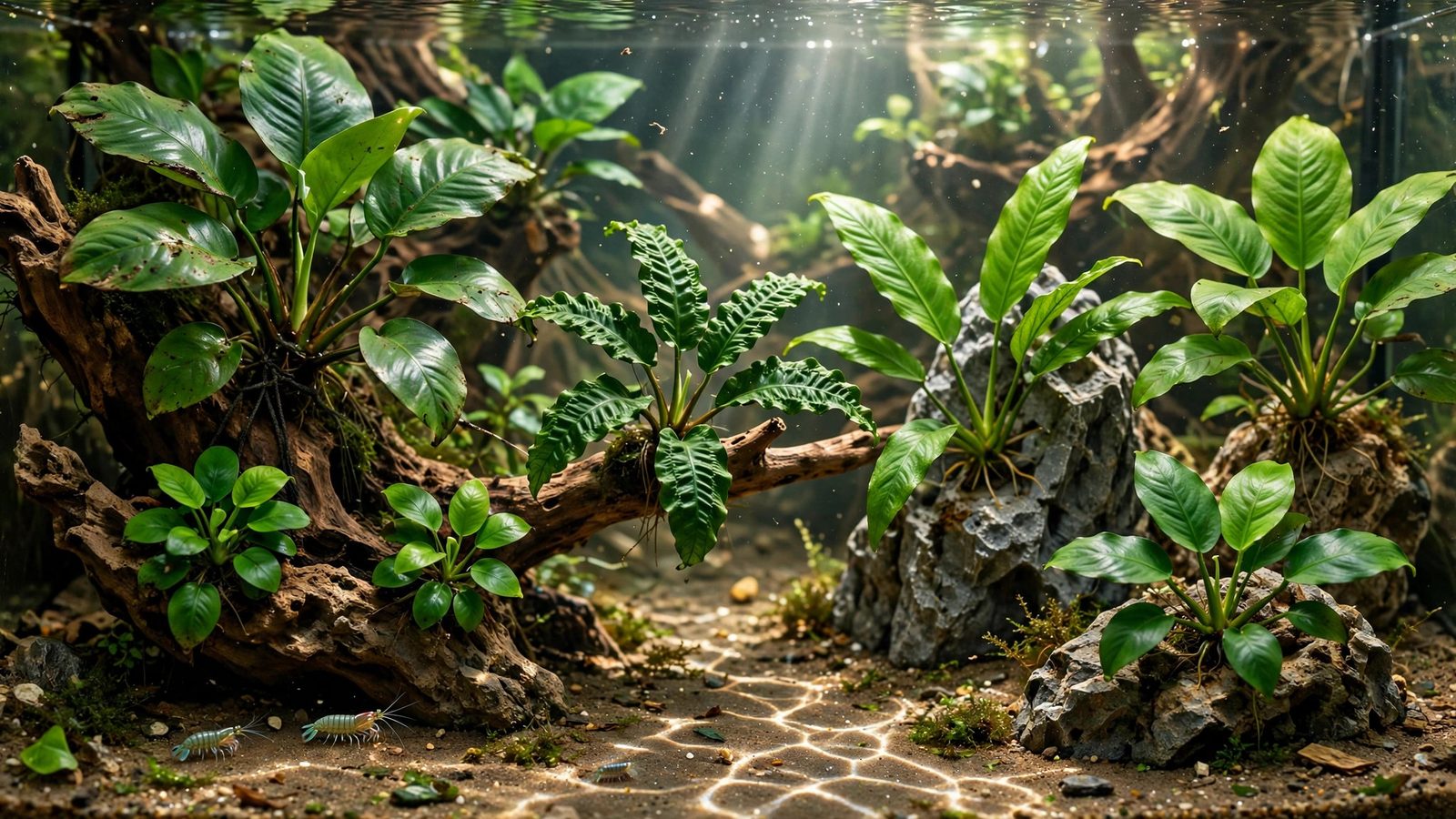
If you have ever stared at a plant tank in a fish shop wondering which of the many types of anubias to take home, you are not alone. Anubias is the most recommended beginner aquarium plant in the hobby — nearly unkillable, fine in low light, happy without CO2 — but the label on the pot tells only half the story. Anubias barteri and Anubias nana can look identical as starter pots yet mature into wildly different plants, with leaves ranging from thumbnail to dinner-plate size. Pick the wrong variety and your foreground plant swallows the hardscape, or your midground plant vanishes behind the rocks it was meant to soften. This guide compares ten real varieties: adult size, leaf looks, growth rate, best placement, and top picks for betta and shrimp tanks.
Why Anubias Belongs in Almost Every Tank
Anubias earns its reputation for three reasons. First, it is an epiphyte: its thick horizontal rhizome must stay above the substrate, so you tie or glue it to driftwood and rocks instead of planting it. Second, its leaves are thick, waxy, and bitter-tasting, so most herbivorous fish and even hungry shrimp leave them alone. Third, it grows slowly — roughly one new leaf every few weeks — so it rarely needs trimming and never takes over overnight. If you are building a low-tech setup, our roundup of easy aquarium plants that need no CO2 explains why anubias tops the list, and our guide to epiphyte plants for aquariums covers the whole rhizome-plant family it belongs to.
How This Comparison Works
Each variety below is rated on the same criteria:
- Adult size: typical height and leaf size after a year or more — not the starter pot size.
- Leaf look: shape, texture, and color — what actually distinguishes mature plants.
- Growth rate: slow, very slow, or moderate by anubias standards.
- Best placement: the tank zone (foreground, midground, background) where each variety looks best.
10 Types of Anubias Compared
1. Anubias barteri var. barteri — the classic workhorse
The original anubias and still one of the best background plants in the hobby. Mature leaves reach 10–15 cm (4–6 inches) on a rhizome that creeps outward year after year, eventually spanning 25–40 cm wide. The broad, heart-based leaves are deep green and leathery enough to survive nibbling cichlids and goldfish that shred softer plants. Expect a new leaf every 3–4 weeks. Best tied to large driftwood or placed in the background, where its bold foliage fills vertical space — the plant to choose when you want one specimen anchoring the aquascape for a decade.
2. Anubias barteri var. nana — the all-rounder
If anubias has a default variety, this is it. Nana stays compact at 5–10 cm (2–4 inches) tall with rounded dark-green leaves about 5–8 cm long. It grows slightly faster than the species form and tolerates everything from dim betta tanks to bright high-tech setups. It works as a midground plant in larger tanks and a background accent in nano tanks — genuinely versatile. Tie it to a small rock or spider wood and it will slowly colonize the surface. For a first anubias, nana is the safest pick of all ten: it forgives low light, irregular fertilizing, and most beginner mistakes.
3. Anubias barteri var. nana 'Petite' — the nano specialist
Petite is the miniature form of nana and the variety behind most jaw-dropping nano aquascapes. Leaves stay under 3 cm long and a mature clump rarely exceeds 5 cm — true foreground scale. It grows very slowly, sometimes one leaf a month, so a carpet effect can take a year. The small leaves catch light beautifully and give shrimp a dense jungle to graze, making it a favorite in shrimp-breeder tanks. Attach it to small stones or hardscape crevices. Often sold as a tissue-culture cup — check our tissue culture vs potted plants comparison before buying, since lab-grown cups arrive tiny but adapt fast.
4. Anubias barteri var. coffeefolia — the textured showpiece
Coffeefolia is the variety you buy when anubias should be the star, not the supporting cast. Its leaves are deeply rippled and puckered between the veins like seersucker fabric, with new growth emerging reddish-brown before hardening to dark green — a two-tone look no other anubias offers. It reaches 15–25 cm tall, suiting the midground to background, and appreciates slightly more light than nana to keep the texture pronounced; in very dim tanks the leaves flatten and lose character. Place it off-center on a rock where light catches the ripples, and it becomes a permanent focal point.
5. Anubias lanceolata — the elegant spear
Where most anubias have broad rounded leaves, lanceolata grows long, narrow, spear-shaped foliage up to 15 cm long and only 3–4 cm wide — closer to a sword plant in silhouette than a typical anubias. Mature height runs 15–30 cm, suiting the midground of medium tanks. It is one of the slightly faster growers and responds well to good flow, which keeps its long leaves algae-free. A clump tied at the base of a vertical branch draws the eye upward. If you like the look of echinodorus sword varieties but want a plant that stays put on wood instead of sending runners everywhere, lanceolata is the anubias answer.
6. Anubias hastifolia — the tall background giant
Hastifolia is built for big tanks. Its arrowhead-shaped leaves sit on long petioles, lifting foliage 30–60 cm above the rhizome — the tallest anubias here by far. In a deep tank it creates a dramatic backdrop of bold green triangles. The rhizome creeps steadily along large logs or rock faces. This is strictly a background plant for tanks of 120 liters (30+ gallons) and up; in anything smaller it crowds out the light within a year. It is also one of the toughest varieties, tolerating digging cichlids and browsing silver dollars. Buy hastifolia only if you have the vertical space — otherwise choose lanceolata for a similar look at half the height.
7. Anubias heterophylla — the variable midground filler
Heterophylla ("different-leaved") is the wildcard: leaf shape varies noticeably even on the same rhizome, from lance-shaped to broadly oval, giving mature clumps a natural, unstructured look. It typically reaches 15–25 cm tall with 8–12 cm leaves — squarely midground territory. Growth is moderate for anubias, and it adapts to both the low light of a low-light beginner setup and the brighter conditions of a CO2-injected tank. Because no two clumps look alike, it suits natural-style aquascapes where planting should look found rather than arranged. Less common in shops than nana or barteri — ask your retailer or check specialist nurseries.
8. Anubias barteri var. caladiifolia — the heart-leaf giant
Caladiifolia grows some of the largest, most dramatic leaves in the genus: broad heart-shaped blades up to 20 cm long on a plant reaching 30 cm tall and spreading just as wide. New leaves emerge light green and darken with age, and one specimen can dominate a 200-liter tank's background. Like all big anubias it grows slowly and lives for many years — a long-term investment. Anchor it to a heavy rock or thick driftwood, because a mature clump is genuinely heavy.
9. Anubias glabra (var. minima) — the narrow-leaf climber
Usually sold under the old name Anubias barteri var. minima, glabra is the narrow-leaf specialist. Its smooth, lance-shaped leaves grow 6–10 cm long on a rhizome that creeps aggressively along surfaces — faster than most anubias, and willing to climb vertical wood. Mature height is 10–20 cm. That climbing habit makes it ideal for covering branching hardscape, softening hard lines without the bulk of broader varieties, and it holds its color in shaded corners where other plants fade. Place it midground on vertical wood or rock faces and let the rhizome do the decorating over the following year.
10. Anubias afzelii — the strap-leaf background plant
Afzelii closes the list with long, strap-like leaves reaching 20–35 cm, arching gracefully from a creeping rhizome. It is one of the fastest-growing anubias — still slow by general standards, but noticeably quicker than nana — and adapts to harder, more alkaline water that some anubias dislike. Mature plants reach 25–40 cm tall: a background plant for medium to large tanks whose arching foliage frames swimming space beautifully behind a school of tetras or rasboras. Often cheaper than trendier varieties, it is excellent value for filling a big background on a budget.
Side-by-Side Comparison Table
| Variety | Max Size (H × W) | Best Placement | Difficulty |
|---|---|---|---|
| A. barteri var. barteri | 20–30 cm × 25–40 cm | Background / large wood | Easy |
| A. barteri var. nana | 5–10 cm × 10–15 cm | Midground | Very easy |
| A. barteri var. nana 'Petite' | 3–5 cm × 5–10 cm | Foreground | Easy (very slow) |
| A. barteri var. coffeefolia | 15–25 cm × 15–25 cm | Midground focal point | Easy–moderate |
| A. lanceolata | 15–30 cm × 15–25 cm | Midground / background | Easy |
| A. hastifolia | 30–60 cm × 30–40 cm | Background (large tanks) | Easy |
| A. heterophylla | 15–25 cm × 15–25 cm | Midground | Easy |
| A. barteri var. caladiifolia | 25–35 cm × 25–35 cm | Background (large tanks) | Easy |
| A. glabra (minima) | 10–20 cm × 10–20 cm | Midground / vertical wood | Very easy |
| A. afzelii | 25–40 cm × 20–30 cm | Background | Very easy |
Best Tank Placement by Zone
Think of your tank in three bands. The foreground belongs to nana 'Petite' almost exclusively — nothing else here stays small enough, and its dense leaves give shrimp and fry a safe grazing zone. The midground is where most of the action happens: nana, coffeefolia, lanceolata, heterophylla, and glabra all sit comfortably here, tied to rocks and wood at eye level. Use coffeefolia as the single focal point and surround it with plainer varieties so it stands out. The background belongs to barteri, hastifolia, caladiifolia, and afzelii — tall, bold foliage that hides equipment and fills vertical space. The classic mistake is buying for the pot size on the shelf rather than the adult size in the table above. If you want fast-growing stems behind your slow anubias backdrop, our beginner stem plant guide pairs well here.
Anubias for Bettas and Shrimp Tanks
Two of the hobby's most popular tank types are practically designed around anubias. In betta tanks, the broad leaves of nana and barteri give bettas what they crave: resting spots near the surface and sight-line breaks that reduce stress. A nana tied to driftwood just below the waterline becomes a favorite hammock within days. Skip the giant varieties in a standard 20-liter betta tank — they eat the swimming space. See our full betta tank plant recommendations for companions. In shrimp tanks, anubias is close to perfect: slow-growing leaves develop a permanent film of biofilm that shrimp graze constantly, and dense petite clumps shelter newborn shrimplets. Nana 'Petite' and glabra are the top picks. Our shrimp tank plant guide covers the supporting cast, plus red beginner-friendly plants for a pop of color alongside the green.
Anubias Care Basics: Rhizome Safety and Attachment
Every variety here shares one non-negotiable rule: never bury the rhizome. The thick green stem that leaves and roots grow from rots under substrate, and a rotted rhizome kills the plant. Attach anubias to hardscape instead: tie it with cotton thread or fishing line (cotton rots away once roots grip), or glue it with cyanoacrylate gel superglue — aquarium-safe once cured; dab it on dry hardscape, press the rhizome on, hold 30 seconds. Light needs are modest: low to medium suits all ten varieties, and excess light invites their one real enemy — algae on slow-growing leaves. If algae appears, shorten the photoperiod or add floating plants for shade. Feed with a comprehensive liquid fertilizer weekly, since epiphytes drink from the water column. To propagate, cut the rhizome between leaf nodes once it has 5–6 leaves and attach both pieces — each becomes a new plant.
Gel superglue is the standard rhizome-safe adhesive: Seachem Flourish Glue.
Frequently Asked Questions
Which anubias variety is best for beginners?
Anubias barteri var. nana is the best starting point for almost everyone. It stays a manageable 5–10 cm tall, tolerates low light and irregular fertilizing, grows a little faster than most anubias, and suits everything from betta tanks to large community setups. Nana 'Petite' is equally easy but grows so slowly beginners sometimes think it has stalled — start with regular nana first.
Can different types of anubias be planted together?
Yes, and they look better mixed than any single variety alone. A classic combination is nana 'Petite' in the foreground, nana or glabra in the midground, and barteri or afzelii in the background, with coffeefolia as one textured focal point. All anubias share the same care needs — low to medium light, water-column feeding, unburied rhizomes — so mixed plantings never conflict. Just give each variety its correct zone so small ones are not shaded out.
Why are my anubias leaves turning yellow?
Yellowing usually has three causes. A buried rhizome rots from the base and yellows the oldest leaves first — unbury it and trim any mushy tissue. Nutrient deficiency, especially nitrogen or iron, yellows newer growth; weekly comprehensive liquid fertilizer fixes it within weeks. Old leaves also yellow naturally after many months — if only the oldest one or two are affected and the rhizome is firm and green, just trim them off.
How fast do anubias plants actually grow?
Slowly — most varieties produce one new leaf every 2–4 weeks under average conditions, and nana 'Petite' can take a full month per leaf. Afzelii and glabra are the relative speedsters but still qualify as slow growers. The upside is stability: anubias almost never needs trimming, never melts after planting, and one specimen can anchor your aquascape for a decade. Buy the size you want to see, because it will not fill in quickly.
Do anubias need CO2 or special substrate?
No to both — exactly why they top every beginner list. Anubias grows perfectly well without injected CO2 in low-tech tanks, and as an epiphyte it feeds from the water column, so plain gravel or sand is fine since the rhizome sits on hardscape anyway. A weekly dose of comprehensive liquid fertilizer is the only feeding needed. CO2 speeds growth slightly but is a luxury, not a requirement.
Final Verdict: Start With Nana, Build Around It
Across all ten types of anubias, one pattern holds: there is no bad choice, only a wrong size for your tank. Start with nana for reliability, add petite for nano detail or coffeefolia for texture, and reserve the giants — hastifolia, caladiifolia, afzelii — for tanks big enough to show them off. Respect the rhizome, keep the light moderate, and every variety here will reward you with years of nearly maintenance-free greenery. For authoritative species details and photos, browse Tropica's Anubias plant database, which documents the nursery standards behind most commercial varieties.