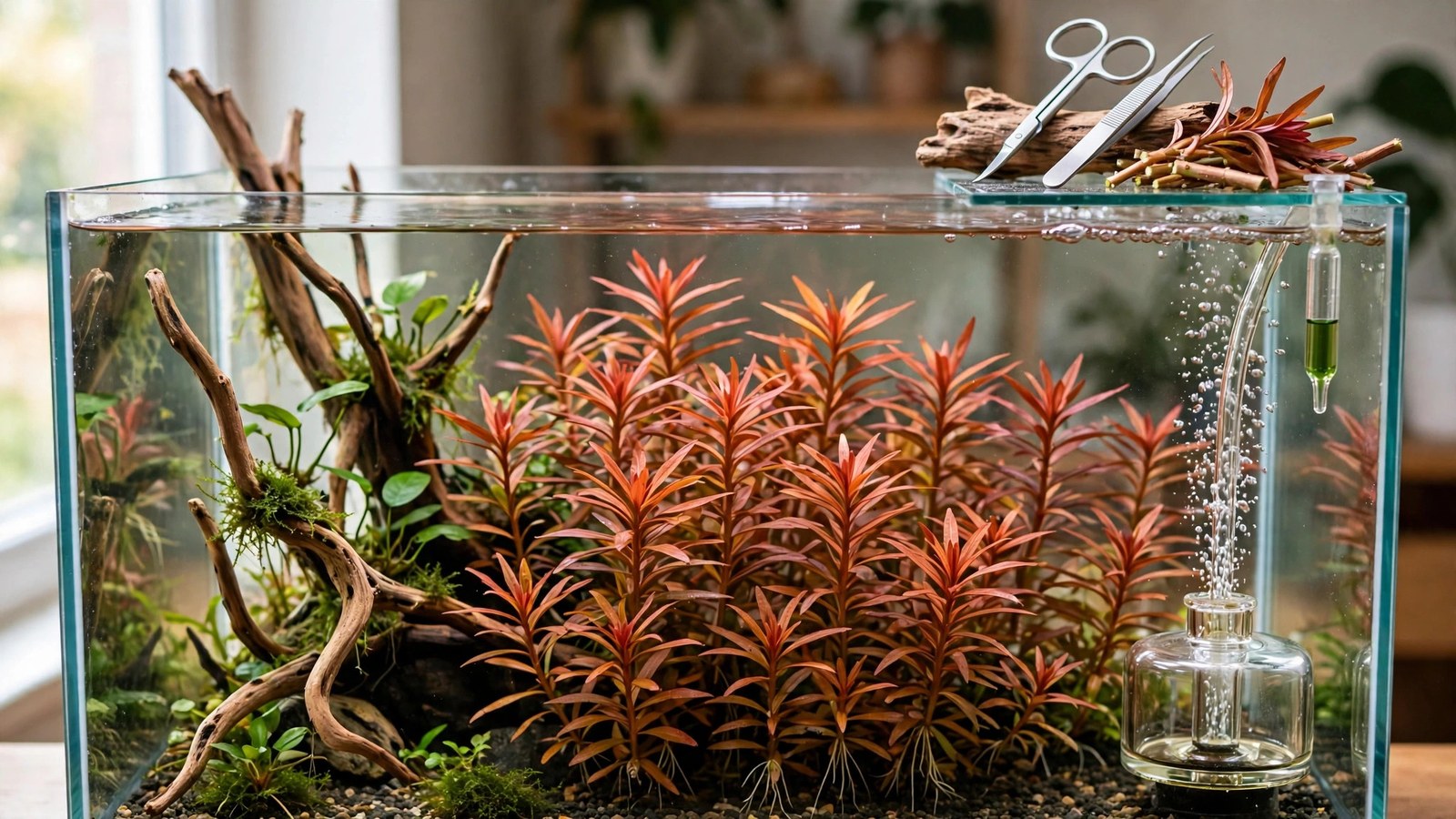
Most red stem plants make you pay for color with constant fussing — but here is the secret about Ammannia gracilis: give it strong light and steady carbon dioxide, and it turns a copper-red so rich it looks dipped in autumn leaves, then rewards you by growing like a weed. Get those two things wrong and the same plant stays a leggy, olive-green disappointment. This ammania gracilis care guide covers the exact light, CO2, and nutrient setup that unlocks the red, how to plant and trim it so the stand stays dense from base to tip, and how to read the two algae problems that love its tender new growth.
Why Ammannia Gracilis Earns Its Place in a Red Scape
Ammannia gracilis is a West African stem plant with narrow, lance-shaped leaves in opposite pairs along a sturdy stem. Under moderate light it looks pleasant but unremarkable — yellowish-green with a hint of orange at the tips. Push the light hard and add CO2, and the whole stem flushes a deep, metallic copper-red with bronze undersides that no green plant can match for contrast. Once a tank is dialed in, it is the rare red stem that stays colorful without weekly interventions, which is why it anchors so many red and autumn-themed scapes.
It is also a fast, bushy grower that throws side shoots after every trim — a stand of five stems can become twenty within two months. That vigor forgives beginner planting mistakes but demands one thing: regular trimming. Let the canopy shade the base and the lower stems drop their leaves and go bare. For a red plant that tolerates neglect, Alternanthera reineckii is more forgiving — but it never matches Ammannia's growth speed or the bronze depth of its mature coloration.
Light: The Single Biggest Factor in Red Coloration
Red pigments in Ammannia gracilis are the plant's sunscreen — it only spends energy making them when light is intense enough to warrant protection. That is why dim setups keep it stubbornly green no matter how much fertilizer you dose. Aim for 60–90 PAR at the leaf level: for most modern planted-tank LEDs, that means 80–100% output on a 30–40 cm deep tank with a 7–8 hour photoperiod.
Give it the brightest real estate — the middle third of the tank, directly under the fixture, not the corners where PAR can drop by half. If your light dims, ramp up over two weeks rather than jumping to full power on day one; blasting a fresh planting with 90 PAR before roots establish invites hair algae on the tender new shoots. Read the leaf tips like a meter: orange-red new growth means enough light; pale, yellowish tips mean you are under-lit.
CO2 and Nutrients: What Ammannia Actually Needs
Light drives the color, but CO2 drives everything else. Ammannia gracilis needs a consistent 20–30 ppm of dissolved CO2 to turn that strong light into healthy tissue. Without injected CO2, expect the classic failure pattern: small crinkled new leaves, stretched internodes, stems leaning sideways, and green dust algae colonizing the upper leaves. Rotala macrandra behaves the same way — for both plants, CO2 is a requirement, not a bonus.
 ★4.1
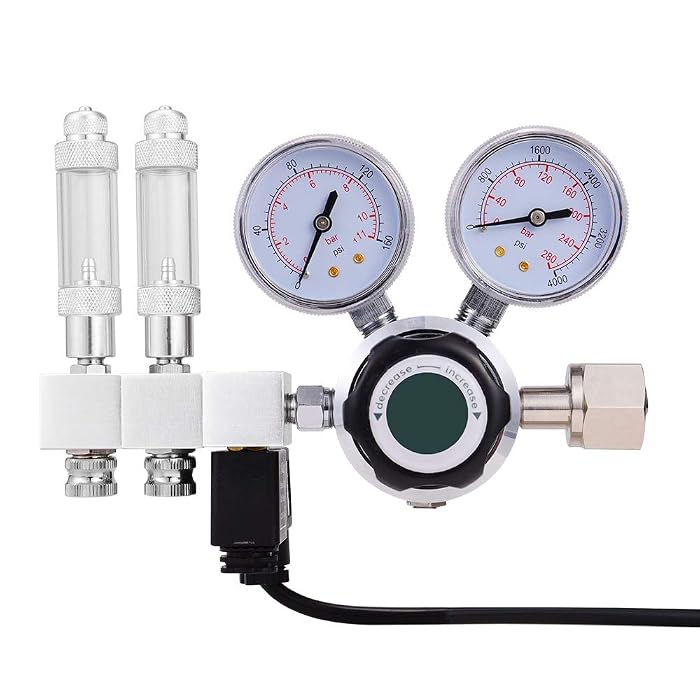
Clscea CO2 Regulator with Dual Gauge, Bubble Counter and Solenoid
Check Price on Amazon ★4.1With CO2 solved, feeding is straightforward. Ammannia is a heavy water-column feeder: dose a complete all-in-one liquid fertilizer at the bottle rate, adjusted until nitrates hold at 10–20 ppm. Root feeding matters too — plant in aquasoil or set a root tab under each stem group and refresh every 3–4 months. Iron has an outsized reputation in red-plant talk, but keep it in the normal 0.1–0.2 ppm range as part of your complete mix and spend your attention on light and CO2 instead.
| Parameter | Target range | Notes |
|---|---|---|
| Temperature | 22–28 °C | Slows below 20 °C |
| pH | 6.0–7.5 | Thrives slightly acidic with CO2 |
| GH | 3–10 dGH | Stunts above ~12 dGH |
| Nitrates | 10–20 ppm | Zero nitrates stalls growth |
| Phosphates | 1–2 ppm | Keep the N:P ratio sane |
| Symptom | Likely cause | Fix |
|---|---|---|
| New leaves pale, tiny, crinkled | CO2 too low or inconsistent | Raise injection; check drop checker at lights-on |
| Lower leaves melting, stems bare | Canopy shading | Trim tops; replant at wider spacing |
| Red fading to yellow-green | Weak light or short photoperiod | Raise intensity or extend to 8 hours |
| Pinholes in older leaves | Potassium deficiency | Increase K in your dosing |
Planting Ammannia the Right Way
Whether you buy potted or tissue-culture plants, preparation is the same: strip off any rockwool, rinse the roots, and separate the clump into individual stems. If stems arrive long and leggy, cut them to 10–15 cm — Ammannia establishes faster from compact, fresh stems.
- Trim roots to 2–3 cm to encourage new feeder-root growth.
- Push each stem 3–5 cm into the substrate at a slight angle with tweezers.
- Plant loose groups of 3–5 stems, spaced 2–3 cm apart so light reaches the base.
- Hold each stem for two seconds after placing so the substrate settles around it.
Expect a melting hiccup in week one, especially from emersed-grown nursery stock: outer leaves shed while the plant converts to submerged growth. As long as stems stay firm and new growth appears at the tips within 10–14 days, the conversion is on track.
Trimming, Topping, and Propagation
In a healthy CO2 tank, stems reach the surface in 3–4 weeks, then the top keeps growing while the shaded base drops leaves. The fix is top-and-replant, and it doubles as propagation:
- Let the stand grow to 5–10 cm below the water surface.
- Cut each stem about halfway down, just above a leaf node.
- The bottom stumps sprout 2–3 side shoots within a week — leave them to thicken the base.
- Replant the cut tops (strip the lowest leaves first) to extend the stand, or give them away.
Rotate two styles to keep the stand shapely. Topping resets height and keeps the group uniform. Pinching the apical bud on a few stems encourages branching for a bushier look. Alternating them gives a stand dense from substrate to surface. Never let it grow past the surface for long: emergent growth shades everything below, and re-submerged tips often melt, setting the group back by two weeks.
Growth Rate and Tank Placement
In a dialed-in tank, Ammannia gracilis grows 2–4 cm per week — fast enough to top monthly, and fast enough to compete hard against algae for nutrients in the first two months. In a 30 cm nano, a trimmed stand works as a midground accent behind a carpet; in 45–60 cm tanks, let it run to 30–40 cm as a background curtain, its bronze mass offsetting green vallisneria or bright rotala wallichii. The reddest stands sit in groups of 5–9 stems — a "red island" reading as one sculptural mass. It works from 20-liter tanks upward, but truly shines in 60+ liters where a full stand has room to layer; in very small tanks, Ludwigia 'Super Red' holds a smaller footprint.
Tank Mates and Algae: What to Watch
Ammannia is a peaceful, non-toxic plant: tetras, rasboras, corydoras, and small livebearers weave through a red stand beautifully, and cherry shrimp graze biofilm off the leaves without damaging them. Avoid stem shredders — goldfish, silver dollars, and large cichlids chew Ammannia to the stems within days. Nerites and amano shrimp are allies, polishing the upper leaves where algae lands first.
The algae on an Ammannia stand is diagnostic. Green dust on the top leaves means CO2 dipped or the canopy got too dense — thin the stand and check the drop checker. Hair algae tangled in new shoots means excess light relative to carbon — back the fixture off 10–15% or raise CO2 slightly. Staghorn on older leaves is the low, fluctuating-CO2 signature: smooth out the injection schedule before reaching for algaecide. Since Ammannia outgrows damage fast, a well-timed trim is often the best treatment: remove the affected growth, fix the cause, and let the stand regrow clean.
Ammannia vs. Nesaea: Are They Different?
They are the same plant. Ammannia gracilis spent years in the trade as Nesaea pedicellata, and a taxonomic revision folded Nesaea into Ammannia — so the correct current name is Ammannia gracilis. Sellers and old forum threads still use the Nesaea name freely; grow it exactly the same way. Our Nesaea pedicellata care notes cover the naming history in full.
| Plant | Leaves | Color potential | Difficulty |
|---|---|---|---|
| Ammannia gracilis | Narrow lance, opposite pairs | Deep copper-red under high light + CO2 | Intermediate |
| Limnophila aromatica | Feathery serrated whorls | Purple-red tips, less full-stem red | Intermediate |
| Persicaria 'Sao Paulo' | Broad oval, serrated | Intense pink-red, very CO2-hungry | Advanced |
| Rotala 'H'ra' | Small, dense, whorled | Orange-pink sunset tones | Intermediate |
Week-by-Week Setup Plan for a Red Stand
- Week 1 — Plant and stabilize. Plant 7 stems in loose spacing, light at 60% for 6 hours, CO2 moderate. Expect some leaf shedding from emersed stock; change nothing.
- Week 2 — Ramp up. Raise light to 80% and 7 hours as submerged growth appears. Tune CO2 so the drop checker reads lime green at lights-on. Stems stand upright, 15–20 cm tall.
- Week 3 — Full power. Light to 100% for 8 hours, CO2 steady at 20–30 ppm. New leaves should arrive visibly orange-red. Run weekly 30% water changes.
- Week 4 — First top. Top every stem halfway down and replant the tops, widening the group to 12–15 stems. The stumps bush out with side shoots within days.
- Weeks 5–8 — Maintain. Repeat top-and-replant every 3–4 weeks, thinning any bare lower stems. By week 8 you have a copper-red curtain 10–20 cm wide — the backbone of a red or autumn-themed scape.
That red curtain is exactly the element an autumn layout is built around. If you are designing the whole tank toward fall colors; pair it with bronze and crimson companions that share its light and CO2 demands, and Ammannia becomes the midground anchor of the palette.
Frequently Asked Questions
Why is my Ammannia gracilis staying green?
Green Ammannia almost always means too little light — red anthocyanins only develop above roughly 60 PAR at the leaf level. Raise your fixture's output, shorten its distance to the water if possible, and confirm the stand is not shaded by floaters or tall neighbors. If light is genuinely high and it stays green after two weeks, check CO2 is steady at 20–30 ppm, since unstable carbon also suppresses color.
Can Ammannia gracilis grow without CO2?
It survives without injected CO2 but will not thrive or turn properly red — expect slow olive-green growth, crinkled new leaves, and algae on the tender tips. For Ammannia at its copper-red best, pressurized CO2 is a requirement, not a bonus. Low-tech keepers should consider Ludwigia repens, which holds red tones in much milder setups.
How do I keep the lower stems from going bare?
Bare lower stems mean the canopy is shading the base. Plant stems 2–3 cm apart instead of tight clumps, top and replant every 3–4 weeks so the stand never gets too tall, and trim no more than a third of the group per session. The bottom stumps regrow side shoots quickly under good light, thickening the base over two or three trim cycles.
Is Ammannia gracilis the same as Nesaea pedicellata?
Yes — they are the same plant. Nesaea pedicellata was the older trade name, and a taxonomic revision folded the Nesaea genus into Ammannia. Nurseries and older forum threads still use the Nesaea name freely, so treat both identically in care, planting, and trimming.
What algae problems does Ammannia attract?
Its tender new growth is a first-responder to imbalances: green dust on the top leaves signals low or fluctuating CO2, hair algae means excess light relative to carbon, and staghorn on older leaves means the CO2 schedule is unstable. The fastest fix is a trim — remove affected growth, correct the cause, and the fast-growing stand replaces it clean within two weeks.
Can I grow Ammannia gracilis emersed?
Yes — in paludariums, Wabi-Kusa, or humidity domes, where it forms green, slightly waxy leaves and may produce small pinkish flowers. Emersed stems shed most old leaves within two weeks of submersion before pushing new aquatic growth. Buy whichever form is available; submerged-grown stock adapts faster, but quality emersed stock is fine.
Is Ammannia Right for Your Tank?
Ammannia gracilis is the red stem for the aquascaper who has already committed to strong light and CO2 and wants a fast, bushy payoff. It is not a beginner's first plant and not a low-tech plant — but with the fundamentals in place, few species deliver this much bronze-red mass this quickly, and none propagate more generously. Plant it spaced, top it monthly, keep CO2 steady, and it will give you the copper curtain that makes a red or autumn scape look finished. For the species authority, see the Tropica database entry for Ammannia gracilis and the Aquasabi plant profile with growth parameters.