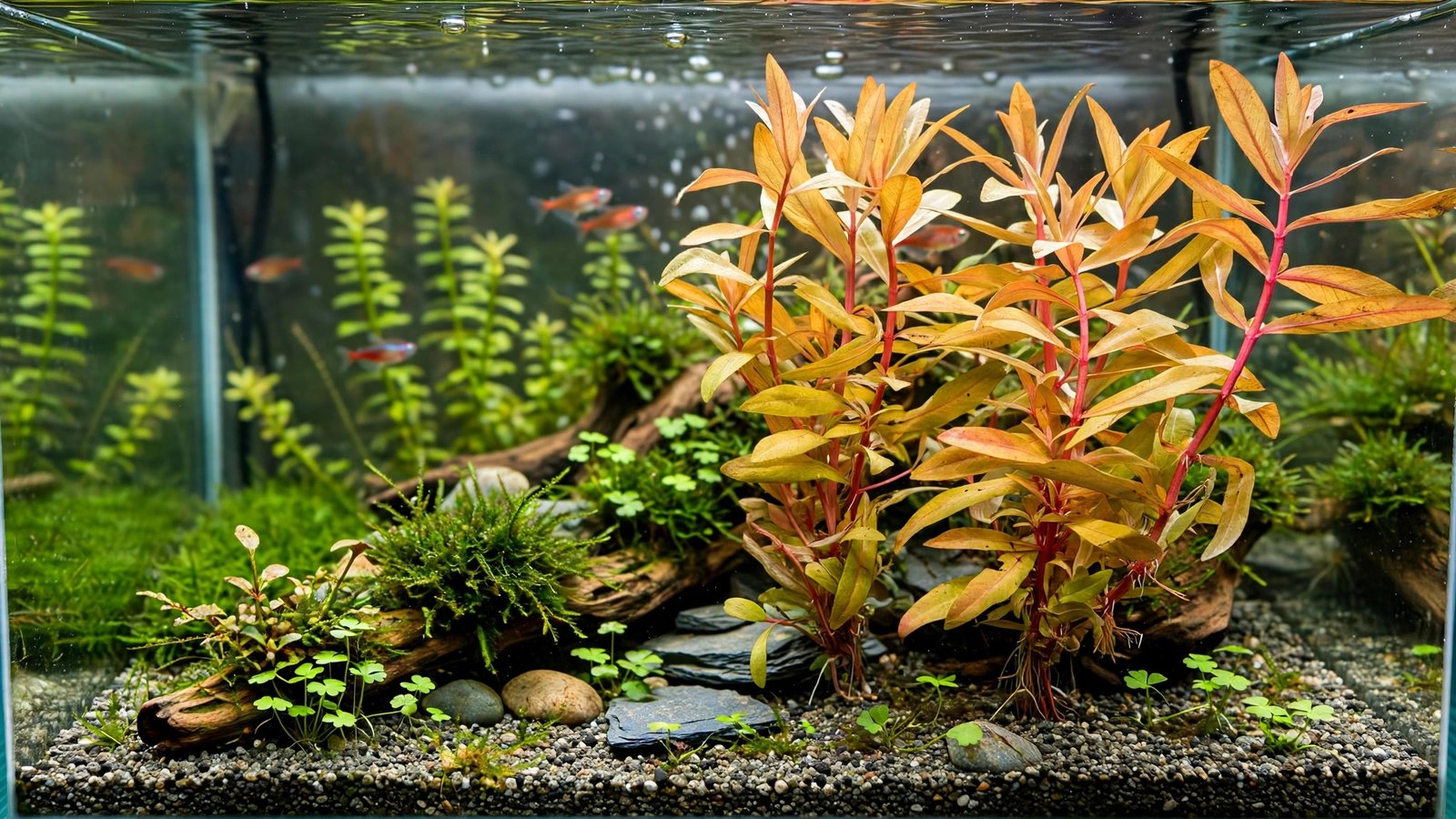
Few aquarium plants deliver as much visual payoff as a well-grown stand of red nesea. Nesea pedicellata care rewards the attentive aquarist with blazing red stems that climb toward the light, turning an ordinary planted tank into something that looks professionally aquascaped. Closely related to the Ammannia species it is so often confused with, this stem plant has a reputation for being difficult — but that reputation mostly comes from growers who give it moderate light and neutral water, then wonder why it arrives green and leggy. Give it the soft, slightly acidic water it evolved for, strong lighting, and steady iron, and it becomes surprisingly cooperative.
Learning nesea pedicellata care is really about understanding what a red stem plant needs to express its color. Redness is not painted on; it is the plant's response to intense light combined with the right minerals. Once you dial those in, this species grows fast enough to demand regular trimming and fills out into the dense red bushes that make it a favorite backdrop plant in Dutch-style and high-contrast aquascapes.
What Is Nesea Pedicellata?
Nesea pedicellata (often sold under the older name Ammannia pedicellata, and frequently mixed up with Ammannia senegalensis and Nesaea crassicaulis) is a stem plant native to tropical regions of Africa and Asia. In the wild it grows along riverbanks and in shallow marshy areas, where it experiences alternating submerged and emergent conditions. That amphibious background matters in the aquarium: like many stem plants, it is typically grown emersed (out of water) at commercial nurseries, and new plants may shed their round emersed leaves before pushing out the narrow, pointed submerged foliage you see in show tanks.
What sets it apart from the crowded field of red stem plants is its color ceiling. Where many "red" plants top out at a muddy orange-red, nesea pedicellata under strong light turns a vivid, almost crimson red with pinkish new growth at the stem tips. Under insufficient light it fades to green — still healthy, but ordinary. That light-driven color is why the species carries its fussy reputation: the plant is honest about your lighting, for better or worse.
Water Parameters for Red Nesea
This species is pickier about water chemistry than about almost anything else. It comes from soft, slightly acidic habitats, and it shows that preference clearly in the tank.
| Parameter | Target range | Notes |
|---|---|---|
| Temperature | 22–28°C (72–82°F) | Grows fastest at 24–26°C |
| pH | 5.5–7.0 | Best color below pH 6.5 |
| General hardness (GH) | 3–8 dGH | Soft to moderately soft |
| Carbonate hardness (KH) | 1–5 dKH | Lower KH suits it |
| Nitrate | 5–20 ppm | Avoid zeroing out nitrates |
| Phosphate | 0.5–2 ppm | Steady supply matters more than spikes |
| Iron | 0.05–0.1 ppm maintained | Key mineral for red coloration |
Hard, alkaline water is the single most common reason this plant underperforms. In water above roughly 8 dGH with a pH over 7.2, growth slows, new leaves stay small, and the stems may develop a pale, stunted look. If your tap water is hard, consider blending with RO water or choosing a different red stem plant such as Ludwigia repens, which tolerates a wider chemistry window.
Light: The Non-Negotiable Factor
Red nesea is a high-light plant, full stop. To hold its red coloration you need genuinely strong lighting — think modern LED fixtures running at 70–100% over a tank no deeper than 60 cm, or fixtures with a proven high-PAR reputation. Aim for at least 50+ PAR at the substrate. Under medium light the plant will still grow, but it will grow green, and the internodes (the gaps between leaf pairs) will stretch, producing the leggy look that frustrates beginners.
Depth matters as much as fixture choice. This plant is best suited to tanks up to about 60 cm deep; in deeper tanks it needs either a stronger fixture or placement on a raised hardscape terrace closer to the light. A photoperiod of 7–8 hours is a sensible starting point — long enough for strong photosynthesis, short enough to limit algae on slow weeks. If you run CO2 injection, you can often shorten the photoperiod slightly since the plants photosynthesize more efficiently.
Signs Your Light Is Insufficient
- Green growth: new leaves emerge green instead of red or pink.
- Stretched stems: long gaps between leaf pairs as the plant reaches for light.
- Lower-leaf drop: bottom leaves melt off while the top stays healthy.
- Thin stems: new growth looks weak and pale rather than robust.
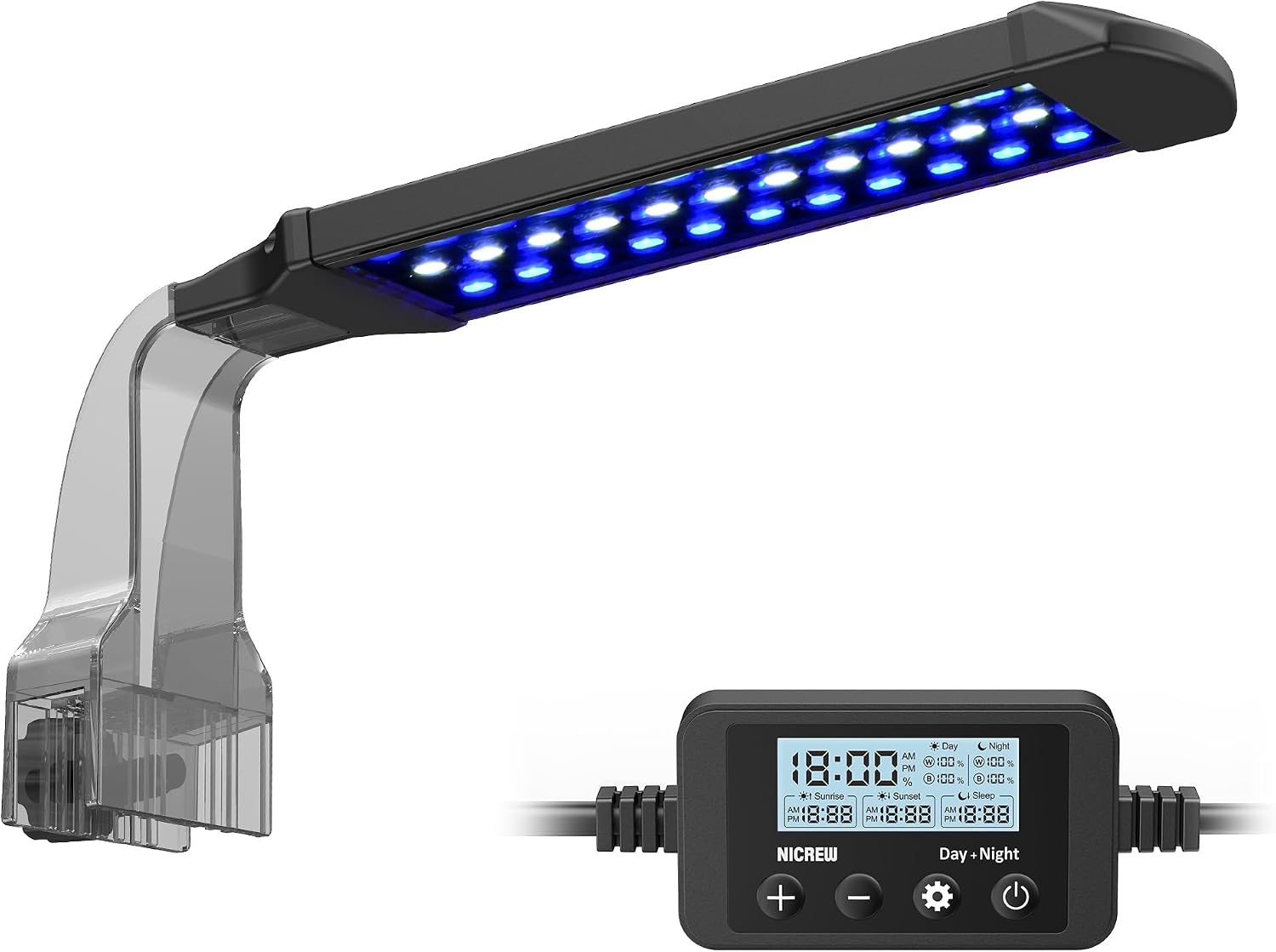
Red color starts with strong light: a high-output light like the NICREW ClassicLED Plus.
 ★4.6
NICREW ClassicLED Plus planted aquarium light
Check Price on Amazon ★4.6CO2 and Fertilization
Nesea pedicellata does not require injected CO2, but it responds to it dramatically. In a low-tech tank without CO2 it will grow slowly and stay mostly green unless the light is truly intense. With pressurized CO2 at a conservative 1–2 bubbles per second (for a typical 60–120 L tank, adjusted to hold a stable pH drop of about 1.0), growth accelerates, stems thicken, and the red coloration deepens noticeably.
Fertilization should be complete and steady rather than heavy. A comprehensive liquid fertilizer dosed per the manufacturer's low-to-mid range supplies the iron, potassium, and trace minerals this plant leans on. Iron deserves special attention: red pigmentation in stem plants is strongly tied to available iron, so a chelated iron supplement dosed a couple of times per week — starting low and watching livestock for any stress — is one of the highest-value interventions you can make for this species. A nutrient-rich substrate (aquasoil) underneath gives the roots a reserve to draw on during the first few months.
A word of caution: never dose aggressively to "force" color. Excess fertilizer with unstable CO2 is an algae invitation. Start low, observe your plants and livestock for a week or two, and only then step doses upward.
Red stems pull hard on iron: an iron supplement like Seachem Flourish Iron.
Planting and Placement
Plant individual stems 2–3 cm apart in groups of 5–10. The classic placement is the midground-to-background transition, where its 30–50 cm height forms a red wall behind shorter foreground plants. Planting in staggered clusters rather than a straight row looks more natural and fills in faster.
Because nurseries grow it emersed, expect a transition period of 1–3 weeks where the round emersed leaves yellow and drop. This is normal, not a failure — the plant is redirecting energy to submerged growth. Do not panic and uproot it; new submerged shoots will emerge from the stem nodes. Trimming off any melting emersed leaves keeps detritus down and lets light reach the new growth.
Good aquascaping companions include green contrast plants behind or beside it: Bacopa caroliniana and Hygrophila polysperma make excellent green foils, while flame moss on nearby hardscape softens the transition from red stems to rock or wood.
Trimming and Propagation
Nesea pedicellata is one of the more rewarding stem plants to trim, because it responds so vigorously. Once stems reach the surface — typically every 2–4 weeks in a healthy tank — top them: cut the stem about 10–15 cm below the surface and replant the top portion. The remaining rooted base will push out two or more side shoots from the leaf nodes near the cut, so each trimming cycle makes the bush denser. This is how a sparse initial planting becomes a thick red hedge over a few months.
- Use sharp aquascaping scissors for a clean cut — crushed stems rot.
- Cut at a slight angle just above a leaf node on the remaining base.
- Replant the healthiest tops 2–3 cm apart; discard mushy or algae-covered lower sections.
- Remove trimmed waste promptly — floating cuttings decay and feed algae.
- Expect the replanted tops to pause for a few days before resuming growth.
If you notice stems melting from the base upward, bottom-up melt usually signals insufficient light reaching the base or anaerobic substrate — both fixable with the trimming and substrate tips above. And if you keep shrimp, a light biofilm on older leaves is harmless and actually grazed by the colony, so do not scrub every leaf.
Common Problems and Fixes
Stunted, pale new growth
Usually a water-chemistry problem: hard or alkaline water locks out the micronutrients this plant needs. Test GH and pH first. If they are high, soften your water source or switch to a less demanding red plant. Low iron can produce similar symptoms, so check your dosing routine too.
Green instead of red
Almost always insufficient light intensity. The plant is healthy — it simply is not receiving enough light to produce protective red pigments. Raise the fixture intensity, raise the plant's position, or accept a green nesea, which is still an attractive plant.
Melting after planting
Emersed-to-submerged transition melt is expected. Remove dead leaves, keep parameters stable, and give it 2–3 weeks. If melt continues past a month with no new submerged shoots, suspect unstable CO2 or nutrient deficiencies.
Algae on leaves
Red stem plants under strong light are algae magnets when anything is out of balance. The usual culprits are fluctuating CO2 and excess light relative to plant mass. Trim affected leaves, stabilize CO2, and consider a slightly shorter photoperiod until the plants outgrow the problem.
Nesea Pedicellata vs Other Red Stem Plants
Choosing the right red plant for your setup saves months of frustration. Here is how nesea pedicellata compares to common alternatives:
| Plant | Light demand | Water preference | Color potential |
|---|---|---|---|
| Nesea pedicellata | High | Soft, acidic | Vivid crimson red |
| Ludwigia super red | Medium–high | Adaptable | Deep red, easier to achieve |
| Ludwigia repens | Low–medium | Very adaptable | Orange-red, modest |
| Alternanthera reineckii | Medium–high | Soft preferred | Pink-red undersides |
| Limnophila sessiliflora | Low–medium | Adaptable | Green (contrast, not color) |
In short: nesea pedicellata offers the most dramatic red of the group but asks the most in return. If your water is hard or your lighting is modest, Ludwigia super red delivers reliable red color with far less fuss. Reserve nesea for setups where you can meet its soft-water, high-light demands — that is where it earns its place.
Tank Mates and Nighttime Care
Nesea pedicellata pairs well with most community livestock. Small tetras, rasboras, and dwarf shrimp leave it alone and look spectacular against the red backdrop. Avoid large herbivorous fish (silver dollars, larger cichlids) that will strip stem plants. In heavily planted tanks running CO2 by day, remember that plants consume oxygen at night — adding a little surface agitation after lights-out keeps livestock comfortable in a dense stem-plant tank.
Responsibility Note
Nesea pedicellata is a tropical plant and is not known to be invasive in temperate regions, but aquarium plants should never be released into local waterways — even seemingly harmless species can disrupt local ecosystems. Dispose of trimmings in the trash or compost, never down a drain that leads to natural water. Always check your local regulations before ordering plants across borders, as some jurisdictions restrict live plant imports.
Frequently Asked Questions
Is nesea pedicellata hard to grow?
It has a difficult reputation, but the difficulty is specific, not general. The plant needs soft, slightly acidic water and strong lighting — meet those two conditions, add steady fertilization with iron, and it grows quickly and trims well. Most failures come from hard alkaline water or medium light. In the right setup it is no harder than other red stem plants.
Can I grow red nesea without CO2?
Yes, but with realistic expectations. Without injected CO2 the plant grows slowly and usually stays green or only faintly pink unless the light is very strong. You will get a healthy, attractive stem plant, just not the blazing crimson showpiece. For the full red effect, CO2 injection is the single biggest upgrade you can make.
Why is my nesea pedicellata turning green?
Green new growth almost always means insufficient light intensity. Red pigments are the plant's sunscreen — it only produces them when light is strong enough to need protection. Increase your light intensity, move the plant to a shallower position, or check that an old fixture's output has not degraded over time. Stable iron dosing also supports red coloration, so review your fertilizer routine as well.
How fast does nesea pedicellata grow?
In a high-light tank with CO2 and good fertilization, expect 5–10 cm of growth per week, requiring trimming every 2–4 weeks. Without CO2, growth slows to a few centimeters per month. Growth rate is a useful diagnostic: if your plant is barely moving under strong light, check water hardness and nutrient levels.
Should I trim the tops or the bottoms when propagating?
Always keep the tops. Cut the stem and replant the healthy top portion; the rooted base will sprout multiple side shoots from its nodes. This top-and-replant method is how you multiply your stock and thicken the bush simultaneously. Discard any mushy lower stems rather than replanting them.
Is nesea pedicellata the same as Ammannia pedicellata?
Yes — the same plant is sold under both names. Taxonomists have moved species between the Nesea, Nesaea, and Ammannia genera over the years, and the aquarium trade has been slow to catch up. When buying, focus on the plant's appearance (narrow leaves, red potential) rather than the exact genus spelling on the label, and be aware it is also confused with Ammannia senegalensis.
Nesea Pedicellata Care: The Red Payoff
For broader context on red stem plant care, the Tropica plant database is an authoritative reference for growth requirements across species. With the right water, strong light, and patient trimming, nesea pedicellata care pays off in one of the most striking red displays any freshwater planted tank can offer — a plant that rewards precision with color you simply cannot get any other way.