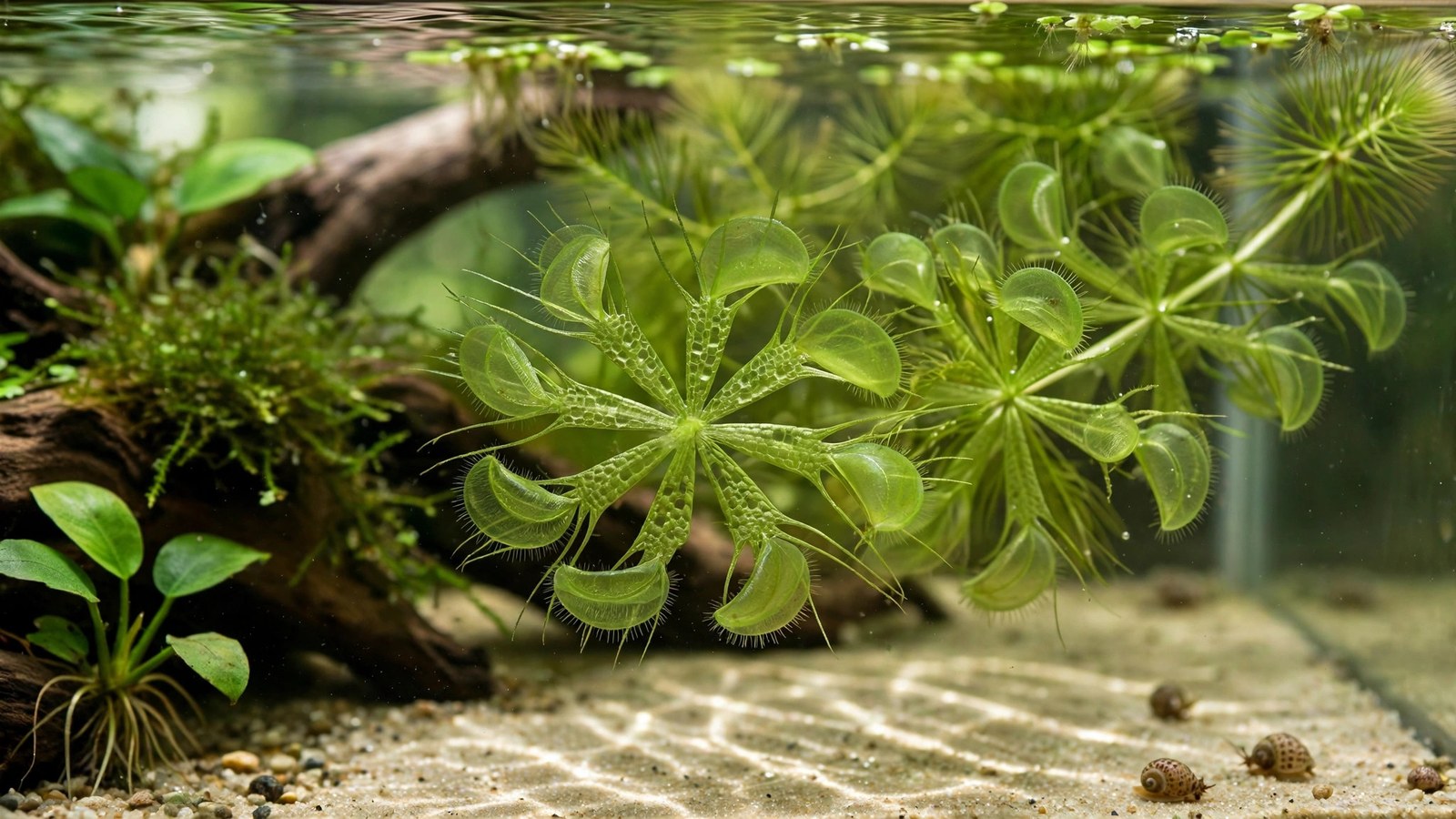
Most carnivorous aquarium plants forgive a bad week. This one won't. Aldrovanda vesiculosa is a rootless, free-floating hunter that snaps shut on live prey like a tiny underwater Venus flytrap — and it will quietly starve in a bright tank with perfect water if you never feed it. The waterwheel plant is one of the most fascinating plants you can keep — but it's advanced, and this aldrovanda vesiculosa care guide is the honest briefing you need before buying a culture.
What Aldrovanda Vesiculosa Actually Is
Picture a translucent green star drifting just under the surface. Each stem grows in whorls of 8–12 tiny trap leaves arranged like spokes — the "waterwheels" behind the common name. Every trap is a snap-trap a few millimeters across, lined with trigger hairs. When a passing water flea brushes those hairs, the trap fires in a fraction of a second, sealing the prey inside to be digested over several days.
It is the only free-floating snap-trap carnivore on Earth, and the closest living aquatic relative of the Venus flytrap. Rootless, it simply drifts in calm water, growing from the tip while the older end decays — up to 1–2 cm per week in summer. Fellow carnivorous resident utricularia graminifolia hunts microscopic prey with suction traps; Aldrovanda hunts bigger game with visible snap-traps, which is exactly why it is the more demanding of the two.
Aldrovanda Vesiculosa Care: Tank Setup and Water Parameters
This plant cares about water chemistry more than almost anything else you can keep. In the wild it grows in nutrient-poor bogs with soft, acidic water — it never evolved to handle hard tap water. Get this table right first.
| Parameter | Target | Why it matters |
|---|---|---|
| pH | 5.5–6.5 | Matches its bog habitat |
| TDS | Below 60 ppm | Minerals impair traps and damage tissue |
| GH / KH | 1–4 dGH, 0–2 dKH | Keeps pH naturally acidic |
| Temperature | 68–82°F (20–28°C) | Warmth drives growth; cold triggers dormancy |
| Flow | Near zero | Current shreds stems and scatters prey |
Practically: RO, distilled, or clean rainwater lightly remineralized; a sponge filter on a trickle; no airstones under the mat. Park the colony in a calm corner — powerheads are its enemy. If your tap water is hard, this plant is off the table until you commit to RO. That soft-water demand also runs through our best floating aquarium plants for beginners — though Aldrovanda itself is firmly not a beginner pick.
 ★4.8
Seachem Catappa Leaves 12-pack
Check Price on Amazon ★4.8Light: Bright, and Don't Skimp
Aldrovanda is a sun-lover: 6+ hours of strong light daily, roughly 40–60 PAR at the surface, or several hours of direct sun in an outdoor tub. Under weak light the stems stretch, whorls space out, and trap production collapses. It won't die overnight, but it stops being a carnivore and starts fading.
The catch: bright light over still, lean water invites algae, and algae smothering the traps is a top colony-killer. Keep water-column nutrients near zero, skip liquid ferts, and skim thread algae off the mat by hand. Many keepers use dedicated outdoor tubs in summer to control light and nutrients without wrecking a scape. Vigorous floaters like salvinia and water lettuce will out-compete it for surface space — keep the colony separated.
Feeding the waterwheel plant: Live Food Is Non-Negotiable
Most listings skip this: Aldrovanda cannot survive on photosynthesis alone. Unfed plants stall, shrink, and die within weeks to a couple of months, even under perfect light and water.
| Food | Schedule | Notes |
|---|---|---|
| Live daphnia | Every 2–3 days | Gold standard — right size, triggers every trap |
| Grindal worms | Every 2–3 days | Drop near the mat; they drift into traps |
| Baby brine shrimp (newly hatched) | 2× per week | Use sparingly; uneaten nauplii foul water |
| Copepods / seed shrimp | Ongoing | A seeded tank sustains itself between feedings |
Dried, frozen, and pellet foods are useless — traps only fire on live, moving prey, and dead matter rots on the whorls. You don't need to feed every trap; a cloud of daphnia drifting through the mat every couple of days feeds the colony. Starting from a tissue-culture cup? Order a live daphnia starter culture from the same aquatic suppliers that sell soft-water conditioners — one purchase seeds both the food supply and gentler water.
Winter Dormancy: Expect Die-Back, Not Failure
When water cools or conditions decline, growth stops, stem tips condense into tight dark winter buds called turions that sink, and the rest disintegrates. First-time keepers panic and bin the tank. Don't — turions are the plant's survival strategy, each a compressed package of next season's growth. In nature they overwinter in cold mud, then float up and unfurl once water warms past roughly 60–65°F (15–18°C). Leave dormant turions undisturbed in cool (50–60°F / 10–15°C), dim water for 6–10 weeks, then warm gradually. Many keepers induce dormancy each autumn by moving cultures to an unheated room; it resets vigorous spring growth.
Honest Difficulty: This Is an Advanced Plant
Let's be blunt: this is not a beginner plant. It demands RO-level soft water, strong light, calm conditions, and a standing live-food supply — four commitments that rule out casual keeping. New to planted tanks? Start with forgiving floaters like amazon frogbit or red root floater.
The traps are small but real predators — newly hatched fry and baby shrimplets can get caught, so Aldrovanda is not shrimp-safe and has no place in a breeding tank. Adult shrimp and fish are far too large to be trapped. If you're weighing plants against livestock plans, our fish-first guide to aquarium plants walks through exactly this compatibility call.
Finally, conservation: Aldrovanda is endangered or extinct across large parts of its native range in Europe and Asia. Never collect from the wild, never release it into local waterways, and buy only lab-cultured or tissue-culture stock — this Oryx journal assessment of its conservation status documents the pressure on wild populations, and the International Carnivorous Plant Society maintains grower and conservation resources. For gentle cover in a soft-water setup, guppy grass, hornwort, and egeria densa all tolerate the lean, calm conditions it demands.
Frequently Asked Questions
Can Aldrovanda survive on light alone without being fed?
No. Unfed colonies stall, shrink, and die within weeks to a few months even under strong light and perfect water. It evolved in nutrient-poor bogs where captured prey supplies nitrogen and phosphorus. Provide live food like daphnia or grindal worms several times per week for every week it is actively growing.
What water does the waterwheel plant need?
Soft, acidic, mineral-poor water: pH 5.5–6.5, TDS below 60 ppm, GH 1–4 dGH, and near-zero flow. RO, distilled, or clean rainwater is safest, since most tap water is far too hard. Keep nutrients near zero and skip liquid fertilizers, which fuel algae that smothers the traps.
Will Aldrovanda eat my shrimp or baby fish?
It can catch newly hatched fry and baby shrimplets — the traps are small but functional predators. It is not shrimp-safe and should never go in a breeding tank. Adult shrimp, fish, and snails are far too large to be trapped and coexist fine; use a dedicated tub if you breed livestock.
My Aldrovanda turned brown and sank — is it dead?
Probably not — it likely formed turions, the tight winter buds produced when water cools or conditions decline. Old stems disintegrate while turions rest on the bottom. Leave them undisturbed in cool, dim water for 6–10 weeks, then warm gradually past 60–65°F and they will float up and regrow.
Aldrovanda asks more of you than nearly any other aquarium plant — RO water, strong light, still conditions, and a live daphnia supply on rotation. In return you get something no other plant offers: a floating colony of working snap-traps, a living waterwheel turning slowly under your lights. Master the water, feed the predator, respect the dormancy cycle, and this endangered hunter will thrive under your care for years.