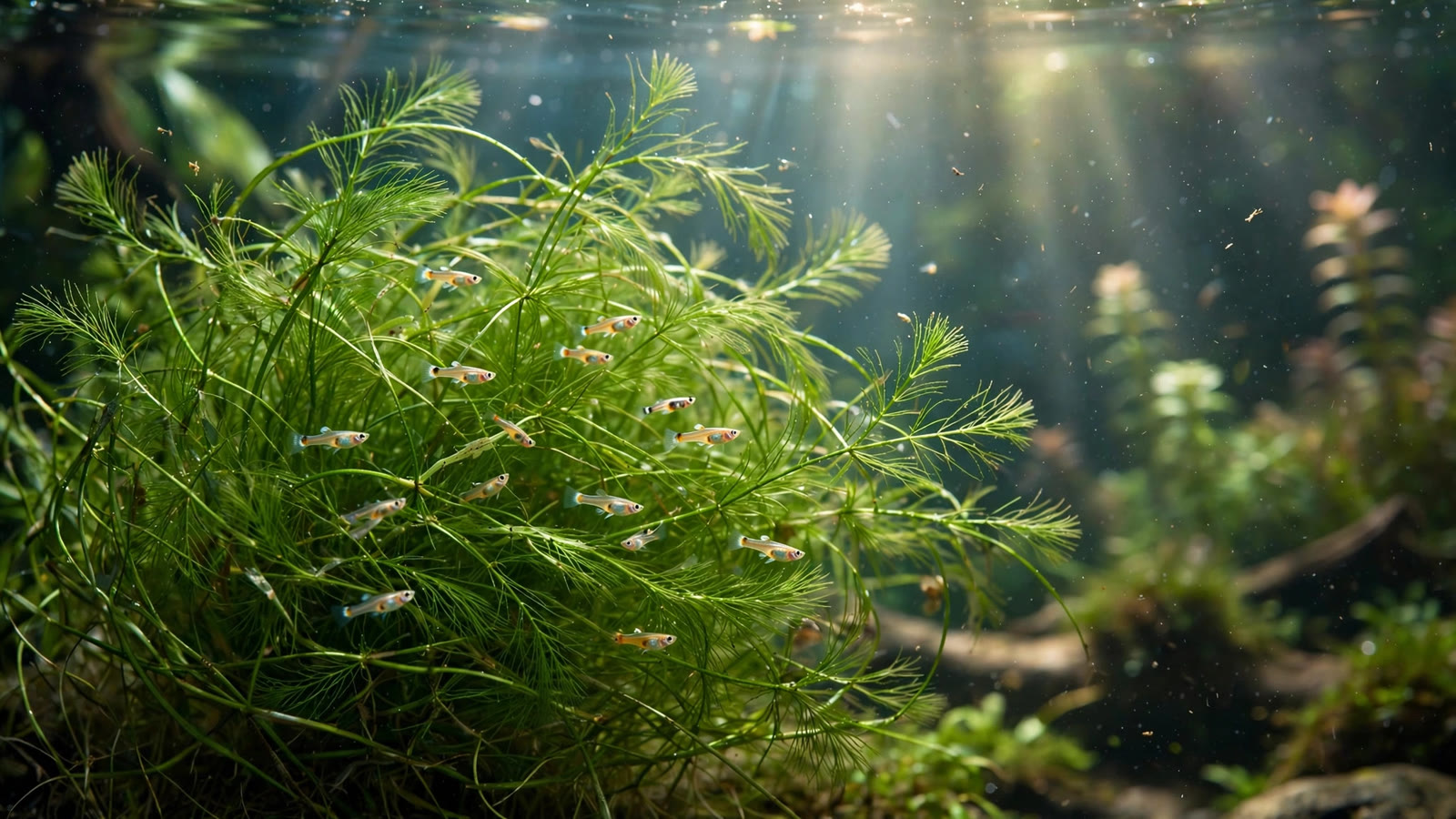
If you have ever killed a houseplant just by looking at it sideways, meet the aquarium plant that was seemingly designed to forgive you. Guppy grass care is so undemanding that its real reputation is not "easy" but "almost impossible to kill." Scientifically known as Najas guadalupensis — also sold as najas grass or common water nymph — this fast-growing American native works as a floating jungle, a planted background thicket, and the finest shelter you can give newborn fry and baby shrimp. Whether your tank is new and fighting algae or established and breeding livebearers, guppy grass probably deserves a spot in it.
What Is Guppy Grass?
Guppy grass (Najas guadalupensis) is a submersed aquatic plant native to still and slow-moving freshwater across the Americas, from the southern United States through Central and South America. In the wild it colonizes ponds, ditches, and quiet backwaters — the same kind of habitat a home aquarium provides — and earned its name because livebearer fry survive in far greater numbers when a tangled mass of it floats in the tank (see Tropica's Najas guadalupensis plant profile).
Beginners sometimes confuse it with hornwort, another fast-growing floater, but they differ in important ways. Hornwort sheds needles in sheets when unhappy; guppy grass stays green under a much wider range of conditions, and most hobbyists find it hardier in warm, low-tech tanks. If hornwort has disappointed you, try guppy grass next.
Guppy Grass Care Specs at a Glance
| Parameter | Requirement |
|---|---|
| Scientific name | Najas guadalupensis |
| Common names | Guppy grass, najas grass, common water nymph |
| Temperature | 64–82°F (18–28°C); most vigorous at 72–78°F |
| pH | 6.0–8.0 (tolerates a wide range) |
| Light | Low to high; 8–12 hours per day |
| CO₂ | Not required; added CO₂ speeds growth further |
| Growth rate | Very fast — several cm per day in good conditions |
| Max size | Up to ~3 ft (90 cm) of stem length untrimmed |
| Placement | Float freely, or anchor lightly in the substrate |
| Propagation | Stem cuttings — snip and replant or float |
| Difficulty | Beginner — among the easiest aquarium plants available |
Planting and Placement: Float It or Anchor It
Most aquarium plants demand the right spot; guppy grass barely demands that you choose one. It has two legitimate lifestyles, and both work beautifully.
Floating: the zero-effort option
Drop a handful in and walk away — that is a complete planting guide. Floating, guppy grass weaves into a porous mat that newborn fry and shrimplets can slip through while larger fish cannot. The mat also acts as a natural dimmer, softening harsh light for plants and livestock below. Just keep a small clear patch at the surface for feeding and light penetration.
Anchored: the background-wall option
For a planted look, push stems about an inch deep into the substrate — no more. Spread stems slightly apart rather than cramming a bundle into one hole, because packed stems shade each other and weaken. Within days the fine filaments at the bases begin to grip, and the stems grow upright into a dense green curtain along the back glass. No root tabs or rich substrate are needed, since the plant feeds from the water.
One handling warning: guppy grass stems are brittle and snap easily. This is normal, not a sign of poor health. Move slowly and do not worry about broken pieces — every fragment is free inventory, as the propagation section explains.
Light, CO₂, and Nutrients
Light: low to high, with one caveat
Guppy grass grows under anything from a dim desk lamp to full high-tech lighting, on 8–12 hours a day. More light means faster growth and denser branching; low light simply means a slower, leggier plant that still survives. One exception: under very intense light it can develop a reddish tint. Most hobbyists find this is a mild stress signal — the plant's version of sunburn — not disease. Shorten the photoperiod and the green returns.
CO₂: optional, not required
No injected CO₂ is needed — a big reason guppy grass is the default recommendation for low-tech setups alongside hardy growers like water wisteria. It strips dissolved CO₂ and bicarbonates from the water efficiently on its own. If you already run CO₂, the plant simply grows faster; nothing needs to change.
Feeding from the water column
Because it absorbs nitrates, phosphates, potassium, and micronutrients straight from the water, guppy grass genuinely competes with algae for dissolved food. In a new tank, a healthy mass pulls nutrients away from the films that coat glass and leaves during the unstable early weeks. Many keepers grow it for years on fish waste alone; if older leaves yellow in an otherwise healthy tank, a light all-in-one fertilizer usually fixes it within a week or two.
Growth Rate and Maintenance
Under decent light, guppy grass grows at a pace that borders on comical: several centimeters of new stem per day, with side branches sprouting from leaf axils constantly. A modest starter portion can double several times over in one month — maintenance means trimming, not nursing.
Trimming: cut freely, it will not mind
When stems reach the surface or the mass gets too dense, pull out the excess by hand or snip with aquascaping scissors. No delicate technique, no recovery period. Trimming doubles as nutrient export: every handful removed permanently carries absorbed nitrates and phosphates out of the tank. Fighting elevated nitrates? A weekly handful of guppy grass is one of the cheapest management tools available.
What "melting" means for this plant
After moving to a new tank, some stems may shed leaves or go soft for a week or two. This transition melt is normal as plants adjust to new water and lighting, and guppy grass recovers fast — while a few stems struggle, others in the same bunch already grow. Only if the whole mass keeps declining after two weeks should you suspect a systemic cause like a temperature crash.
Keeping a floating mass tidy
Floating mats sometimes ride up against the filter outflow and pile into a corner; simply spread the mass out during weekly maintenance. Surplus trimmings make a welcome gift for a fellow hobbyist.
The Real Benefits: Fry, Shrimp, and Water Quality
A living nursery for fry and shrimplets
A floating mat's fine, tangled structure creates pockets that tiny fry and baby shrimp can navigate but adult fish cannot. A newborn guppy fry is little more than a speck — in open water it is food within minutes, but inside guppy grass it survives, grazing on infusoria and biofilm coating the leaves until it outgrows the danger zone.
Nutrient uptake and algae prevention
Fast growth must be fueled by something, and here the fuel is dissolved nitrate and phosphate — the same leftovers that feed algae. Growing inches per week, guppy grass locks those nutrients into plant tissue, and trimming exports them. That is why it is a classic pick for new aquariums, much like anacharis: it stabilizes a young system while the biological filter matures.
Oxygen and tank stability
Like all healthy plants, guppy grass releases oxygen into the water while photosynthesizing. A dense stand visibly pearls — tiny bubbles streaming from the leaves — under strong light. That extra oxygen steadies heavily stocked or warm tanks, and constant photosynthetic activity softens day-to-night pH swings.
Propagation: Snip and Go
Beginners sometimes assume propagation must have a catch. It does not. Cut a stem anywhere, drop the cutting to float or push it an inch into the substrate — both the cut top and the cut base keep growing. Broken pieces work identically: a snapped stem is not a loss, it is a cutting. One bag from the fish store, bought once, becomes an endless supply for every tank you ever own.
Common Problems and Quick Fixes
- Stems turning soft and clear: usually transition melt after a move. Remove the worst pieces, keep the green ones, and wait two weeks. Persistent whole-mass melt signals a water-quality problem — test ammonia, nitrite, and temperature.
- Reddish leaves: a stress tint from very high light, in most hobbyists' experience. Shorten the photoperiod or add partial shade; green returns.
- Algae on the plant: the plant is not sick; the tank has excess light or nutrients. Fast growers like ambulia face the same issue — add plant mass, shorten the light period, and rinse the stems.
- Growth stalls: check temperature (below ~64°F slows it sharply) and nutrient availability. A starving plant in a bare tank with few fish stalls; a light fertilizer dose restarts it.
- Everything keeps breaking: normal stem brittleness, not damage. Handle gently and replant the pieces.
A Note on Responsible Keeping
Najas species are vigorous by design, and outside their native range some have established in the wild where they do not belong — crowding out local plants and altering habitats. The Native Plant Trust's species page for Najas guadalupensis documents its wide distribution, and that adaptability is why it must never be released into local waterways, ponds, storm drains, or wetlands — it regenerates from a single stem fragment. Compost or bin trimmings, never flush them, and check local regulations before acquiring it.
Frequently Asked Questions
Does guppy grass need to be planted in substrate?
No. It grows perfectly well floating freely, which is how many keepers use it for fry shelter. It can also be anchored by pushing stems about an inch into any substrate. It has no true feeding roots, so substrate type does not matter — gravel, sand, and aquasoil all work equally as simple anchors.
How fast does guppy grass actually grow?
Very fast. Under moderate to strong light, most hobbyists see several centimeters of new growth per day with constant side branching. A small starter portion can fill a 20-gallon tank's surface or background within a month or two. A weekly handful of trimming is the only maintenance this pace demands.
Can guppy grass survive in a low-light tank?
Yes. It is one of the few genuinely fast-growing plants that tolerates low light, where it simply grows more slowly and leggier. It will not stay compact in dim tanks, but it stays alive and functional as shelter. To get fuller growth, raise the light gradually rather than blasting it all at once.
Why is my guppy grass turning red?
A reddish tint under very intense light is a stress response — the plant shielding itself from excess light — not a disease. Most hobbyists find that shortening the photoperiod or adding shade returns it to green within days. No treatment or fertilizer change is needed; just ease off the light.
Is guppy grass good for betta and shrimp tanks?
Excellent for both. In a betta tank, floating portions soften the light and give the betta shaded resting spots near the surface. In a shrimp tank it is near-perfect: the fine structure shelters newborn shrimplets, and the leaves grow a rich biofilm shrimp graze constantly. Both pearl weed and bacopa pair well with it in low-tech setups.
Will guppy grass outcompete my other plants?
It can shade slower growers if neglected, since a thick floating mat blocks a lot of light. The fix is management, not removal: keep a clear feeding patch, thin the mat weekly, and make sure rooted plants below still get light. Its nutrient uptake is aggressive but rarely starves established, fertilized plants in a stocked tank.
Guppy Grass Deserves Its Reputation
Strip away the hype and guppy grass earns its fame honestly: it grows in nearly any freshwater tank, needs no CO₂ or special substrate, shelters your smallest livestock, and exports the nutrients that would otherwise become algae. Its only demands — weekly trimming, gentle handling, and never releasing it into the wild — are trivial beside what it gives back. Start with a generous portion of Najas guadalupensis; most hobbyists who try it once keep it forever. Compare it with floating frogbit for a different surface plant, or round out the background with vallisneria — but keep the guppy grass.
Tissue-culture plants are the exception — they’re grown in sterile gel and adapt with minimal melting, which is part of what you’re paying for. Plants bought submersed from another hobbyist’s tank also transition with little melt, since they’re already in the right form.
Which Plants Melt Most (and Least)
Heavy melters (expect significant leaf loss)
- Cryptocorynes — infamous for “crypt melt,” sometimes dropping every leaf after any disturbance. They almost always recover from the roots within weeks.
- Stem plants grown emersed — rotala, ludwigia, and hygrophila often shed lower emersed leaves while the growing tips transition.
- Amazon swords — emersed-grown swords typically lose their broad oval aerial leaves and replace them with longer submersed ribbon leaves.
Light melters
- Anubias, java fern, bucephalandra — slow-growing rhizome plants transition gradually; occasional old-leaf melt but rarely dramatic.
- Vallisneria — usually transitions well, though it dislikes the move itself and may sulk for a week.
- Floating plants — minimal melt since their leaves were already at the air-water interface.
The Acclimation Protocol
Step 1: Quarantine or dip first
Before acclimating to your tank’s conditions, make sure you’re not acclimating pests along with the plant. Run new arrivals through our quarantine and dip protocol — it adds days upfront but prevents months of regret.
Step 2: Float to temperature-match (30 minutes)
Float the bag or container in your tank for 20–30 minutes to equalize temperature. Plants are less temperature-sensitive than fish, but a 10°F shock on top of transplant stress is an avoidable insult.
Step 3: Trim before planting
Remove any leaves that are already damaged, yellowing, or heavily algae-covered — they won’t recover and they’ll rot in your tank, feeding algae. For stem plants, trim off the bottom inch and any emersed leaves that look unlikely to adapt; the plant wastes energy maintaining leaves it’s going to shed anyway. Keep the healthy growing tips — that’s where recovery starts.
Step 4: Plant correctly the first time
Follow our planting guide — right depth, crown exposed on rosettes, rhizomes unburied on epiphytes. Every uprooting and replanting restarts the acclimation clock, so get placement right on the first attempt. Decide where each plant goes before it goes in the water.
Step 5: Run a gentle first week
For the first 7 days after planting:
- Moderate light — run your normal photoperiod but consider dropping intensity 20–30% if your light is dimmable. Blast-level light on a melting plant grows algae on the dying leaves, not recovery.
- Stable CO2 — if you inject CO2, keep it consistent. Fluctuating CO2 during acclimation is a melt accelerator. If you’re low-tech, this doesn’t apply — see growing without CO2.
- Half-strength fertilizer — new plants with damaged leaves can’t use full dosing, and the excess feeds algae. Ramp to full strength over 2–3 weeks per our fertilizer schedule.
- No disturbance — don’t move, trim, or “check on” new plants for at least two weeks. Every touch resets root establishment. This is especially critical for crypts.
Step 6: Remove melt, keep the base
As emersed leaves melt, remove the mushy material promptly — decaying leaves release ammonia and grow fungus that can spread to healthy tissue. But never discard the plant while the crown, rhizome, or roots are firm and alive. A crypt that’s lost every leaf but has firm roots is a plant that’s about to recover, not a dead plant. Give it 3–4 weeks before judging.
Telling Normal Melt From Real Problems
Normal transition melt:
- Affects oldest/emersed leaves first, newest growth last
- New submersed leaves emerge even as old ones dissolve
- Roots and crown stay firm and white/green
- Timeline: 1–4 weeks, then obvious new growth
Concerning melt (see our full melting diagnosis guide):
- New growth also melts or emerges deformed
- Rhizome or crown turns mushy and brown — this is rot, not transition
- Entire plant dissolves within days with no new growth after 4+ weeks
- Melting spreads to established plants that weren’t recently moved
Buying Tips to Minimize Melt
- Buy submersed-grown when available — hobbyist-grown cuttings transition with almost no melt.
- Choose tissue culture for sensitive species — crypts and delicate stems establish far more reliably from sterile cups.
- Avoid plants already melting in the store tank — some melt is normal, but a plant that’s mostly mush at purchase has less energy for recovery.
- Transport carefully — keep plants damp and out of direct sun/heat. A plant that dries out or cooks in a hot car melts far worse than one transported properly.
The First-Month Timeline: What to Expect Week by Week
Knowing what’s normal when removes most acclimation anxiety. Here’s the typical timeline for a healthy plant adapting to a new tank:
Week 1: The quiet week
Almost nothing visible happens. The plant is growing roots you can’t see and assessing its new environment. Some species (vallisneria, stem plants) may start shedding their lowest leaves. This is normal. Resist the urge to “help” — no moving, no extra fertilizer, no light changes. The most common beginner mistake is intervening during a week when the correct action is nothing.
Week 2: Melt peaks
This is when emersed leaves give up in earnest. Crypts may drop everything; swords shed their broad aerial leaves; stem plants lose lower foliage. It looks catastrophic and it’s usually fine. Keep removing mushy material, keep conditions stable, and watch the crown and growing tips — if those are firm and green, recovery is already underway.
Week 3: The turn
New submersed-adapted leaves emerge — smaller, thinner, often a slightly different shade of green than the emersed foliage. Stem plant tips start growing visibly; crypts push tiny curled leaves from the crown; swords unfurl narrow ribbon leaves. This is the moment most beginners exhale for the first time.
Week 4+: Established
New growth outpaces melt, and the plant is functionally yours. You can resume full-strength fertilizer, normal trimming, and stop treating it as fragile. Some slow growers (anubias, bucephalandra) take 6–8 weeks to show obvious progress — that’s their normal speed, not a problem.
Acclimating Different Plant Formats
Tissue-culture cups
Sterile, pest-free, and already adapted to high-humidity (not emersed) growth — tissue cultures melt the least of any format. Rinse the agar gel off gently (leftover gel rots and feeds fungus), split the portion into small plantlets, and plant per our planting guide. They establish slowly for the first two weeks, then accelerate. No dip needed, minimal acclimation stress — this is the premium experience you’re paying for.
Potted plants
Remove the pot and strip away the rockwool completely — leftover rockwool traps debris and rots. Tease the root mass apart gently; if it’s a dense mat, splitting it into 2–3 smaller portions actually establishes faster than planting one big clump (more growing points, better water flow around roots). Potted plants are usually emersed-grown, so expect the standard 2–4 week melt cycle.
Bare-root / bunched stems
Typically sold as weighted bunches. Remove any bands, foam, or weights, strip the lower leaves, and plant stems individually or in small groups. Bunched stems from the store are often already transitioning — check for new submersed growth at the tips, which tells you the plant is mid-adaptation and will settle quickly.
Hobbyist cuttings
Already submersed-grown and the fastest to establish — often showing new growth within days. The main acclimation factor is water-parameter difference between the two tanks. Float to temperature-match, plant promptly, and they’ll usually take off with minimal melt. This is why experienced hobbyists prefer trading cuttings over buying potted plants.
Frequently Asked Questions
Should I use a “plant starter” or transplant fertilizer?
Products marketed for transplant shock are mostly B-vitamins and mild hormones. They don’t hurt, but there’s no strong evidence they help aquarium plants specifically. Stable conditions and patience outperform any bottle. Save the money for more plants.
My new plant melted completely — bare crown, no leaves. Is it dead?
Probably not, if the crown or rhizome is firm. Crypts and swords routinely lose 100% of their leaves and regrow from the base within a month. The test is firmness: firm and pale/green means alive; mushy and brown/black means rot. Give firm-but-leafless plants a full 4 weeks before declaring them dead.
Can I speed up acclimation with extra light or CO2?
No — and trying usually backfires. A melting plant can’t use extra light; the excess just grows algae on its dying leaves. Keep light moderate and CO2 stable (not boosted) during acclimation. Growth speed comes from the plant’s own adaptation timeline, which you can’t rush, only avoid delaying.
Should new plants go straight into my main display tank?
After quarantine/dipping, yes — there’s no benefit to a separate “growing-in” tank for most plants. They acclimate to your water fastest in the tank they’ll live in. The exception is very delicate species going into a tank with boisterous fish; give those a few weeks in a calm corner or breeder box first.
The Patience Rule
The single most important acclimation skill is restraint: plant it right, set gentle conditions, remove decay, and then leave it alone for a month. The hobbyists with the best plant growth aren’t doing something clever in week one — they’re simply not interfering in weeks two through four while the plants do what they’ve evolved to do. Melt looks like failure and feels like failure, but in most cases it’s the visible part of a plant successfully becoming yours.